reflections, updates and homilies from Deacon Mike Talbot inspired by the following words from my ordination: Receive the Gospel of Christ whose herald you have become. Believe what you read, teach what you believe and practice what you teach...
In Assisi, Pope encourages young people to ‘touch the suffering flesh of others'
At Mass for the 2026 Franciscan Youth Meeting in Assisi, the Pope encourages young people to “overcome resignation and fear,” and “write new pages of history.”
By Tiziana Campisi
Pope Leo celebrated Mass on Thursday for the thousands of young people from across Europe gathered in Assisi for Go! the 2026 Franciscan Youth Meeting.
At Mass in the Basilica of Saint Mary of the Angels, the Pope encouraged his young listeners to go “to the margins” of society, “where the injustice and arrogance of a few deny the dignity and dreams of many”.
“We are called to read the Scriptures with the Master,” Pope Leo said, “to interpret our times, and to make decisions as we walk in His footsteps. We are here to overcome resignation and fear, to untangle the doubts that hold us back just as they held back the apostles. Jesus calls us into a dialogue with His story so that we may write new pages of history.”
Assisi is a place where “everything whispers that our lives can be transformed, unleash light, and repair the world,” the Pope said, reminding his listeners that it was here in Assisi that “the transfiguration of Francis, of Clare, and then of thousands of other young people” first began.
Young people gathered for Mass with Pope Leo (@VATICAN MEDIA)
Listening and decision-making
Pope Leo began his homily by considering the Feast of the Transfiguration of the Lord, which the Church marks today.
Jesus, the Pope said, was “transfigured precisely in conversation with the Father, with those who preceded him — Moses and Elijah — and with his contemporaries, the disciples.”
The Church exists, Pope Leo said, “to draw us into this dynamic of listening and deciding, helping us understand for whom to live and how to live.”
The Church is “the community where we learn to distinguish the voice of God”, the Pope stressed, “and to dare that obedience to the Holy Spirit that made bold and creative all those who agreed to follow Jesus.”
Embracing 'sister poverty'
While St Francis’ choice to turn away from the world was revolutionary, St Clare’s was “even more striking”, Pope Leo said. Like Francis, Clare “wanted to live … in true freedom”, and this, the Pope explained, is the "energy" of Christianity - “that of beginnings and many fresh starts”.
“And so, dear young people, today Europe and the whole world are looking to you for new saints: dare to believe in the word of the Gospel, become fully human with the freedom of Jesus Christ, and embrace Sister Poverty! The title of your gathering—Go!—is a mission, a sending out onto roads for which we have no maps, because they open up as we listen to the heart, obey the Spirit, and follow the Risen Lord where He has chosen to go before us.”
All of this must be done without keeping our distance “from the wounds of the Lord,” as Pope Francis warned, Leo continued, quoting Evangelii gaudium, in which his predecessor stresses that “Jesus wants us to touch human misery, to touch the suffering flesh of others. He expects us to stop looking for those personal or communal niches that allow us to keep our distance from the heart of human suffering.”
Committing to the civilization of love
Even if his listeners "might not be understood, even by those in your own home—just as happened to Saint Francis,” the Pope stressed that “stepping away from the culture of power and tearing down the walls that divide human beings is never a betrayal of family, city, or tradition.”
Rather, he said, it serves to free us "from their ghosts, from enemies invented out of fear and ignorance, and from the violence that seeks to impose its own neat little order on a reality that vastly exceeds us on every side.”
“To trust in God is to discover, like Francis and Clare, a world of brothers and sisters to be appreciated and served, not exploited and dominated,” the Pope said. “Not a world to be defended, but one to be embraced.”
Pope Leo during his visit to Assisi in November 2025 (@Vatican Media)
Pope
In Assisi, Pope to encourage young people to dream "great things"
Pope Leo XIV will visit Assisi on 6 August to meet thousands of young Europeans and encourage them, in the spirit of Saint Francis, to dream boldly and embrace a life of faith, purpose and service.
By Daniele Piccini
Pope Leo XIV’s pastoral visit to the Italian town of Assisi on Thursday, 6 August, will bring to an end four days of encounters, workshops and opportunities for sharing. The Pope will answer young people's questions and preside over Mass, inviting them, as he did a year ago during the Jubilee of Youth at Tor Vergata, not to settle for a mediocre life.
Those involved in the pastoral care of young people - such as Friar Luca de Pasquale, one of the organisers of the “GO! Franciscan Youth Meeting”, which will bring thousands of Europeans aged between 18 and 33 to the city of Saint Francis from the 3rd to the 6th of August - note that many of them often lack strong desires and have already stopped dreaming of their future.
The 38-year-old Friar Minor told to Vatican News how important it is to hear from someone like the Pope, who is able to speak to them about the fullness of life. He also spoke of the value of looking to a model of “holy restlessness” such as Saint Francis, who can speak to today’s young people as though he were their contemporary.
Friar Luca, what will the programme of the Pope’s visit to Assisi look like on the morning of 6 August?
The Holy Father will arrive quite early on the morning of 6 August, at 8:30, and everything will take place at Saint Mary of the Angels, in the Basilica that houses the little Porziuncola chapel, which Francis of Assisi restored, where he lived, founded the Order of Friars Minor and died. It is a key place for our family and also for the 800th anniversary of Francis’ “Transitus”, which we are celebrating this year.
The Pope will spend a brief moment in personal prayer inside the Porziuncola. He will then go out into the square, where, before the crowd, which is unable to enter the Basilica because of capacity restrictions, he will listen to three young people from different parts of Europe, who will put three questions to him on three different subjects.
The Pope will then meet privately with the Franciscan families. Afterwards, at around 10 or 10:30, he will preside over Mass. It will also be the Solemnity of the Transfiguration of the Lord.
The forecourt of the Basilica of Saint Mary of the Angels, where the Pope will preside over Mass on 6 August.
A great many young people will be in Assisi: those participating in the “GO! Franciscan Youth Meeting”; those who will have just completed the 44th Franciscan March and arrived for the Pardon of Assisi; and those coming especially for Mass with Pope Leo XIV. It will be like a Franciscan World Youth Day…
We are certain that, during his homily, the Holy Father will be able to offer a word that captures the meaning of everything the young people have experienced over the preceding days. On Thursday, 6 August, after Mass and once the Pope has departed, we will present the young people with a kind of “missionary charter”.
What will that involve?
During the days preceding their encounter with the Pope, they will take part in workshops on various subjects. On the one hand, they will be called to listen; on the other, they themselves will take centre stage and have the opportunity to express their views.
At the end, we will prepare a kind of synthesis of what emerges from the young people’s discussions and use it to draw up a missionary charter, which they will then be able to put into practice within their local communities across Europe and beyond.
The encounter with the Pope will be the culmination of four days devoted to young people. In your opinion, what will be the most important or evocative moments of those four days?
The workshops are at the heart of the entire event. On the first evening, the young people will arrive and begin by listening to an introduction that will provide a key for understanding what we are about to experience, through the words of the Bishop of Assisi, Archbishop Felice Accrocca, and Professor Marco Erba.
They will seek to place in context the experience of the Chapter of Mats of 1221, an episode in the life of Francis and the Franciscan Order that also inspires our gathering today.
We will hold workshops on peace, forgiveness and vocation. This will offer young people an opportunity to listen anew to God’s call in their lives. They will therefore spend 4 August listening, while on 5 August, through more “active” workshops, they will be able to speak and express themselves directly.
There will also be a place that is very dear to us and which we were determined to include: the Burning Bush, a dedicated chapel that the young people can visit between workshops. There will be perpetual Eucharistic adoration throughout the event at Saint Mary of the Angels, as well as an opportunity to visit two exhibitions.
Who organised these exhibitions?
One of them, on Francis, has been organised by us Friars Minor of Umbria and Sardinia. Its purpose is to help people discover him by stripping away many of the images that have been attributed to him and returning to Francis’ own words in his Testament.
Another exhibition has been prepared by a group of students from Lombardy. Beginning with situations of war, they identified people who brought light through the grace of the Gospel.
The event is intended for young people aged between 18 and 33, both believers and non-believers. Could you explain what expectations led you to invite non-believers and what response you hope for?
Seeing how Francis continues to attract people beyond the boundaries of faith prompted us to be a little daring and to make ourselves available to those who may wish to take a step beyond prejudice, reconnect with the important things in life and perhaps encounter the Lord. We do not know whether that will happen—it is what we hope for, but without making any assumptions.
How many young people will attend?
Registration closed on 30 June. Around 2,150 young people will participate in the event, in addition to all those coming for the Pope’s Mass.
The figure of Saint Francis encompasses many issues close to young people’s hearts: care for the environment, a radical relationship with Christ, charity towards the most vulnerable and respect for women. In your experience, what kind of relationship do young people have with this saint?
Francis is fascinating. What attracts people to him is his simplicity, his ability to speak to the lives of young people as though he were one of their peers and, above all, the fact that Francis was always a great dreamer. He was never a young man who simply settled for what life offered, and that is something that fascinates many young people.
Whenever I meet young people here, I enjoy asking them a question. Regardless of their age, I always ask: “What is your dream? What is the greatest desire you carry in your heart?” It is sad to hear that many of them do not know how to answer. It is as though they have already given up. Yet when they listen to the story of Francis’ life, they see how he never gave up, but always dared to go further.
More than ever in recent years, Italy’s bestseller lists have been dominated by books about Saint Francis. How do you explain the fact that interest in the Poor Man of Assisi has moved beyond specialist literature and spread among the wider public?
Francis touches upon subjects that are very contemporary and highly relevant: care for creation, respect within relationships, and seeing and feeling ourselves to be brothers and sisters in a context increasingly marked by individualism. These are all themes that speak profoundly to people today.
The risk we must avoid is making Francis say things that he did not say or attributing to him an identity that is not truly his.
As part of this event, we have included an exhibition that we presented at last year’s Rimini Meeting. It will remain on display here at Saint Mary of the Angels from the beginning of the GO! event until the Feast of Saint Francis itself. While occasionally acting as guides to the exhibition, we saw people come out saying: “We had never really known Francis before!”
Could you give an example of something frequently attributed to Saint Francis that he never actually said or did?
The Canticle of Brother Sun is often interpreted as a hymn to ecology, as though Francis were the environmentalist par excellence and creatures were of fundamental importance, taking precedence over everything else in his life.
The Canticle is misunderstood when read in this way. When Francis wrote it, he had just received the stigmata at La Verna. His friars had also pushed him aside and no longer wanted him as Minister General of the Order, so spiritually he found himself in a state of solitude.
The Canticle, which is superficially attributed to Francis as a hymn to ecology, is actually a song to God. Francis draws upon creatures because they bear God’s imprint, and therefore to see them is to see something of God. This helped Francis avoid turning inwards upon his struggles and suffering.
The event is addressed to the young people of Europe. What can Saint Francis say to the Old Continent today?
Our hope is that he can help respond to the yearning for depth that young people carry within themselves; that Francis can help them pursue the questions they already hold and continue a search that may already have found its goal or destination, but which still needs to be accompanied by a father or a friendly figure.
Francis could be that figure: someone capable of crossing the boundaries of a religious context and truly embracing every possible sphere of life.
Pope’s schedule for Assisi visit and liturgical celebrations in August
The Holy See Press Office releases the schedule for Pope Leo XIV’s visit to Assisi on August 6, where he will celebrate Mass with the young people participating in the “Go! Franciscan Youth Meeting 2026.”
By Isabella H. de Carvalho
On Thursday, August 6, Feast of the Transfiguration, Pope Leo XIV will make a pastoral visit to the Italian town of Assisi, where he will gather with hundreds of young people, celebrate Mass, and meet local authorities and Church representatives.
His visit will see him meet with young people participating in the "Go! Franciscan Youth Meeting,” taking place in Assisi on August 3-6.
According to the schedule released by the Holy See Press Office on Thursday, Pope Leo will leave the Vatican at 8:00 AM by helicopter and arrive in Assisi at 8:30 AM, where he will be welcomed by the Archbishop of Assisi, Felice Accrocca, and Italian civil authorities.
He will then go to the Basilica of St. Mary of the Angels, where he will meet with Ministers General of the Franciscan Orders, before gathering with young people in the Square of St. Mary of the Angels at 8:45 AM and answering three of their questions.
Following the event, the Pope will greet representatives of the Franciscan Order – including the members of the national committee that organized the events for the 800th anniversary of St. Francis’ death – in the cloister of the convent at 9:15 AM.
Then, at 10:30 AM, Pope Leo XIV will celebrate Mass in the Basilica of St. Mary of the Angels, and at the end a young person will thank him for this meeting.
The Pope’s helicopter is scheduled to leave Assisi at around 12:15 PM and land in the Vatican at 12:45 PM.
Young people meet St. Francis
The “Go! Franciscan Youth Meeting” is an international gathering in Assisi aimed at young people aged between 18 and 33 – believers and non-believers – from all over Europe. It will feature workshops, prayers, a music competition and more.
2026 marks the 800th anniversary of St. Francis’ death, and throughout the year in Assisi there have been many events, liturgies and gatherings to mark this commemoration.
Pope's other appointments in August
The Office for the Liturgical Celebrations of the Supreme Pontiff also released the Pope’s various other liturgical appointments throughout the month of August.
Other than in Assisi, the Pope will also celebrate Mass at 10:00 AM on Saturday, August 15, Solemnity of the Assumption of the Blessed Virgin Mary, in the Pontifical Parish of St. Thomas of Villanova in Castel Gandolfo.
On Saturday, August 22, Pope Leo XIV will embark on a pastoral visit to the central Italian city of Rimini, to participate in the 47th edition of the Meeting for Friendship among Peoples. He will celebrate Mass in the city’s port at 6:30 PM.
Then, on Saturday, August 29, the Pope will celebrate Mass and lead a procession at 6:00 PM at the Church of Our Lady of the Lake in Castel Gandolfo.
The five Spanish Franciscan friars collectively known as the “Georgia Martyrs” will be beatified in Savannah, Georgia, on Oct. 31, according to a recent Vatican announcement.
Cardinal Francis Leo of the Archdiocese of Toronto, Canada, will celebrate the beatification, according to the Dicastery for the Causes of Saints.
In September 1597, the five Franciscans were killed for defending the sanctity of marriage at a mission in present-day Georgia. In January 2025, Pope Francis recognized Father Pedro de Corpa, Father Blas Rodríguez, Father Miguel de Añon, Brother Antonio de Badajóz, and Father Francisco de Veráscola as martyrs.
The missionaries left their homes in Spain to evangelize and minister to the Indigenous people, about two decades before the Pilgrims landed at Plymouth Rock. They lived among the native Gaule people along the coast of Georgia, evangelizing, catechizing, and providing sacraments. Often a single Franciscan friar would serve in a village of 1,000, according to the Georgia Martyrs website.
Conflict arose when an heir to a Guale chiefdom, a young Indigenous man named Juanillo, sought to take a second wife as was the Guale custom. Father de Corpa told him that as a baptized Christian, he couldn’t have multiple wives and that he would oppose his succession as chief if he persisted.
In response, Juanillo killed the priest with a stone hatchet on Sept. 14, 1597. He and a band of men proceeded to attack the other Guale missions in the area, killing all of the friars except one, Francisco de Avila, whom they kidnapped and tortured for 10 months until the governor of St. Augustine secured his release.
De Avila refused to testify against the men in a trial because he knew they would be put to death. His personal account of the episode would later be used as a source by Luís Gerónimo de Oré in “The Martyrs of Florida” (c. 1619). Though the original manuscript was never recovered, it, along with two other primary sources, are the principal sources of information for the martyrs’ stories.
The cause for canonization of the Georgia Martyrs officially began in 1950. A documentary of their lives, “For the Sake of the Gospel,” released in 2024, can be viewed here.
Pope to Franciscan magazine: Build bridges of peace in a world of war
Pope Francis grants an interview to the monthly magazine of the Franciscans of the Sacred Convent in Assisi and invites them to be "apostles of reconciliation and forgiveness" in a world ravaged by warns
By Francesca Merlo
“There is so much cruelty, that is why I ask for bridges of peace!” says Pope Francis in an interview granted to the monthly magazine San Francesco Patrono d'Italia (Saint Francis Patron of Italy), published by the friars of the Sacred Convent in Assisi.
In the January issue, the Pope once again asked that we be instruments of peace by building bridges and stretching out our hands to our brothers and sisters in need. Since the end of the Second World War, the Pope noted, the world has not ceased to make wars everywhere: we see Palestine and Ukraine well because they are close to us. The Holy Father also added that the times in which we are living are delicate and that there are many people in prison for political reasons. When faced with such cruelty, Pope Francis stresses that we need bridges. “Build bridges” he stressed.
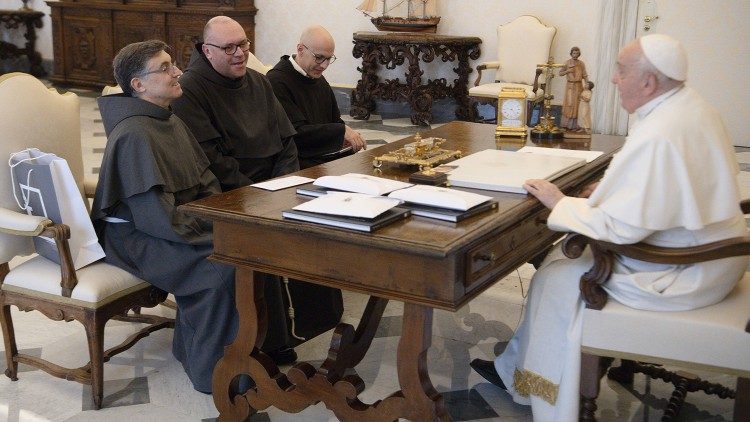
The interview took place on 29 December, after having received in audience the Minister General of the Friars Minor Conventual, Friar Carlos Trovarelli; the Custos of the Sacred Convent, Friar Marco Moroni; and the Director of the Communications Office of the Sacred Convent, Friar Giulio Cesareo, OFMConv. Pope Francis was asked who Saint Francis is to him - a question to which he responded by saying that he is “a special saint, who imitated Christ in a special way”. He is the saint of humility and goodness, explained the Pope; he is patient and asks nothing of anyone whilst offering himself fully to everyone. This, the Pope explained, is how Saint Francis chose to imitate the Lord, and he did so until the end.
Finally, the Holy Father highlighted the gift that the Holy Spirit wants to give the Church through Franciscans: goodness. Pope Francis explained that goodness means witness and forgiveness. “A Franciscan must be very welcoming in the sacrament of reconciliation, forgiving everything”, stressed the Pope, emphasizing that “the Lord does not tire of forgiving” and that “Francis had a big heart and he too did not tire of giving forgiveness”. What he expects from Franciscans, the Pope concluded, “is that they be apostles of reconciliation and forgiveness”.