Showing posts with label Father Cantalamessa. Show all posts

Friday, December 16, 2022

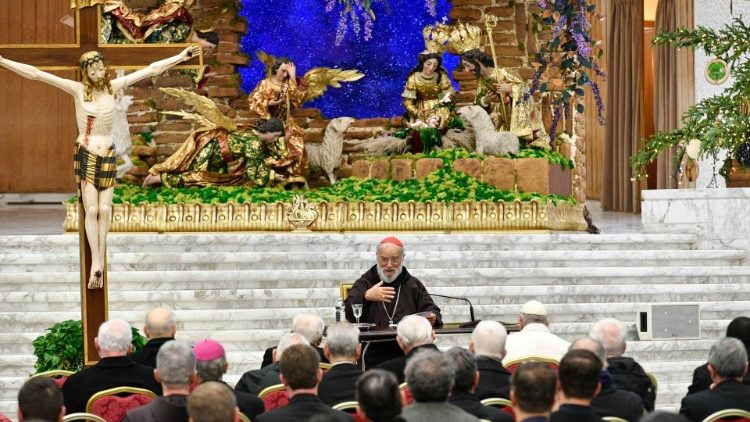
The 3rd Advent sermon for the Pope and Papal Household by Cardinal Cantalamessa


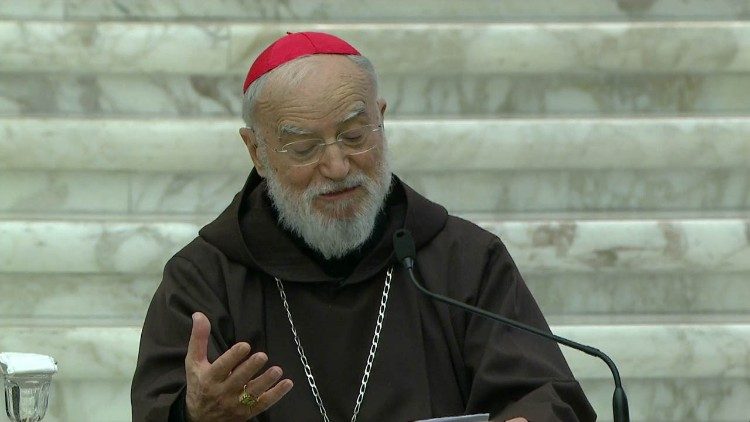
Cardinal Cantalamessa delivers his third Advent homily to the Pope and Roman CuriaCardinal Cantalamessa delivers his third Advent homily to the Pope and Roman Curia  (Vatican Media)

Cardinal Cantalamessa: Mary places Jesus in our arms at Christmas

Cardinal Raniero Cantalamessa delivers his third Advent Sermon to Pope Francis and the Roman Curia, and encourages us to welcome God’s love in Jesus into our lives during this Christmas Season.

By Devin Watkins

The Preacher of the Papal Household brought his series of Advent Sermons to a close on Friday, offering the Pope and the Roman Curia a reflection on “The Gate of Charity”.

Cardinal Raniero Cantalamessa, OFM Cap., began his sermon by noting that the ancient pagans—as expressed by Aristotle—understood God to be active and effective only to the extent that he (or they, in their view) received the love of human beings.

The New Testament, said the Cardinal, completely reversed this to make our ability to love dependent on God’s own love, as expressed in His Son, Jesus Christ.

“In this is love: not that we have loved God, but that He loved us and sent His Son as expiation for our sins... We love because He first loved us” (1 Jn 4:12.19).

Welcoming gift of love like children

The theological virtue of charity is therefore a participation in God’s gratuitous love, rather than the result of our own efforts.

“Opening the door of love to Christ, therefore, means a very specific thing: welcoming the love of God, believing in love.”

Christmas, said Cardinal Cantalamessa, offers us a chance to receive “the infinite gift of God’s love” with “amazement and gratitude”.

He added that we must become like children to believe in love, since life’s disappointments tend to make us cautious and even cynical about love.

“Children believe in love, but not based on reasoning. By instinct, by nature. They are born full of confidence in the love of their parents,” he said. “They ask parents for the things they need, perhaps even by stamping their feet, but the unspoken assumption is not that they have earned it; rather that they are the children and that one day they will be the heirs of everything.”

The Holy Spirit, noted the Cardinal, allows us to welcome God’s love, since He is the love shared between the Father and the Son.

Humanity’s unique ability to love

Cardinal Cantalamessa went on to note that charity forms an essential part of the nature of the Church, which St. Augustine called the “communion of saints”.

After everything disappears, in St. Paul’s telling, “charity remains”, as if the scaffolding were taken down and the building “appears in all its glory.”

Charity, added the Preacher of the Papal Household, builds up both the Church and civil society, recalling that “social sentiment was born on the soil irrigated by the Gospel”.

As we interact with others, love for God and neighbor remains the unique ability of the human person, something which cannot be replaced by Artificial Intelligence or any technological advancement.

“We can conceive of an artificial intelligence: but can we conceive of an artificial love? Perhaps it is then precisely here that we must place the specific of the human and the inalienable attribute of him or her.”

Welcoming Jesus into our hearts

In conclusion, Cardinal Cantalamessa recalled that the Child Jesus comes to the door of our heart this Christmas to knock, offering Himself and God’s love as His gift.

He concluded with a story to illustrate how the Virgin Mother seeks to offer Jesus to the world and how we need to become children in order to receive Him.

A legend says that among the shepherds who went to see the Child on Christmas Eve, there was a shepherd boy so poor that he had nothing to offer his Mother, and he stood aside in shame. Everyone competed to give Mary their gift. The Mother could not hold them all, having to hold the Child Jesus in her arms. Seeing the little shepherd next to her with empty hands, she then takes the Child and puts Him in his arms. Having nothing was his luck. Let's make this luck be ours too!

Friday, December 9, 2022

2nd Advent Homily to the Papal household by Cardinal Cantlamessa


Cardinal Cantalamessa delivers his second Advent homilyCardinal Cantalamessa delivers his second Advent homily  (Vatican Media)

Cardinal Cantalamessa: Hope helps us on our personal journey of sanctification

In his second homily for Advent season 2022, Cardinal Raniero Cantalamessa highlights the importance of Christian hope, and encourages the Church to offer the world this gift of hope that has eternity as its horizon, and as guarantor, Jesus Christ and His resurrection.

By Benedict Mayaki, SJ

Cardinal Raniero Cantalamessa, the Preacher of the Papal Household, focused his second homily for the season of Advent 2022 on “the gate of hope” – one of the doors to be opened by the theological virtues: faith, hope and charity.

He noted that the Temple of Jerusalem had a door called the “Beautiful Gate” (Acts 3:2) and the temple of God, which is our heart, also has a “beautiful gate” which is the door of hope – the door we want to open to Christ who comes.

Waiting for the blessed hope

To explore the object of the “blessed hope”, the Cardinal started by placing the Gospel revelation against the background of ancient beliefs about the afterlife.

He noted that even the Old Testament had no answer to give. However, he said, the great thing that distinguished Israel from other peoples was that, despite everything, it “continued to believe in the goodness and love of its God” and did not attribute death, as the Babylonians did, to the envy of the divinity which reserves immortality only to itself, but rather attributed it to man's sin (Gen 3), or simply to one's own mortal nature.

Indeed, Israel seemed to have gone as far as to desire and glimpse the possibility of a relationship with God beyond death: a being "torn from hell" (Ps 49:16), "to be with God always" (Ps 73, 23) and "be satisfied with joy in his presence" (Ps 16, 11). Jesus, explained the Cardinal, gave an “irrefutable proof by rising from the dead. After Him, for the believer, death is no longer a landing, but a take-off!”

More so, some mystics have been given to experience something of the “ocean of joy” that God keeps prepared for His people but all of them affirm that nothing can be said about it in human words. St. Paul says that he was taken to the “third heaven” in paradise and he heard “unspeakable words that it is not lawful for anyone to pronounce" (2 Cor 12, 2-4).

Thus, “reflecting on Christian hope means reflecting on the ultimate meaning of our existence,” said the Cardinal, noting that one thing is common to all in this regard: the longing for living ‘well’, for ‘wellbeing.’

Material/personal good and the common good

In considering what is meant by “good,” Cardinal Cantalamessa made a distinction between two classes of people: those who think only of the material and personal good, and those who think of the moral good of all – the common good.

For those who think of the material good, Cantalamessa explained, the world has not changed much since the time of Isaiah and St. Paul when the saying “let us eat and drink because tomorrow we will die” was common, and it is indeed, more interesting to understand those who proposed to “live well” not only materially and individually, but also morally and together with others.

St. Augustine, for his part, expressed the core of the problem by asking "What is the use of living well, if it is not given to live always?". Before him, Jesus had said: "What good is it for man to gain the whole world if he then loses his life?" (Lk 9:25). Hence, the response of theological hope assures us that “God created us for life, not death; that Jesus came to reveal eternal life to us and to give us the guarantee with His resurrection.”

Cardinal Cantalamessa clarified that living “always” is not opposed to living “well” as “the hope of eternal life is what makes also present life beautiful, or at least acceptable.” Though everyone has their share of the cross, it is one thing to suffer without knowing for what purpose, and another to suffering knowing that "the sufferings of the present time are not comparable to the future glory that will be revealed in us" (Rom 8:18).

Evangelization and hope

The preacher of the papal household went on to consider the important role that theological hope plays in relation to evangelization, as one of the determining factors in the spread of the faith in the early days of Christianity was the announcement of a life after death that was fuller and more joyful than the earthly one.

In the First Letter of St. Peter, the activity of the Church externally (propagation of the message) is presented as “giving reason for hope”, and the happenings after the first Easter show that the Church is born from a surge a “living hope” with which they set out to conquer the world. Also, the Letter to the Hebrews compares hope to “an anchor of the soul, sure and firm" (Heb 6:18-19). Another image of hope is “the sail” which makes the boat advance in the sea, while the anchor gives the boat safety and keeps it steady between the swaying of the sea.

Cantalamessa noted the attacks on Christian hope from people like Feuerbach, Marx and Nietzsche, and the creation of a so-called “theology of hope”. However, he stressed, the task before us with regard to hope is “no longer that of defending it and justifying it philosophically and theologically, but of announcing it, of showing it and of giving it to a world that has lost the sense of hope and is sinking more and more into pessimism and nihilism, the true 'black hole' of the universe.”

Gaudium et spes

The Cardinal remarked that perhaps “the modern world has never shown itself so well disposed towards the Church and so interested in her message, as in the years of the Vatican Council. And the main reason is that the Council gave hope.” He invited the Church to “resume the movement of hope initiated by the Council” and warned against falling into the temptation against hope which is the fear of appearing naïve.

“The Church cannot give the world a better gift than to give it hope; not human, ephemeral, economic or political hopes, over which she has no specific competence, but pure and simple hope, the one that also, without knowing it, has eternity as its horizon and as guarantor Jesus Christ and his resurrection. It will then be this theological hope that will support all other legitimate human hopes.”

He added that God does not promise to remove the reasons for weariness and exhaustion but he gives hope, and hope gives the strength to rise above.

Get up and walk

Recalling the healing of the cripple at the beautiful gate, Cardinal Cantalamessa said that something similar could also happen to us with regard to hope, as we too often find ourselves spiritually in the position of the cripple – inert, lukewarm and paralyzed in the face of difficulties. However, when divine hope passes by us, “we jump to our feet and finally enter into the heart of the Church, ready to take on, once again and joyfully, tasks and responsibilities.”

“In addition to evangelization, hope helps us on our personal journey of sanctification,” the Cardinal affirmed, adding, that it becomes, in those who exercise it, the “principle of spiritual progress” and allows us to always discover new “possibilities for good” and always something that can be done.

Monday, December 5, 2022

In faith, we go to meet Christ


Cardinal Raniero Cantalamessa, preacher of the papal householdCardinal Raniero Cantalamessa, preacher of the papal household 

Cardinal Cantalamessa: The Church lives by her faith

In his first sermon for the season of Advent 2022, Cardinal Raniero Cantalamessa highlights the importance of the theological virtue of faith in our Christian journey, and urges the faithful to go to meet Christ, who comes with an act of faith that is a promise of God and a prophecy.

By Benedict Mayaki, SJ

Cardinal Raniero Cantalamessa, the Preacher to the Papal Household, has focused his Advent sermons this year on the three theological virtues: faith, hope, and charity.

“Faith, hope, and charity are the gold, frankincense, and myrrh that we, the Magi of today, want to bring as a gift to God who ‘comes to visit us from on high’,” he said. He explained that “the great door that man can open or close to Christ is one and is called freedom.” However, this door opens in three different ways according to three types of decisions that we can consider as three doors: faith, hope, and charity.

These doors open from inside and the outside at the same time with two keys, he noted, adding that one is “in the hand of man and the other in the hand of God.” Nonetheless, “Man cannot open them without the help of God and God does not want to open them without the cooperation of man.”

Faith in Christ

Focusing on the door of faith in this first of three sermons for the season, the Cardinal noted that God opens the door to us by sending those who preach the good news. Man, in turn, opens the door of faith by accepting this possibility. Thus, with the coming of Christ, there is “a leap in quality with regard to faith” – not in its nature, but in its content – as it is no longer a question of generic faith in God, but of faith in Christ, who was born, died and rose for us.

In fact, he explained, before Jesus performed miracles, He asked, “Do you believe?” and after accomplishing it affirmed, “Your faith has saved you.” He was referring to faith in Himself, in the divine power granted to Him.

The process of faith

This faith, the cardinal continued, “is placed at the end of a process” that St. Paul traces, saying “Faith comes from listening.” Hence “from the ears, the movement passes to the heart, where the fundamental decision is made: corde creditur, 'with the heart one believes'. From the heart, the movement goes back to the mouth: 'with the mouth one makes the profession of faith': ore fit confessio.”

However, the process does not end there. It continues from the ears, the heart, and the mouth to the hands, Cardinal Cantalamessa said. Because "faith works through love" (Gal 5: 6) and St. James gives room for “works”; however not before, but after. More so, St. Gregory notes, “One does not arrive at faith starting from the virtues, but to the virtues starting from faith.”

Faith and salvation

The Cardinal went on to consider our pluralistic society, exploring the idea in some Christian circles that “outside faith there is no salvation.” He notes that this perspective, given the diversity of religions that exist, “cannot leave us satisfied and it does wrong to Christ, depriving him of a large part of humanity” because “One cannot believe that Jesus is God, and then limit his actual relevance to a single narrow sector of it.”

“Jesus is "the savior of the world" (Jn 4:42); the Father sent the Son "that the world may be saved through him" (Jn 3:17): the world, not some few people in the world!”

He explained that even adherents of other religions, generally believe that "God exists and rewards those who seek Him". More so, “the main reason for our optimism is not based, however, on the good that adherents to other religions are able to do, but on 'God’s varied grace' (1Pt 4: 10).”

“God has far more ways to save than we can think of. He has established 'channels' of His grace, but He has not bound Himself to them. One of these "extraordinary" means of salvation is suffering. After Christ has taken it upon Himself and redeemed it, it is also, in some way, a universal sacrament of salvation.”

The challenge of science

Cardinal Cantalamessa considered scientific advancements, including a telescope launched into space on 25 December 2021 which has sent extraordinary images of the universe, and according to the news, “has opened a new window on the cosmos, able to catapult us back in time, until shortly after the initial Big Bang of the world.” It is also “the most detailed view of the early universe ever obtained. It represents the first taste of a new and revolutionary astronomy that will reveal the universe as we have never seen it before ".

He said that “if faith - as well as from listening - is born, as has been said, from amazement, these scientific discoveries should not diminish the possibility of believing, but increase it.” Because “the cosmos did not make itself. It is the quality of being, not the quantity that decides; and the quality of creation is to be… created! Billions of galaxies, billions of billions of light years away, do not change this quality.”

“Faced with the unfolding before our eyes of the boundless dimensions of the universe, the greatest act of faith for us Christians is not to believe that all this was created by God, but to believe that "all things were created through Chris and for Him. "(Col 1:16), that "without Him, nothing came to be” (Jn 1: 3). The Christian has a much more convincing proof of God than that obtained from the cosmos: the person and life of Jesus Christ.”

Living by faith

“Faith is the only criterion capable of making us relate correctly, not only to science, but also to history,” Cardinal Cantalamessa affirmed. In fact, St. Paul, quoting the famous prophecyof Habbakuk, says that “the righteous one will life by faith”.

The Cardinal notes that Habbakuk’s message is relevant for us today, with instances of injustices and violence arising in the world. However, in response to the prophet’s question, “Lord, until when?” God’s answer is still the same: “Those who do not have a right heart with God succumb to pessimism and are scandalized, while the just will live by faith and find the answer in his faith…”

The role of the Church

Cardinal Cantalamessa goes on to recommend that the Church, in order not to passively witness the unfolding of history, should “take sides against oppression and arrogance and always put herself, 'in time and out of time', on the side of the poor, the weak, the victims, those who bear the brunt of every misfortune and every war.”

He also suggests that the Church should work to remove rivalry between religions and the notorious “religious wars”, getting its moral thrust from “the understanding and loyal collaboration between the great religions that imprints on history that new course we in vain expect from political powers.”

“Faith is the weapon of the Church,” he said, noting that “even the Church, like the righteous of Habakkuk, 'lives by her faith'."

“The greatest act of faith that the Church can do - after having prayed and done everything possible to avoid or stop conflicts - is to surrender to God with an act of total trust and serene abandonment, repeating with the Apostle: 'I know in whom I have placed my trust!': Scio cui credidi (2 Tim 1:12). God never draws back to make those who throw themselves into His arms fall into the void.”

Cantalamessa concluded by urging everyone to go to meet Christ-who-comes with an act of faith, which is also a promise of God and therefore a prophecy. He affirmed that “the world is in the hands of God and when, misusing his freedom, man has hit the bottom, He will intervene to save him” because “this is why He came into the world two thousand twenty-two years ago.”
Friday, April 15, 2022

Homily from Passion service from Rome today


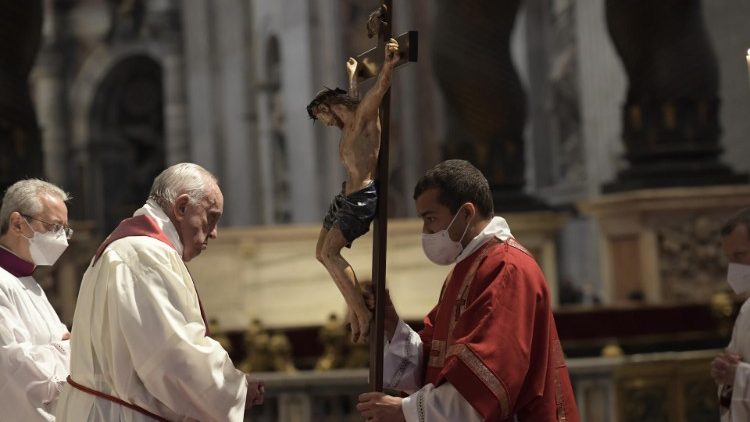
Pope Francis adores the Holy Cross during the liturgy of the Passion of the LordPope Francis adores the Holy Cross during the liturgy of the Passion of the Lord 

Cantalamessa at Passion liturgy: Easter 'a chance to cling to Jesus who never fails us'

At the Celebration of the Passion of the Lord on Good Friday, presided over by Pope Francis, Cardinal Raniero Cantalamessa invites Christians to reflect on Jesus – the truth – and to cling to Christ, who never passes from our changing world.

By Benedict Mayaki, SJ

Cardinal Raniero Cantalamessa focused on the dialogue of Jesus with Pilate from the Gospel of John, during his sermon at the Celebration of the Passion of the Lord held at St. Peter’s Basilica on Good Friday, and presided over by Pope Francis.

“Are you the king of the Jews?”

The Preacher of the Papal Household explained that through the dialogue which began with Pilate’s question: “Are you the king of the Jews?”, Jesus tried to lead Pilate to “a higher plane”, to see if he does not simply repeat an accusation from others. Hence Jesus asks him in turn, “Do you say this on your own, or have others told you about me?”

Jesus speaks to Pilate of His Kingdom which is “not of this world”, and reaffirms His superior origins, saying: “I came into the world…” to be a witness to the truth, indicating that He existed before His earthly life.

In the dialogue, explains the Cardinal, “Jesus treats Pilate as a soul who needs light and truth,” and is interested “in the destiny of the man Pilate more than in his own destiny.”

Thus, with His appeal for the truth, Jesus “wants to prompt him to come to his senses, to look at things with different eyes, to place himself above the momentary dispute with the Jews.”

Pilate, however, frightened by the mystery he glimpses in Jesus’ words, prefers to end the conversation, muttering to himself “what is truth?” and leaves the praetorium.

“What is truth?”

Cardinal Cantalamessa remarked that today, as in the past, man asks himself “what is truth?” However, in countless debates on religion and science, faith and atheism, Jesus is hardly mentioned, and in cases that He is, it is often treated as an “irrelevant digression.”

Some even go beyond Pilate’s skepticism, refusing that the question should not be asked because for them, “the truth simply does not exist! Everything is relative, nothing is certain!”

The consequence of this, the Cardinal noted, is that “the word ‘God’ becomes an empty vessel for everyone to fill at will.” However, it is precisely for this reason that God took care to give content to His name and “the Word became flesh” and “truth became flesh.”

In this light, even though some say there is too much injustice and suffering in the world to believe in God, the evil that surrounds us becomes “more absurd and hopeless… without faith in a final triumph of truth and good” and “the Resurrection of Jesus from the dead…is the promise and the sure guarantee that this is what will happen because it has already begun with him.”

The Cardinal thus implored the faithful not to leave this world as Pilate left the praetorium with the unanswered question: “what is truth?” because “it is too important” and it “is a question of knowing whether we live for something, or in vain!”

A reflection for the Church

Cardinal Cantalamessa went on to note that Pilate’s words: “Your people and the chief priests have handed you over to me” (Jn 18:35) also offers another reflection addressed to believers and men of the Church.

“People of your Church, your priests have abandoned you, they have discredited your name with horrendous misdeeds! And should we still believe in you?” he asks.

To this, the Cardinal responded, quoting the words of J.R. Tolkien to his son: “Our love may be chilled and our will eroded by the spectacle of the shortcomings, folly, and even sins of the Church and its ministers, but I do not think that one who has once had faith goes back over the line for these reasons (least of all anyone with any historical knowledge)…” Tolkien adds that “It is convenient because it tends to turn our eyes away from ourselves and our own faults to find a scapegoat.”

Putting our feet on solid ground

Concluding, Cardinal Cantalamessa pointed out that we celebrate Easter this year amid the noise “of bombs and explosions not far from here.” In this regard, he called for repentance and appeals that swords be beaten into plowshares and spears into pruning hooks. (Is 2:4)

He also remarked that these events have reminded us that “the structures of the world can change form one day to another” and everything passes and ages. The only way to escape the current of time, which drags everything along with it, is “to pass on to that which does not pass” and to “put our feet on firm ground.”

“Easter, Passover, means passage: let us all aim to experience a real Easter this year,” the Cardinal urged. “…let us pass on to the One who does not pass. Let us pass on now with our heart, before passing on one day with our body!”

Friday, April 8, 2022

A Vatican Cardinal preaches on service to the Papal Household


Cardinal Raniero Cantalamessa, preacher of the papal householdCardinal Raniero Cantalamessa, preacher of the papal household 

Cardinal Cantalamessa: Service does not consist in self-seeking

In his fifth Lenten sermon for 2022, Cardinal Raniero Cantalamessa, the Preacher to the Papal Household, reflects on service and the example of Jesus who washed the feet of His apostles and lived a life spent for others.

By Benedict Mayaki, SJ

“Why, in the account of the Last Supper, John does not speak of the institution of the Eucharist, but speaks instead of the washing of the feet?” asks the Preacher to the Papal Household, Cardinal Raniero Cantalamessa, at the start of his fifth sermon for the season of Lent this year.

The papal preacher responds by noting that in everything concerning Easter and the Eucharist, John emphasizes the event more than the sacrament – the meaning more than the sign. For the evangelist, the Cardinal notes, “the new Passover does not begin so much in the Upper Room, when the rite that must commemorate it is instituted…rather it begins on the cross when the fact that it is to be commemorated is fulfilled.”

Washing of the feet

Reflecting on the meaning that John attaches to the washing of the feet, the Cardinal notes that it helps us to understand how a Eucharist can be transferred into life and thus, we “imitate in life what we celebrate on the altar.” In the washing of the feet, Jesus wanted to summarize the whole meaning of his life so that it will remain in the memory of the disciples. The gesture tells us, “that the whole life of Jesus, from beginning to end, was a washing of feet, which is, serving humanity.”

“Before the incarnation, there is the pre-existence of Christ, after the incarnation the pro-existence of Christ, that is, an existence lived in favor of others.” With Jesus’ words “Do you too as I did,” he institutes the diakonia (service) elevating it to a fundamental law or a lifestyle and model of all relationships in the Church, as if he were saying in the washing of the feet as in instituting the Eucharist: “do this in memory of me!”.

The doctrine of charisms, in this regard, “is entirely oriented to service” and St. Paul affirms that every particular manifestation of the Spirit is given “for the common good.” "Each one lives according to the grace (chárisma) received, putting it at the service (diakonía) of others" (1 Pt 4, 10). The two things - charisma and ministry, charisma and service - always appear vitally connected to each other, hence, “the Church is charismatic to serve!”.

Spirit of service

The Cardinal explains that the Gospel speaks of service in a way that does not necessarily exclude or disqualify its use in worldly terms (like the way a shopkeeper serves his customer), however, the difference “lies in the reason for the service and in the inner attitude with which it is carried out.” In this regard, “service is not a virtue but it springs from virtue, especially from charity…[it] is a manifestation of the agape, of a love that does not insist on its own interests but on that of others; it does not consist in self-seeking but in giving.”

Besides gratuity, service is also the expression of another aspect of divine agape: humility, the Cardinal explains. Jesus, himself said “You also ought to wash one another’s feet” highlighting that “charity and humility together form evangelical service.” Jesus humbled himself to come from heaven to serve and from the moment of the incarnation, he continued to come down to the point of kneeling down to wash his apostles’ feet.

Discernment of spirits

“The important thing to know is whether we are serving our brothers and sisters or whether, instead, they are serving our purposes,” the Cardinal said. To have a discernment of spirits of our intentions of doing service, “we should be aware of what we do willingly and what we do our best to shirk” and see if “our heart is ready to abandon a noble, prestigious service, if required, for a humble unappreciated one.”

The opposite of a spirit of service is the “wish to domineer, the habit to enforce our wills… authoritarianism,” Cardinal Cantalamessa warns. In another way, “being too attached to our habits and comforts also goes against the spirit of service – a spirit of laxness, as it were.” To counter all of this, “the rule of service is always the same: “Christ did not please himself.”

Service of the Spirit

If, for all Christians, to serve means “living no longer for themselves” (2 Cor 5:15), for pastors it means “not feeding themselves,” the papal preacher stresses. St. Paul also notes in this regard: “Do not domi­nate over those in your charge but be an example to the flock” (cf. 1 Pet 5:3).

“We must imitate God’s way of acting,” the Cardinal urges. In the washing of the feet, “Jesus was not afraid of compromising his divine dignity, fostering people’s disrespect by disregarding his own privileges and appearing as one among us.” He rather led a simple life, because “sim­plicity has always been the beginning and the sign of a genuine return to the gospel.” Thus, those, like priests, who are called by vocation to a spiritual service, are called to be servants, first of God and of their brethren.

Jesus, after explaining to the apostles the meaning of the washing of the feet, said to them: "Knowing these things you will be blessed if you do them" (Jn 13:17). Cardinal Cantalamessa notes that we too will be blessed, “if we are not satisfied with knowing these things - namely that the Eucharist pushes us to service and sharing -, but if we put them into practice,” because “the Eucharist is not only a mystery to be consecrated, received and adored, but also a mystery to be imitated.”

Concluding, the papal preacher warns against reducing the gifts we have received to duty, noting that “we have not only received the command to wash the feet and serve our brothers and sisters, we have received the grace of being able to do so.”

Friday, December 17, 2021

3rd Advent Sermon by Cardinal Cantalamessa at the Papal household


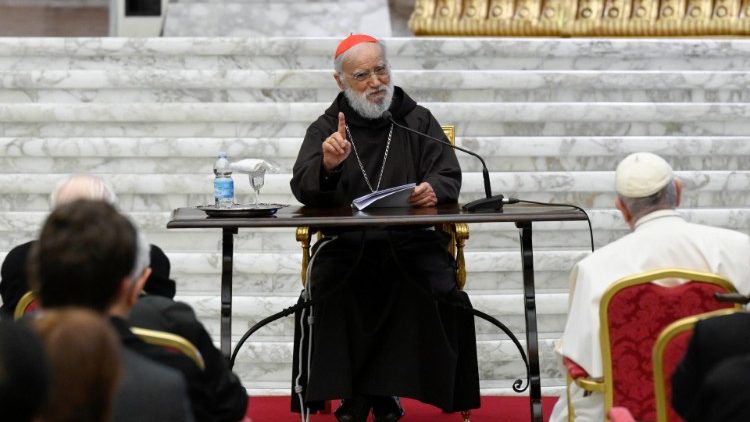
Pope Francis listens to Cardinal Cantalamessa's second Advent SermonPope Francis listens to Cardinal Cantalamessa's second Advent Sermon  (Vatican Media)

Cardinal Cantalamessa: Church must bear Christ for our world

The Preacher of the Papal Household, Cardinal Raniero Cantalamessa, delivers his third Advent sermon to the Pope and the Roman Curia, and reflects on Jesus’ birth “of a woman” and what that means for the Church’s mission to preach Christ.

By Devin Watkins

“When the fullness of time had come, God sent his Son, born of a woman.”

Cardinal Raniero Cantalamessa took this line from Paul’s Letter to the Galatians as the basis of his reflection for the third Advent Sermon on Friday, which saw Pope Francis and various officials of the Roman Curia take part.

The Preacher of the Papal Household focused especially on the implications of the phrase: “born of a woman.”

He noted with the Fathers of the Church that, without those words, Christ would appear as “a heavenly, disembodied illusion”, an image of Christ which the Docetist heresy sought to promote.

Being born “of a woman” and in the flesh is “clear proof of his human nature,” said the Cardinal with St. Leo the Great.


‘Mary, or the Church, or the soul’

Cardinal Cantalamessa said St. Paul’s reference to Mary as “woman” places her within the long Biblical tradition that begins with Eve and ends with the woman of the Book of Revelations who is “clothed with the sun, with the moon under her feet”, a clear reference to the Church. It also reflects Jesus’ way of referring to his mother in the Gospel of John at the wedding at Cana and at Golgotha.

The Cardinal noted that the Church Fathers closely linked the images of the Church, the Virgin Mary, and the individual Christian. So, what Sacred Scripture says of one can be applied to the other two analogously.

“In the inspired Scriptures, what is said in a universal sense of the virgin mother, the Church, is understood in an individual sense of the Virgin Mary, and what is said in a particular sense of the virgin mother Mary is rightly understood in a general sense of the virgin mother, the Church... In a way, every Christian is also believed to be a bride of God’s Word, a mother of Christ, his daughter, and sister, at once virginal and fruitful. These words are used in a universal sense of the Church, in a special sense of Mary, in a particular sense of the individual Christian. (Isaac of Stella)”

Church bearing Christ

Therefore, said Cardinal Cantalamessa, just as Mary conceived Jesus in her womb and bore Him in the flesh for the world, so must the Church give birth to Jesus for humanity of every age.

He said that whoever sees the Church should not stop there but “should look to Jesus.”

“This is the struggle against the Church becoming self-referential, a theme often underscored by the last two Supreme Pontiffs: Benedict XVI, and Pope Francis.”

He added that Christ has entrusted his message of salvation to the Church and sent her into the world, though many people still unknowingly dream of receiving that message.

Dangers and “walls of division” lurk within the Church, however, noted the Cardinal. He said these include “excess bureaucracy, the remnants of meaningless ceremonials, including vestments, former laws, and disputes that by now have become nothing more than debris.”

Cardinal Cantalamessa then thanked Pope Francis for “the steps forward” which the Church has made to “reach the existential peripheries of the world, bringing them the message of Christ.”

Born of our hearts

At the same time, each individual Christian must bear Christ for our world.

“In the Gospel Jesus explains to us how to become a mother of Christ, He says that it happens by listening to the Word and putting it into practice (see Lk 8:21). It is important to note that two things need to take place. Even Mary became the mother of Christ through these two processes: first, by conceiving him, and then by giving birth to him.”

However, Cardinal Cantalamessa warned against two forms of “spiritual abortion”.

One is that the believer “conceives Jesus without giving birth to Him”, that is, he or she welcomes the Word but then never puts it into practice through concrete actions.

On the other hand, the believer can “give birth to Christ without having conceived Him”, much like a form of in vitro fertilization.

He said these people perform many good things without their actions being motivated by kindness, or the love of God, or even right intentions. Habit or hypocrisy motivates them. Rather, our deeds are good “only if they come from the heart and are conceived for the love of God and in faith.”

‘While all around was silence’

Cardinal Cantalamessa therefore recalled the need for “sound discernment” in the quest to put into practice what has been conceived in the heart.

“We must insist on one thing, however: the determination or resolution to lead a new life must be translated without delay into concrete action, into a change in the way we live and in our habits, possibly even in external and visible ways. If our resolution is not acted upon, Jesus is conceived, but not brought to birth. It will be one of many spiritual abortions.”

The first way to start, urged the papal preacher, is to create “a little silence around us and within us.” In this way, we mirror the contemplative silence that surrounded Jesus upon His virgin birth into our world.