Showing posts with label Eucharistic coherence. Show all posts

Friday, March 3, 2023

And now Cardinal McElroy responds to criticisms of his recent article


Cardinal McElroy responds to his critics on sexual sin, the Eucharist, and LGBT and divorced/remarried Catholics


In January, America published an article I wrote on the theme of inclusion in the life of the church. Since that time, the positions I presented have received both substantial support and significant opposition. The majority of those criticizing my article focused on its treatment of the exclusion of those who are divorced and remarried and members of the L.G.B.T. communities from the Eucharist. Criticisms included the assertion that my article challenged an ancient teaching of the church, failed to give due attention to the call to holiness, abandoned any sense of sin in the sexual realm and failed to highlight the essential nature of conversion. Perhaps most consistently, the criticism stated that exclusion from the Eucharist is essentially a doctrinal rather than a pastoral question.

I seek in this article to wrestle with some of these criticisms so that I might contribute to the ongoing dialogue on this sensitive question—which will no doubt continue to be discussed throughout the synodal process. Specifically, I seek here to develop more fully than I did in my initial article some important related questions, namely on the nature of conversion in the moral life of the disciple, the call to holiness, the role of sin, the sacrament of penance, the history of the categorical doctrine of exclusion for sexual sins and the relationship between moral doctrine and pastoral theology.

The report of the U.S. Conference of Catholic Bishops on the synodal dialogues held in our nation last year pointed to the profound sadness of many, if not most of the people of God about the broad exclusion from the Eucharist of so many striving Catholics who are barred from Communion because they are divorced and remarried or L.G.B.T.

In January, I proposed that three foundational principles of Catholic teaching invited a re-examination of the church’s practice in this area. The first is Pope Francis’ image of the church as a field hospital, which points to the reality that we are all wounded by sin and all equally in need of God’s grace and healing.

The second is the role of conscience in Catholic thought. For every member of the church, it is conscience to which we have the ultimate responsibility and by which we will be judged. For that reason, while Catholic teaching has an essential role in moral decision-making, it is conscience that has the privileged place. As Pope Francis has stated, the church’s role is to form consciences, not replace them. Categorical exclusions of the divorced and remarried and L.G.B.T. persons from the Eucharist do not give due respect to the inner conversations of conscience that people have with their God in discerning moral choice in complex circumstances.

Finally, I proposed that the Eucharist is given to us as a profound grace in our conversion to discipleship. As Pope Francis reminds us, the Eucharist is “not a prize for the perfect, but a powerful medicine and nourishment for the weak.” To bar disciples from that grace blocks one of the principal pathways Christ has given to them to reform their lives and accept the Gospel ever more fully. For all of these reasons, I proposed that divorced and remarried or L.G.B.T. Catholics who are ardently seeking the grace of God in their lives should not be categorically barred from the Eucharist.

In the weeks since my article was published, some readers have objected that the church cannot accept such a notion of inclusion because the exclusion of remarried women and men or L.G.B.T. persons from the Eucharist flows from the moral tradition in the church that all sexual sins are grave matter. This means that all sexual sins are so gravely evil that they constitute objectively an action that can sever a believer’s relationship with God.

I have attempted to face this objection head-on by drawing attention to both the history and the unique reasoning of the principle that all sexual sins are objectively mortal sins.

For most of the history of the church, various gradations of objective wrong in the evaluation of sexual sins were present in the life of the church. But in the 17th century, with the inclusion in Catholic teaching of the declaration that for all sexual sins there is no parvity of matter (i.e., no circumstances can mitigate the grave evil of a sexual sin), we relegated the sins of sexuality to an ambit in which no other broad type of sin is so absolutely categorized.

In principle, all sexual sins are objective mortal sins within the Catholic moral tradition. This means that all sins that violate the sixth and the ninth commandments are categorically objective mortal sins. There is no such comprehensive classification of mortal sin for any of the other commandments.

In understanding the application of this principle to the reception of Communion, it is vital to recognize that it is the level of objective sinfulness that forms the foundation for the present categorical exclusion of sexually active divorced and remarried or L.G.B.T. Catholics from the Eucharist. So, it is precisely this change in Catholic doctrine—made in the 17th century—that is the foundation for categorically barring L.G.B.T. and divorced/remarried Catholics from the Eucharist. Does the tradition that all sexual sins are objectively mortal make sense within the universe of Catholic moral teaching?

It is automatically an objective mortal sin for a husband and wife to engage in a single act of sexual intercourse utilizing artificial contraception. This means the level of evil present in such an act is objectively sufficient to sever one’s relationship with God.

It is not automatically an objective mortal sin to physically or psychologically abuse your spouse.

It is not automatically an objective mortal sin to exploit your employees.

It is not automatically an objective mortal sin to discriminate against a person because of her gender or ethnicity or religion.

It is not automatically an objective mortal sin to abandon your children.

The moral tradition that all sexual sins are grave matter springs from an abstract, deductivist and truncated notion of the Christian moral life that yields a definition of sin jarringly inconsistent with the larger universe of Catholic moral teaching. This is because it proceeds from the intellect alone. The great French philosopher Henri Bergson pointed to the inadequacy of any such approach to the richness of Catholic faith: “We see that the intellect, so skillful in dealing with the inert, is awkward the moment it touches the living. Whether it wants to treat the life of the body or the life of the mind, it proceeds with the rigor, the stiffness and the brutality of an instrument not designed for such use…. Intuition, on the contrary, is molded on the very form of life.”

The call to holiness requires both a conceptual and an intuitive approach leading to an understanding of what discipleship in Jesus Christ means. Discipleship means striving to deepen our faith and our relationship to God, to enflesh the Beatitudes, to build up the kingdom in God’s grace, to be the good Samaritan. The call to holiness is all-encompassing in our lives, embracing our efforts to come closer to God, our sexual lives, our familial lives and our societal lives. It also entails recognizing sin where it lurks in our lives and seeking to root it out. And it means recognizing that each of us in our lives commits profound sins of omission or commission. At such moments we should seek the grace of the sacrament of penance. But such failures should not be the basis for categorical ongoing exclusion from the Eucharist.

It is important to note that the criticisms of my article did not seek to demonstrate that the tradition classifying all sexual sins as objective mortal sin is in fact correct, or that it yields a moral teaching that is consonant with the wider universe of Catholic moral teaching. Instead, critics focused upon the repeated assertion that the exclusion of divorced/remarried and L.G.B.T. Catholics from the Eucharist is a doctrinal, not a pastoral question.

I would answer that Pope Francis is precisely calling us to appreciate the vital interplay between the pastoral and doctrinal aspects of church teaching on questions just such as these.

Seen through a pastoral prism

In his teachings, Pope Francis has framed a substantive pastoral theology at the heart of the life of the church. This pastoral outlook demands that all of the branches of theology attend to the concrete reality of human life and human suffering in a much more substantial way in forming doctrine. It states that the lived experience of human sinfulness and human conversion are vital to understanding the central attribute of God in relation to us, which is mercy. It demands that moral theology proceed from the actual pastoral action of Jesus Christ, which does not first demand a change of life, but begins with an embrace of divine love.

The pastoral theology of Pope Francis requires that the liturgical and sacramental life of the church be formed in compassionate embrace with the often overwhelming life challenges that prevent men and women at some periods in their life from conforming fully with important Gospel challenges. And the pastoral theology of Pope Francis rejects a notion of law that can be blind to the uniqueness of concrete human situations, human suffering and human limitation.

There are three fundamental foundations for this pastoral theology.

The first foundation for the pastoral theology that Pope Francis is pointing to lies in the recognition that the church should mirror the pastoral action of the Lord himself. It is the pattern of Jesus Christ who walked the earth that we are to incorporate into every element of ecclesial life. First, the Lord embraces the person, then he heals them. Then he calls the person to reform. Each of these elements of the saving encounter with the Lord is essential. But their order is also essential. Christ first reveals the overpowering merciful and limitless love of God. Then he moves to heal the particular form of suffering that the person is experiencing. And only then does he call the person specifically to a change in that person’s life.

This pattern must become ever more deeply the model for the church’s proclamation of the faith and healing action in the world. This must be the imitatio Christi for a pastoral church in an age that rejects abstraction, authority and tradition. The clear recognition of sin and the call to change one’s life to conform more fully with the Gospel is essential to Christian conversion and the achievement of true happiness in this world and the next. But that call must be expressed in the tender, compassionate welcome of a church that patiently ministers over time, as Christ did.

The second principle of Pope Francis’ pastoral theology is that the church must be committed to true accompaniment. In “The Joy of the Gospel” (“Evangelii Gaudium”), Pope Francis expresses both the depth of commitment and the openness that must suffuse pastoral life and action in the church. “The Church will have to initiate everyone—priests, religious and laity—into this ‘art of accompaniment’ which teaches us to remove our sandals before the sacred ground of the other.” The challenge of this is to come to see others as God sees them, incredibly precious souls, individual in nature and identity, yet equally treasured by the Lord.

The final foundation for the pastoral theology that Pope Francis is delineating for the life of the church is the assertion that the church’s identity, teaching and action must be rooted in the life situations that men and women actually experience in the world today. Every disciple encounters certain enormously complex circumstances that consistently prevent him or her from living out the teaching of the church in its fullness. Those who are divorced and remarried or sexually active members of the L.G.B.T. communities are among them. Pastoral theology and accompaniment seek to recapitulate and replicate the saving encounter of Jesus Christ with the saint and the sinner who resides in every human soul, touching every dimension of human existence in the real world, inviting all striving disciples to the eucharistic banquet in this world and the next.

Those who oppose elements of the pastoral mission of Pope Francis frequently argue that doctrine cannot be superseded by the pastoral. It is equally important to recognize that the pastoral cannot be eclipsed by doctrine. For the pastoral ministry of Jesus Christ stands at the heart of any balanced understanding of the church that we are called to be. And pastoral authenticity is as important as philosophical authenticity or authenticity in law in contouring the life of the church to the charter our Lord himself has given to us. Let us pray that in the coming months the Holy Spirit will lead the church in discerning how such a vision of faith and grace can be accomplished.

Correction (March 3): A previous version of this article translated "Evangelii Gaudium" as "The Gospel of Joy," rather than "The Joy of the Gospel."

Wednesday, November 17, 2021

Eucharistic document approved at USCCB, no rebuke of disobedient Catholic politicians


U.S. bishops overwhelmingly approve document on the Eucharist


BALTIMORE – With an overwhelming positive vote, the U.S. Conference of Catholic Bishops’ on Wednesday approved a much anticipated document on the Eucharist that, to the disappointment of some and joy of others, makes no reference to pro-choice Catholic politicians who receive Communion.

After a short public discussion – that followed lengthy private talks, 222 bishops voted in favor of the document, eight against, and three abstained. The voting was electronic and secret.

The document is 30 pages long and is called The Mystery of the Eucharist in the Life of the Church. Its drafting was approved by the bishops during the spring meeting back in June. Tasked with writing the document was the USCCB’s Committee on Doctrine, headed by Bishop Kevin Rhoades of Fort Wayne-South Bend.

During the June meeting, a major focus of the bishops’ virtual discussions highlighted whether the document would address denying Communion to Catholic politicians who support legal abortion.

Some bishops issued a strong rebuke of President Joe Biden, the nation’s second Catholic president, because of his actions protecting and expanding abortion access. Other prelates warned that this would portray the bishops as a partisan force, further fueling the polarization in the United States.

It’s worth noting that the decision to make the Eucharist the focus of the conference’s 2021-2024 strategic plan was decided long before Biden ran for president. The strategic plan is titled “Created Anew by the Body and Blood of Christ, Source of Our Healing and Hope,” and it was provisionally approved by the full body of bishops at the June 2019 general meeting, with drafts written that year, and the plan formally accepted at the 2020 fall plenary.


However, once Biden got elected many of the bishops themselves attempted to turn the document into a rebuttal of the president.

Archbishop José Gomez of Los Angeles, president of the U.S. Conference, announced at the end of the 2020 fall meeting that Archbishop Allen H. Vigneron of Detroit was going to head up a special working group to address issues surrounding the election of a Catholic president and policies that may come about that would be in conflict with Catholic teaching.

“We are facing a unique moment in the history of our country” with the election of only the second Catholic as president, Gomez said soon after the 2020 election. “This presents certain opportunities but also certain challenges.”

The document voted on by the bishops on Wednesday did not specifically call out Catholic political leaders. Instead, it does more generally point out the seriousness of the sacrament, warning that “one is not to celebrate Mass or receive Holy Communion in the state of mortal sin without having sought the Sacrament of Reconciliation and received absolution.”

There was, however, a brief mention of politicians – none by name – in the comments that preceded Wednesday’s vote. Archbishop Joseph Naumann spoke of the importance of engaging Catholic politicians in areas of both agreement and disagreement.

“I think it was good to reiterate in this document what we have said before about our responsibility to have dialogue and conversation with those who are Catholic but who act in a way contrary to our faith in this basic moral teaching,” Naumann, the chairman of the USCCB Committee on Pro-life Activities said. “I’m not sure we’ve taken that seriously as bishops, our responsibility for the care of the souls of these politicians to really enter into a dialogue.”

Bishop Donald DeGrood of Sioux Falls followed Naumann, and said that it’s important for bishops to be united in the implementation of the document.

“It’s really how we will be united as bishops and how we move forward is not just focusing on one aspect of the document, but really both,” DeGrood said. “Addressing the beauty and all of the teachings we have in the faith, but then taking the next steps where there needs to be a deeper dialogue so there’s unity in how we handle the sacred mysteries.”

Based on the committee’s responses and rationale for the approval and rejection of the amendments suggested by the bishops – 28 in total, with 9 approved, 19 rejected –the document is not intended to be a “comprehensive treatise on the Eucharist,” it’s intended as a theological and not disciplinary document and the focus of it is “on the return to the Mass.”

National Eucharistic Congress

The document on the Eucharist was presented by the bishops as the launching pad for a National Eucharistic Congress, part of the three-annual Eucharistic Revival initiative, to be held in Indianapolis in July 17-21, 2024, with an expected attendance of some 80,000 to 100,000 participants. The proposal was presented by Auxiliary Bishop Andrew Cozzens of St. Paul and Minneapolis, who is bishop-designate of Crookston.

“It will have a World Youth Day like spirit,” said Cozzens, the chairman USCCB Committee on Evangelization and Catechesis said..

The Eucharistic revival initiative will be formally launched at the diocesan level in June.

The estimated “completely inclusive budget” that includes renting venues, insurance, security, registration, management, food and beverages, is of a little over 28 million dollars. Fundraising goal for the event is estimated at $12 million. Our Sunday Visitor has already donated $1 million for the Congress and the Knights of Columbus have also promised their support.

During the discussions of the proposal, Archbishop Timothy Broglio, of the Archdiocese for the Military Services, was the first one to question the cost of the event, saying that “it’s a lot of money,” particularly seeing other things for which the Church already must pay, including Catholic schools. The budget for the congress, he said, is that of his diocese for four years.

“I’m sure that the spiritual fruits of the event will be worth the investment,” Cozzens answered.

The proposal to hold the congress also received overwhelming support, with 201 voting in favor, 17 against and 5 abstaining.

Modifying the charter on abuse prevention

The nation’s bishops voted overwhelmingly to move the review of the 2002 Charter for the Protection of Children and Young People – last amended in 2018 – to as early as next summer, after the U.S. Bishops’ Conference Committee on the Protection of Children and Young People chair made the case that the slated 2025 review “is simply too long to wait.”

Bishop James Johnson, Jr. of Kansas City-St. Joseph, the committee chair, cited the legislative and procedural changes Pope Francis Made in Vos Estis Lux Mundi, and the Holy Father’s more recent promulgation of Book Six of the Code of Canon Law.

Johnson mentioned the review will also consider learnings from last year’s report on ex-Cardinal Theodore McCarrick, and “other events in the life of the church and societal trends that present challenges for maintaining a safe environment.”

The proposal passed by a 230-5 vote. Johnson said the review could begin as early as next summer or fall, following the June 2022 plenary.

Bishops weighed in with suggestions and support before the vote.

Bishop Nicholas DiMarzio of Brooklyn urged that the review begin as quickly as possible, with an added focus on the “urgent” issue of priests being taken out of ministry “because they are actually considered guilty until proven innocent.”

“That is a real problem especially in dioceses where we cannot even investigate because the attorneys for the plaintiffs will not allow any investigation,” DiMarzio said. “So we have people who could be out of ministry for years with actually no proof of it.”

Archbishop George Lucas of Omaha commented on the recent investigation findings into Nebraska’s three dioceses from the state’s attorney general. Lucas noted the attorney general commented on the considerable difference of instances of abuse, and the handling of abuse allegations since the implementation of the charter.

“I think it’s really important we acknowledge the effectiveness of the charter and that we do everything we can to keep it current,” Lucas said.

Last to comment was Cardinal Seán O’Malley of Boston, who is a leader in the global church’s fight against clergy sex abuse. He called the charter an “extraordinary” contribution from the Church in the United States to the global church before highlighting the fact that there are “some issues that need to urgently be addressed,” particularly on the matter of protection of young adults and the implementation on changes in canon law that have been approved by Pope Francis with a series of laws published after the charter’s last revision.

Monday, November 15, 2021

So Cardinal Mahony decides to opine as he weighs in, fwiw


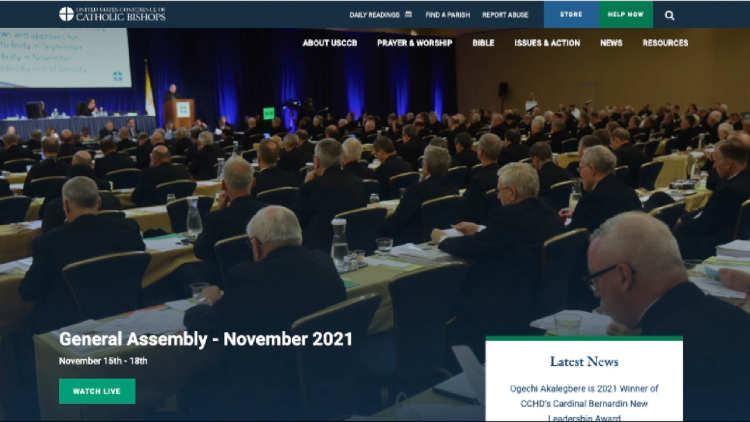
The USCCB holds its Fall Plenary from 15 to 18 November 2021The USCCB holds its Fall Plenary from 15 to 18 November 2021 

Card Mahony encourages US bishops to take the ‘pathway to constructive dialogue’

The United States Conference of Catholic Bishops gathers from Monday to Thursday in Washington, D.C., for its Fall Plenary meeting. In an interview with Vatican News, Cardinal Roger Mahony sheds some light on a document on the Eucharist that is on the agenda.

By Sr. Bernadette Reis, fsp

The Mystery of the Eucharist in the Life of the Church is the title of a document on which the Bishops of the United States will vote during its Fall Plenary this week. This document sparked debate among the Bishops themselves during their plenary meeting in June.

In September, Cardinal Roger Mahony, Archbishop emeritus of Los Angeles, wrote a letter to his brother bishops expressing his thoughts on the proposed document. In an interview with Vatican News, the Cardinal helps us understand the causes of some of the debate over this document.

Your Eminence, back in September, you sent an open letter to your brother Bishops regarding the proposed document on the Eucharist that will be discussed by the USCCB during its plenary beginning on Monday. Can you tell us your thoughts on the proposed document in its present draft?

I think it's unfortunate that we're even having this document before us because recall this topic came up at the Ad limina visit we had last January 2020 before Covid hit. The Holy Father, of course, is always, always looking for the path of encounter and dialogue to deal with issues like this, especially among the Bishops. And then Cardinal Ladaria, Prefect of the Congregation for Doctrine of the Faith, sent a quite lengthy letter to the Bishops of the United States, at the Holy Father’s urging, in which he outlined the process for us to go through. It was a wonderful three-step process in that letter, in which we would meet regionally for maybe 2 or 3 days together. And really come to know each other, to understand what was going on, what our differences were. We didn't do that because of Covid. If we had done it I think we would be in a far different situation. And if we had really had this honest dialogue among ourselves and got to understand each other's positions and then acted as the communion of Bishops with our unity, we could have found a path forward. I believe we would have decided we do not need this document.

Remember this document was intended primarily to go after and penalize Catholic legislators. However, the Holy See reminded us that the Bishops’ conference has no power to mandate something binding on every bishop and every diocese in the country or any country without being approved by the Holy See. The document of any kind should be at the very end of the process. That's why I am so unsettled about this document that we have before us.

First of all, this document is totally unnecessary because at our June meeting we also approved a path forward for Bishop Andrew Cozzens and his Committee on Evangelization, which will begin after the holidays – a two-year intensive program of revitalization through the Eucharist ending in 2024 with a National Eucharistic Congress. So, we already have in place this important piece. I think the document as we have it is being passed just as we come up on the holiday season, no one is going to read, it is not something that can be put into a pamphlet form of teaching document. It will never have any impact because, right after the holidays, we’re getting into this Eucharistic Revival, which is what we should be doing in the first place. 


You’ve brought up the fact that the original debate that the document sparked was definitely about the fact that it was concentrating perhaps on targeting a message to pro-choice politicians and yet Catholics in the United States and other places in the world have had to endure a lot of revelation about scandalous behaviour regarding priests and Bishops. Why haven't we heard something similar against these grave sins against communion?

Precisely. First of all, we are a democratic republic. Our country’s path is one of separation of church and state. And so, it’s a very difficult position for politicians, Catholics, who are pressured by some in the Church to make all of the decisions based on Catholic Church doctrine. That is very difficult, it’s almost impossible. If you would want to say that any elected Catholic, or any Catholic judge who at any time has ever voted for or issued a decree or a judgment in any way whatsoever that somehow allowed abortion in some form or another, you have got maybe hundreds of thousands of people right there. That is simply unworkable in a democratic republic.

What I think we have failed to do is realize the good faith of our Catholic legislators. And I was thrilled on June 18th, 60 Catholic Members of Congress, issued a statement of principles. I read it through two to three times, and I said, “This is us! This is the Church!” They want to collaborate with us in many ways and they gave a whole list of ways we could collaborate beginning with reducing as much as possible the need for abortion and the occurrence of abortion. When I read it, I said, “This is the pathway to constructive dialogue. They want to help us in their rule to do what we want to do. And it’s amazing! And so, it prompted me to do an open statement to my brother bishops because no one's ever heard of this and it’s precisely the constructive dialogue that Pope Francis insists. And they started it. They gave us the open door. And they quoted heavily from Church teaching. But their sincerity, their desire to work together with us was astounding. And I just hope instead of worrying about documents, we enter into the dialogue and start working with them.


That goes back to the synodal process that the Holy Father is offering to the church at this time. Again, talking about the Sacrament of Eucharist as communion among believers. It seems that those believers who find themselves in high levels of government in the United States are willing to sit down and talk. So how can we encourage the building up of this type of communion in order to avoid the division that seems to be caused?

In the synodal process that we are now beginning, what is the number one thing the Holy Father has in all those documents? Listening to each other. Reflecting. Discernment. What a wonderful vehicle. And we haven't done that. And so to be honest with you, I don't see anything is going to happen with this document or next week in Washington, D.C., that is going to bring about this unity. I think what’s going to happen is we will pass this. Hopefully, we will accept the offer of the Catholic Congress members and move forward with them after the holidays, with the new Eucharistic revival. And those elements will bring together the unity and communion that we all want.

Saturday, November 13, 2021

USCCB, Biden, Pelosi and the media


The US Bishops and the Communion Controversy: Blame Biden, Pelosi and the Media

EDITORIAL: The fault lies with the news media that continually misrepresent the matter — and, even more, with Joe Biden, Nancy Pelosi and the other prominent Catholic politicians who continue to scandalize the faithful by their Eucharistically incoherent support for legal abortion.


The U.S. bishops will gather Nov. 15-18 in Baltimore for their annual fall assembly. There, it’s virtually certain that the issue of Catholic politicians who promote abortion rights and also insist on receiving Communion will once again dominate the secular media’s coverage of their discussions. Staff writer Lauretta Brown previewed the meeting.

Yet it’s not the bishops who are forcing debate of this issue at the assembly. The problem has been generated by these wayward politicians’ obstinate refusal to reform their consciences and to repent of their support for the evil of abortion — a scourge that has been responsible for the deaths of more than 60 million innocent unborn babies in the half-century since abortion was legalized in the United States. 

Moreover, as has been documented many times over in these pages during the course of this year, it’s impossible to avoid the matter in light of the actions of the two most prominent Catholic politicians in the nation, President Joe Biden and Speaker of the House Nancy Pelosi. 

Since Biden became president in January, aided and abetted by Pelosi’s actions in Congress, he has sought to push forward the Democratic Party’s current pro-abortion agenda, which is far and away the most extreme expansion of the so-called right to abortion in our nation’s history. 

Neither Biden nor Pelosi has had the slightest compunction about continuing to advertise themselves as being devout, Mass-attending Catholics, despite their profound political breach with the Church’s teaching about what the U.S. bishops call “the preeminent moral issue of our time.” In October, both politicians made a point of traveling to Rome to meet with Pope Francis to parade their Catholic credentials, highlighting areas where their political perspectives do align with the Church’s, while ducking away from the efforts of faithful Catholic media outlets to question them about why they are ignoring the Holy Father’s repeated characterizations of abortion as a form of murder.

Clearly, by their own actions, Biden and Pelosi — along with other U.S. Catholic politicians who similarly push for the advancement of legal abortion and yet present themselves for Communion — are forcing our bishops to address their lack of Eucharistic coherence. That’s why the bishops’ conference has reinitiated the discussion.

Secular news media continue to circulate the canard that it’s the bishops who are “obsessing” over the issue, when it’s obvious for anyone with eyes to see and ears to hear that it’s the fault of these Catholics in public life who have so egregiously placed themselves outside of communion with what their Church proclaims about the sanctity of life, which includes the unborn. 

The truth is, the bishops plan only to include a relatively small component addressing the worthiness to receive Holy Communion in a new document on the Eucharist that will be debated and then voted on in Baltimore. The document is called “The Mystery of the Eucharist in the Life of the Church,” and it has been crafted by the USCCB’s doctrine committee in conjunction with the evangelization committee’s proposal to launch a three-year National Eucharistic Revival. 


During the assembly, the bishops will also vote on the plans for the revival. It’s an initiative that is urgently needed, in light of recent polls that show a majority of U.S. Catholics have major misunderstandings about this central sacrament of our faith. 

As always, there are a number of other significant USCCB proposals that the bishops will discuss, including an update of their “Socially Responsible Investment Guidelines”; a discussion of the implementation of the Committee for Pro-Life Activities’ “Walking With Moms in Need” initiative, which aims to mobilize parishes and dioceses in support of expectant mothers who are facing difficulties in their pregnancies; and a new pastoral framework for marriage and family ministry that’s drawn from the Pope’s 2016 apostolic exhortation Amoris Laetitia (The Joy of Love). Given the scope of these discussions, it should be clear the bishops are responding constructively to a broad range of pastoral needs, not fixating narrowly on the issue of Catholic politicians and reception of Communion.

Another falsehood that continues to be propagated by secular media outlets that align with the abortion lobby is the claim that the bishops’ conference intends to reignite the so-called “wafer wars” by advising local bishops that they are obliged to deny Communion to obstinately pro-abortion public officials. In fact, there is virtually no chance this will happen; the discussion in June and a draft of the Eucharistic document have clearly communicated such actions will remain at the discretion of individual diocesan bishops.

In fact, the draft indicates the U.S. bishops will be less specific in their document than was the Latin American bishops’ 2007 Aparecida document, which was drafted under the leadership of then-Cardinal Jorge Bergoglio of Buenos Aires. It stated forcefully, “We must adhere to ‘Eucharistic coherence,’ that is, be conscious that they [i.e., legislators, heads of government and health professionals] cannot receive Holy Communion and at the same time act with deeds or words against the commandments, particularly when abortion, euthanasia and other grave crimes against life and the family are encouraged.” 

The point is that these politicians are the ones who need to discipline themselves to stay away from the Communion line, since they can have no legitimate excuse any longer for insisting that their “pro-choice” position is acceptably Catholic.

Maybe it’s too much to hope that such Catholic politicians will ever be swayed by a medicinal correction regarding their support for legal abortion. But don’t criticize the bishops if the issue of reception of Communion does overshadow the other things on the agenda at the meeting in Baltimore. The fault lies with the news media that continually misrepresent the matter — and, even more, with Joe Biden, Nancy Pelosi and the other prominent Catholic politicians who continue to scandalize the faithful by their Eucharistically incoherent support for legal abortion.

Tuesday, November 9, 2021

Eucharistic revival coming to the USA


Meet the Catholic leader planning a Eucharistic revival in the US


After the publication of a survey that found a majority of Catholics don't believe in the Real Presence, Bishop Andrew H. Cozzens will present details on his multi-year plan at this month's episcopal meeting.

Bishop Andrew H. Cozzens was recently named bishop of Crookston, Minnesota, an area of the country that’s mostly known for its sugar beet farms.

While Bishop Cozzens might be heading for a diocese that, for many Americans, is in the middle of nowhere, he is central to a discussion taking place among the 432 Catholic bishops of the United States. That discussion, it is hoped, will lead to a renewed faith in and love for what is central to the life of the Church: the Eucharist — the sacrament established by Jesus Christ as an eternal memorial of his death and resurrection and his presence in creation. 

In addition to his duties as bishop of Crookston — he’ll be installed there on December 6 — Cozzens is one of two U.S. bishops who head committees working on the so-called “Eucharistic revival” in the U.S. Cozzens is chairman of the United States Conference of Catholic Bishops’ Committee on Evangelization and Catechesis, while Bishop Kevin C. Rhoades of Fort Wayne-South Bend, Indiana, also working on the multi-year effort, chairs the USCCB’s Committee on Doctrine.

Aleteia emailed Bishop Cozzens some questions about the joint work of the committees, as well as his view of an apparent trend among young Catholics favoring Eucharistic adoration [Read that story here]. The bishops began work on a Eucharistic revival in part because of a 2019 Pew Research survey suggesting a dramatic decline in belief among Catholics concerning the Eucharist. While Pew’s methodology has been questioned by some Catholic experts, its findings included the fact that only a quarter of Catholics under 40 believe in transubstantiation, the doctrine that when a priest consecrates the bread and wine at Mass their substance is changed into the substance of the Body and Blood of Christ.

Bishop Cozzens said that the Eucharistic revival is “counting on young people and all who are already on fire with love for the Eucharist.” The interview follows:

Bishop Cozzens, as you and your fellow bishops consider ways to revive devotion to the Eucharist among Catholics in the U.S., it’s been pointed out that there is growing popularity among young people for Eucharistic adoration. What have you observed in this regard? Is this devotion significant among young Catholics? Do you find it to be growing? What have you seen out there?

Yes, adoration is a very popular devotion among young adults who are active in their faith. It is sometimes a preliminary step for anyone who may not be actively practicing the faith. Most places that gather young adults or university students for adoration are in a way reaping the fruits of youth ministry, summer camps, and youth conferences where adoration is not only practiced but held as a revered way of encountering the Lord. Parishes and diocesan entities with perpetual adoration or holy hours are modeling for young people the beautiful action of spending time with Jesus in the Eucharist. And many bishops have mentioned to me the connection they see between adoration and vocations. Many young people who learn to spend time in adoration of the Blessed Sacrament also learn to listen to his voice, and that voice sometimes calls them to give their lives entirely to him.

As Catholics, we know that the celebration of the Eucharist, or Mass as it is often referred to, is the ultimate prayer; it is the source and summit, as we say. But the Eucharist is such a profound mystery that we need to spend time in adoration to receive all this mystery has for us, especially to open our hearts and minds to Jesus Christ and learn to respond to him fully with our hearts. Adoration opens the heart and mind to receive and respond to the gift of the Mass by allowing our hearts to receive the graces of the previous one and increasing our receptivity for the next one.  

If Eucharistic adoration really is growing among young Catholics, why might this be? How did this come about? In 2019, a Pew survey reported significant disbelief of transubstantiation among Catholics under 40. If Eucharistic adoration is growing in popularity among this group, that would seem contradictory.

There are many reasons why young Catholics attend adoration, and each reflects how the Holy Spirit is working in one’s life sometimes without that person even realizing it. A very popular reason that some attend adoration is it is something their friends are doing, an invitation. The Gospel spread through word of mouth and this devotion continues to spread one person at a time, through personal testimonies. A person can receive an invitation, a testimony, to attend from anyone but when a friend extends that invitation and witness, it has a greater depth. As young people invite each other to adoration, the experience spreads to others. Many explain that they find peace in adoration, freedom from the distractions of the modern world, space to allow their soul to breathe and experience his love. Ultimately, young people are going to adoration because they find Jesus waiting for each of them.  

It is normal when you are young to seek answers to the questions of life, like “Who am I?”, “What is the purpose of my life?” and “Why is there suffering?” Young people can find innumerable answers to those questions online or in the culture. For those who let Christ in the Eucharist pursue them, His answers do not disappoint. Since Jesus in the Eucharist “fully reveals man to himself” [Vatican II, Gaudium et Spes], young people are going to Adoration because the answers to their questions that the world provides fail to satisfy. In adoration, they not only find compelling answers; they discover who they are, and the One who loves them. As Pope Francis says, they learn to see themselves in the gaze of Jesus.

Even though the Pew study showed that most Catholics don’t believe in the real presence, it is clear that still significant numbers of Catholics are discovering the truth and beauty of this teaching. And those who do believe are perhaps more committed to the truth than the generation before them, especially among young adults. To be a believing young adult today requires someone to go against the tide of the culture, and this requires being strong in one’s faith. 

Has your planning for a national Eucharistic revival included consideration of this apparent popularity among young people for adoration? Are you thinking of leveraging that in some way, and if so, how?

Planning for the revival is exciting as we engage different people, and the enthusiasm and momentum grows, and the revival is counting on young people and all who are already on fire with love for the Eucharist. The first phase will be to energize the base. Those who are already attending adoration and/or Mass will be invited deeper to allow the fire of the Holy Spirit to permeate every part of their life and over time to consider how to reach out to those who are not as involved and later the people on the margins. 

As a bishop, I take great joy in knowing that many young people are already attending adoration. We look forward to fostering encounters so that the current young adorers can grow in their relationship with God, awakening a deeper sense of their Baptismal call to go out, and eventually become missionaries. This does not necessarily mean [going] to the other side of the world, but it may mean at work, in the gym, in the local community, and even at home. To share the Gospel may not be an effective entry point today with someone who thinks they have already heard it, but if a young adult simply shares the peace she’s found in adoration and invites a friend to come along, it literally transforms hearts. For those not ready to hear that simple testimony, the testimony of a life transformed by a living relationship with Jesus in the Eucharist is still a powerful witness. 

Would you give me an update on the work for this revival. What’s the latest with the plans, and what are the next steps? What specifically will be discussed at the U.S. bishops’ fall generally assembly this month?

The revival is in its planning year and there are many great and exciting initiatives being developed. The first year will focus on those who are currently most engaged; the second year, on inviting those who are less engaged but practicing. And the third year will focus on reaching out to the disaffiliated or those on the margins. 

One of the topics on the agenda for discussion and vote at the U.S Bishops’ meeting is a national event in 2024, which has the potential to gather close to 100,000 people to express our faith in the Real Presence of Jesus in the Eucharist and the importance of Sunday Mass. During the meeting, I will give a presentation to my brother bishops and invite discussion on it, and then we will vote on it. I see the national event as an essential part of the revival to send the missionaries to the peripheries. Please keep the vote as well as the ongoing work of the Revival in your prayers, that what we will do will bring many people back to the heart of Christ in the Eucharist!