Showing posts with label Catholic University. Show all posts

Monday, May 13, 2024

He plays Jesus on "The Chosen"; he addressed graduates at Catholic University


‘The Chosen’ star Jonathan Roumie urges Catholic University grads to emulate Christ


Tyler Arnold

Actor Jonathan Roumie, who plays Jesus Christ in the popular television series “The Chosen,” encouraged graduates at the Catholic University of America (CUA) to emulate Christ and strengthen their prayer lives during the university’s commencement ceremony Saturday morning.

“Last time I spoke [to] a crowd this big, there were loaves and fish and baskets of them,” Roumie joked, referencing the Sermon on the Mount. “So many leftovers.”

Roumie headlined the commencement ceremony for CUA graduates held on the lawn of the Basilica of the National Shrine of the Immaculate Conception in Washington, D.C., which sits adjacent to the university.

The actor was also awarded an honorary doctorate in fine arts for his work evangelizing through his acting career.

The speech focused on three main points: emulating Christ, praying more, and surrendering oneself to God. These subjects, he said, are “concepts I wish I had heard upon graduating college myself.”

“You don’t need to play Jesus for the world in order to be Jesus to the world,” Roumie told the crowd of graduates. 

“I’ve realized that just because I play Jesus on a TV show doesn’t mean I can or I should stop being Christ to everyone I know when the cameras turn off, and neither should you,” he said.

“Just because you’re not an actor playing Jesus or a priest or a nun doesn’t mean you’re not meant to represent him at all times, wherever you go.”

Roumie said this does not mean “God is expecting perfection from you,” but that “you must endeavor to preach the Gospel by the life you live, by your actions and [by] the choices you make.” 

He said, as Catholics, this includes “the political positions you take and the advocacy for the causes you champion,” such as “defending life at all stages.”

His second message to outgoing students was to “pray more.” He referenced the First Epistle to the Thessalonians, in which St. Paul instructs the faithful to “pray without ceasing.” 

The actor said that “the era we’re living in demands a revolution of deep prayer.”

Roumie, who also partners with the Catholic prayer app Hallow to guide people through prayers and meditation, noted that regular access to the sacrament of reconciliation, followed by Mass and receiving the Eucharist, has been essential to him in preparing for his role in “The Chosen” and is important for everyone in following Christ. 

“By this, I’m granted peace,” Roumie explained. “I’m given wisdom in areas of my life experiencing conflict beyond my human understanding, and I’m strengthened to go forward and handle situations I’m otherwise overwhelmed by.”

Roumie emphasized “the power of prayer” and the intercessory role of the Blessed Virgin Mary and all of the angels and saints. 

In his speech, the actor also discussed the importance of “surrender” and recognizing that “you’re not in charge; God is.” 

Roumie noted that before his role in “The Chosen,” he had been struggling to find success as an actor and faced serious financial hardships. He said he surrendered all of his hardships to God: “I dropped to my knees and I poured myself out to the Lord and surrendered everything to him, saying, ‘I can’t do this without you.’”

“I would not be standing with you here today if God had not brought me to my knees in utter desperation to surrender my entire life and more specifically my career over to him — something I hadn’t even considered before,” the actor said. 

“It’s the hardest thing that I’ve ever done, but the greatest thing that has ever happened to me,” Roumie said. “And it will be the most life-changing thing that will ever happen to you if you allow it, especially at this point in your young lives.”

About 1,300 students graduated from the university on Saturday.

Four other attendees also received honorary doctorates: Father Piotr Nawrot, a priest of the Divine World Ministries who rediscovered and reconstructed 13,000 pages of music of the Moxo and Chiquito tribes; John Finnis, a Catholic legal and political thinker; Teresa Pitt Green, the co-founder of the Healing Voices magazine; and Rabbi Jack Bemporad, who has authored several books on Christian and Jewish relations and is the founding director of the Center for Interreligious Understanding.

Friday, May 3, 2024

Pope Francis: Catholic education needs to illuminate the student with the presence of Jesus


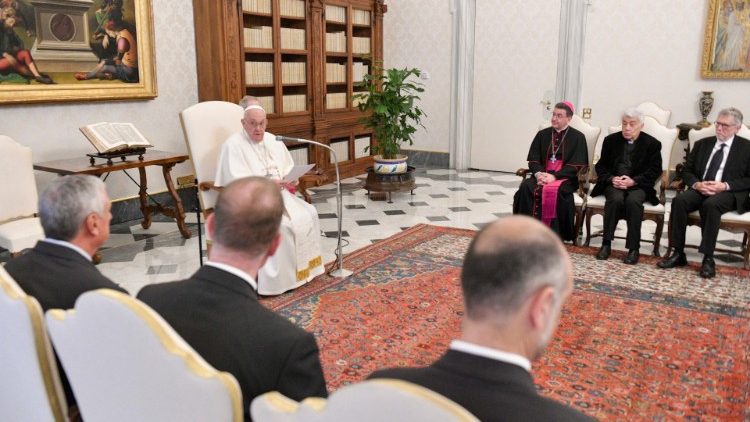
Pope Francis meets with the Blanquerna Foundation in the Vatican's Apostolic PalacePope Francis meets with the Blanquerna Foundation in the Vatican's Apostolic Palace  (Vatican Media)

Pope: Education must form people, not offer impossible ideals

Pope Francis meets with members of the Blanquerna Foundation from Barcelona, and urges Catholic universities to provide education that helps people form their minds and hearts, without seeking to create “illusory replicas of impossible ideals.”

By Devin Watkins

“How much pain and frustration are produced by the unattainable stereotypes that markets and pressure groups try to impose on us.”

Pope Francis offered that analysis of modern life on Friday as he met with members of the Blanquerna Foundation at the Ramon Llull University, in the Spanish city of Barcelona.

In his address, the Pope noted the foundation’s name—Blanquerna—was drawn from a literary character created by Blessed Ramon Llull, a 13th-14th century philosopher and theologian.

Blessed Ramon Llull employed the character to give a “precise description of his time,” said the Pope, adding that his pedagogy continues to uphold a model of Christian life.

The Holy Father said Blessed Llull moved away from the “fantastic heros who seek to evade our reality” and instead proposed “simple and natural life models, in which one can serve the Lord and be happy.”

Christian path is call, not a career

Pope Francis noted that young people today, as in the 13th century, must overcome many obstacles to discover God’s plan for them.

“Your foundation, and the entire Ramon Llull University, by taking this name, assumes this exciting commitment,” he said.

The Blanquerna Foundation, he added, works to help the family rediscover its original vocation in society, offer young people different paths of life and overcome challenges, and teach society that the path of a Christian hero is “not marked by careerism but is a response to a call.”

The Pope invited university professors to help students realize that even when they have achieved their goals, they must still “strive for an encounter with the Lord and dedicate themselves fully to service of God.”

Educate based on analysis of reality, not escapism

The Holy Father urged the Blanquerna Foundation to educate, “with a contemporary, modern, agile, pedagogical language, based on a precise analysis of reality.”

However, he added, education must “always bear in mind that we form full men and women, not illusory replicas of impossible ideals.”

The goal of education, said the Pope, is to form “holistic people who try to give the best of themselves in the service to which God calls them, knowing that they are pilgrims, that in reality everything is a path towards a goal that surpasses this reality, the meeting of the friend with the beloved, in that love poured into our hearts that gives us the strength to move forward.”

Illuminating presence of Jesus in education

In conclusion, Pope Francis expressed his hope that Catholic universities might “illuminate the lives of your students with the presence of Jesus.”

“May this certainty,” he prayed, “make them aware of their dignity as friends, of God and other people, and that they are capable of dispelling the darkness that covers this world estranged from its true essence.”

Wednesday, January 31, 2024

Catholic University professor fired; what was she thinking?


Catholic University fires professor who hosted ‘abortion doula’ in class


The Catholic University of America has dismissed one of its professors for bringing an abortion advocate to class to speak to students.

A Tuesday email from the school’s president, Peter Kilpatrick, obtained by CNA said that the school began an investigation last week after learning of reports of an abortion advocate being invited to a class. The president said the school also learned that a student had an audio recording of the class in question.

The Daily Signal, which obtained and released a copy of the recording last week, identified the psychology professor as Melissa Goldberg.

“Now that we have clear evidence that the content of the class did not align with our mission and identity, we have now terminated our contract with the professor who invited the speaker,” Kilpatrick wrote on Tuesday. 

Goldberg’s faculty page was no longer available on the university website as of Tuesday afternoon.

“As a Catholic institution, we are committed to promoting the full truth of the human person and to protecting human life from conception to natural death. In our rigorous pursuit of truth and justice, we engage at times with arguments or ideologies contrary to reason or to the Gospel,” he wrote. 

“But we do so fully confident in the clarity given by the combined lights of reason and faith, and we commit to never advocate for sin or to give moral equivalence to error,” Kilpatrick added. 

“As witnessed by the life and virtue of St. Thomas Aquinas, whose feast we just celebrated as a community, such engagement with opposing ideas helps us both to grow in our command of truth and to respond to error with empathy, compassion, and mercy.”

According to the Daily Signal, which spoke to a student who was part of the lecture, Goldberg invited Rachel Carbonneau to the class on Jan. 23. Carbonneau, the founder and CEO of the doula company Family Ways, spoke to the class about working with women who have elective abortions and abortions that are “for medical reasons,” according to the recording.

Doulas are most commonly associated with providing emotional and physical support to women prior to, during, and after birth, though a range of doula services exist for events such as death or miscarriage.

Discussing abortions, Carbonneau in the recording said that the “goal for a lot of providers is to try to perform the abortion before the baby’s nerve endings are formed. So the goal is to do it at a time when the baby is not going to feel any pain.” 

Carbonneau also discussed what she called “the risk to the birthing person” including “a risk of hemorrhage and a risk of [a] baby that’s not going to survive, and the conversation to have with her older children about why she’s been pregnant and now there’s no baby.”

“There are a lot of pieces to these puzzles, emotionally and socially,” she said. 

When asked by a student to expand on her use of the term “birthing persons,” Carbonneau said that she works with clients who identify as transgender. “Birthing person” is a term transgender advocates often use to avoid gendered language such as “woman” or “mother.”

Kilpatrick said in his letter this week that “at Catholic University, we have the unique opportunity and common blessing to pursue truth, to grow in faith, and to exercise charity. Our studies aim at producing wisdom, which includes excellence in living and sharing the truth with others.”

“May our common study help us to understand life, to love goodness, and to promote and protect the dignity of the human person,” he wrote.

Wednesday, April 19, 2023

Catholic Universities and Colleges receiving phone threats


Phone-In Active Shooter Threats

At Catholic Universities, Other Colleges 

Part Of ‘Swatting’ Trend


(OSV News) — Shelter-in-place orders were issued April 13 at two Catholic universities in Washington, with all-clears declared shortly thereafter, as part of an apparent wave of false threats made against schools throughout the nation the same day and in recent weeks.

At 10 a.m. April 13, the D.C. Metropolitan Police Department received a 911 call alleging “an active shooter on campus,” Brianna Burch, MPD public affairs specialist, told OSV News.

MPD police informed CUA’s public safety department immediately, both in person and by radio, according to a university statement provided to OSV News by Daniel Drummond, CUA’s associate vice president of communications.

The first shelter-in-place alert was sent to the campus community at 10:07 a.m. through Rave, an emergency mass communications platform used by a number of institutions and municipalities. Several additional alerts were subsequently sent out during the event, advising recipients to continue sheltering in place as the search continued, according to the university.

MPD and CUA public safety officers conducted a “systematic search” of the campus buildings and locations, as an MPD helicopter also flew overhead, searching for any active threats, the university said in its statement. After “an exhaustive search of the campus, no threat was found by MPD or DPS,” the university stated, with an “all clear” alert sent out at 11 a.m.

“I thank God for keeping this campus safe today, for our community, and that we quickly came together in response to what turned out to be a call by someone making a false report of a threatening situation at our campus,” said CUA President Peter Kilpatrick in a statement emailed to the university community and families of students.

All classes at the university were canceled for the remainder of the day. CUA also made counseling resources available through its campus ministry, counseling center and Office of the Dean of Students.

Trinity Washington University, located about a mile from CUA, also was placed on a brief lockdown after the MPD received a call about an active shooter at that school.

“The police received the call at about 9:50 a.m.,” Trinity President Patricia McGuire told OSV News. “I was informed about five minutes later and we put out our campus alert.”

McGuire said an all-clear was soon declared and classes resumed, although students were excused if needed, she said, adding the “counseling staff was made available to them.”

“There’s a lot of anxiety about gun violence,” she said. “Some handle it really well, and others cannot deal with the stress.”

Trinity nursing student Indya Fleet said she was still rattled after the lockdown was lifted.

“I was pacing around in my room, like, what do I do?” Fleet told the Trinity Times on campus. “The first thing I did was call my mom. She was telling me to just stay put: ‘Stay there. If you want to come home, come home, after they clear it.’ I was scared.”

Shelter-in-place alerts also were issued April 13 at several schools in Texas, including Baylor University in Waco, Collin College in McKinney, Del Mar College in Corpus Christi, Galen College of Nursing in San Antonio and Texas Wesleyan University in Fort Worth. Threats at all of the schools proved to be false.

On April 12, the Illinois State Police issued a press release stating that local law enforcement in 19 counties had reported a total of 21 calls with threats towards schools, all of which turned out to be unfounded.

The ISP said schools in Illinois and across the country were experiencing increased incidents of swatting — the practice of making false emergency calls to provoke a response from law enforcement, such as a SWAT (special weapons and tactics) team.

“While state and national intelligence agencies have seen a pattern of these fake calls, each call is taken seriously,” said the ISP release.

Senate Majority Leader Chuck Schumer, D-N.Y., called on the FBI to investigate and crack down on swatting, following a March 30 wave of 36 such threats that affected 226 schools across New York state.

Pointing to recent swatting incidents at K-12 schools in Massachusetts, Pennsylvania, Iowa and other states, Schumer said a larger trend may be at work, one involving foreign actors possibly seeking to cause disruption, target specific groups or test law enforcement’s response.

“The bottom line is that Americans need to know who is committing these attacks,” Schumer said, adding that “ensuring that criminals know that if they commit these heinous acts that they will be held accountable is one of the strongest deterrents.”

“That starts with making sure the FBI has the resources it needs (to) bring people to justice swiftly,” he said, “and that the data is being collected to curb this unique disturbing trend.”

Gina Christian is a national reporter for OSV News. Follow her on Twitter at @GinaJesseReina. Miriam Barcenas, a correspondent for Trinity Times, contributed to this report.

Wednesday, October 19, 2022

Catholic Project study reveals Priests trust in Bishops has eroded


Study reveals priests’ trust in bishops has eroded


A new study released today by the Catholic Project at the Catholic University of America reveals a deep crisis in priests’ confidence in the leadership of the U.S. bishops. Overall, only 24% of priests across America express confidence in the “leadership and decision-making” of the bishops.

The new research initiative, titled the National Study of Catholic Priests, is based on 3,516 responses from 10,000 diocesan and religious priests. Stephen White, director of the Catholic Project told Our Sunday Visitor: “The goal of this study is to better understand how our priests are doing.” “In particular,” White continued, “we wanted to better understand how the abuse crisis, and the Church’s response to that crisis, has affected trust between priests and bishops.”

In an early letter of support for the project, Cardinal Wilton Gregory of Washington and Cardinal Timothy Dolan of New York write, “[The study] is an ambitious project with the goal of ascertaining the overall well-being of the American presbyterate with a particular emphasis on how the two decades since the Dallas Charter have affected relationships and trust between priests and bishops.”

Perhaps surprisingly, overall priests report remarkable well-being. Using the Harvard Flourishing Index — a comprehensive quantitative measurement index — the study found that on average, priests scored 82 out of 100. This average, the study reports, is “relatively high in comparison to the general population.” One priest said in an interview conducted by the study, “I feel remarkably fulfilled in my life as a priest. I mean, just being able to minister to people, being able to love them. Being able to be Christ for them. It’s just, it’s such a beautiful life.” Despite finding “ample evidence” of “challenges and stress,” only 4% of priests report considering departing from ministry.

One of the most significant findings of the study is the disparity of burnout indicators between diocesan and religious priests. “Our study finds that 45% of priests report at least one symptom of ministry burnout, which is unevenly distributed between diocesan (50%) and religious (33%) priests, and only 9% exhibit severe burnout,” an initial report says.

The study found another disparity between religious and diocesan priests: trust in leadership. While 67% of religious priests express confidence in their major superior, fewer than half (49%) of diocesan priests express trust in their own diocesan bishop. This factor of trust significantly impacts priests’ well-being. The study found that “An erosion of trust between a priest and his bishop is associated with an 11.5% reduction in that priest’s level of well-being.”

According to the new survey, 90% of priests “see their dioceses as having a strong culture of child safety and protection.” Since the adoption of the Dallas Charter, the 2002 national policy implemented by the U.S. bishops for the protection of minors, a culture of fear has grown among priests. In the present climate, the study found that “82% of priests regularly fear being falsely accused of sexual abuse.”

Furthermore, in the case of a false accusation, only 36% of diocesan priests report that they would be provided with sufficient resources by the diocese to defend themselves in court. Only 51% of diocesan priests believe they would have the support of their diocesan bishop in such a case. Again the discrepancy between religious and diocesan priests is significant, since 85% of religious priests believe they would be given sufficient resources for legal defense and 86% report that they believe they would have the support of their major superior.

Going forward, the study concludes by proposing three significant steps to improve priests’ trust in the bishops. First, priests report desiring a father figure, rather than an administrator. While 70% of bishops reported seeing themselves as a father to their priests, only 28% of priests report they consider their bishop a father. Second, priests desire great transparency around processes like making assignments and the review process for allegations of abuse. And finally, priests desire to see bishops held accountable in order to rebuild trust with priests and laity alike.

“Every Catholic I know, from the lay faithful to the bishops, wants to support our priests,” says White. “To do that well, we need to better understand both how priests are flourishing and how they are struggling. My hope for this study is that it will help do just that.”

Saturday, May 12, 2018

Archbishop Gomez tells Catholic University grads to tell a new story

Facing a divided America, LA prelate calls on youth to ‘tell a new story’

Facing a divided America, LA prelate calls on youth to ‘tell a new story’
Archbishop Jose H. Gomez of Los Angeles, who is vice president of the U.S. Conference of Catholic Bishops, gives the closing keynote address Jan. 19 at a Vatican-sponsored conference on mass migration and humanitarianism at the University of California in Los Angeles. (Credit: CNS.)
Archbishop Jose Goméz urged the 2018 graduates of the Catholic University of America to tell the story of "a new America."
NEW YORK - Archbishop José Gomez of Los Angeles said Saturday that the U.S. is facing a “crisis of identity,” more bitterly divided and anxious than he has ever witnessed, and he called on college graduates “to tell a new story for a new America.”
“I know that many of you feel the way that I do - that our great nation is losing her way,” Gomez said, while delivering the commencement address at the Catholic University of America.
As the head of the largest and most diverse Catholic diocese in the United States, Gomez urged graduates to rediscover and tell anew the story of America’s founding, one that has not always been pure, yet one that is still defined by “American holiness and heroism.”
On Saturday, Gomez recalled Pope Francis’s 2015 visit to the grounds of the Catholic University of America, where he canonized St. Junípero Serra. Not only did it mark the first time a Catholic had been canonized on American soil, but also it was a bold statement by Francis to cement the legacy of Serra as one of America’s founding fathers.
“It is interesting to think: St. Junípero Serra never even saw Washington, D.C.,” Gomez reflected. “He was a Hispanic missionary who came up from Mexico to preach and build in California. And he never left there. The United States of America was not even established as a nation until the final years of his ministry.”
Even so, Gomez said, America’s founders, including Serra, “dreamed of a nation where men and women from every race, religion and national background could live in equality. As brothers and sisters, children of the same God.”
In order to reclaim that vision, Gomez urged graduates to remember the “mystics and missionaries; martyrs and immigrants; refugees and exiles” that have kept the country’s founding vision alive.
“There are indigenous saints, such as Black Elk, the Lakota Sioux mystic and Catholic catechist. There are freed slaves such as Father Augustus Tolton, our country’s first black priest,” he said.
“The litany of American saints goes on and on, and it includes servants of the poor such as the Creole saint Henriette Delille and Mother Marianne Cope who served the lepers; there are artists and activists such as Dorothy Day and Thomas Merton,” Gomez continued.
In the same manner in which Francis used his 2015 address to the United States Congress to highlight the particular lives of great Americans - Catholic and non-Catholic alike - that have given lived witness to the promise of America, Gomez added that “the saints I know best are in my Catholic tradition. But there are American saints in every faith tradition, and in every family and every neighborhood.”
“They are the hidden saints, saints of the everyday,” he continued. “Holy wives and holy husbands, working hard to do what is right, sacrificing for their children; being good friends and good neighbors; serving the poor and working to make their communities stronger.”
Gomez said that the story of a “new America” would begin with lives of sacrifice for others.
“America’s founders - the missionaries and the statesmen - they knew this truth,” he said. “They knew that we belong to a story that began long before us, the story of our Creator.”
In a nod to the national debate over immigration, where Gomez has long been among the leading champions of immigrant rights among the U.S. bishops, he added: “They knew that we are born with a dignity and a destiny that can never be denied. No matter who we are. Or where we came from. Or how we got here.”
Gomez, who is an adult immigrant to the United States from Mexico, was also conferred an honorary doctorate by the University, for his long-standing advocacy of immigrants and “especially efforts to keep families together and support Dreamers.”
“Dear graduates, now it is your turn to hold these truths and to tell them to a new generation,” Gomez said on Saturday.
In a final summation that wove together Abraham Lincoln, Emma Lazarus, and the Declaration of Independence, Gomez insisted, “the American story is not over yet. It continues in you and in me.”
“We can still rely on the protection of divine Providence. We can still open our door with confidence to people who are yearning to breathe free. We can still practice a politics with malice toward none and charity for all. We are made for greater things,” he concluded.
The Catholic University of America is the national university of the Catholic Church - the sole institution of higher education to be founded by the U.S. bishops.