reflections, updates and homilies from Deacon Mike Talbot inspired by the following words from my ordination: Receive the Gospel of Christ whose herald you have become. Believe what you read, teach what you believe and practice what you teach...
Showing posts with label Cardinal Wilton Gregory. Show all posts
Showing posts with label Cardinal Wilton Gregory. Show all posts
Cardinal Robert McElroy took over leadership of the D.C. archdiocese on Tuesday, bringing a well-known advocate for immigrant rights to one of the most prominent posts in the U.S. Catholic Church.
More than 3,500 people filled the Basilica of the National Shrine of the Immaculate Conception, the country’s largest Catholic Church, for McElroy’s installation as archbishop. As is custom, Cardinal Christopher Pierre, the pope’s ambassador in DC, started the ceremony by asking McElroy if he would accept the position and “devote yourself to the people of God” in the D.C. archdiocese. McElroy said he accepted the position and then ascended to an elevated chair, where he was handed the archbishop’s crosier, a symbol of his new position.
McElroy gave a brief homily focused on the power of hope. “All of us are wounded, in pain, sinners,” he said. “Mercy and compassion must be our first instinct.” God’s vision of every human equal in dignity “deeply contrasts with our world.”
During the ceremony, a handful of advocates stood on the sidewalk outside the basilica with signs calling for more transparency in the Church.
The San Franciscan native is seen by many church-watchers as a counterbalance to the Trump administration, which has called for mass deportation of immigrants and slashing funding for programs for the needy.
McElroy, 71, takes leadership of the archdiocese, which includes D.C. and suburban and rural parts of Southern Maryland, at a time when it is facing a budget crunch and potential fallout from Trump administration efforts to cut funding for some church priorities.
It also comes as high-level members of the Trump administration and allies of the president have leveled attacks on religious groups, including Catholics. Earlier this year, Vice President JD Vance — who converted to Catholicism in 2019 — criticized the U.S. Catholic Church’s efforts to help immigrants and refugees, suggesting the Church is motivated by money, and alleged without evidence that it works with millions of “illegal immigrants.”
About 35 percent of the Washington Archdiocese’s budget comes from government funding, so potential Trump administration cuts to federal social programs could impact the kinds of service the diocese will be able to provide, said Monsignor John Enzler, former head of Catholic Charities and a longtime leader in the local diocese. An archdiocesan spokeswoman declined comment, saying staff was “busy.”
McElroy, appointed in early January, is one of the country’s leading Catholic clerics to espouse Pope Francis’s vision of a welcoming church focused on the poor and marginalized. In his previous post as head of the diocese of San Diego, which shares a border with Mexico, he was known for his pastoral approach to migrants and outreach to the LGBTQ+ community.
Catholic teaching, McElroy said last month, says nations have the right to control their border — “as long as it’s done with dignity to people.”
“What’s going on now is a wider cultural attack upon all of those who are undocumented … many fleeing persecution and violence,” he said.
More than one-third of the D.C. archdiocese, which includes about 667,000 Catholics, are Latino.
While McElroy speaks out regularly for Catholic teachings that may clash with the new administration, he will not seek a confrontation with the White House, Catholic leaders have said.
McElroy is taking over leadership of an archdiocese that needs to get on solid financial and spiritual footing. Some younger priests, who tend to be more theologically conservative, have said they are wary of McElroy welcoming LGBTQ people without reiterating traditional teaching, which prohibits sexual relationships outside heterosexual marriage.
And two Catholic outlets, the Pillar and National Catholic Reporter, reported over the last year that the archdiocese is running a deficit as high as $10 million. The diocese’s financial issues are related to multiple factors, the outlets reported, including a major sexual misconduct scandal that erupted in 2018, as well as the pandemic shutdowns and a failure to adapt fast enough to a period when many weren’t coming to church to put money in the basket. The church is also receiving about $5 million less a year from congregants, said Enzler, the former head of Catholic Charities.
Catholic leaders pray for DC plane crash victims, first responders
Emergency personnel and divers work Jan. 30, 2025, in a search-and-rescue mission on the Potomac River in Washington after American Eagle flight 5342 collided with a Black Hawk Army helicopter late Jan. 29 while on approach to Ronald Reagan Washington National Airport for landing and crashed into the river. Sixty passengers and four crew members were aboard the jet, and three soldiers were on the helicopter. (OSV News/Reuters/Carlos Barria)
January 30, 2025
by Brian Fraga
Pope Francis and several Catholic bishops offered their prayers and condolences Thursday (Jan. 30) for the victims of a midair collision Wednesday night in Washington D.C. that killed dozens of passengers and crew members.
Around 9 p.m Jan. 29, a regional jet flying from Wichita, Kansas, collided with a U.S. Army helicopter while approaching Ronald Reagan Washington National Airport, according to the Federal Aviation Administration.
The aircraft plummeted into the Potomac River, and more than 60 passengers and crew members on board American Airlines Flight 5342 were feared dead, the Associated Press reported.
Pope Francis, in a telegram sent Jan. 30 to President Donald Trump, expressed his "spiritual closeness" to all those affected, including his prayers for the first responders who have been retrieving the victims' bodies.
"In commending the souls of the deceased to the loving mercy of Almighty God, I offer my deepest sympathies to the families who are now mourning the loss of a loved one," the pope said.
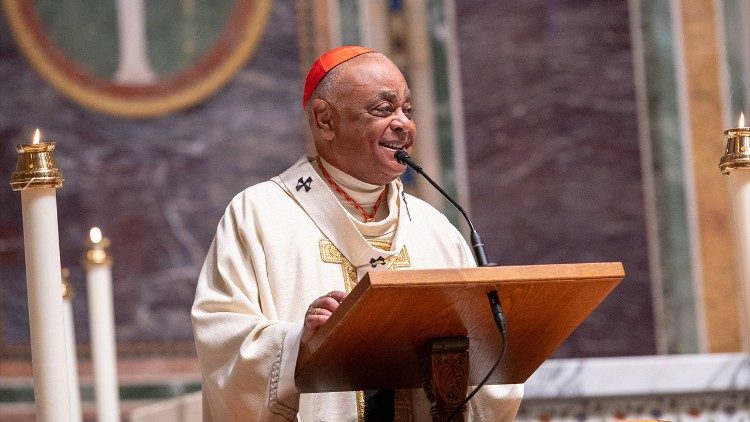
Cardinal Wilton Gregory of Washington said in a Jan. 30 statement that "Catholics throughout the Archdiocese of Washington today join men and women of good will here and around the world in praying for those who perished in last night's heartbreaking accident" and will also be praying for their "grieving families and loved ones."
"We praise God for the generous assistance of our courageous first responders," he said, and prayed that the disaster would "serve as an impetus to strengthen our unity and collaboration."
In a statement posted on X, Baltimore Archbishop William Lori said: "Our hearts go out to those who lost their lives in the tragic collision at Reagan National Airport. Let us pray for them and for their loved ones who mourn them. Our thoughts and prayers are also with the first responders during this very difficult time."
"The airplane originated from Wichita," Kemme wrote. "It is sobering to think that I and two other priests were on this very flight one week ago on our way to DC for [the] March for Life. May God bring divine assistance to everyone involved."
On Jan. 30, Bishop Michael Burbidge of Arlington, Virginia, celebrated Mass livestreamed from the Cathedral of St. Thomas More in Arlington. In his opening words, he spoke of a "tendency to feel helpless" in light "of the horrific tragedy last night claiming so many lives."
"But we're not," Burbidge said. "We are able to gather here today in faith, and to entrust all those who have died to God's loving embrace, to ask the Lord to bless and console family members and friends, and to watch over all the first responders."
In his homily, Burbidge said that Wednesday night’s tragedy was a reminder of how "fragile life really is."
Said Burbidge: "Each new day is a gift. Each moment we have with loved ones is a gift. Each day we have to do good for others is a gift. So perhaps the most powerful way we can honor those who lost their lives last night is to make sure we never take these gifts for granted."
Mass deportations ‘incompatible with Catholic doctrine,’ Cardinal McElroy says in DC debut
Cardinal Robert McElroy at the Church of San Frumenzio ai Prati Fiscali in Rome on Apr. 23, 2023, when he took possession of his titular church as a cardinal. | Credit: Pablo Esparza/CNA
National Catholic Register, Jan 7, 2025 / 06:00 am
Cardinal Robert McElroy, the new archbishop of Washington, D.C., says he wishes success for President-elect Donald Trump’s incoming administration but that he’ll be watching closely to see how Trump deals with immigrants who are in the country without legal status.
“The Catholic Church teaches that a country has the right to control its borders. And our nation’s desire to do that is a legitimate effort,” McElroy said Monday, shortly after being introduced as Washington’s eighth archbishop during an online press conference at the Cathedral of St. Matthew the Apostle amid an unusually heavy snowstorm in the nation’s capital.
“At the same time, we are called always to have a sense of the dignity of every human person. And thus, plans which have been talked about at some levels of having a wider indiscriminate massive deportation across the country would be something that would be incompatible with Catholic doctrine. So, we’ll have to see what emerges in the administration.”
The Vatican announced Monday that Pope Francis has appointed McElroy, 70, as archbishop of Washington, a high-profile see that includes about 667,000 Catholics in the District of Columbia and five counties in southern Maryland.
McElroy, widely seen as a progressive and an ally of Pope Francis, was appointed by the pope to the College of Cardinals in August 2022. He has served as shepherd of San Diego since 2015.
In Washington, he replaces Cardinal Wilton Gregory, 77, who has served as archbishop there since 2019.
The appointment was immediate. Gregory was already listed Monday as among the “former archbishops” of Washington on the archdiocese’s website.
The two cardinals appeared together at the online press conference.
The press conference, which was emceed by a moderator, featured prepared statements by the two cardinals, two questions from reporters the moderator posed to McElroy, and one question from a reporter the moderator posed to Gregory.
Gregory took over the archdiocese in April 2019 when it was reeling after revelations of sexual abuse by Theodore McCarrick, the sixth archbishop of Washington, whom Pope Francis dismissed from the clerical state, and the awkward departure of the seventh archbishop, Cardinal Donald Wuerl, who was sharply criticized for how he handled allegations against McCarrick and for how he handled certain clergy-sex-abuse cases when he was bishop of Pittsburgh.
Gregory, who has been seen as a lower-profile prelate than his predecessors, has worked to right the ship in Washington. But financial and other problems loom, as McElroy noted in his prepared statement.
“The journey of this Catholic community has known mountaintop moments, the visits of St. John Paul II, Pope Benedict, and Pope Francis, and it has known also moments of failure and shame — in the massive betrayal of the young to sexual abuse and the moral and financial reckoning for this betrayal which lie ahead of us,” McElroy said.
“In this mixture of mountaintop and failure, we are no different from the first disciples of the Lord. The light of Christ radiates in the Catholic community of this diocese in all of these dimensions, but most powerfully, it radiates in the lives of individual women and men who form the people of God, struggling in a world filled with turbulence, hardship, and illusion to follow the pathway of Christ,” he added.
The first question McElroy fielded was about decreasing reliance on so-called fossil fuels (such as oil and natural gas) in the Diocese of San Diego, such as through using solar panels.
McElroy, a staunch promoter of Pope Francis’ environment-focused encyclical Laudato Si’, said San Diego implemented the Archdiocese of Washington’s already-existing plan.
“So I’m here to learn as much as to bring new ideas. I think one of the great challenges for the Church in the world at this moment is that of the care for our home on this Earth, for the planet, and all of the abuse which it is suffering,” McElroy said.
“And it is a top issue in terms of our world,” he said. “How are we going to preserve the creation that God has given to us and enhance?”
The second and final question he received was about the incoming second Trump administration.
McElroy said he addressed a similar question about polarization in the United States during a panel discussion about six months ago, long before the November 2024 election that Trump won. His answer remains the same, he said.
“All of us as Americans should hope and pray that the government of our nation is successful in helping to enhance our society, our culture, our life, and the whole of our nation. And that is my prayer. It was my prayer then, not knowing who it would be, and it is my prayer now,” McElroy said.
“I pray that President Trump’s administration and that all of those state and local legislators and governors across the whole of the country will work together to make our nation truly better and to talk through the major issues that we face and make a difference,” he added. “And so our first responsibility for all of us is support for that goal, of success for our government.”
McElroy had been rumored as a likely replacement for Gregory since at least Oct. 10, 2024, when he met with Pope Francis at the Vatican, along with two other allies of the pope, Cardinal Joseph Tobin, the archbishop of Newark, New Jersey, and Cardinal Blase Cupich, the archbishop of Chicago. While details of the private meeting have not been made public, some observers have suggested the men discussed high-profile archbishoprics that needed to be filled, including Washington.
Gregory, who was appointed archbishop of Washington in April 2019, served five years and nine months in the post. His successor’s tenure could be even shorter.
McElroy turns 71 next month. Under Church law, he must submit his resignation to the pope in early February 2029, about four years from now, when he turns 75. Pope Francis has allowed certain bishops to continue serving until age 80, which for McElroy would mean 2034
Gregory answered one question during the press conference, saying that he plans to stay in the Archdiocese of Washington and assist in any way he can.
At the end, McElroy whispered to Gregory: “That was easy.”
Cardinal Robert W. McElroy received a biretta from Pope Francis when he was installed as a new cardinal in 2022 at St. Peter’s Basilica in Vatican City.Credit...Alessandra Benedetti/Corbis, via Getty Image
Pope Francis on Monday named Cardinal Robert W. McElroy, bishop of San Diego, to be the next Roman Catholic archbishop of Washington, moving one of his most vocal allies on immigration to one of the most prominent posts in the American church.
The move, announced in the Vatican’s daily bulletin, comes at a critical moment two weeks before President-elect Donald J. Trump is inaugurated and signals that Pope Francis is establishing his own priorities in the face of the incoming administration.Many powerful American Catholics, including Vice President-elect JD Vance, have aligned themselves with Mr. Trump’s efforts against immigration and abortion.
Cardinal McElroy, 70, is a longtime supporter of the pope’s pastoral agenda, and is known for regularly speaking out on the inclusion of migrants, women and L.G.B.T.Q. people in the Catholic church and in the United States.
He will succeed Cardinal Wilton Gregory, 77, the first African-American to be made a cardinal,a member of the church’s highest governing body.
The Holy Spirit is still at work in the Church: An interview with Cardinal Wilton Gregory
In this interview with Vatican News, Cardinal Wilton Gregory, the Archbishop of Washington, D.C., speaks about the meaning of synodality, the Church’s mission, and the work of the Holy Spirit in the Church today.
By Christopher Wells
Synodality, says Cardinal Wilton Gregory, “is the effort of people listening to one another and believing that the Holy Spirit is prompting those conversations, that the Holy Spirit is the one who plants the hopes, the dreams, the fears… And in the midst of those conversations, I think synodality means that out of those conversations will come a vision and a wisdom that will open up the horizons for tomorrow.”
Speaking with Vatican News on the sidelines of the General Assembly of the Synod, the Archbishop of Washington, D.C., highlighted both the diversity and the atmosphere of the ecclesial gathering.
“I find the Synod an amazing moment of encounter,” the Cardinal told Christopher Wells.
“I find the Synod an amazing moment of encounter.”
After noting the wide variety of Synod participants, even within his small group, Cardinal Gregory said the climate at this year’s meeting “is such that we can talk to each other about our experience of Church in our own culture and our own region, and share both our concerns but also our triumphs.”
He also expressed his hopes for the outcome of the Synod’s deliberations. “I would hope that one of the things that would come out of the Synod is an enthusiasm for the mission of the Church” – a mission that involves “the enthusiastic proclamation of the gospel, the revitalization of our sacramental life.”
Cardinal Gregory said, “I think Pope Francis, as he as he has set up this Synod, believes that as the Holy Spirit guided that early Church in its deliberation and its plans, the Holy Spirit is still working.”
“And I like to say,” he continued, “that if we get out of His way, He will lead us to a level of increased faith and evangelization efforts that will allow us to pass on the faith to a new generation.”
Read the full text of Cardinal Wilton Gregory’s conversation with Christopher Wells:
Vatican Radio: I’m going to ask you about the Synod… I’ve got just a couple of questions.
So, you’re here for this [synod], and now we’re about halfway through, right around the halfway point of the second session of the General Assembly. And you participated in the session last year, as well as most of the synod fathers did.
Can you tell us a little bit about your personal experience and what you’ve gained from the Synod so far?
Cardinal Wilton Gregory: Well, Chris, I hope I said this to you last time when we talked about this, I found the Synod or I find the Synod an amazing moment of encounter.
That is, I’m at a table. I’m – as far as I know, I’m the only American at my table. Okay. So, the other members come from Europe, come from Asia, come from Oceania. We’ve got a woman religious who is a provincial in her own community. So, it’s a diverse gathering.
But as last year, it’s also… the climate is such that we can talk to each other about our experience of Church in our own culture and our own region, and share both our concerns but also our triumphs. There are things that that the members of the Synod share with each other that they feel pretty good about. The church may be a distinct minority, as it is in a number of cultural environments, but, you know, as a couple of them have said, we’ve learned how to make sure that our faith is well represented and is respected, even though it’s a distinct minority within this cultural environment. So that’s good.
They also talk about things that are challenging for them. Under some of those circumstances, they cannot be as publicly open about their Catholicism as they might want to be.
And then there are the challenges that modern world brings the challenges of social media, the manipulation of the truth, facts. But the bottom line is, when the day and the conversation is concluded, no one feels as though they have been dismissed or belittled. Opinions are offered. Observations are made. And there’s a certain… veneer, I would like to say more than veneer, but a certain experience of charity.
Q: Some of the fathers and mothers of the Synod that I’ve talked to have commented on the atmosphere at the Synod and the experience of being together. But it’s kind of a unique experience where you have 400 people gathered from around the world. You’re all in one place. You’re able to dedicate yourselves entirely to the experience of synodality here. How do you translate that back when you go back to your local church in D.C.? How will you be able to translate it to the lived experience of the faithful there?
Well, one of the first things that I’m going to do, at the request of our deacon community, the permanent deacons and their wives, I will have Mass with them. There’s an annual mass that invites all of the permanent deacons and their wives for a get together, a confab, and they’ve decided they want me to talk about the Synod and give a little presentation, but a Q&A mostly.
Because many of the many people who are wonderfully faithful Catholics don’t have the foggiest idea of what a Synod is. What do you do? What’s the end of it? What’s the purpose?
Some of them may have heard of a synod, but then it was primarily a gathering of bishops. And Pope Francis has said, it’s still [the case that] the majority of participants are bishops, the vast majority.
But of the – and I would throw this number out because I don’t have any specific number – of the 350 participants, about 100 are priests, religious lay men and women who have full voting rights and full rights to voice their opinions. In other words, they’re a part of the mix.
And, in my humble opinion, it’s really the Church of the 21st century, although at times it may read like the Church, or it may seem like the Church of the book of the Acts of the Apostles, because it was in those days, as the Church was evolving from its foundation, that many of the people who were engaged in leadership were the clergy, the faithful, you know, addressing the challenges that that world presented to them.
And I think Pope Francis, as he as he has set up this Synod, believes that as the Holy Spirit guided that early Church in its deliberation and its plans, the Holy Spirit is still working. And, I like to say, if we get out of his way, He’ll lead us to a level of increased faith and evangelization efforts that will allow us to pass on the faith to a new generation.
Q: I think you’re right when you say that maybe a lot of people don’t have a real clear idea of what the Synod is and what Synodality is. Can you give us a preview? And for people, when people come up and ask you, you’re at this big synod, it’s about synodality. What in the world is Synodality?
Synodality I think, if I could be so bold, is the effort of people listening to one another and believing that the Holy Spirit is prompting those conversations, that the Holy Spirit is the one who plants the hopes, the dreams, the fears. And you know, the Holy Spirit doesn’t deal in fears, but He allows us to raise issues of importance. And in the midst of those conversations, I think synodality means that out of those conversations will come a vision and a wisdom that will open up the horizons for tomorrow.
Q. One of the things that I’ve noticed in following the news and speaking with some participants, but also people who are invested in the Synod, even if they’re not here, is perhaps something that might be called synodal fatigue. We’ve been at this process for several years. Three years, two sessions of the General Assembly, and people are maybe wondering what’s the point? Or where are we headed?
I believe that the process will end up presenting the Holy Father with the recommendations that come from the Synod discussions, and then he, as the pontiffs before him, will take all of that and put it together in some vehicle. That will be either an apostolic exhortation or maybe even an encyclical, but he’ll be able to crystallize what took place in the auditorium and use that as an incentive for the Church facing tomorrow.
Some of the apostolic exhortations that have come from synods in the past have done just that. The synod that that treated priestly vocations; when there have been Synod continental synods that have served as a as a jumping off point for evangelization in a cultural environment. There have been two synods on Africa, and I was a participant in the second one.
And so, the work that comes out of the Synod, it’s not an “add water and stir kind of solution”, but it does give a perspective on the challenges – sacramental life, religious life, a cultural situation – that we face and can guide us in responding to the issues that that have surfaced.
Q. And in a week or two, when you do come up with the final document for this session of the General Assembly, it’s certainly going to be a collective effort where you have all the voices coming together. Do you personally have some ideas of what you’d like to see come out of the Synod?
Well, I’m one voice among 300 plus, but I would hope that one of the things that would come out of the Synod is an enthusiasm for the mission of the Church. That is, it will take us to another level of excitement about being a Catholic in the various situations that we find ourselves upset. Pope Francis has been very, very good at allowing his writings to energize the Church. He gives us that boost that I think helps us respond, in a much more enthusiastic way to the challenges that the Church faces in the modern world.
Q. In a word – because we’ve heard it said often enough, you spoke about revitalizing Christians and Catholics for the mission of the Church – in a word, what is the mission of the church that we need to be revitalized towards?
The enthusiastic proclamation of the gospel, the revitalization of our sacramental life.
Let’s face it, the Church, throughout the world, the wholeworld, the whole human community is recovering from Covid, which has had its own unfortunate influence. We’ve been isolated from each other. People have not been able to gather. Certainly not for worship, but have not been able to gather for the ordinary things that used to energize us.
I watch – I don’t watch a lot of television – I think I watch basically two things, news and sports. And I can recall when the when Covid first hit, one of the things that it – did not the only thing – but when it shut down the sporting world.
And now we’ve got people who are gathering again, whether it’s soccer or baseball or football or tennis or golf or whatever, there’s a certain joy in being able to engage in those kinds of activities that were denied to us during Covid. And as a pastor, I’m still grappling with how we get people back in church.
Our church numbers have not recovered, Chris. They really haven’t. Now, there’s reasons that are given. People are still leery, especially if there are people whose health is frail or their age; but we haven’t been able to restore the sacramental vitality that is Catholicism, to the same degree that it was prior to Covid.
Now, I also have to say that even prior to Covid, the numbers were not what they should be, but they’ve been depressed since then and we had to figure out how do we… It’s not just a matter of getting people back in church, but how do we make them enthused about being together again in worship and in prayer together?
Q: I’ll ask one final question… In your own diocese, in Washington Archdiocese, how have you been implementing or beginning to implement Synodality? How have you taken what you’ve gathered from these three years now of the experience of Synodality and started to apply it in your local Church?
Well, we’ve introduced the themes of the Synod in our consultative bodies, the presbyteral council, pastoral council. We’ve had a lot of, small group gatherings., and hopefully we’ve tried to listen.
One of the things that, that has emerged from some of those small deanery gatherings or regional gatherings, is that our people say, “We want to see you guys more often.” They want to connect with their bishops, and not just for confirmation or the parish’s 50th jubilee. And I like to go to a parish just for an ordinary Sunday Mass. I tell people, look, I’m coming. This is a Mass without chrism and in green [that is, an ordinary Sunday Mass].
Q.You ever go incognito to Masses in your archdiocese?
I don’t think that works anymore.
Although I do, I have to tell you, sometimes I go, you know, in the public, I shop and sometimes I just shop as an ordinary guy buying bananas, you know? And I think people like that. Yeah, absolutely. They like to say, “That looks like the Cardinal, and he’s getting a five-pound bag of potatoes. I wonder what he’s making tonight.” It allows me to identify with them in a way that validates the way they live.
Q. Is there anything else you’d like to share?
CWG: I think, Chris, we touched every base. I’ve run around the bases a couple of times.
This transcript has been edited for length and clarity.
Pope Francis sends greetings to participants in “Outreach” conference
Replying to a message from Fr. James Martin, who carries out his mission among the LGBTQ community in the United States, Pope Francis says he is spiritually united with those participating in the meeting at Georgetown University from August 2 to 4.
By Vatican News
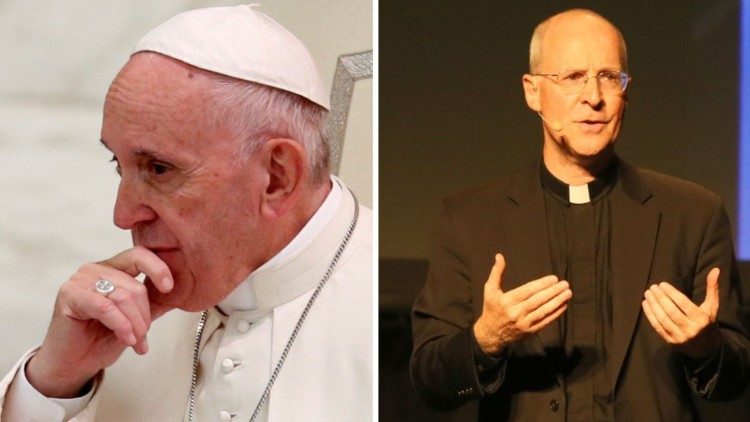
Pope Francis greeted Jesuit Father James Martin on the occasion of the “Outreach” Conference for LGBTQ Catholics, taking place at Georgetown University in Washington, DC, on August 2–4. Cardinal Wilton Gregory, Archbishop of Washington, is due to celebrate Mass for participants.
Fr. Martin, who carries out his apostolate among the LGBTQ community, wrote to the Pope, asking if he would like to send his greetings to the conference.
Pope Francis sent a brief response, which was released on Thursday, saying he was pleased by the fact that Cardinal Gregory would be celebrating Mass for them.
The Pope said he is “united in prayer” with those participating in the conference: “May Jesus bless you and the Holy Virgin care for you.”
This is the fourth time that Pope Francis has sent his regards to an “Outreach” event.
On other occasions, the Pope has invited the Jesuit priest, whom he has named a Consultor of the Dicastery for Communication (Vatican News’ parent organization), to transmit God’s “style” of closeness, mercy, and affection to the LGBTQ community.
Ryan Burge, a leading researcher on religion and politics, recently compiled data indicating that “cafeteria Catholicism” is rampant in the United States. Specifically, the country’s Catholics express widespread disagreement with the Church’s teaching on abortion, euthanasia, and the death penalty.
The term “cafeteria Catholic” refers to a Catholic who picks and chooses which Church teachings he or she affirms and adheres to. Washington, D.C., Cardinal Wilton Gregory recently used the term to describe President Joe Biden, who as president has advocated for unrestricted abortion through all nine months of pregnancy.
Burge found that only 0.9% of Catholics agree with Church teaching on all three of the issues. His conclusions were based on 2022 data collected by the Global Social Survey (GSS) and compiled by the Association of Religion Data Archives (ARDA). Burge told CNA that the 0.9% number is an all-time low since GSS started collecting data in 1972.
“It’s not just many Catholics who disagree with the teachings of the Church — in fact, if you look at the data, it’s nearly all of them,” said Burge, who teaches political science at Eastern Illinois University.
This coincides with an overall 12% decline in Church attendance among Catholics over the last two decades, as found by Gallup.
Abortion
Despite the Catholic Church’s clear teaching that abortion is gravely immoral, Burge said, there is “clear majority support for elective abortion in almost every circumstance.”
Over 50% of Catholics support abortion when the mother’s health is at risk, the child is the result of rape, if there is a “strong chance of serious defect in the baby,” and when the family or mother either does not want or cannot support another child.
Nearly 90% of Catholics support abortion in such cases in which the mother’s health is at risk. Over 80% of Catholics support abortion in cases of rape, and close to 80% of Catholics support abortion for serious defects.
ARDA also reports that 17.7% of Catholics believe abortion should be illegal in all cases.
Euthanasia
Regarding euthanasia, which the Church teaches is morally unacceptable, and suicide, which the Catechism of the Catholic Church calls “contrary to love for the living God,” most Catholics again are not in agreement with the Church’s teaching.
According to the data, 70% of Catholics support euthanasia, defined in the survey as a person’s ability to commit suicide in the case of an incurable disease. As pointed out by Burge, Catholics’ support for euthanasia and assisted suicide has been growing since the 1980s.
Death penalty
In recent decades, the Church has been increasingly voicing its opposition to the death penalty. In 2018, the Catechism of the Catholic Church was revised to reflect that opposition.
The catechism acknowledges that in the past “recourse to the death penalty on the part of legitimate authority, following a fair trial, was long considered an appropriate response to the gravity of certain crimes and an acceptable, albeit extreme, means of safeguarding the common good.”
“Today, however, there is an increasing awareness that the dignity of the person is not lost even after the commission of very serious crimes. In addition, a new understanding has emerged of the significance of penal sanctions imposed by the state. Lastly, more effective systems of detention have been developed, which ensure the due protection of citizens but, at the same time, do not definitively deprive the guilty of the possibility of redemption,” the catechism indicates.
The catechism goes on to quote Pope Francis in stating that “the death penalty is inadmissible because it is an attack on the inviolability and dignity of the person.”
Despite this, ARDA found that 61% of Catholics are in favor of the death penalty for convicted murderers. Support for the death penalty among Catholics has waned in recent decades after reaching a high of 81% in 1990.
‘A lot of work to do’
Monsignor Charles Pope, a Catholic author and pastor of Holy Comforter-Saint Cyprian Church in the Archdiocese of Washington, told CNA that the 0.9% number does not accurately represent Catholics’ “buy-in” to the faith.
Pope called the study “very unfair” and said it is “bringing things together which need to be analyzed separately.” He pointed out that the Church is clear in its teaching that abortion is intrinsically evil, while there is more leeway when it comes to the death penalty, which he described as a “prudential” rather than a “doctrinal” matter.
He agreed, however, that there is still a disconnect between Church teaching and what many Catholics believe. This, he thinks, is due to what he called “the politicization of moral issues.”
“Politics, sadly, is driving the conversation more than faith, because we are very worldly in our outlook,” he said. “So, if there’s one positive thing to take from this study it’s that we certainly have a lot of work to do to convince our own faithful of our teachings.”
“We’ve got a lot of work to do, but it doesn’t mean our teachings are wrong,” he went on. “It’s not the job of the Church to reflect the public opinion polls of our people, it’s the job of the Church to say: ‘Here’s what Jesus says.’”