Showing posts with label Assyrian Church. Show all posts

Monday, October 27, 2025

Pope Leo XIV meets with Patriarch of the Assyrian Church ahead of the anniversary of the Council of Nicaea and promoting synodality


Pope Leo meets with His Holiness Mar Awa II, the Catholicos Patriarch of the Assyrian Church of the EastPope Leo meets with His Holiness Mar Awa II, the Catholicos Patriarch of the Assyrian Church of the East  (@VATICAN MEDIA)

Pope: ‘Synodality presents itself as a promising path forward’

Pope Leo addresses the Catholicos Patriarch of the Assyrian Church of the East and the Members of the Joint Commission for the Theological Dialogue between the Catholic Church and the Assyrian Church of the East. In his discourse, he praises the progress the two Churches have made on their path of dialogue.

By Kielce Gussie

Pope Leo XIV welcomed His Holiness Mar Awa III, the Catholicos Patriarch of the Assyrian Church of the East and the Members of the Joint Commission for the Theological Dialogue between the Catholic Church and the Assyrian Church of the East to the Vatican on Monday.

Speaking with them, the Holy Father explained how the combined visits of the Catholicos Patriarch and the Commission members “bear witness to the face that fraternal encounter and theological dialogue are mutually constitutive elements on the path toward unity.”

Pope Leo stressed that the “dialogue of truth” is an expression of “the love that already unites our Churches, while the ‘dialogue of charity’ must also be understood theologically.”

A time of growth

To mark the 30th anniversary of the official dialogue between the two Churches, the Catholicos Patriarch made a visit to Rome in 2024. Pope Leo highlighted that “the progress made over these years is significant, having faithfully followed the mandate and methodology established by our predecessors.”

Referencing the 1994 Joint Declaration of Pope John Paul II and His Holiness Mar Dinkha IV, the Holy Father reiterated how “communion presupposes unanimity concerning the content of the faith, the sacraments, and the constitution of the Church.”

This three-sided description created the framework for the next steps in the theological dialogue between the two Churches. The 1994 document helped resolve a 1,500-year-old controversy, which in turn advanced the dialogue between the two “mutual recognition of sacraments, enabling a certain communicatio in sacris between our Churches.”

Pope Leo expressed his gratitude to the theologians in the Joint Commission for their dedication and work to helping reach these agreements.

A new focus

Now, the Pope said, the focus of the dialogue between the two Churches is the constitution of the Church. Here, the Holy Father pointed out that “the principal challenge lies in jointly developing a model of full communion, inspired by the first millennium, while thoughtfully responding to the challenges of our time.”

Yet, as his predecessors have argued, Pope Leo agreed this will not be achieved by “absorption or domination”. Rather, the model should encourage a sharing of gifts among the two Churches.

He stressed that “on this journey towards full communion, synodality presents itself as a promising path forward.” The Holy Father continued, reflecting on Pope Francis’ words in the Final Document of the Synod on Synodality: “The journey of synodality undertaken by the Catholic Church is and must be ecumenical, just as the ecumenical journey is synodal”.

With the spirit of the Synod in mind, Pope Leo expressed his hope that the 1700th anniversary of the Council of Nicaea will help concretely apply forms of synodality among all Christians and “inspire us with new ‘ecumenical synodal practices’.”

Closing, the Pope asked for the intercession of all the saints of both Churches, especially Saint Isaac of Nineveh, on this pilgrimage of dialogue. Through their intercession, Pope Leo prayed that the Christians in the Middle East always bear faithful witness to Christ, and he asked that "our dialogue hasten the blessed day when we will celebrate together at the same altar, sharing in the same Body and Blood of our Saviour, 'so that the world may believe' (Jn 17:21)


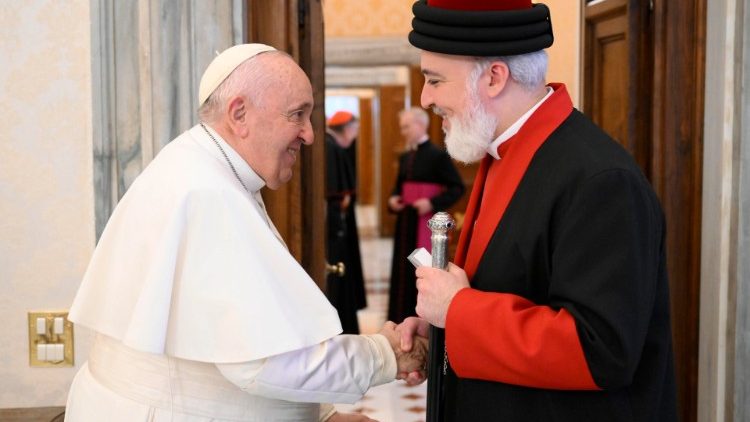
Saturday, November 9, 2024

Important meeting between Pope and Catholicos-Patriarch focuses on Christians in the Middle-East


Pope Francis meets with Mar Awa III, Catholicos-Patriarch of the Assyrian Church of the East on November 9, 2024Pope Francis meets with Mar Awa III, Catholicos-Patriarch of the Assyrian Church of the East on November 9, 2024  (VATICAN MEDIA Divisione Foto)

Pope: Christians in Middle East bear witness in lands martyred by war

Pope Francis meets with Mar Awa III, Catholicos-Patriarch of the Assyrian Church of the East, and includes St. Isaac of Nineveh, a 7th-century Assyrian Bishop, in the official Roman Martyrology.

By Devin Watkins

“Through the intercession of St. Isaac of Nineveh and the Blessed Virgin Mary, Mother of Christ our God and Savior, may the Christians of the Middle East continue to bear witness to the Risen Christ in lands martyred by war.”

Pope Francis expressed that hope on Saturday as he met with Mar Awa III, Catholicos-Patriarch of the Assyrian Church of the East, and members of the Joint International Commission for Theological Dialogue between the Catholic Church and the Assyrian Church of the East.

The audience came just ahead of the 30th anniversary of the signing of the Common Christological Declaration on November 11, 1994, which ended 1,500 years of doctrinal disputes stemming from the Council of Ephesus.

It also marked 40 years since Pope St. John Paul II and Mar Dinkha IV, the then-Catholicos-Patriarch of the Assyrian Church of the East, met in the Vatican for the first official meeting between the heads of the Catholic and Assyrian Churches.

Looking toward day of full communion

In his remarks at the audience on Saturday, Pope Francis encouraged all efforts toward full Christian unity.

“I recall what the great theologian John Zizioulas, a man of God, used to say: ‘I know the date of the union, I know it.’ When is it? ‘The day after the final judgment.’ Before that, full union will not happen, but in the meantime, we must walk together, pray together, and work together,” said the Pope.

He went on to praise the common “desire for unity” that inspires Catholic and Assyrian Christians to respond to Christ’s call in the Gospel: “That they may all be one” (Jn 17:21).


Believers in the same Christian faith

The Pope said efforts toward Christian unity are rooted in the belief that “the same faith handed down by the Apostles has been expressed and received in different forms and ways, according to varying life circumstances,” as stated in Unitatis Redintegratio, the Vatican II Decree on Ecumenism.

He recalled the 2001 agreement on the Anaphora of Addai and Mari, which allowed for a certain communicatio in sacris under specific circumstances; the 2017 joint declaration on the sacramental life; and, the 2022 document Images of the Church in Syriac and Latin Traditions, which laid the groundwork for a shared understanding of the Church’s constitution.

Unity in faith visible in the Saints

Pope Francis thanked the theologians of the Joint International Commission for their commitment to working through issues so that doctrinal and pastoral progress may be made.

“Theological dialogue is indispensable for our journey toward unity, as the unity we seek must be unity in faith,” he said. “However, the dialogue of truth must never be separated from the dialogue of charity and the dialogue of life—a fully human and comprehensive dialogue.”

The Saints, he added, bear witness in their respective Churches that unity in faith is already possible, as Christians journey toward full communion.

Pope Francis announced that he had received the consent of Mar Awa III and the Patriarch of the Chaldean Church to include St. Isaac of Nineveh in the Roman Martyrology, the Catholic Church’s official list of Saints.

Also known as St. Isaac the Syrian, the 7th-century Assyrian Bishop is among the most revered Fathers of the Syriac tradition and is recognized as a “master theologian and Saint by all Christian traditions.”

In conclusion, the Pope encouraged Mar Awa III and all Assyrian Christians of the East to continue walking with Catholics toward full unity.

“May the friendship between our Churches flourish until the blessed day when we can celebrate together at the same altar and receive communion in the Body and Blood of the Savior, “so that the world may believe.”

Saturday, November 19, 2022

Pope meets leader of Assyrian Church, towards unification, perhaps


Pope Francis with Mar Awa III, Catholicos Patriarch of the Assyrian Church of the EastPope Francis with Mar Awa III, Catholicos Patriarch of the Assyrian Church of the East  (ANSA)

Pope urges Catholics, Assyrian Christians to continue on common journey

Pope Francis met Saturday morning with Mar Awa III, the head of the Assyrian Church of the East, urging members of the two Churches “to pray and work diligently in preparation for the much awaited day” when full unity is achieved.

By Christopher Wells

Pope Francis received Mar Awa III at the Vatican on Saturday morning – the first visit of the head of the Assyrian Church of the East since his election as Catholicos-Patriarch in September 2021.

The Assyrian Church of the East is an eastern Christian Church with historic roots in disputes over the Ecumenical Councils of Ephesus and Chalcedon.

Improved relations

In his address on Saturday, Pope Francis noted the growth in the relationship between the Catholic Church and the Assyrian Church in recent decades, recalling the visits of Mar Awa’s predecessors Mar Dinkha IV and Mar Gewargis III, and the signing of documents including the Common Christological Declaration and a Statement on the situation of Christians in the Middle East.

The Holy Father also expressed his appreciation for the work of the Mixed Commission for Theological Dialogue between the two Churches, highlighting a study on the Anaphora [Eucharistic Prayer] of the Apostles Addai and Mari, which allowed some reciprocal admission to the Eucharist in specific circumstances; as well as a Common Declaration on the Sacramental life.

“Your meetings and dialogues have, with the help of God, borne good fruit and fostered pastoral cooperation for the benefit of our faithful, a pastoral ecumenism that is the natural way towards full unity.”

The Pope also praised their current work on “images of the Church in the Syriac and Latin patristic tradition,” noting the tendency of the Church Fathers to speak of the Church using the “simple and universally accessible” language of images, following the example of Jesus. He emphasized the importance for faithful of both Churches not only to return to their roots, but to bear witness together to “the mystery of the love between Christ and His bride, the Church.”

Rights of Christians in the Middle East

In this regard, Pope Francis pointed to the many things the two Churches have in common, including a common history of faith and mission, great saints, a rich theological and liturgical patrimony, and, especially in recent decades, the witness of martyrs. In the historic home of the Assyrian Church in the Middle East, many Christians have been forced to leave their homelands, while many others have struggled to remain. With Mar Awa, Pope Francis renewed his appeal for the rights of those Christians – especially the right to religious liberty and the right to full citizenship – to be respected.

Noting that the faithful of both Churches already, in some places, live in almost full communion, Pope Francis said this is “a sign of the times, a powerful incentive for us to pray and to work diligently in preparation for the much awaited day when we can celebrate together the Eucharist, the holy Qurbana, at the same altar, as the fulfilment of the unity of our Churches.”

Synodality and ecumenism

Looking ahead to Mar Awa’s upcoming talk on synodality in the Syriac tradition, Pope Francis insisted that “the journey of synodality undertaken by the Catholic Church is and must be ecumenical, just as the ecumenical journey is synodal.”

“It is my hope that we can pursue, ever more fraternally and concretely, our own syn-odos, our ‘common journey’, by encountering one another, showing concern for one another sharing our hopes and struggles, and above all… our prayer and praise of the Lord.”

A common date for Easter?

In particular, he thanked Mar Awa for his desire to find a common date for Easter, insuring the Catholicos-Patriarch that the Catholic Church is ready to accept any proposal that is made together. “Let us have the courage to put an end to this division...” the Pope said, adding, “The sign we should give is: one Christ for all of us.” And he expressed a dream that the separation between the Assyrian Church of the East and the Catholic Church, “the longest in the history of the Church” might be “the first to be resolved.”

Pope Francis concluded his address by entrusting the journey towards full unity to “the intercession of the martyrs and saints who, already united in heaven, encourage our progress here on earth.” And he offered to Mar Awa the gift of a relic of the Apostle Saint Thomas, associated with the foundation of the churches in Assyria, which will be placed in the new Patriarchal Cathedral of the Assyrian Church in the East in Erbil, Iraq.

“May Saint Thomas, who touched with his hand the wounds of the Lord, hasten the complete healing of our wounds from the past,” the Pope said, “so that soon we may be able to acknowledge around the same Eucharistic altar the crucified and risen Christ, and say to Him, together: ‘My Lord and my God!’”