Showing posts with label Archdiocese of Indianapolis. Show all posts

Friday, November 21, 2025

Pope Leo XIV connected with 15,000 teenagers today in a enthusiastic online meeting


Pope Leo meets online with young American Catholics attending the National Catholic Youth ConferencePope Leo meets online with young American Catholics attending the National Catholic Youth Conference  (@Vatican Media)

Pope Leo to young people: Technology can help us live our Christian faith

Pope Leo XIV meets online with over 15,000 teenagers gathered in Indianapolis, Indiana, and invites young Catholics to grow in friendship with Jesus Christ, use technology healthily to deepen their faith, and avoid using political categories to speak about the Church.

By Devin Watkins

Over 15,000 young people met with Pope Leo XIV via video link on Friday, as they attended the National Catholic Youth Conference (NCYC) in the US city of Indianapolis.

Moderated by Katie Prejan McGrady, the event saw six young Catholics ask the Pope to share his thoughts on topics ranging from the Sacraments and mental health to artificial intelligence and the future of the Church.

In his opening remarks, Pope Leo praised the American youth for taking the time to meet together in person and encouraged them to be active members of their parish communities.

The conference gave them the chance to attend Mass, pray before the Blessed Sacrament, and receive the Sacrament of Reconciliation, and the Pope said these activities are “real opportunities to meet Jesus.”

Life in the Sacraments

The first question put to the Pope asked about accepting God’s mercy when we’ve sinned or let others down.

Pope Leo XIV acknowledged that everyone struggles with asking for God’s mercy and accepting that He truly does forgive us in Confession.

“Sin never has the final word,” he said. “Whenever we ask for God’s mercy, He forgives us. Pope Francis said that God never gets tired of forgiving—we get tired of asking!”

God’s heart, he added, is different than our own, since He never tires of searching for the lost sheep. The Pope invited young people to encounter Christ in the Sacrament of Reconciliation, confessing their sins openly and welcoming Jesus’ forgiveness in the priest’s absolution.

Struggling with depression and mental health issues

Next, the Pope responded to a question about mental health struggles, such as feeling sad or overwhelmed.

He invited everyone to open themselves to a deep relationship with Jesus, entrusting their difficulties to Him in prayer.

“In the quiet, we can speak honestly about what is in our hearts,” he said. “During Eucharistic adoration, you can look at Jesus in the Blessed Sacrament and know He looks at you with love.”

Young people, added the Pope, should also find trusted adults whom they trust, so that God can speak to them through others, such as parents, teachers, priests, and youth ministers.

He also invited them to pray for the gift of true friends, who push us to “seek Jesus when life gets confusing or difficult.”

“Many young people say, ‘No one understands me.’ But that thought can isolate you,” said Pope Leo. “When it comes, try saying, ‘Lord, you understand me better than I understand myself,’ and trust that He will guide you.”

Faith and technology

Answering a question about technology’s effects on faith, Pope Leo XIV upheld the usefulness of modern tools to connect people who thousands of miles are apart.

“Technology can help us do many things and even really help us live our Christian faith,” he said. “It also gives us amazing tools for prayer, reading the Bible, and learning more about what we believe.”

At the same time, the Pope noted that technology can never replace real, in-person relationships and participation in the Eucharist, inviting young Catholics to be intentional with their screen time and making sure that technology serves their lives, not the other way around.

Artificial intelligence, said Pope Leo, has become a defining feature of our times, pointing out that safety is not only about controlling the development of AI models but also about empowering people to make healthy decisions through education and personal responsibility.

Every tool should support our journey of faith and intellectual development, not hinder it, he said.

“Be careful that your use of AI does not limit your true human growth,” he said. “Use it in such a way that, if it disappeared tomorrow, you would still know how to think, create, and act on your own. Remember: AI can never replace the unique gift that you are to the world.”

Future of the Church

Pope Leo then responded to a question about the future of the Church, recalling Jesus’ promise to Peter that “the gates of hell will not prevail against the Church.”

The Church prepares for the future by remaining “faithful to what Jesus asks of us today,” he said, recalling that the Holy Spirit has guided the Church through two millennia of issues and challenges.

Young people, said the Pope, are not only the future of the Church but also her present, and he urged them to get involved by attending Sunday Mass and joining youth activities where their faith can grow.

“If you feel the Lord may be calling you to something specific, talk to your parish priest or another trusted leader,” he said. “They can help you discern what God is asking.”

Friends of Christ, missionaries of the Gospel

Finally, Pope Leo XIV expressed his hopes for the future of young people in the Church, inviting them to help shape her in the years ahead.

In response to their youthful desire to do something meaningful, the Pope urged young Catholics to offer their time and talents generously to build up the Church.

“Deep down, we long for truth, beauty, and goodness because we were created for them,” he said. “And this treasure we seek has a name: Jesus, who wants to be found by you.”

Young people are called to be friends of Christ and peacemakers, “who build bridges instead of walls, who value dialogue and unity instead of division.”

“Be careful not to use political categories to speak about faith,” he said. “The Church does not belong to any political party. Rather, she helps form your conscience so you can think and act with wisdom and love.”

In conclusion, Pope Leo invited young American Catholics to listen to God’s call in their lives and to discern their vocation, whether to marriage, the priesthood, or religious life.

“What greater cause could you dedicate your life to than the Gospel?” he asked. “The world needs missionaries. It needs you to share the light and joy you have found in Jesus.”

Monday, July 29, 2024

A concluding statement about the National Eucharistic Congress by Bishop Andrew H. Cozzens


STATEMENT FROM BISHOP ANDREW H. COZZENS, S.T.D., D.D. CHAIRMAN, NATIONAL EUCHARISTIC CONGRESS


July 27, 2024  
If then my people, upon whom my name has been pronounced, humble themselves and pray, and seek my face and turn from their evil ways, I will hear them from heaven and pardon their sins and heal their land.” (2 Chr 7:14)  
Dear Brothers and Sisters in Christ,

At the opening Holy Hour of the 10th National Eucharistic Congress, on Wednesday July, 17, 2024, I prayed these very words, inviting tens of thousands in the stadium and thousands more watching virtually to join me in asking the Lord to pardon our sins and heal our land. 
Then on Friday evening, July 19th, we all united around Our Eucharistic Lord again in Lucas Oil Stadium in Indianapolis to make reparation for our sins. We humbled ourselves in the presence of Jesus, Our Lord and Savior. Recognizing that if one member of the Body of Christ suffers, we all suffer, we prayed together for healing and forgiveness. We were lead through a litany of healing and repentance in the Eucharist by Fr. Boniface Hicks, O.S.B. Many people told me that this moment of communal penance and reparation was a moment of great healing for them. It was amongst the most powerful experiences of grace for me personally during those holy days.  
Just one week later, on July 26th in Paris, where the newly restored Cathedral of Notre Dame stands as an iconic reminder to our belief in the importance of the Mass, which makes spiritually present to us the Last Supper, nearly 1 billion men, women and children, in person and through live telecast, witnessed the public mockery of the Mass, the “source and summit of the Christian life”  (LG, 11). During the opening ceremonies of the Summer Olympics, the famous DaVinci Masterpiece The Last Supper was depicted in heinous fashion, leaving us in such shock, sorrow and righteous anger that words cannot describe it. 
Brothers and sisters, we know that what the enemy intends for evil, God uses for good. We know that “where sin increased, grace overflowed all the more” (Rom 5:20). 
Throughout salvation history, the Lord and his prophets have called us—the people of God—to respond to the darkness of evil with the light that comes from the Lord. At the heart of this call are prayer and fasting. Jesus told us that some demons “can only come out through prayer [and through fasting]” (Mk 29:9). He modeled this for us when he spent 40 days in the desert before beginning his public ministry, praying and fasting, begging God the Father to prepare him for all that lay ahead—including his perfect gift of self through his death on the Cross. 
We believe that the Last Supper is united with the death of Christ on the Cross and, together with the Resurrection, these events are all one in the Paschal Mystery. This passover, which begins at the Last Supper, is the most sacred moment in the life of Jesus. This is when Jesus offered his life for us so that we could share in his divine life forever. 
Jesus experienced his Passion anew Friday night in Paris when his Last Supper was publicly defamed. As his living body, we are invited to enter into this moment of passion with him, this moment of public shame, mockery, and persecution. We do this through prayer and fasting. And our greatest prayer—in season and out of season—is the Holy Sacrifice of the Mass.

As the Church throughout the world gathers tomorrow at the Lord’s Altar, let us do so with renewed zeal. Let us pray for healing and forgiveness for all those who participated in this mockery. Let us commit ourselves this week to greater prayer and fasting in reparation for this sin. Perhaps you could attend Mass once more this week or do an extra holy hour?

We may also be called upon to speak about this evil. Let us do so with love and charity, but also with firmness. France and the entire world are saved by the love poured out through the Mass, which came to us through the Last Supper. Inspired by the many martyrs who shed their blood to witness to the truth of the Mass, we will not stand aside and quietly abide as the world mocks our greatest gift from the Lord Jesus. Rather, through our prayer and fasting, we will ask the Holy Spirit to strengthen us with the virtue of fortitude so that we may preach Christ—our Lord and Savior, truly present in the Eucharist—for the Glory of God and the Salvation of Souls.

Let us, strengthened by Christ, be the Eucharistic Missionaries we are called to be.

+In Christ Jesus,

Most Rev. Andrew H. Cozzens, S.T.D., D.D.
Bishop of Crookston
Chairman of the Board of the National Eucharistic Congress

Monday, July 22, 2024

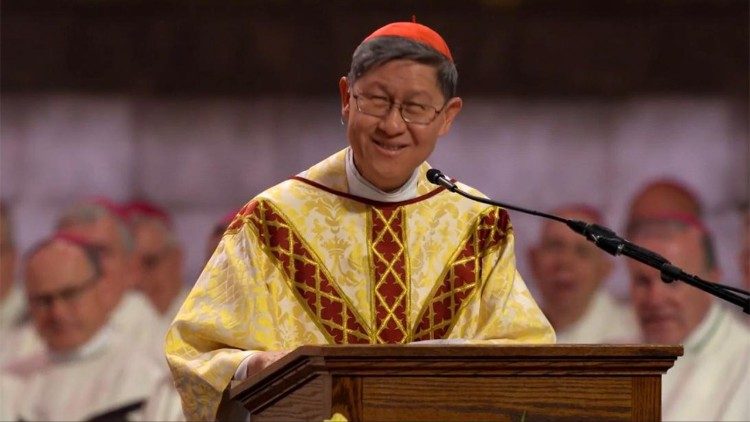
Homily from Cardinal Luis Tagle at final Mass at National Eucharistic Congress


Cardinal Luis Antonio Tagle celebrates Holy Mass at the National Eucharistic Congress in IndianapolisCardinal Luis Antonio Tagle celebrates Holy Mass at the National Eucharistic Congress in Indianapolis 

Cardinal Tagle invites Catholics to share God's gifts

The National Eucharistic Congress in the US city of Indianapolis concludes with the celebration of Mass and a homily by Cardinal Luis Antonio Tagle, who calls for a renewed commitment to Eucharistic and missionary conversion.

By Vatican News 

Reflecting on the theme of the National Eucharistic Congress, from the Gospel of John “Remain in Me”, Pope Francis’ special envoy to the event highlighted Jesus' mission as a gift from the Father.


"Jesus is sent to be given by the Father to others," Cardinal Luis Antonio Tagle said during his homily, and he explained that the Eucharist encapsulates this gift, as Jesus offers His body and blood for the life of the world.

The Cardinal, who is the Pro-Prefect for the Section of Evangelization of the Dicastery for Evangelization, celebrated Holy Mass at the National Eucharistic Congress in Indianapolis, Indiana, that concluded on Sunday, July 21.

He challenged the faithful to see their own lives and the world through the lens of gift rather than mere achievement.

"Do we still look at ourselves, persons, objects, work, society, events, and creation within the horizon of gift?" he asked, warning that losing this perspective leads to self-absorption and a lack of missionary zeal.


The pain of leaving Jesus

Cardinal Tagle addressed the difficult reality of disciples who abandoned Jesus, as narrated in the Gospel of John, chapter 6, and he invited introspection on whether the Church's actions sometimes contribute to this departure.

"Is it possible that we disciples contribute to the departure of others from Jesus?" he asked, urging a deeper engagement with the Eucharist and its transformative power.

He also highlighted the need to welcome those who feel marginalized, such as the poor, migrants, and the elderly, ensuring they feel part of the Church community.


A call to Eucharistic Missionaries

Cardinal Tagle said that those who choose to stay with Jesus must also be willing to be sent by Him.

"We should not keep Jesus to ourselves. That is not discipleship. That is selfishness," he stated, and he called on the faithful to share the love and compassion they have received from Jesus with the weary, the lost, and the divided.

Message from Pope Francis

Cardinal Tagle finally conveyed the blessings and prayers of Pope Francis, whom he said wrote him a letter expressing the hope “that the participants of the Congress, fully aware of the universal gifts they receive from heavenly food, may impart them to others.”

The papal envoy concluded by telling a story from his time as a parish priest and that, he said, illustrates the need to live out the Eucharist in daily life.

It is the story of a woman whose extraordinary devotion resulted in her being present at the Church on all occasions and at all times. But when he thanked her for her dedication and asked her to thank her family for allowing her to serve, she said her constant presence derived from the fact that she wanted to avoid her family.

"When the priest or deacon says, 'The Mass is ended. Go in the peace of Christ,' please go! What you have heard, touched, and tasted, you must share with others," he exclaimed.

Friday, July 19, 2024

In Indianapolis, 50,000 Catholics worship the Lord Jesus in the Blessed Sacrament


For Catholic pilgrims, all roads lead to Indy for an old-style devotion in modern stadium setting


Like the star of an arena tour, a spotlight illuminated the glittering, golden vessel carried by a Catholic bishop. Inside, it held a round communion host, which Catholics believe is the full presence of Jesus in the appearance of bread.

The bishop placed it on an altar at the center of Lucas Oil Stadium in Indianapolis on Wednesday evening. It was the culmination of more than two years of preparations and two months of four cross-country pilgrimages destined for the Midwestern city and the first National Eucharistic Congress in more than 80 years. Thousands of Catholics converged for the start of a five-day gathering focused on devotion to the Eucharist and the core Catholic doctrine that it is not merely a symbol but is the reality of Jesus among them.

The congress reflects bishops’ attempt to revive traditional devotions that have waned in recent generations, even as some have questioned how this movement was forged. There has been debate involving politics as well as disputed research over whether most Catholics actually believe the doctrine.

The stadium remained quiet for a half hour of devotional adoration, followed by prayers, multiple speakers and an extended session led by a worship band in front of a stage set and lighting that simulated the look of gothic stained-glass windows. The music ranged from the solemn hymn “Holy God, We Praise Thy Name” to contemporary, electronic-infused music that more resembled that of an evangelical megachurch than of a Mass songbook.

Bishop Andrew Cozzens, who brought in the Eucharist, read a gospel passage in which Jesus calls himself the bread of life.

“We want every Catholic to realize that you are alive in the Eucharist and to encounter your love,” said Cozzens, of the Diocese of Cookston, Minnesota, in an extended prayer.

Attendees expressed enthusiasm.

“It’s a beautiful thing to see so many families, religious (order members), priests, the whole church here represented,” said Sister Teresa Christine DesGeorges, one of several members of the Carmelite Sisters of the Most Sacred Heart of Los Angeles who traveled from California. “There was something about being in that room with so many thousands of people for the same reason that reignites the faith.”

There were nine National Eucharistic Congresses between 1895 and 1941, an era when Catholics also gathered by the tens of thousands in stadiums and parades in their home cities for rosary prayers, Eucharistic adoration and other traditional devotions. Such events displayed the growing numbers and clout of the Catholic population, then largely defined by their urban neighborhoods and parishes made up of European immigrant families.

By the 1950s, mass devotional gatherings had declined, and liturgical reforms of the 1960s put emphasis on other areas, such as preaching, lay involvement and congregational singing.

Many churches retained such practices on smaller scales, but this event coincides with a push by some to revive many older traditions, including the Latin Mass.

A 2021 document from U.S. bishops, “The Mystery of the Eucharist in the Life of the Church,” arose amid debate over whether bishops should withhold Communion from Catholic politicians like President Joe Biden or Rep. Nancy Pelosi, Democrats who supported abortion rights. Following cautionary signals from the Vatican, the document ultimately avoided that direct question, though it called on Catholics to examine whether they align with church teachings.

Some bishops also said the Eucharistic doctrine needed a fresh emphasis, citing a 2019 survey that found most church members didn’t believe it.

But some researchers have questioned the phrasing of that survey.

A follow-up poll in 2022 — by the Georgetown University-affiliated Center for Applied Research in the Apostolate — used multiple phrasings and found that 64% of Catholics expressed belief in Jesus’ presence in the Eucharist in at least one response, as did virtually all who attended Mass weekly.

Among the main speakers Wednesday was Pope Francis’ diplomatic representative to the U.S., Cardinal Christophe Pierre. While many traditionalist Catholics have been disenchanted with Pope Francis, such as with his outreach toward LGBTQ+ people, Francis has endorsed the Eucharistic revival and personally blessed the custom-made monstrance used to display the Communion host at the congress.

Pierre underscored themes of the Francis papacy, including “synodality” — church-wide dialogue — and bridging cultural divides.

“Our encounter with Christ’s real presence in the sacrament opens us to an encounter with him in the rest of our lives,” he said. “Not only is he present in our family, friends, communities, but he is also present in our encounters with people from whom we would otherwise consider ourselves divided. This might include people from a different economic class or race. People who challenge our way of thinking, people whose perspective is informed by experiences that differ greatly from our own.”

Another speaker, Sister Bethany Madonna of the Sisters of Life, spoke of how Eucharistic adoration is integral to the group’s work with pregnant women considering abortion.

The five-day event includes stadium gatherings, breakout sessions, Masses, rosary prayers and more. In keeping with the traditionalist tenor, there are displays of saints’ relics and of a replica of the Shroud of Turin, which some believe is Jesus’ burial cloth.

The event included greetings in English and Spanish, reflecting the large Hispanic presence amid the diverse crowd

Logistical delays led to long registration lines Wednesday, but the stadium gradually filled to roughly 70 percent of capacity.

Tim Glemkowski, chief executive officer of the congress, said he anticipates 50,000 attendees over the course of the congress. “We did a lot of things over the past couple of years to make it affordable,” he said, including some discounted tickets as well as free admission for young children.

Event organizers have studiously emphasized that it’s not political and wasn’t timed to coincide with the Republican National Convention.

But the event comes during a conservative Catholic moment in U.S politics. Even as the Eucharistic gathering was underway, Ohio Sen. J.D. Vance, a Catholic convert, accepted the GOP nomination as the vice presidential running mate of Donald Trump. And some U.S. Catholics are voicing their belief that God spared Trump’s life in Pennsylvania on July 13, associating the assassination attempt with an apparition of the Virgin Mary that same date in 1917 in Fatima, Portugal.

Catholics voters are far from monolithic and are often seen as a crucial swing voters, though traditionalist Catholics are often supportive of conservative candidates and policies such as opposition to abortion.

Glemkowski said he’s aware of the current events, but “everyone who’s here and everyone watching at home is clear, what this is about is the church unified and encountering Jesus in the Eucharist. As long as we stay focused on that, people will see this is not a political movement but a movement of grace.”

___

Freelance photographer Doug McSchooler in Indianapolis contributed to this report.

___

Associated Press religion coverage receives support through the AP’s collaboration with The Conversation US, with funding from Lilly Endowment Inc. The AP is solely responsible for this content.