Wednesday, February 25, 2026

Saint of the Day for Thursday


St. Isabel of France


Sister of St. Louis and daughter of King Louis VIII of France and Blanche of Castile, she refused offers of marriage from several noble suitors to continue her life of virginity consecrated to God. She ministered to the sick and the poor, and after the death of her mother, founded the Franciscan Monastery of the Humility of the Blessed Virgin Mary at Longchamps in Paris. She lived there in austerity but never became a nun and refused to become abbess. She died there on February 23, and her cult was approved in 1521.

One of U.S. Women Gold Medal Hockey stars is a devout Catholic


‘Christ is my identity, my foundation,’ says Catholic player on US women’s hockey team

 February 25, 2026


Haley Winn of the U.S. women's hockey team, holding the U.S. flag, celebrates her team's Olympic gold medal win during a victory ceremony Feb. 19, 2026, after they won in overtime by defeating Canada 2-1 during the Milano Cortina 2026 Olympics at Milano Santagiulia Ice Hockey Arena in Milan, Italy. (OSV News photo/David W Cerny, Reuters)


By Mike Latona / Catholic Courier

ROCHESTER, N.Y. (OSV News) — The Olympic gold medal hanging from Haley Winn‘s neck was a crowning touch on her rapid rise to ice hockey’s mountaintop.

Winn — a graduate of Bishop Kearney High School in the Rochester suburb of Irondequoit — and her United States women’s team struck gold Feb. 19, thanks to a 2-1 overtime win over Canada in the Olympic final in Milan, Italy. Winn played stellar defense throughout the 2026 Winter Games, helping her team score 33 goals in seven games while allowing just two goals.

‘Tears of joy, disbelief’

“It’s crazy to think about. It’s so hard to put into words,” Winn, 22, told the Catholic Courier, newspaper of the Diocese of Rochester, in a Feb. 22 telephone interview from Milan. “Just to be a part of something so much bigger than myself, it’s so special. There’s been so many emotions — a lot of tears of joy, disbelief.”

The gold-medal win came in Winn’s first Olympics and followed three world titles with other U.S. national teams on which she played. She asserted that her hockey success was only made possible through two mainstays in her life — her family and her Catholic faith.

“I wouldn’t be (an Olympic champion) without them,” Winn said of her parents, Janet and Mike, and older brothers Casey, Ryan and Tommy — all five of whom were on hand in Milan to cheer her on. “It’s their medal as much as mine.”

Inspiration from praying together

Winn said she also drew inspiration from praying together with several U.S. teammates before each Olympic game.

“Christ is my identity, my foundation,” she said. “I think it’s the thing that keeps me grounded.”

Staying grounded was no easy task in the gold-medal contest, as Winn’s U.S. team faced a 1-0 deficit until Hilary Knight’s goal tied the score with just over two minutes left in regulation. Megan Keller followed with the game-winner 4:07 into sudden-death overtime, setting off a wild U.S. celebration.

“I just had a sense of belief and confidence that as soon as we got that tying goal, it was over,” Winn said, lauding the ability and cohesiveness of her U.S. teammates: “It’s the best team I could have played on, a great group of girls. Everyone just has so much trust in each other and gives you the confidence to play your own game.”

Logged substantial ice time

Winn, a 5-foot-5-inch defenseman wearing uniform No. 8, logged substantial ice time in every Olympic game. Offensively, she netted her first Olympic goal — in a 5-0 win over Switzerland Feb. 9 — and three assists during the Games.

En route to her Olympic success, Winn spent her high school career with the BK Selects Hockey Academy for boys and girls, playing in elite youth events across the U.S. and Canada.

Winn, as well as BK Selects players from other states and countries, resided in dormitories on Bishop Kearney’s top floor while attending the school, where Winn’s mother is on the board of directors. She was one of eight BK Selects alumnae to play in the Olympics — five for the U.S. squad — yet was the only Rochester-area resident among those eight.

Upon graduating from Bishop Kearney in 2021, Winn played Division I hockey at Clarkson University in Potsdam, New York. In her senior season, she served as co-captain and was named ECAC Player of the Year as well as first team All-American. She graduated in 2025 with a bachelor’s degree in psychology.

Winner of world championships

Winn also has won International Ice Hockey Federation women’s world championships in 2023 and 2025 and was on the U.S. under-18 national team that earned the world title in 2020. In June 2025, she was selected second overall by the Boston Fleet in the Professional Women’s Hockey League draft. Through late February, she had helped the Fleet to a first place showing in the eight-team PWHL.

Despite the time demands of playing top-level hockey, Winn makes ample time for her Catholic faith and is adamant about sharing it with others. While attending Clarkson, she joined a team Bible study group as a sophomore, and by her senior year, she was overseeing it.

Winn noted that her faith kicked into another gear while still at Bishop Kearney. Through attending Masses at Rochester’s St. Frances Xavier Cabrini Parish with other team members, Winn developed a friendship with Father Robert Werth, a Diocese of Rochester priest who assists in the parish. Winn’s parents eventually became good friends with Father Werth as well.

Becoming stronger in Catholic faith

“Father Bob and Haley have really helped Mike and I become strong in our faith through the years,” Janet Winn said, noting that they often attend Sunday Masses that Father Werth celebrates when they’re not traveling for their daughter’s hockey games.

“He is amazing. I don’t have enough good things to say about him,” Winn remarked about Father Werth. The priest, in turn, lauded the star hockey athlete: “She is the best — the most humble person, maybe even a little shy.”

The same cannot easily be said about Winn’s brothers. Casey, Ryan and Tommy became viral sensations during the Olympics with their zany outfits and videos; their supportive antics even led the four siblings to being featured on NBC’s “Today” show.

Meanwhile, Winn was part of a U.S. squad that, according to published reports, attracted a television viewing average of 5.3 million people — peaking at 7.7 million during overtime — in the final against Canada, making it the most-watched women’s ice hockey game on record.

Gold medalists of the U.S. Women’s Hockey Team pose for a team group photo during the victory ceremony during the victory ceremony during the ceremony after they won in overtime defeating Canada 2-1 during the Milano Cortina 2026 Olympics at Milano Santagiulia Ice Hockey Arena in Milan, Italy, Feb. 19, 2026. (OSV News photo/David W Cerny, Reuters)

As she continues to gain popularity around the world, Winn said she will utilize that attention not for personal gain, but to continue voicing her religious beliefs.

“I am so blessed that God is using me to glorify him on this platform,” she stated.

Mike Latona is senior staff writer at the Catholic Courier, newspaper of the Diocese of Rochester. This story was originally published by the Catholic Courier and distributed through a partnership with O

Pope Leo XIV Apostolic Journeys for 2026 announced


Pope Leo at the beginning of his first Apostolic Journey outside of Italy, which took him to Türkiye and Lebanon at the end of last yearPope Leo at the beginning of his first Apostolic Journey outside of Italy, which took him to Türkiye and Lebanon at the end of last year  (@VATICAN MEDIA)

Pope Leo XIV to make Apostolic Journeys to Africa, Spain and Monaco

The Holy See Press Office announces Pope Leo XIV’s upcoming Apostolic Journeys: ten days in Africa, between Algeria, Cameroon, Angola, and Equatorial Guinea, in April; one day in the Principality of Monaco at the end of March; and six days in Spain, between Madrid, Barcelona, and the Canary Islands archipelago, in June.

Vatican News

Pope Leo XIV will make a ten-day Apostolic Journey to Africa and two others in Europe; the Holy See Press Office announced on Wednesday.

The first visit will be a day trip at the end of March to the Principality of Monaco, followed by the Africa Journey in April, and finally the six-day Journey to Spain and in the Spanish archipelago of the Canary Islands in June.

After the significant journey to Türkiye and Lebanon at the end of 2025 and after the announcement of the upcoming pastoral visits in Italy that will take him as far as Lampedusa, Pope Leo is resuming his pilgrimages throughout the world. 

Africa

The longest—from 13 to 23 April—will see him following in the footsteps of Saint Augustine in Algeria, where he will visit Algiers and Annaba; then visiting Cameroon in Central Africa, with stops in Yaoundé, Bamenda and Douala; Angola, where he will visit Luanda, Muxima and Saurimo; and finally, Equatorial Guinea, where he will visit Malabo, Mongomo and Bata.

This will be a complex trip, which is at the same time a journey in memory of the saint of Hippo, to whose figure the Successor of Peter is linked; and then touching two developing countries, with particular attention to the least, the poor and those who care for them.

Moreover, the Journey will be focused on peace.

Pope Leo will go to the Anglophone region in the north of Cameroon, where for ten years a civil war has been underway involving the regular armed forces and the separatists.

The final stage of this African Journey will be to Equatorial Guinea, the only Spanish-speaking African country.

The length of this Papal Visit approaches that of Pope Saint John Paul II in 1985, when he visited seven countries in 11 days.

Principality of Monaco

Yet it is a lightning European day trip to the Principality of Monaco, scheduled for 28 March, on the eve of Holy Week, that will inaugurate the Holy Father's Apostolic Journeys for the first half of 2026. 

The Pope desired to respond positively to the repeated invitations made by the Monegasque authorities, first to Pope Francis and then to himself.

The Principality is a European reality where Catholicism is the State religion and where dialogue between civil institutions and the Church remains a matter of concrete importance in the public debate. 

Also significant is the Principality’s commitment to peace, which will welcome a Pope for the first time in the modern era.

Spain

Finally, from 6 to 12 June Leo will visit Spain, first the capital Madrid and then Barcelona, where he will inaugurate the newest and tallest tower of the Sagrada Familia, the monumental basilica that has reshaped the skyline of the Catalan city.

The visit falls on the hundredth anniversary of the death of Antoni Gaudí, the brilliant architect who “dreamed” the Basilica by beginning to build it, and who last year was declared a Venerable Servant of God.

Continuing his Journey to Spain, the Holy Father will travel from Barcelona to the Canary Islands archipelago, to carry out a journey that was already in the heart of the late Pope Francis, as the Archbishop of Madrid, Cardinal José Cobo Cano, underlined in January.

While in the Canary Islands, the Pope will visit Tenerife and Gran Canaria.

Diverse and meaningful destinations

Through these three Apostolic Journeys, Pope Leo will have the opportunity to encounter the most diverse types of countries and situations.

He will move from Algeria, a Muslim nation where Christians are a small minority and a seed of fraternity, to countries with a Christian majority situated in the heart of the African Continent, with their challenges, but also their joyful testimony of faith.

The Holy Father likewise will make a brief trip to the second smallest country in the world after Vatican City, located on the French Riviera; to a large European country, Spain, whose identity has been shaped by the Christian faith, but also affected by secularization. And finally, the Holy Father will conclude the Apostolic Journey in the Canary Islands, one of the main migratory routes from Africa toward Europe, with tens of thousands of landings every year.

Tuesday, February 24, 2026

Venerating the relics of St. Francis of Assisi for 1st time in 800 years


St. Francis’ relics open to public for first extended veneration in 800 years

5:06 PM February 22, 2026

Monks from the local Franciscan community venerate the relics of St. Francis, which were exhumed from their shrine in the Basilica of St. Francis in Assisi, Italy, the morning of February 21, 2026. The remains were exhumed in the presence of the friars and placed on a specially prepared table in the crypt, before being displayed for public veneration Feb. 22. (OSV News photo/courtesy Sala Stampa Sacro Convento Assisi)

ASSISI, Italy (OSV News) — For the first time in eight centuries, the mortal remains of St. Francis of Assisi are being exposed for an extended period of public veneration, drawing hundreds of thousands of pilgrims from around the world to pray before “the Little Poor Man of Assisi.”

The bones of the beloved saint were unveiled for public display Feb. 22 in the Lower Church of the Basilica of St. Francis of Assisi. Pilgrims waited in line outside of the Assisi Basilica, taking in the panoramic views of the Umbrian countryside from the medieval hilltop town, for their chance to pray before the relics. 

The veneration runs through March 22 as part of the Catholic Church’s yearlong celebration of the 800th anniversary of St. Francis’ death in 1226.

Among the first to venerate relics

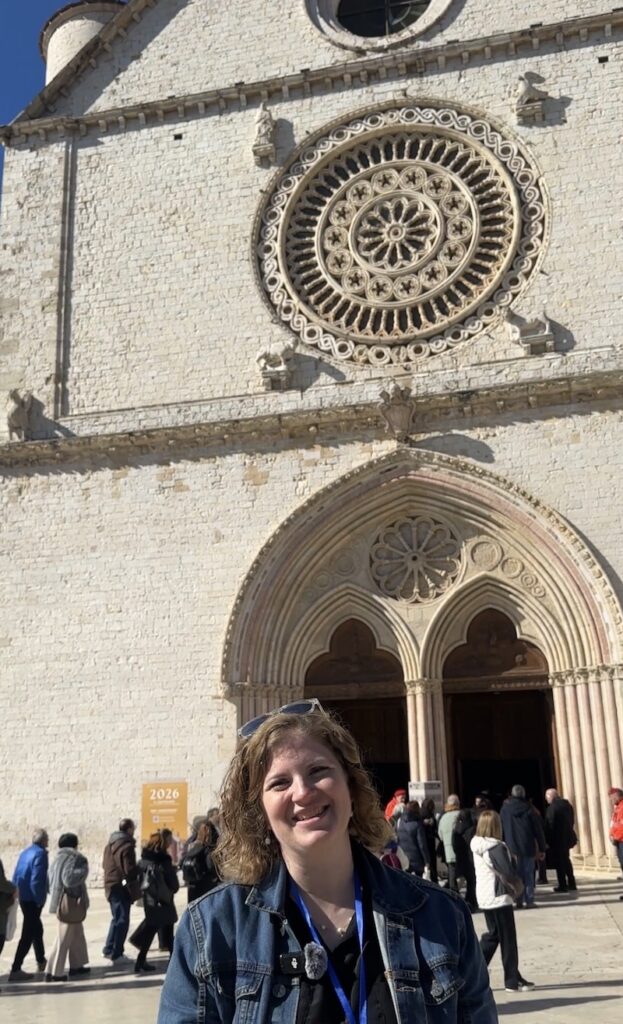
Heather Martin, an American mother who has lived in Assisi for five years with her family, was among the first pilgrims to venerate the relics of St. Francis on display Feb. 22, 2026, in Assisi, Italy. (OSV News photo/Courtney Mares)

Heather Martin, an American mother who has lived in Assisi for five years with her family, was among the first pilgrims to venerate the relics. 

“St. Francis is by far the most important saint in my life. He’s shown up for me in so many ways and so many dark moments,” she told OSV News. 

“This experience to be able to go and physically see his physical form has been utterly life changing.”

Martin recalled a conversation she had with one of the Franciscan friars about the experience. “He felt like he was finally meeting a long-lost relative for the first time,” she said. “And I can’t agree with that more.”

Fabrizio Ballanti traveled from Ancona, Italy, as part of a care home run by the Focolare movement.

‘Came together to live this experience’

“We are a community for people with HIV and AIDS, and we all came together to live this experience,” Ballanti said. 

Standing before the relics of St. Francis, he said, “I felt the presence of the Lord very strongly,” calling it “a truly powerful experience.”

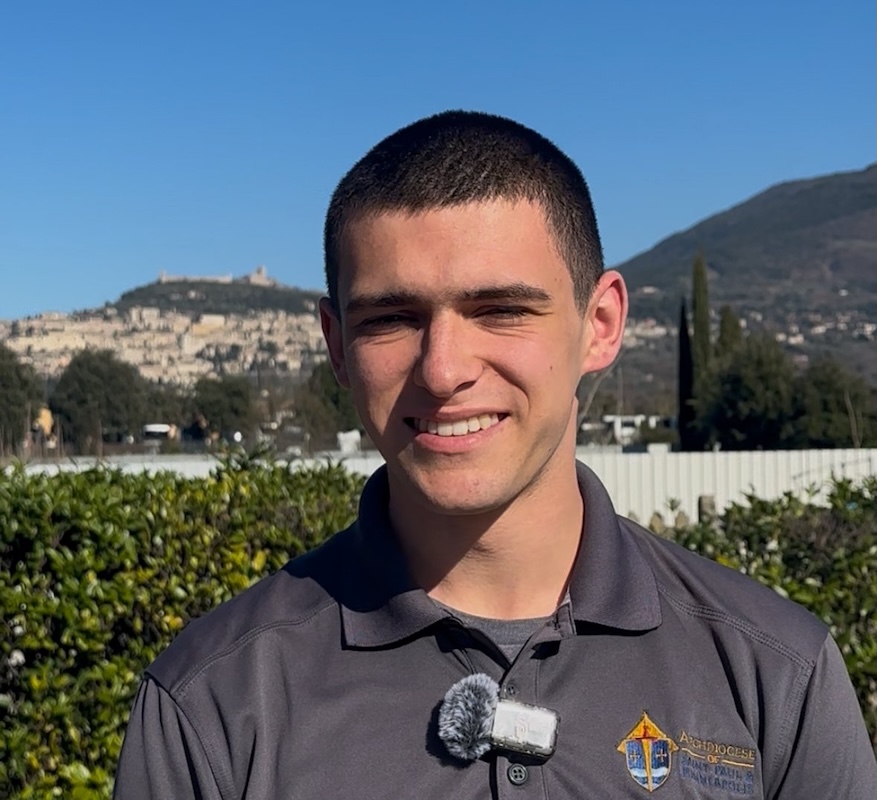
Gregory Maloney from the Archdiocese of St. Paul and Minneapolis is pictured Feb. 22, 2026, in Assisi, Italy. The 21-year-old seminarian said that visiting the relics of St. Francis was an opportunity for him to ask for the gift of a deeper conversion “to grow in the virtue of poverty.” (OSV News photo/Courtney Mares)

For 21-year-old seminarian Gregory Maloney from the Archdiocese of St. Paul and Minneapolis, the moment was an opportunity to ask St. Francis for the gift of a deeper conversion “to grow in the virtue of poverty.” 

He said that the long wait in line to view the relics gave him an opportunity to reflect on the life of St. Francis in prayer. “Here is the man who wanted to live poverty as Christ really said it in the Gospel,” Maloney said. “He wanted to give up his whole life, to give up all the things of the world to focus on the pearl of great price … the treasure of heaven.”

“And so that was a great encouragement for me then to say, ‘OK, what are the areas in my life I need to give to the Lord? I need to focus more on the things of heaven,” the seminarian added.

Opening of the sarcophagus

Monks prepare the relics of St. Francis of Assisi in the crypt of the basilica in Assisi, Italy, Feb. 21, 2026, for public veneration, which began Feb. 22 and runs through March 22. (OSV News photo/courtesy Sala Stampa Sacro Convento Assisi)

Franciscan friars opened the sarcophagus to exhume St. Francis’ remains Feb. 21, placing his bones on a specially prepared table in the crypt before carrying them in procession through the Lower Church while praying the Litany of the Saints. 

Franciscans from across the world participated in a solemn vespers with the exposed relics beneath the basilica’s frescoed ceiling on the evening before the relics opened to the public.

Friar Ignacio Ceja Jimenez, a Franciscan friar from Mexico, called it a historic moment of fraternity for all branches of the Franciscan family “because we all recognize ourselves as children of St. Francis, heirs to his charism.”

“Seeing and praying before the body of St. Francis also means that we must commit ourselves to living what he lived,” he said.

Gospel’s transformative power

“St. Francis reminds us that the Gospel can not only transform human beings, hearts, but that the Gospel can also transform the structures of our world and help us build a fraternal, peaceful world.”

Cardinal Ángel Fernández Artime, the pontifical delegate for the Papal Basilicas of Assisi, presided over both the vespers and the inaugural Mass Feb. 22. 

The cardinal recalled St. Francis’ final hours on Oct. 3, 1226, in his homily for the Feb. 21 vespers.

“When St. Francis felt his death approaching, he asked a friar to read the Gospel to him. Not just any passage, but chapter 13 of John: ‘Before the feast of the Passover, Jesus, knowing that his hour had come … having loved his own who were in the world, he loved them to the end,'” Cardinal Artime said.

“His life had been this: a constant listening to the Word, a burning desire to conform himself to the poor and crucified Christ. Service and self-sacrificing love are the heart of Francis’s spirituality.”

Advice for those unable to get to Assisi

Brother Jimmy Zammit of Toronto, now based in Rome as general definitor for the Franciscan order, shared his advice for Catholics unable to make the trip to Assisi who want to live out the special Jubilee Year of St. Francis in a particular way.

“If our heart becomes more Franciscan, we become makers of peace,” Brother Zammit said. “We seek out to help those who are less fortunate than we are to help the poor, but also to help those who are suffering because they’re feeling isolated and maybe even shunned in some way.”

Approximately 370,000 people from five continents have registered to venerate the relics, with Italians making up 80% of registrants. International registrations include 5,000 from the United States, 3,100 from Croatia, 2,000 from Slovakia and 1,500 each from Brazil and France. Some 400 volunteers from dozens of countries are giving of their time to make the monthlong historic event possible. 

Free to viewing relics but registration needed

Entry to view St. Francis’ relics is free, but it requires advance registration at saintfrancisliveson.org. The exposition will close with Mass on March 22 in the Upper Church, to be presided over by Cardinal Matteo Maria Zuppi, archbishop of Bologna and president of the Italian Episcopal Conference.


A banner noting the 800th anniversary of the death of St. Francis occurring in 2026 hangs outside the Basilica of St. Francis in Assisi, Italy, Feb. 22, 2026. (OSV News photo/Courtney Mares)


“We are experiencing an event of extraordinary grace: For an entire month, in this holy land where St. Francis of Assisi lived and was buried, the exposition of his body is offered for the veneration of the faithful, on the eighth centenary of his death,” Cardinal Artime said.

“This body, fragile and poor, reminds us that the Gospel is also lived with the body, with real choices, with daily gestures. Francis did not love an idea of Christ: He loved Christ, poor and crucified, to the point of bearing his marks in his flesh.”

Courtney Mares is Vatican editor for OSV News. Follow her on X @catholicourtney.

Pope Leo XIV introduction to the book "Peace Be with You!"


Cover of Pope Leo's book "Peace Be with You!"Cover of Pope Leo's book "Peace Be with You!" 

Pope Leo XIV: Only peaceful hearts can build just and lasting peace

We publish the text of Pope Leo XIV’s new introduction to the book “Peace Be with You!” published by HarperCollins and available in bookstores in the United States and English-speaking countries starting February 24, which is the English-language version of the volume “E pace sia!” published in August 2025 by the Vatican Publishing House.

By Pope Leo XIV

Peace is one of the great issues of our time and is both a gift and a commitment: a gift from God built by men and women throughout the ages.

We live in a world wounded by too many conflicts and struck by bloody hostilities. Bitter nationalism tramples on the rights of the weakest. Even before it is crushed on the battlefield, peace is defeated in the human heart when we give in to selfishness and greed and when we allow partisan interests to prevail instead of looking to the common good. Many writers have said that it is when we refuse to listen to other people’s stories that we begin to deprive them of their dignity. Depersonalizing others is the first step in any war. To know others, on the other hand, is a foretaste of peace. But in order to know, one must first know how to love. Saint Augustine said that “no one can be known except through friendship” (Eighty-three Different Questions, 71).

I would like to reflect here on this dual dimension of peace, which is vertical (peace as a gift from Above) and horizontal (peace as the responsibility of each person).

Peace is a gift that God has given to men and women of every age through Jesus’ birth in Bethlehem. The angels announced peace on earth because God became man. He embraced humanity so deeply that with his cross he destroyed the enmity of sin. Saint Augustine writes: “We, too, shall be a source of additional glory to God in the highest when, after the resurrection of our spiritual body, we shall be lifted up in the clouds to meet Christ, on condition, of course, that we work for peace with good will while we are here on earth” (Sermons, 193). The glory of God descended upon the earth to make us participants in his infinite goodness. This gift calls into action the responsibility of our answer, of our “good will”, as the Saint of Hippo writes.

Furthermore, peace is the gift that the Risen One gave to his disciples. It is a peace “injured” by the wounds of the crucifixion, because Jesus’ peace gushes forth from a heart that loves and lets itself be struck by the suffering of every time and place. “The Lord appeared to His disciples after His resurrection, as ye have heard, and saluted them, saying, ‘Peace be unto you.’ This is peace indeed, and the salutation of salvation: for the very word salutation has received its name from salvation” (Saint Augustine, Sermons, 116).

However, peace is also a commitment and responsibility for each one of us. Peace means teaching children to respect others and not to bully others when they play. Peace means overcoming our personal pride and making room for the other, in our family, at work, in sports. Peace is when our heart and our life are inhabited by silence, meditation and listening to God; because God never blesses violence, he never approves of taking advantage of others, or of the frenzied abuse of the one Earth that is disfiguring Creation, a caress of the Creator.

We may feel powerless before the many wars being fought around the world. We can respond in various ways to what I called the ‘globalization of powerlessness’: believers can, first and foremost, give voice to prayer. Prayer is an “unarmed” force that that seeks only the common good, without exclusions. By praying, we disarm our ego and become capable of gratuitousness and sincerity.

Moreover, our heart is the most important battlefield. It is there that we must learn the bloodless but necessary victory over the impulses of death and the tendencies toward domination: only peaceful hearts can build a world of peace. We must practice a culture of reconciliation, by creating non-violent workshops, places where suspicion of others can become an opportunity for encounter. The heart is the source of peace: there we must learn to meet rather than clash with each other, to trust and not of mistrust, to listen and understand instead of closing ourselves to others.

Finally, politics and the international community are responsible for facilitating the mediation of conflicts, utilizing the arts of dialogue and diplomacy. “O Lord God, grant your peace to us…, the peace of rest, the peace of the Sabbath which has no evening”: with these words of Augustine, let us ask the Father to grant our world, all people, especially those who are most forgotten and who suffer the most, the blessing grace of a just and lasting peace.

Monday, February 23, 2026

Cardinal Dolan reveals JD Vance apology, discusses NY Mayor and new NY Archbishop

 Cardinal Dolan says Vance apologized for claiming bishops were pro-immigrant for the money

(RNS) — Despite Dolan’s condemnation of Vance’s comments, he said in the EWTN interview that Vance is 'a very good guy. I enjoy him a lot.'


Cardinal Timothy Dolan, left, and Vice President JD Vance. (Screen grab; AP Photo/Jon Cherry)


Aleja Hertzler-McCain

(RNS) — Vice President JD Vance apologized to Cardinal Timothy Dolan for his accusations that Catholic bishops expressed concerns about immigration issues because they were motivated by money, the cardinal said in an interview on EWTN, a large Catholic television network, released Thursday (Feb. 19).

“He and I had a little tête-à-tête, you probably know, when he suggested that bishops in the United States were pro-immigrant because we were making money, which I said was not only untrue, but it was also scurrilous. And he apologized. All right? He says that was out of line, and that’s not true,” Dolan, who retired as archbishop of New York in December, told Mark Irons in an interview on “EWTN News in Depth” that touched on many political topics.

Vance, a Catholic, made the comments about the bishops’ “bottom line” in his first television interview after becoming vice president when he was asked by CBS’ Margaret Brennan about bishops’ concerns over an executive order lifting restrictions on Immigration and Customs Enforcement raids on schools and houses of worship, signed by President Donald Trump early in 2025.

“I think that the US Conference of Catholic Bishops needs to actually look in the mirror a little bit and recognize that when they receive over $100 million to help resettle illegal immigrants, are they worried about humanitarian concerns? Or are they actually worried about their bottom line?” Vance said.

In 2024, the U.S. Conference of Catholic Bishops received more than $180 million dollars in federal government contracts for programs assisting refugees and unaccompanied migrant children. Refugees enter the U.S. legally after being vetted by the federal government. Until recently in the past year, refugees were not typically the targets of immigration enforcement agencies.


U.S. bishops have repeatedly said they spend more on their work with refugees than they receive. In 2024, they spent more than $179 million on those programs, while in 2023, they spent upward of $130 million, almost $1 million more than they received in government grants.

Despite publicly defending their history of working with refugees, in April 2025, the conference announced they would not seek to renew their agreements with the federal government to support refugees and unaccompanied minors.

The announcement came after months of uncertainty over whether the federal government would reimburse refugee agencies for their work, even though a federal judge formally blocked the administration’s suspension of the refugee resettlement program.

Despite Dolan’s condemnation of Vance’s comments, he told Irons in the EWTN interview that Vance is “a very good guy. I enjoy him a lot. I agree with a bunch of stuff that he talks about.”

Dolan said he and Vance find agreement when the vice president speaks about family, babies, patriotism and “the beauty of what the United States stands for,” but they also don’t agree on Ukraine.

Of politicians, Dolan said, “You’re not going to get anybody batting a thousand,” making an analogy to baseball, where even legendary players only get a hit about a third of the time they’re at bat.

The cardinal used the same analogy when talking about New York Mayor Zohran Mamdani, a Muslim. “If a politician gets a C+, it ain’t bad,” he said of Mamdani. (He declined to give Vance a letter grade.)

“I’m afraid he would be an avowed, a Democrat, meaning he’s not pro-life, right? You worry, is he going to protect religious liberty? You worry if he’s going to protect the dignity and the definition of the family,” said Dolan. 

But the cardinal said, “We may have some other areas where we’re saying ‘hey, not bad,’ such as openness to the immigrant, his desire for fair housing, his earnest desire to increase the income and the prosperity of most of the people in this town.”

Dolan said he was “ticked off” that Mamdani hadn’t invited Dolan to his inauguration, that Mamdani didn’t attend Archbishop Ronald Hicks’ installation nor have many Catholics on his transition team.

Of Hicks, his successor, Dolan said, “What a gem he is.”

The cardinal said he had asked Mamdani “point blank” why he was a socialist, saying a socialist is defined by supporting “government ownership of the means of production.”

Dolan said Mamdani replied, “I’m not that. I’m an economic socialist in that I want greater distribution of the wealth.” Dolan said, “Well, who doesn’t?”

Mamdani is a democratic socialist. The Democratic Socialists of America say their vision “pushes further than historic social democracy and leaves behind authoritarian visions of socialism in the dustbin of history,” opposes capitalism and works to build “a system where ordinary people have a real voice in our workplaces, neighborhoods, and society.”

Dolan has been considered a favorite of Trump, who said Dolan should be pope in the leadup to the 2025 conclave, and he sits on Trump’s Religious Liberty Commission.

“I’m very happy with the administration that takes religious freedom very seriously,” Dolan told Irons.

But Dolan said he was “upset” with the Trump administration for not taking greater efforts to restrict access to pills that can be used for abortions and for its approach to immigration enforcement.

Pills used for abortion are bad, said Dolan, because “it kind of strengthens the opinion that pregnancy is a disease — that a baby in the womb is someone to get rid of if it happens to be inconvenient or untimely.”

Dolan said he and the Rev. Franklin Graham became very worried “when ICE started going into churches and harassing churches.”

The cardinal said, “ICE would show up on Sunday Mass just in trucks and cars, and the people wouldn’t come.”

“This is a violation of religious freedom,” Dolan said. “People have the right to worship on the Sabbath.”

Dolan said he and Graham spoke with the director of ICE in New York, who committed to stop those actions. “I have yet to hear of any other pastor since then tell me they’re harassing or outside the churches,” said Dolan.

In the interview, Dolan condemned New York Governor Kathy Hochul, who is Catholic, for supporting legislation legalizing medically assisted suicide for terminally ill people, and he decried the University of Notre Dame’s appointment of Susan Ostermann, who has publicly supported abortion rights, to direct the Liu Institute for Asia and Asian Studies.

Dolan also spoke about this year’s 250th anniversary of the U.S. and celebrated that Catholics had grown from a small minority at the country’s founding to a major presence in the population and in public life.

Saying “Catholic values and American values are very similar,” he named the Bible, prayer, faith, religious freedom, “one nation under God,” the family, the principle of subsidiarity or local decision-making, democracy and the “drive to protect the common good” as examples.

“Those are Catholic values. Those are American values,” he said.