reflections, updates and homilies from Deacon Mike Talbot inspired by the following words from my ordination: Receive the Gospel of Christ whose herald you have become. Believe what you read, teach what you believe and practice what you teach...
Pope's audiences temporarily suspended in July for summer break
Pope Francis' audiences will be suspended in July for the summer break and are set to resume in August, with the final Wednesday General Audience taking place on 28 June.
By Vatican News staff reporter
In keeping with custom during the summer season, all of Pope Francis' audiences - including the General Audiences and those with particular groups - will be temporarily suspended throughout the month of July.
The Prefecture of the Papal Household made this announcement through a statement released by the Holy See Press Office.
Papal audiences will resume in August, with the first General Audience scheduled for Wednesday, 9 August.
The final Audience before the summer break, which takes place on Wednesday, 28 June, in St. Peter's Square, marks the first General Audience following the Holy Father's recent hospitalization at Gemelli Hospital for surgery on an abdominal hernia.
The Director of the Holy See Press Office, Matteo Bruni, had announced the cancellation of last Wednesday's scheduled Audience on 21 June in order to allow the Holy Father to rest and recover from his 7 June surgery.
Cardinal Krajewski visits Ukraine on ‘evangelical expedition’
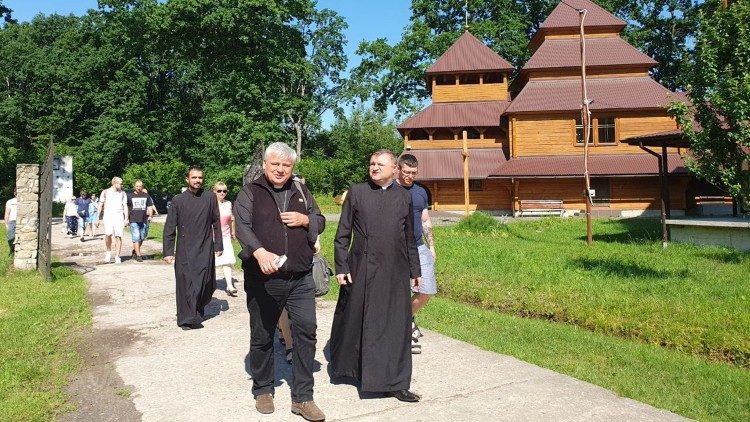
Cardinal Konrad Krajewski, the Papal Almoner, is currently visiting the Ukrainian city of Kherson for his sixth mission to provide aid and solace to the war-torn country and its affected population.
By Salvatore Cernuzio
Cardinal Konrad Krajewski, the Prefect of the Dicastery for the Service of Charity, arrived in Kherson on Tuesday as part of his most recent mission to war-torn Ukraine.
In a voice message sent to Vatican News, the Cardinal referred to this endeavor as an "evangelical expedition."
In recent weeks, the southern Ukrainian city of Kherson experienced the destruction of the Kakhovka hydroelectric dam, resulting in the flooding of more than 80 villages and towns, the devastation of 20,000 hectares of farmland, and the spilling of over 150 tons of oil.
Cardinal Krajewski arrived in Kherson, driving a truck laden with food supplies (mainly sourced from South Korea, including over 100,000 freeze-dried soups).
He also brought with him vital medicines from the Vatican, Gemelli Hospital, and a solidarity fund based in Naples.
Humanitarian mission
Departing from Rome on June 22, the Cardinal embarked on a journey of over 3,125 kilometers. "So many roads, so many kilometers," he recounted.
After spending Sunday night in the Ukrainian city of Odessa, Cardinal Krajewski visited Drohobyč on Monday, the area's second-largest economic center located nearly 100 kilometers from Lviv.
He toured a Greek Catholic humanitarian center that extends aid and refuge to those in need. The Cardinal then visited a local hospital, a center for alcoholics, and a children's center, which now serves as a sanctuary for refugees during vacations.
On Tuesday, Cardinal Krajewski traveled to Mikołajów, where he visited an active parish that remarkably remains open despite extensive Russian bombardment.
The papal almoner spent a few hours with the local parish priest, expressing gratitude for his unwavering dedication and courage. He also expressed his appreciation to the people who chose not to flee. Together, they engaged in prayer using the Pope's Rosaries, which the Cardinal presented as gifts.
Vital humanitarian aid and spiritual support
Bishop Jan Sobiło, auxiliary of Kharkiv-Zaporizhzhia, accompanied the almoner throughout his journey.
As they visited Kherson, Cardinal Krajewski said they “promptly unloaded vital first aid medicines. A doctor then sorted the medicines, after which ambulances arrived to distribute them to various clinics and hospitals.”
His itinerary included a visit to the city center, which the Cardinal described as almost deserted, with closed establishments.
"Every now and then,” he said, “we hear sirens, and upon entering, we witness ongoing bombing. A kilometer away, we could observe smoke and fire. Even last night, the city faced attacks."
Nevertheless, he added, "Together with the parish priest, we have visited people, engaged in conversations, and provided concrete assistance."
The Greek Catholic Basilians awaited Cardinal Krajewski's arrival on Tuesday evening. “We will offer them consolation and the embrace of the Pope, conveying the message that he thinks of them, and that not a day passes in which he fails to pray for Ukraine and those who suffer.”
Pope Francis’ closeness to Ukrainians
The Cardinal is set to undertake extensive travel in the upcoming days.
"We will stay in Kherson for two days, and then perhaps proceed to Kyiv,” he said. “|I am eager to meet the communities, as we have also received immense support from these people."
The final phase of the mission will take place in Lviv, a city that Cardinal Krajewski has frequently visited during his previous trips to Ukraine.
"There are still numerous kilometers ahead, and on the journey back, who knows how many more encounters and moments of prayer await us,” said the Cardinal.
Although no return dates have been specified, Cardinal Krajewski’s objective remains unflinching, aligned with his previous missions.
“We must be near to these people in the name of the Holy Father. Words are insufficient; presence is paramount,” said the Cardinal.
“Let us pray for all of them," he urged, “ and let us pray for ourselves, so that we may not become desensitized to the realities of war, but continue to offer aid to those in need.”
Cardinal Zuppi to visit Moscow as Pope Francis' peace envoy
Pope Francis is sending Cardinal Matteo Maria Zuppi as his envoy to Moscow to foster dialogue and seek a peaceful solution to Russia’s war in Ukraine.
By Devin Watkins
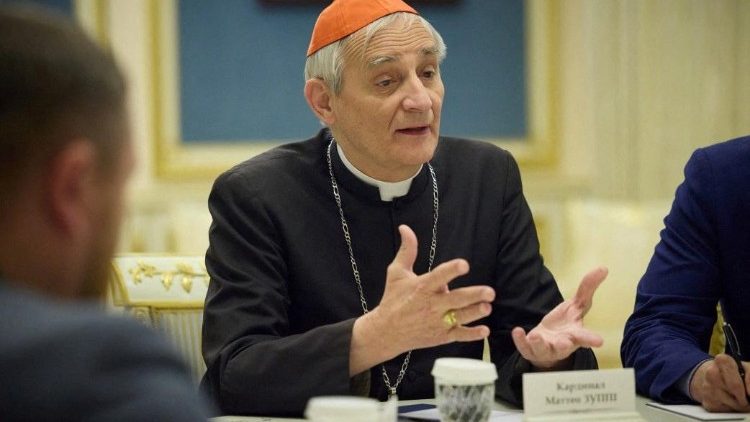
The Holy See Press Office confirmed on Tuesday that Cardinal Matteo Maria Zuppi, Archbishop of Bologna and President of the Italian Bishops' Conference, will embark on a visit to Moscow as an envoy of Pope Francis.
The visit, scheduled for 28-29 June 2023, aims to strengthen “gestures of humanity that can contribute to promoting a solution to the current tragic situation and find paths toward a just peace.”
Cardinal Zuppi will be accompanied by an Official from the Secretariat of State.
As he visits Moscow, Cardinal Zuppi will likely uphold Pope Francis desire for a resolution to the war on the European continent.
The Pope has been a vocal advocate for peace, consistently calling on world leaders and individuals alike to work towards resolving conflict through peaceful means.
He has made countless appeals for prayers for people suffering due to the war in Ukraine.
Previous visit to Kyiv
The Italian-born Cardinal’s visit comes on the heels of his previous visit to Kyiv, on 5-6 June, during which he met with Ukrainian President Volodymyr Zelensky and other high-level government officials.
During the meeting, Cardinal Zuppi conveyed Pope Francis' concern for the Ukrainian people.
The Cardinal emphasized the need for parties involved to prioritize dialogue and find common ground for a just resolution to the war.
The meeting with President Zelensky provided an opportunity to discuss steps to alleviate suffering, rebuild trust, and advance reconciliation.
Cardinal Zuppi reiterated the Vatican's readiness to assist through diplomatic channels and humanitarian initiatives.
As the papal peace envoy, Cardinal Zuppi's visit to Moscow seeks to underscore the Holy See’s dedication to actively engage in peacebuilding efforts and collaborate with international partners on behalf of peace.
Pope Francis Appoints Bishop Christopher Coyne as Coadjutor Archbishop of Hartford
WASHINGTON - Pope Francis has appointed Most Reverend Christopher J. Coyne, bishop of Burlington, as Coadjutor Archbishop of Hartford.
The appointment was publicized in Washington, D.C. on June 26, 2023, by Archbishop Christophe Pierre, apostolic nuncio to the United States. Archbishop Leonard P. Blair is the current archbishop of Hartford, and the appointment as coadjutor archbishop confers on Bishop Coyne the right of succession for the Archdiocese of Hartford.
The Archdiocese of Hartford is comprised of 2,288 square miles in the State of Connecticut and has a total population of 1,926,810 of which 427,669, are Catholic.
Pope Francis Accepts Resignation of Bishop Richard Stika of Knoxville and Appoints the Archbishop of Louisville as Apostolic Administrator
WASHINGTON - Pope Francis has accepted the resignation of the Most Reverend Richard F. Stika from the pastoral governance of the Diocese of Knoxville. At the same time, the Holy See has appointed the Most Reverend Shelton J. Fabre of Louisville, as the Apostolic Administrator of the Diocese of Knoxville to serve until the appointment and installation of the new bishop.
The resignation and appointment were publicized in Washington, D.C. on June 27, 2023, by Archbishop Christophe Pierre, apostolic nuncio to the United States.
The Diocese of Knoxville is comprised of 14,242 square miles in the State of Tennessee and has a total population of 2,509,421 of which 68,075, are Catholic.
St. Cyril of Alexandria, Bishop and Doctor of the Church (June 27) Cyril was born at Alexandria, Egypt. He was nephew of the patriarch of that city, Theophilus. Cyril received a classical and theological education at Alexandria and was ordained by his uncle. He accompanied Theophilus to Constantinople in 403 and was present at the Synod of the Oak that deposed John Chrysostom, whom he believed guilty of the charges against him. He succeeded his uncle Theophilus as patriarch of Alexandria on Theophilus' death in 412, but only after a riot between Cyril's supporters and the followers of his rival Timotheus. Cyril at once began a series of attacks against the Novatians, whose churches he closed; the Jews, whom he drove from the city; and governor Orestes, with whom he disagreed about some of his actions. In 430 Cyril became embroiled with Nestorius, patriarch of Constantinople, who was preaching that Mary was not the Mother of God since Christ was Divine and not human, and consequently she should not have the word theotokos (God-bearer) applied to her. He persuaded Pope Celestine I to convoke a synod at Rome, which condemned Nestorius, and then did the same at his own synod in Alexandria. Celestine directed Cyril to depose Nestorius, and in 431, Cyril presided over the third General Council at Ephesus, attended by some two hundred bishops, which condemned all the tenets of Nestorius and his followers before the arrival of ArchbishopJohn of Antioch and forty-two followers who believed Nestorius was innocent. When they found what had been done, they held a council of their own and deposed Cyril. Emperor Theodosius II arrested both Cyril and Nestorius but released Cyril on the arrival of Papal Legates who confirmed the council's actions against Nestorius and declared Cyril innocent of all charges. Two years later, Archbishop John, representing the moderate Antiochene bishops, and Cyril reached an agreement and joined in the condemnation, and Nestorius was forced into exile. During the rest of his life, Cyril wrote treatises that clarified the doctrines of the Trinity and the Incarnation and that helped prevent Nestorianism and Pelagianism from taking long-term deep root in the Christian community. He was the most brilliant theologian of the Alexandrian tradition. His writings are characterized by accurate thinking, precise exposition, and great reasoning skills. Among his writings are commentaries on John, Luke, and the Pentateuch, treatises on dogmatic theology, and Apologia against Julian the Apostate, and letters and sermons. He was declared a doctor of the Church by Pope Leo XIII in 1882. His feast day is June 27th.
Black nun who founded first African American religious congregation advances closer to sainthood
By LUIS ANDRES HENAOJune 23, 2023
Mother Mary Elizabeth Lange -- a Black Catholic nun who founded the United States’ first African American religious congregation in Baltimore in 1829 -- has advanced another step toward sainthood.
Under a decree signed by Pope Francis on Thursday, Lange was recognized for her heroic virtue, and advanced in the cause of her beatification from being considered a servant of God to a “venerable servant.” The Catholic Church must now approve a miracle that is attributed to her, so she can be beatified.
Lange grew up in a wealthy family of African origin, but she left Cuba in the early 1800s for the U.S. due to racial discrimination, according to the Vatican’s saint-making office. After encountering more discrimination in the southern U.S., she moved with her family to Baltimore. Recognizing a need to provide education for Black children in the city, she started a school in 1828, decades before the Civil War and the abolition of slavery.
In 1829, she founded the Oblate Sisters of Providence -- the country’s first African American religious congregation. They were trailblazers for generations of Black Catholic nuns who persevered despite being overlooked or suppressed by those who resented or disrespected them.
The Oblate Sisters continue to operate Baltimore’s Saint Frances Academy, which Lange founded. The coed school is the country’s oldest continually operating Black Catholic educational facility, with a mission prioritizing help for “the poor and the neglected.”
“She lived her virtuous existence in a hostile social and ecclesial context, in which the preeminent opinion was in favor of slavery, personally suffering the situation of marginalization and poverty in which the African American population found itself,” the Vatican’s saint-making office wrote.
Lange is among three Black nuns from the U.S. designated by Catholic officials as worthy of consideration for sainthood. The others include Henriette Delille, who founded the New Orleans-based Sisters of the Holy Family in 1842 because white sisterhoods in Louisiana refused to accept African Americans, and Sister Thea Bowman, a beloved educator, evangelist and singer active for many decades before her death in 1990.
Pope Francis’s advancement of Lange’s sainthood cause “is a monumental step forward in the long fight for Black Catholic saints in the United States and for recognition for the nation’s long embattled African American Catholic community, especially nuns,” said Shannen Dee Williams, a history professor at the University of Dayton and author of “ Subversive Habits: Black Catholic Nuns in the Long African American Freedom Struggle.”
Currently there are no recognized African American saints. Williams said Lange joins three other African American sainthood candidates who have been declared “venerable — Delille, Father Augustus Tolton and Pierre Toussaint.
Williams said only one Black woman has been declared a saint in the modern era — St. Josephine Bakhita, a formerly enslaved Sudanese nun who made “the extraordinary journey from slavery under Islamic auspices to freedom in an Italian Catholic convent in the late 19th century.”
“This is why Lange’s cause is so important and revolutionary,” Williams said via email. “There is absolutely no way to tell Lange’s story or the story of her order accurately or honestly without confronting the Catholic Church’s mostly unreconciled histories of colonialism, slavery, and segregation.”
Williams said that unlike most of their counterparts in religious life, Lange and the Oblate Sisters of Providence were not segregationists, and never barred anyone from their ranks or institutions based on color or race. Instead, Williams said, Lange’s multiethnic and multilingual order preserved the vocations of hundreds of Black Catholic women and girls denied admission into white congregations in the United States, Canada, Latin America and the Caribbean.
“Lange and her Oblate Sisters of Providence’s very existence embody the fundamental truth that Black history always has been Catholic history in the land area that became the United States.” Williams said,
Their story “upends the enduring myth that slaveholding and segregationist Catholic priests and nuns were simply people ‘of their times.’” Williams said. “Mother Lange and the Oblate Sisters of Providence were also people of those times.”
UPDATE: Vatican-ordered investigation targets Bishop Strickland of Tyler, Texas
CNA Newsroom, Jun 25, 2023 / 11:11 am
The Vatican’s Dicastery for Bishops has completed a formal investigation of Bishop Joseph E. Strickland and the Diocese of Tyler, Texas, according to multiple media reports and confirmed by EWTN News.
The inquiry, known as an apostolic visitation, marks a rare though not unprecedented intervention by Rome into a U.S. diocese and points to possible disciplinary action against Strickland, a widely popular though polarizing Texas firebrand viewed as a culture war champion by many U.S. conservatives for his staunch defense of the unborn, marriage, the traditional Latin liturgy, and Catholic orthodoxy.
The leader of the eastern Texas diocese since 2012, Strickland, 64, has faced criticism for what some see as intemperate social media posts unbecoming of a prominent U.S. prelate, including a May 12 tweet that suggested Pope Francis was “undermining the Deposit of Faith.”
Not one to sit on the sidelines, he recently played a prominent role in a eucharistic procession and prayer rally in Los Angeles on June 16 organized to protest Major League Baseball’s Los Angeles Dodgers for honoring an anti-Catholic drag group at the team’s annual Pride Night game.
Though he was hailed for his leadership in some circles for joining the Dodgers protest, others saw the involvement of a bishop from another diocese as a breach of ecclesiastical protocol. The Archdiocese of Los Angeles, which condemned the Dodgers’ actions, emphasized in a statement that it had not given “backing or approval” for the rally.
More recently, on June 21, Strickland criticized a newly released Vatican document that suggests topics for discussion at an October assembly tied to the ongoing Synod on Synodality — including questions related to women deacons, married priests, and calls for greater inclusion for LGBT people.
“It is a travesty that these things are even proposed for discussion. I pray that all who truly know Jesus Christ will not be deceived by this path,” he tweeted. “The Gospel welcomes all to repentance & sanctity, if there is no repentance the barriers to sanctity remain.”
News of the Vatican investigation began to circulate among Catholic outlets on Saturday, citing unnamed sources familiar with the matter.
According to a source in the diocese who spoke with EWTN News on background, the apostolic visitation consisted of interviews with diocesan clergy and laity throughout the preceding week before concluding on Saturday morning with a meeting with Strickland. Bishop Emeritus Gerald Kicanas of Tucson and Bishop Dennis Sullivan of Camden, New Jersey, led the inquiry.
According to the source, the process addressed the bishop’s social media use but also questions related to diocesan management.
During Strickland’s 10-plus years at the helm of Tyler, the diocese has experienced some noteworthy changes, such as the 2018 resignation of three diocesan officials, a move Strickland said at the time would position the diocese to best fulfill its mission.
But Strickland’s tenure has also coincided with positive signs of spiritual and administrative health in Tyler. Currently, 21 men are in priestly formation for the territory of only 55,000 Catholics, a rate of seminarians-per-Catholic considerably higher than most other U.S. dioceses. The diocese is also reportedly in good financial shape, exemplified in part by the its ability to raise 99% of its $2.3 million goal for the 2021 bishop’s appeal six months ahead of schedule.
The path forward following the apostolic visitation remains uncertain. While one source described as someone close to Strickland told the Pillar that the Tyler bishop “doesn’t want to make too big of a deal” of the visitation, a priest related that interviewers “were already asking questions about who might be a good fit to replace [Strickland].”
According to the Dicastery for the Doctrine of the Faith (DDF), an apostolic visitation is an “exceptional initiative of the Holy See” that involves a delegated visitor or visitors being sent to evaluate an ecclesial institute, such as a seminary, diocese, or religious order, on behalf of the pope.
“Apostolic visitations are intended to assist the institute in question to improve the way in which it carries out its function in the life of the Church,” according to a glossary of terms provided by the DDF.
An apostolic visitation is a specific form of canonical visitation, which is any instance of an ecclesial superior visiting or sending a delegate to persons or institutions under their authority to maintain sound doctrine and morals or correct abuses. The pope can initiate apostolic visitations throughout the universal Church in his capacity as the supreme pontiff.
Apostolic visitors differ from other papal delegates, such as nuncios assigned to a specific country, in that their mission is more specific and transient, usually focused on a particular episode or emergency that has emerged. The scope and abilities of a specific apostolic visitation are determined by their associated mandate given by the pope, and conclude when the responsible delegate submits a formal written report to the Holy See.
The practice has been employed frequently by Pope Francis during his 10 years as pontiff.
Pope thanks hospital staff for post-operation 'fraternal care and attention'
Pope Francis pens a letter of thanks addressed to the President of the Foundation that runs the Gemelli Hospital where he recently underwent surgery for an abdominal hernia.
By Linda Bordoni
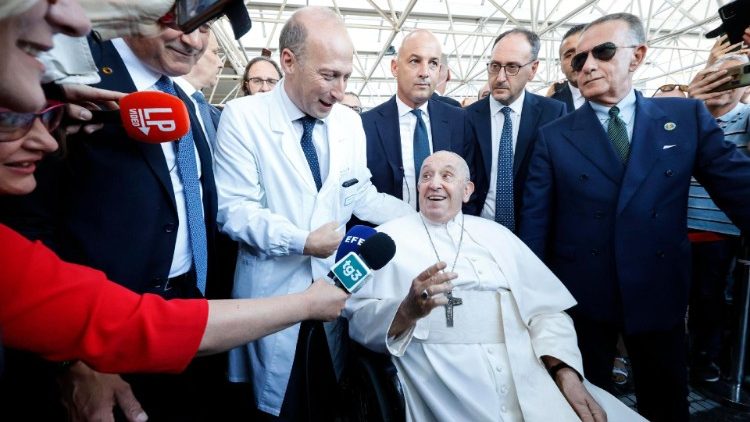
Describing Rome’s Gemelli Hospital where he was recently operated upon and spent nine days of post-surgical recovery as “a place of suffering and hope”, Pope Francis sends a letter of gratitude to the entire hospital staff, whose care and attention, he said, were crucial in helping him get better.
In the letter, addressed to Marco Elefanti, President of the “Policlinico Universitario Agostino Gemelli Foundation”, the Pope writes of his wish to express gratitude for how he was cared for after his recent surgery.
The Pope was admitted to the hospital on 7 June and underwent abdominal surgery to repair a hernia and remove scarring from previous operations. He was discharged on 16 June, with his surgeon, Dr Alfieri, describing him as "better than before" his nine-day hospitalization.
It was the third time the pontiff received treatment at the hospital after having undergone surgery for a “symptomatic diverticular stenosis of the colon” in July 2021 and three days of treatment for bronchitis in March 2023.
A place of suffering and hope
“In that place of suffering and hope, I was once again able to enjoy the family-like, fraternal and welcoming atmosphere, which was greatly helpful for my recovery after the operation,” he writes.
The Pope says his “heartfelt appreciation goes to the entire Gemelli Hospital community for its human and spiritual closeness.”
Concluding, he sends his blessings, asks for prayers, and “fraternally” assures Dr Elefanti of his own prayers for him and his family.
A note released by hospital Board Directors says they have shared "the joy and emotion for the words of the Holy Father,“ with the entire staff.