Saturday, April 29, 2023

Pope Francis meets with Russian Orthodox Patriarch in Budapest


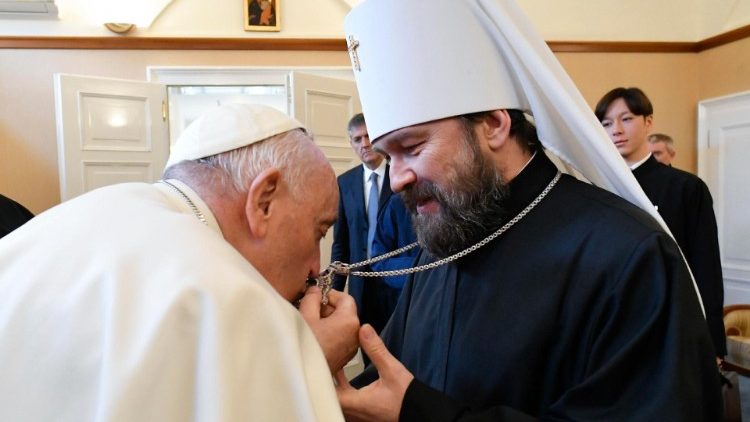
Pope Francis receives Metropolitan Hilarion in the Nunciature in BudapestPope Francis receives Metropolitan Hilarion in the Nunciature in Budapest  (ANSA)

Pope meets with Metropolitan Hilarion in Budapest

Pope Francis holds a “cordial” meeting at the Apostolic Nunciature with the Russian Orthodox Metropolitan Archbishop of Budapest and Hungary, who previously served as the head of the Department of External Relations of the Patriarchate of Moscow.

By Vatican News staff reporter

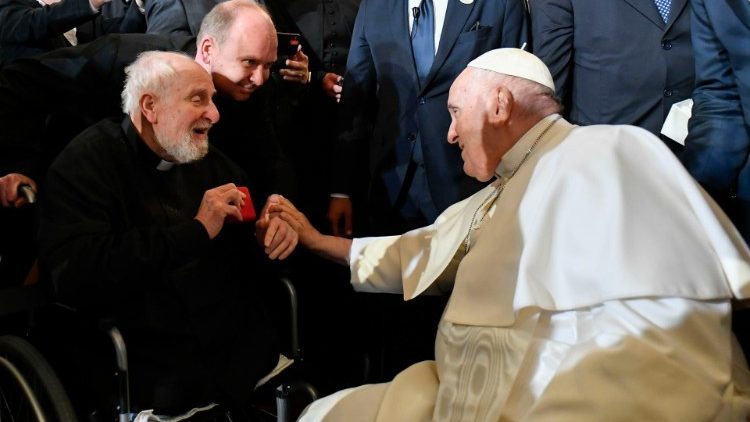
After his morning appointments on the second day of his visit to Hungary, Pope Francis met privately on Saturday with Archbishop Hilarion, the Metropolitan Archbishop of Budapest and Hungary, in the Apostolic Nunciature where he is staying.

The former Metropolitan of Volokolamsk, Russia, was appointed to this post in June 2022, after serving for thirteen years as head of the Department of External Relations of the Patriarchate of Moscow, and was known informally as Patriarch Kirill's "foreign minister".

A cordial meeting

The possibility of a meeting with Archbishop Hilarion had been anticipated by the Director of the Holy See Press Office, Matteo Bruni, on 21 April, during his briefing on Pope Francis’ Apostolic Journey to Hungary. Mr. Bruni stated, however, that an audience was not a part of the official agenda.

As reported by the Holy See, the audience, which took place with the help of an interpreter, was cordial and lasted about 20 minutes.

The Holy Father greeted the Metropolitan with a hug and kissed his pectoral cross.

Previous meetings

Pope Francis and Hilarion last met on 22 December 2021 in the Vatican. On that occasion, according to the Holy See Press Office, the pair discussed some issues of common concern and their commitment "to seek concrete human and spiritual responses".

The first meeting between Pope Francis and the Russian Orthodox Metropolitan took place on 20 March 2013, the day after the beginning of the Pope's Petrine ministry. It was followed by several other encounters, including the one on the occasion interreligious event “Brother Peoples, Future Land" organized by the Community of Sant'Egidio in Rome on 7 October 2021.

Pope Francis meets with Greek-Catholics in Hungary


Pope Francis blesses Greek Catholic Church in Hungary

Pope Francis pays a visit to the Greek Catholic community in Budapest, as he prays with the Catholics of the Byzantine rite in the Church of the Protection of the Mother of God.

By Francesca Merlo

Pope Francis paid a brief visit to the Greek Catholic community in Budapest on Saturday morning, the second day of his Apostolic Journey to Hungary.

After meeting with migrants and refugees at St. Elizabeth of Hungary Church, the Holy Father travelled to the nearby Protection of the Mother of God Church, located in the 7th Disctrict's Rose Square, which serves the Catholic faithful of the Byzantine rite.

The Pope was welcomed at the entrance by Archbishop Péter Fülöp Kocsis, the Metropolitan Archbishop of Hajdúdorog, and together they walked to the Iconostasis, while the choir sang in the background. 

After a brief greeting with the Archbishop there was a moment of prayer, led by Pope Francis, with the community. The Pope was handed a cross and blessed the Greek Catholic community of Hungary. 


About the church

The one-nave church, built in 1881 to a design by Győző Czigler, in the Neo-Romanesque style, was originally the Roman Catholic parish church in the neighbourhood.

As the number of worshippers grew rapidly, a huge plot of land in the middle of the same square was chosen to build a larger church. Thus was born the neo-Gothic parish church of St. Elisabeth of Hungary to plans by Imre Steindl. In 1904, therefore, the then-empty church building was given to the Greek Catholic parish, which did not yet have its own Church, and had, until then, operated in the university Church.

Greek Catholic Church in Hungary

The Hungarian Greek Catholic Church was reorganised by Pope Francis on 20 March 2015, and elevated to Metropolitan Church sui iuris.

The Greek Catholic Bishops in Hungary are members of the Hungarian Bishops' Conference with deliberative voting rights. The status of Metropolia sui iuris makes the Greek Catholic Church completely independent from the local Latin Church from a legal point of view, without in any way calling into question its full ecclesiological communion with the Pope. In the liturgy, the Hungarian Greek Catholic Church uses the national language.

Pope Francis meeting with young people in Hungary


Pope tells young Hungarians to aim high in life

Pope Francis meets with young people at the Papp László Sport Arena in Budapest and encourages them to “aim high in life”, reminding them that no one can take their place in the history of the Church and the world.

By Lisa Zengarini

“Invest in the great goals of life! Then, train through dialogue with Jesus, who is the best of coaches”. In the last public event of the second day of his Apostolic Journey to Hungary, Pope Francis encouraged youths to “aim high” in their lives, overcoming their fears and stepping forward, always dialoguing with Jesus, their best friend and brother.

The event, attended by some 12,000 people, was introduced by the greeting speech of the Hungarian lead bishop for Youth Ministry, Bishop Ferenc Palánki, and the testimonies of four youths: Bertalan, Dóra, two high-school students, Tódor, a young Greek-Catholic, and Krisztina, a university student.

Who dares wins

Taking his cue from the first testimony, Pope Francis reminded those gathered that “Jesus wants us to accomplish great things” in life and “never disparages our expectations”. 

“Jesus doesn’t want us to be lazy “couch potatoes”; he doesn’t want us to be quiet and timid; instead, he wants us to be alive, active, ready to take charge. Jesus would agree with a proverb of yours, which I hope I pronounce well: Aki mer az nyer [Those who dare, win the prize].”

But how do we win in life?”, the Pope asked.   “Just as in sports, there are two basic steps”.  The first step, he said, is “to aim high”, putting our talents “to good use”, investing them “in the great goals of life”.

“We don’t achieve greatness by treading upon others, but by serving others!”


Dialoguing with Jesus

The second step is to train through dialogue with Jesus, “who is the best of coaches”.  Indeed, said the Pope, “Jesus encourages you, believes in you” and “constantly invites you to be a team player, never alone but with others: in the Church, in the community, sharing your experiences with others”.

Another important element of this training, the Pope further remarked, is silence which was recalled in the testimony of Krisztina. In a world “bombarded with the message that we have to be fast, efficient and practically perfect, like machines”, said the Pope, “we have to learn how to stop and fill our tanks, to recharge our batteries”, without however, indulging “in moodiness or brood” over our troubles.

Silence, he remarked, “is not sitting glued to your cell phone, or on social media”, but rather “the soil on which we cultivate good relationships”. It “allows us to entrust to Jesus whatever we are feeling, (…), to share our difficulties, to remember our friends and to say a prayer for them”.

Silence is therefore, “the door to prayer”, which is a “dialogue with Jesus”, with whom we freely share our vulnerability “without hiding or disguising anything”.

“Prayer is not boring, it is an encounter with Christ”

The Lord wants authentic people

Indeed, “the Gospel tells us that the Lord does not do great things with exceptional people, but with ordinary people. Those who count on their own abilities and are anxious always to look good before others”, the Pope noted ,” keep God away from their hearts”. 

“Jesus loves you the way you are”

Helping the world to live in peace by serving others

Pope Francis then reflected on the words of Tódor, a young Greek-Catholic, who in his testimony noted that the zeal for the mission "can be blunted by living in security and comfort", while not far from us "war and suffering are daily realities”. 

“This – the Pope commented - is the real challenge: to take control of our lives in order to help our world to live in peace”, by generously and selflessly serving others, “as Jesus taught us”.

Faith starts with giving

Faith, “starts with giving freely, with enthusiasm and generosity, overcoming our fears and stepping forward!”, insisted Pope Francis at the end of his discourse, recalling the miracle of the Multiplication of the five Loaves and two Fish recounted in John’s Gospel in which a young man shares the little bread and fish he has with Jesus to feed the multitude.

“We have to learn to leave things in the hands of Jesus.”

“Each of you is precious to Jesus, and also to me!”, the Pope concluded. “Remember that no one can take your place in the history of the Church and the world: no one can do what only you can do”. 

Friday, April 28, 2023

She helped restore the papacy back to Rome; powerful Saint for Saturday


St. Catherine of Siena

St. Catherine of Siena


St. Catherine of Siena was born during the outbreak of the plague in Siena, Italy on March 25, 1347. She was the 25th child born to her mother, although half of her brothers and sisters did not survive childhood. Catherine herself was a twin, but her sister did not survive infancy. Her mother was 40 when she was born. Her father was a cloth dyer.

At the age of 16, Catherine's sister, Bonaventura, died, leaving her husband as a widower. Catherine's parents proposed that he marry Catherine as a replacement, but Catherine opposed this. She began fasting and cut her hair short to mar her appearance.

Her parents attempted to resist this move, to avoid marriage, but they were unsuccessful. Her fasting and her devotion to her family, convinced them to relent and allow her to live as she pleased. Catherine once explained that she regarded her father as a representation of Jesus and her mother as Our Lady, and her brothers as the apostles, which helped her to serve them with humility.

Despite Catherine's religious nature, she did not choose to enter a convent and instead she joined the Third Order of St. Dominic, which allowed her to associate with a religious society while living at home.

Fellow Dominican sisters taught St. Catherine how to read. Meanwhile, she lived quietly, isolated within her family home.

St. Catherine developed a habit of giving things away and she continually gave away her family's food and clothing to people in need. She never asked permission to give these things away, and she quietly put up with their criticisms.

Something changed her when she was 21. She described an experience she referred to as her "mystical marriage to Christ." There are debates over whether or not St. Catherine was given a ring with some claiming she was given a bejeweled ring, and other claiming the ring was made of Jesus's skin. St. Catherine herself started the rumor of the latter in her writings, but she was known to often claim the ring itself was invisible.

Such mystical experiences change people, and St. Catherine was no exception. In her vision, she was told to reenter public life and to help the poor and sick. She immediately rejoined her family and went into public to help people in need.

She often visited hospitals and homes where the poor and sick were found. Her activities quickly attracted followers who helped her in her mission to serve the poor and sick.

St. Catherine was drawn further into the world as she worked, and eventually she began to travel, calling for reform of the Church and for people to confess and to love God totally. She became involved in politics, and was key in working to keep city states loyal to the Pope. She was also credited with helping to start a crusade to the Holy Land. On one occasion, she visited a condemned political prisoner and was credited with saving his soul, which she saw being taken up to heaven at the moment of his death.

St. Catherine allegedly was given the stigmata, but like her ring, it was visible only to herself. She took Bl. Raymond of Capua has her confessor and spiritual director.

From 1375 onwards, St. Catherine began dictating letters to scribes. She petitioned for peace and was instrumental in persuading the Pope in Avignon to return to Rome.

She became involved in the fractured politics of her time, but was instrumental in restoring the Papacy to Rome and in brokering peace deals during a time of factional conflict and war between the Italian city states.

She also established a monastery for women in 1377 outside of Siena. She is credited with composing over 400 letters, her Dialogue, which is her definitive work, and her prayers. These works are so influential that St. Catherine would later be declared a Doctor of the Church. She is one of the most influential and popular saints in the Church.

By 1380, the 33-year-old mystic had become ill, possibly because of her habit of extreme fasting. Her confessor, Raymond, ordered her to eat, but she replied that she found it difficult to do so, and that possibly she was ill.

In January of 1380, her illness accelerated her inability to eat and drink. Within weeks, she was unable to use her legs. She died on April 29, following a stroke just a week prior.

St. Catherine's feast day is April 29, she is the patroness against fire, illness, the United States, Italy, miscarriages, people ridiculed for their faith, sexual temptation, and nurses.
Truly Pro-Life parents; awaiting the birth of co-joined twins


Catholic mother expecting conjoined twins chooses life


Austin and Nicole LeBlanc are expecting conjoined, twin girls who share one heart and other vital organs. Despite being advised to have an abortion, the couple says it is choosing life and will trust God in the situation. | Credit: Nicole LeBlanc

A Catholic wife and mother in Michigan recently took to social media to share her pregnancy announcement — but the news she shared was not something you hear every day.

The 24-year-old mother, Nicole LeBlanc, is expecting conjoined, twin girls who share one heart and other vital organs.

Nicole and her husband, Austin, spoke with EWTN News Nightly about their journey so far and their decision to choose life despite being advised to have an abortion.

Nicole explained that they were given the news when she was 10 weeks pregnant.


“Nothing ever would’ve prepared me for the ultrasound technician saying, ‘Your twins are very special because they are conjoined and they share a heart,’” said Nicole, who is now 29 weeks pregnant.


Doctors immediately deemed the pregnancy high-risk and suggested termination.

“They definitely pushed an abortion agenda on us and on our babies,” she said. “That is something that we were not okay with and something we are totally, completely against because even though I couldn’t feel them moving at 10 weeks, I could see them clearly jumping together off the side of my womb, jumping together, so it’s a human life.”

Austin, who became a Catholic in 2020, shared that this experience has been a test of faith, but through it all the couple has relied on praying the rosary together daily.

“We get together every night and we pray the rosary. That’s one of the biggest things … and just knowing that God has a plan for everything and there’s always a purpose for everything,” he said.

Several saints and biblical figures have also impacted the couples’ faith and inspired the names they chose for their twin girls — Maria Therese and Rachel Claire.

“We definitely want to have our babies be gifts to our Blessed Mother so, Maria, the Latin name for Mary,” Nicole explained. “And I’ve always had a special connection with the Old Testament story of Rachel so, Maria Therese and Rachel Claire.”

The young mother has been sharing her journey on social media and has received an outpouring of prayers and support from the pro-life community. 

“The pro-life community is absolutely amazing,” she said. “They encouraged me to make a baby shower registry on Amazon and all of the things that I had were quickly purchased, even if they were to live for a day.”

She added: “I really think that the pro-life community is growing and I know that our testimony will be part of that, and I hope to do more work in the future as well.”

Nicole will undergo a Cesarean section in early June and said she will let “God be in control of the situation.” 


Link for video interview at end:  Catholic mother expecting conjoined twins chooses life | Catholic News Agency

Pope Francis meets with Church leaders in Hungary


Pope Francis meets with church leaders in Budapest's Saint Stephen co-cathedralPope Francis meets with church leaders in Budapest's Saint Stephen co-cathedral

Pope Francis to Church leaders in Hungary: Risen Christ is the future

Meeting with Hungarian bishops, priests, deacons, consecrated men and women, seminarians, and pastoral workers, Pope Francis calls for “the grace of discernment,” to enable us to approach our own times with openness and a” prophetic spirit”.

By Christopher Wells

Pope Francis’ message on Friday to Hungarian Church leaders – bishops, priests, deacons, consecrated women and men, seminarians, and pastoral workers – focused on the centrality of the Risen Christ, who is “indeed our future.”

Prophetic receptivity

In the face of the challenges of the modern world, the Pope warned against two contrary temptations of “bleak defeatism” and “worldly conformism.”

Instead, he said, the Church is called to a “prophetic receptivity” based on the Gospel, which gives us “the grace of discernment, enabling us to approach our own times with openness, but also with a prophetic spirit.”

Recalling Christ’s parable of the fig tree, Pope Francis explained that we are called to be open to the signs of the times, and to see the changes and challenges of the modern world “as a fruitful plant pointing to the time of the Lord’s future coming.”

Bear witness to communion

He noted that in Hungary, some of those challenges include secularism, materialism, hedonism, and polarization, which especially threaten families and the young.

Yet, these challenges can help the Church, the Pope said, quoting his predecessor, Benedict XVI, since they provide opportunities to strengthen the faith and understand contemporary issues more deeply.

Pope Francis went on to highlight various trials facing the Church, including the vocations crisis and division within the Church. Of the latter, the Holy Father insisted on the need “to bear witness to communion,” as the "first pastoral priority,” because, he said, “God is communion and He is present wherever there is fraternal charity.”

Men and women of prayer

Concluding his remarks, Pope Francis pointed toward “the Church to which we must aspire: A Church capable of mutual listening, dialogue, and care for the most vulnerable. A Church welcoming to all and courageous in bringing the prophetic message of the Gospel to everyone.”

And he invited Church leaders in Hungary, and all the faithful of the country, to be welcoming, to bear witness to the prophetic message of the Gospel, and above all, to be men and women of prayer “because the future depends on this.”

He prayed that their spirits “might never falter, but always press on with great joy.”

Pope Francis meets Hungarian President and Prime Minister


Pope Francis with Hungarian President Katalin NovákPope Francis with Hungarian President Katalin Novák  (VATICAN MEDIA Divisione Foto)

Pope meets with Hungarian President and Prime Minister

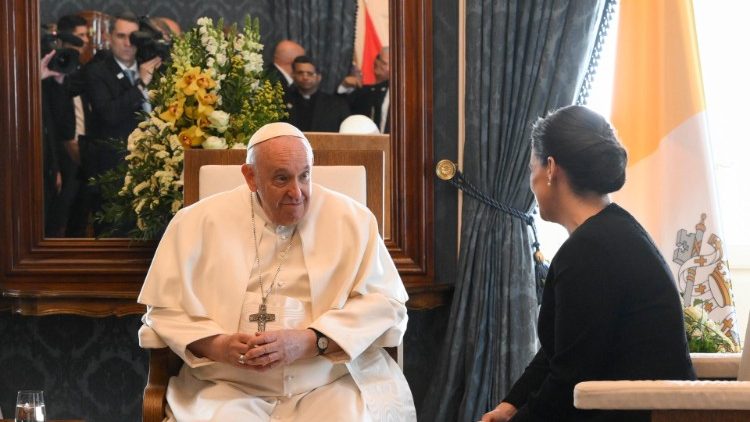
The Pope's first stop on his visit to Hungary was Sándor Palace, the official residence of President Katalin Novák

By Joseph Tulloch

Pope Francis has arrived in Budapest, Hungary, for his 41st Apostolic Journey abroad. 

His first stop upon arrival in the central European nation was Sándor Palace, the official residence of the President of Hungary.

Following a private meeting with President Katalin Novák, Pope Francis met with Viktor Orbán, the country’s Prime Minister. 

Official welcome

The Pope arrived at Sándor Palace at 11:18 local time, and was greeted with a guard of honour. The national anthems of both Hungary and the Vatican City were played, and the Pope greeted the President and Prime Minister, as well as other Hungarian officials. 

Following this official welcome, the Pope and President Novák entered the palace and made for its Empire Hall, where official photographs were taken, and the Pope signed the country’s Book of Honour, writing in Italian:

“I come as a pilgrim and friend to Hungary, a country rich in history and culture; in Budapest, city of bridges and of saints, I think of all Europe, and pray that, in unity and solidarity, it might be in our times too a house of peace and a prophecy of welcome.”


Meeting with President and Prime Minister

The next stop for both the Pope and President Novák was the Palace’s Blue Hall, where they held a private discussion.

As part of the meeting, the pair exchanged gifts, the Pope presenting the President with a commemorative medal featuring St Stephen – the first King of Hungary – and the Virgin Mary, as well as images of the Parliament of Hungary, Budapest’s Basilica of St Stephen, and the River Danube. 

Following the meeting, President Novák introduced her family to the Pope, before accompanying him to the adjacent Maria Teresa Hall, where he met with Prime Minister Orbán. 

Pope Francis has arrived in Budapest, Hungary


Pope Francis arrives in BudapestPope Francis arrives in Budapest  (VATICAN MEDIA Divisione Foto)

Pope to journalists on flight to Hungary: 'Weeds never die!'

The papal flight from Rome touches down at International Airport as Pope Francis arrives in Hungary for his 41st Apostolic Journey abroad. On board the flight he greets journalists and answers a couple of questions including one on his health and one on the "Emananuela Orlandi" case and accusations against Pope St. John Paul II that he described as "nonsense".

By Lisa Zengarini

Pope Francis’  Apostolic journey to Hungary kicked off on Friday morning with the arrival of the papal aircraft  at Budapest Ferenc Liszt International Airport at 11:54  am local time (GMT +2).

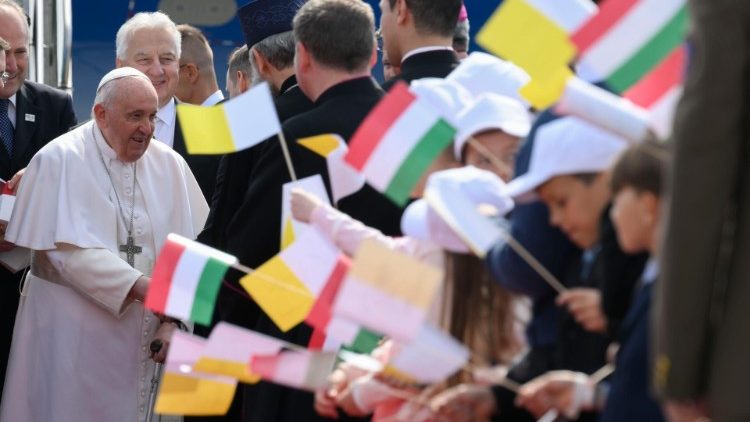
Welcoming him on the tarmac were the Hungarian Vice Prime Minister Zsolt Semjén and two children dressed in traditional costumes offering him salt and bread, a traditional welcome greeting ceremony in many East European cultures.

After the presentation of their respective delegations, the Pope transferred by car to Sándor Palace in Budapest.

There he will pay a courtesy visit to the President of Hungary, Ms Katalin Novák,and Prime Minister Viktor Orban, before addressing Authorities, representatives of civil society, and members of the diplomatic corps at the former Carmelite monastery, used today as the Prime Minister's headquarters.

The Pope is visiting Hungary from 28-30 April under the "Christ is our future".

Besides local Church and civil authorities. during the three-day visit he will meet with migrants and poor people refugees, disabled children and young people.

On the Sunday morning he will celebrate Mass in Budapest’s Kossuth Lajos Square for the country’s Catholic faithful, and in the afternoon he will meet with the Academic and Cultural World before departing back to Rome.


Onflight greetings to journalists and words on Pope St. John Paul II

As is customary, Pope Francis took time to greet the journalists on board the papal flight during the outgoing journey. 

He thanked them for their work and jovially answered a few questions including one on his health to which he responded "weeds never die!"

He also answered a question regarding the groundless accusations made against Pope St. John Paul II by a family member of Emanuela Orlandi - the daughter of a Vatican employee who vanished in 1983. The Pope has already dismissed those accusations and again, today, described them as "nonsense".