Wednesday, July 28, 2021

Feast of American born Priest and Martyr


July 28t + Blessed Stanley Rother
The first US-born priest and martyr to be beatified and the second person to be beatified on US soil.
Stanley Francis Rother (March 27, 1935 – July 28, 1981) was an American Roman Catholic priest from Oklahoma who was murdered in Guatemala. Ordained as a priest for the Archdiocese of Oklahoma City in 1963, he held several parish assignments there until 1968 when he was assigned as a missionary priest to Guatemala where he was murdered in 1981 in his Guatemalan mission rectory.
On December 1, 2016, Pope Francis issued a decree confirming that Rother had been killed "in odium fidei" (in hatred of the faith) which would allow him to be beatified. Rother was beatified on September 23, 2017, during a Mass at the Cox Convention Center in Oklahoma City. He is the first US-born priest and martyr to be beatified by the Catholic Church and the second person to be beatified on US soil following the 2014 beatification of New Jersey-born nun Miriam Teresa Demjanovich.Contents
*
Stanley Francis Rother was born on March 27, 1935, in Okarche, one of four children of Franz Rother and Gertrude Smith, who farmed near that Oklahoma town. He was baptized on March 29, 1935, in Okarche's Holy Trinity Church by Father Zenon Steber. He had a sister, Betty Mae, who became Sister Marita on taking her vows, and two brothers, Tom and Jim.
Rother was strong and adept at farm tasks. After completing high school at Holy Trinity School, he decided to become a priest. He studied at Saint John Seminary and then Assumption Seminary in San Antonio in Texas. He served as a sacristan, groundskeeper, bookbinder, plumber, and gardener. After almost six years, the seminary staff advised him to withdraw.
Following consultation with his local bishop Victor Reed, Rother attended Mount Saint Mary's Seminary in Emmitsburg, Maryland from which he graduated in 1963. Bishop Reed ordained him to the priesthood on May 25, 1963. Rother served as an associate pastor in various parishes around Oklahoma: Saint William in Durant, Saint Francis Xavier and the Holy Family Cathedral in Tulsa, and Corpus Christi in Oklahoma City. In 1968 – at his request – he was assigned to the mission of the archdiocese to the Tz'utujil people (also spelled Tz'utuhil) located in Santiago Atitlán in the rural highlands of southwest Guatemala. While he was at Corpus Christi, he had learned a priest was needed in Guatemala and so applied and was accepted by Reed in 1968.
*
So that Rother could be in closer touch with his congregation, he set out to work to learn Spanish and the Tz’utujil language which was an unwritten and indigenous language that the missionary Ramón Carlín once recorded. He served in Santiago Atitlán from 1968 until his death. He supported a radio station located on the mission property, which transmitted daily lessons in language and mathematics. In 1973 he noted with pride in a letter: "I am now preaching in Tz'utuhil." During that time, in addition to his pastoral duties, he translated the New Testament into Tz'utujil and began the regular celebration of the Mass in Tz'utujil. In the late 1960s, Rother founded in Panabaj a small hospital, dubbed as the "Hospitalito"; Father Carlín served as a collaborator in this project.
By 1975, Rother had become the de facto leader of the Oklahoma-sponsored mission effort in Guatemala as other religious and lay supporters rotated out of the program. He was a highly recognizable figure in the community, owing to his light complexion as well as his habit of smoking tobacco in a pipe. Since there was not a Tz'utujil name equivalent to "Stanley," the people of Rother's mission affectionately called him "Padre Apla's," translated as "Father Francis," a nod to his middle name.
+
Within the last year of his life, Rother saw the radio station smashed and its director murdered. His catechists and parishioners would disappear and later be found dead, with their bodies showing signs of being beaten and tortured. Rother knew all this when he returned to Guatemala in May 1981. In December 1980, he had addressed a letter to the faithful in Oklahoma and wrote about the violent situation: "This is one of the reasons I have for staying in the face of physical harm. The shepherd cannot run at the first sign of danger."
At the beginning of 1981 Rother was warned that his name was on a death list of the radical death squads (he was number eight on the list) and that he should leave Guatemala at once to remain alive. Rother was reluctant but he nonetheless returned to Oklahoma in January and while home in Okarche, celebrated a mass served by Daniel Henry Mueggenborg, a college student who became inspired by Rother to pursue the priesthood, though he later asked the archbishop for permission to return. Another reason for returning was that he wanted to celebrate Easter with them. Rother went back to Santiago Atitlán in April and knew that he was being watched.
On the morning of July 28, 1981, just after midnight, shooters broke into Rother's church's rectory and shot him twice in the head after a brief struggle. The killers forced the teenager Francisco Bocel (who was in the church) to lead them to Rother's bedroom. The men threatened to kill Bocel if he did not show them Rother, and so Bocel led them downstairs and knocked on a door near the staircase.Rother opened the door, and a struggle ensued as Bocel escaped.
Rother was one of 10 priests murdered in Guatemala that year. His remains were flown back to Oklahoma and were buried in his hometown on August 3, 1981, in Holy Trinity Cemetery. At the request of his former Tz'utujil parishioners, his heart was removed and buried under the altar of the church where he had served.
Three men were arrested on charges of murder within weeks of Rother's murder; another man and woman were sought for questioning at that stage as well. The three men arrested admitted to having entered the church in a robbery attempt, and also admitted to having shot Rother dead when the priest attempted to stop them. Despite the confessions, many people familiar with the circumstances of the murder considered the three accused persons as innocent, and the prosecutions to be a cover-up of paramilitary involvement in the murder. Convictions for all three men were later overturned by a Guatemalan appellate court, under pressure from U.S. authorities. No other suspects have been prosecuted for the murder.

Tuesday, July 27, 2021

Another Papal Saint of the Day


St. Innocent I


Innocent was born at Albano, Italy. He became Pope, succeeding Pope St. Anastasius I, on December 22, 401. During Innocent's pontificate, he emphasized papal supremacy, commending the bishops of Africa for referring the decrees of their councils at Carthage and Millevis in 416, condemning Pelagianism, to the Pope for confirmation. It was his confirmation of these decrees that caused Augustine to make a remark that was to echo through the centuries: "Roma locuta, causa finitas" (Rome has spoken, the matter is ended). Earlier Innocent had stressed to Bishop St. Victrius and the Spanish bishops that matters of great importance were to be referred to Rome for settlement. Innocent strongly favored clerical celibacy and fought the unjust removal of St. John Chrysostom. He vainly sought help from Emperor Honorius at Revenna when the Goths under Alaric captured and sacked Rome. Innocent died in Rome on March 12. His feast day is July 28th.

All prison volunteer activity, including Catholic services, visitations, are once again suspended in Louisiana; please pray for our Catholic ministry at Rayburn correctional


DOC suspends visitation, volunteering at Louisiana’s state-run prisons due to fourth COVID surge


BATON ROUGE, La. (WAFB) - Officials with the Louisiana Department of Public Safety and Corrections (DOC) say they are suspending visitation and volunteering at all of Louisiana’s state-run prisons until at least Aug. 16 due to the state’s fourth surge of COVID-19 cases and hospitalizations.

DOC issued the following statement on Tuesday, July 27:

“Out of an abundance of caution concerning the latest surge of COVID-19 positive cases in Louisiana, the Louisiana Department of Public Safety and Corrections (DPS&C) has suspended prisoner visitation and volunteering effective immediately through August 16, 2021, at Louisiana’s eight state-run prisons. The Department has taken this precautionary measure to protect its staff and prisoner populations, and will review and reconsider the need for these measures on August 16, 2021.

In lieu of visitation, the Department will continue to offer two free phone calls per week to ensure inmates have continued connection to family and friends during this event. In addition, video calling remains available for a fee.

A perspective on the Latin Mass in light of Traditionis custodes

 The Latin Mass Is The Future Of The Catholic Church

Pope Francis is punishing a faithful and devout minority of Catholics in hopes of staving off the inevitable.
John Daniel Davidson
By 

You don’t have to know the entire modern history of the traditional Latin Mass to understand what’s behind Pope Francis’s recent apostolic letter, Traditionis custodes, claiming the ancient rite threatens the unity of the Catholic Church and imposing strict new limits on its use.

All you must do to understand what’s happening now is attend a Latin Mass. There, you will see full church pews teeming with young families and couples, mewling infants and unruly toddlers, single twenty-somethings and teens. The air will be full of incense and, in some parishes, the haunting beauty of Gregorian chant.

Most of the women and girls will be in veils, most parishioners will be following along with a 1962 Roman missal and responding to the priest in Latin, kneeling or genuflecting as required. You will see, in short, a religious ritual that looks odd and shockingly out of place in modern society.

You will also see, unmistakably, the future of the Catholic Church.

How can that be? After all, only a small number of Catholics, perhaps only about 150,000 in the United States, regularly attend a Latin (Tridentine) Mass. Fewer than 700 Catholic parishes in the U.S., out of more than 17,000, even offer Latin Mass. If the Latin Mass is the future of the Catholic Church, it portends a church much diminished in size and prestige.

But it also portends a more faithful church, one more committed to the doctrines and teachings of Catholicism, and the obligations they impose. Indeed, the vast majority of Catholics in America today reject central tenets of the faith. A 2019 Pew survey found that nearly 70 percent of American Catholics reject the doctrine of transubstantiation, which says the bread and wine used in Holy Communion become, during Holy Mass, the body and blood of Jesus Christ.

By contrast, polls in recent years have shown that those who regularly attend Latin Mass adhere much more closely to Catholic teaching, including on matters like abortion, gay marriage, and contraception, compared to Catholics who attend the Novus ordo rite that was established in vernacular languages in 1970, after the liturgical reforms of the Second Vatican Council.

One national survey of Latin Mass attendees, conducted by Fr. Donald Kloster in 2018, found that only 2 percent approve of contraception, compared to 89 percent of Novus ordo attendees. On approval of abortion, the split was 1 percent compared to 51 percent. On gay marriage, 2 percent to 67 percent. The same survey found parishioners at Latin Mass have on average nearly 60 percent larger family sizes, donate on average five times more, and attend weekly Mass at 4.5 times the rate of Catholics who attend the Novus ordo rite.

Another survey by Kloster and others, conducted online last year, found that among adults aged 18 to 39 who attend Latin Mass, 98 percent report going every Sunday. This stands in stark contrast to the findings of a 2018 Gallup poll, which showed dramatic declines in weekly Mass attendance among all Catholics, with the sharpest decline in the 21 to 29-year-old demographic, from 73 percent in 1955 to 25 percent in 2017, the lowest of all age groups.

Even more striking, the survey by Kloster found that 90 percent of these young Catholics were not raised in the Latin rite and that the vast majority were drawn to it by forces from within their own generation, rather than by their parents. A plurality, 35 percent, cited “reverence” as what prompted them to seek out the Latin rite.

The seriousness of Catholics who attend Latin Mass confirms something then-Fr. Joseph Ratzinger, later Pope Benedict XVI, said in an interview in 1969, the year before the Latin Mass was effectively replaced by the Novus ordo:

From the crisis of today the Church of tomorrow will emerge — a Church that has lost much. She will become small and will have to start afresh more or less from the beginning. She will no longer be able to inhabit many of the edifices she built in prosperity. As the number of her adherents diminishes, so it will lose many of her social privileges. In contrast to an earlier age, it will be seen much more as a voluntary society, entered only by free decision. As a small society, it will make much bigger demands on the initiative of her individual members.

Benedict understood that the church was going to shrink, but that as it shrank, the remnant would be more zealous, more closely tied to Catholic teaching and doctrine than it had been before. He must have also understood that beauty and reverence in worship had an important role to play in this smaller but more faithful church.

When in 2007 Benedict gave broad permission to conduct Mass according to the old Latin rite, affirming that it had never been forbidden and that it never could be, and encouraged bishops to allow their priests to offer it wherever it was desired, he launched a movement within the church — not a schism but a revival, which now points the way forward for a church that’s still in crisis, and still shrinking. In the 14 years since, adoption of Latin Mass has grown among the Catholic faithful worldwide, attracting converts and cradle Catholics alike.

Why, then, would Francis punish those who worship according to the Latin rite? Why would he misrepresent, in brutal and authoritarian language, the motives of these Catholics? In the letter to the bishops that accompanies his motu proprio, Francis writes:

I am nonetheless saddened that the instrumental use of Missale Romanum of 1962 is often characterized by a rejection not only of the liturgical reform, but of the Vatican Council II itself, claiming, with unfounded and unsustainable assertions, that it betrayed the Tradition and the ‘true Church.’

Now we come to the heart of the matter. Francis fears that Catholics who are drawn to the ancient rite are somehow rejecting the reforms the of Second Vatican Council. In another passage, he writes that the effort to expand the Latin rite by both Saint John Paul II and Benedict, “intended to recover the unity of an ecclesial body with diverse liturgical sensibilities, was exploited to widen the gaps, reinforce the divergences, and encourage disagreements that injure the Church, block her path, and expose her to the peril of division.”

Nothing could be further from the truth. Catholics who attend Latin Mass are by all accounts the least likely to encourage disagreements, widen gaps, or reinforce divergences in the church. They are far more likely to adhere to Catholic teaching and accept the obligations the church places on the faithful than Catholics who don’t attend Latin Mass. Indeed, they stand in stark contrast to the nearly 70 percent of American Catholics who deny transubstantiation, and the large majorities who support abortion and gay marriage, and feel no compunction to fulfill their religious obligations.

That doesn’t mean there aren’t some very online Traditionalist Catholics who boast about the Latin Mass, make inflammatory claims about its superiority, and criticize Francis. But they aren’t representative of Latin Mass-goers as a whole, and the divisions they might foment are nothing compared to the divisions and indeed outright schism that bishops in Germany, for example, have been pushing throughout Francis’s pontificate, seeking to bless same-sex unions and ordain women to the priesthood. The supposed divisions caused by Traditionalists are also nothing compared to the vey real divisions that millions of ordinary Catholics incite routinely when they deny Catholic teaching, bear false witness against the church, and shirk their religious obligations.

Given all this, we have to conclude there’s some other motive, unexpressed in the pope’s motu proprio, for targeting a relatively small group of faithful Catholics who are drawn to the Latin Mass. It’s hard to get at this motive, but it’s perhaps best understood as a generational conflict.

Clerics of Francis’s generation, who came up in the reforms of Vatican II, envisioned a very different future for the church than the one that’s now emerging. They imagined a church that would give no offense, in its worship or its doctrine, to Protestants. They imagined a church that would be pliable, able to change with the times and accommodate new and different mores. The so-called “spirit of Vatican II” was to guide the church into the modern era, make her relevant and attractive to modern people, more welcoming and less severe.

What happened instead, they didn’t see coming. Modern people, it seems, do not want the kind of church that Francis and the German bishops want to give them. Many lapsed Catholics want nothing to do with the church, even a more progressive one, and have simply left it for good. Others would prefer to remain Catholic, nominally at least, but free to ignore or even disparage anything with which they might disagree or that might offend their modern sensibilities.

But a strong and stalwart remnant fervently want a church that espouses and upholds timeless and unchangeable doctrines, given physical form in ancient rituals and worship. They want a church that takes the sacraments seriously, that demands something of them, and in return gives them beauty and truth.

Among these Catholics, a growing number desire to worship according to the Latin rite. Regardless of whatever inchoate and vindictive policy emanates from Rome, their numbers, it seems, will continue to grow.

One gets the sense that this, above all, is what the pope wishes were not so. When Francis looks back over his shoulder to pass the baton to the next generation, perhaps he sees what Benedict saw in 1969: a smaller but more faithful church, young and vibrant, but much diminished in power and prestige.

Perhaps, unlike Benedict, he thought it wouldn’t turn out this way. But it has.

One diocese in Vietnam has 34 newly ordained Priests; sharing them with other dioceses


Bishop Alphonse Nguyen Huu Long of Vinh Diocese.Bishop Alphonse Nguyen Huu Long of Vinh Diocese. 

Vietnamese diocese blessed with 34 new priests

As Vietnam battles its worst surge in the Covid-19 pandemic, Vinh Diocese has been blessed with an abundance of priestly vocations, many of whom will be serving in other territories of the nation.

By Robin Gomes

"It is a day of great joy, a day of great blessing in the Diocese of Vinh, which rejoices for 34 new ordained priests who will also be missionaries, where the Lord will call them to proclaim and bear witness to the Gospel."  This is how Bishop Alphonse Nguyen Huu Long of Vinh introduced the solemn Mass of the priestly ordination which he presided over on Sunday, the Vatican’s Fides news agency reported.

‘Good Samaritan’ amid suffering

He noted that his diocese was “living this moment of great happiness, at a time of great suffering in many parts of the world” due to the surge in Covid-19 infections, including in Vietnam.  The Mass could be attended only by a limited number of religious, seminarians and faithful of the diocese due to the Covid-19 health protocols.

Precisely in this dramatic situation, he pointed out, the new priests will be the ‘Good Samaritan’, “bringing care and mercy to wounded hearts, and they will also be missionaries in remote places or even in three dioceses, where the Lord will call them to live”. "Evangelization,”  he recalled, “is the task of every baptized person; the proper mission of every priest is to lead men and women to God in order to have the gift of salvation and eternal life".

Happy to serve anywhere

Bishop Alphonse said that priests are called to be available and happy to serve anywhere, including in remote mission territories, poor countryside or in areas hard to reach. “The population in places of conflict, or where there are natural disasters or a high risk of contagion from a pandemic,” the bishop said, “really need the presence of priests for material and spiritual comfort, in order to help overcome pain and receive hope".  Bishop Alphonse noted that the Lord continues to call young people despite the fact that nowadays many are unwilling to dedicate their lives to serve people in difficult and dangerous places.  

‘Fidei Donum’ priests

"In the context of the scarcity of priests, and while the population suffers severely from the pandemic and other causes, after a prayer discernment, I have decided to share half of these new priests with isolated territories, in other dioceses that lack priests,” Bishop Alphonse said.  He is sending some of them as 'Fidei Donum' priests in the northern Diocese of Hung Hoa, where there is a shortage of priests to serve about 250,000 faithful in 10 provinces in mountainous and lowland areas.   

The expression ‘Fidei Donum’ is the Latin for ‘the Gift of Faith’.  This is the name of the 1957  encyclical of Pius XII, which called on all bishops to share his vision “to face the challenges of the universal mission of the Church”. This involved not only by means of prayer and assisting each other but also by making priests available to other dioceses, countries and continents.  These priests, who while serving elsewhere are still attached to their own dioceses, are referred to as “Fidei Donum” priests. Turning to the new priests, Bishop Alphonse urged them to show their love for God by repeating in their hearts, “Lord, I come to do your will”. 

Vietnam’s Covid-19 burden

The Communist-ruled country, which successfully contained the coronavirus outbreak throughout 2020, is now experiencing its worst wave so far.  Its Covid-19 numbers have surpassed 6,000 infections a day for the past week.  The health ministry on Monday reported 7,882 new cases, up from 7,531 cases on Sunday and just shy of the record of 7,968 set on Saturday.  Most cases are concentrated in Ho Chi Minh City and its neighbouring provinces, the ministry of health said.

It has recorded more than 109,000 infections since the start of the pandemic, with at least 524 deaths.  A fifth of those cases have occurred between July 23 and 25. 

In this situation, the Catholics in all the diocese are working to provide for the essential, material and spiritual needs of the people in the quarantine areas and other people in need. Some priests, religious and Catholic laity are also volunteering to provide pastoral, spiritual and humanitarian to patients in high-risk areas such as in Covid hospitals.   (Source: Fides)

Monday, July 26, 2021

Tuesday Saint of the Day


Bl. Titus Brandsma


Carmelite martyr who died at the hands of the Nazis. He was born in Bolsward in the Netherlands. Becoming a Carmelite as a young man, he displayed a dazzling intellect and scholarship, receiving ordination as a priest in 1905 and earning a doctorate in philosophy at Rome. Titus then taught in Dutch universities and lectured in many countries on Carmelite spirituality and mysticism. lie also served as rector magnificus at the Catholic University of Nijmegen. In 1935 he became an ecclesiastical advisor to Catholic journalists. His academic and spiritual studies were also printed and widely read. When the Nazis occupied the Netherlands,Titus was singled out as an enemy because he fought against the spread of Nazism in Europe. Arrested, Titus was sent to various concentration camps where he demonstrated charity and concern. In 1942, he was martyred in Dachau. Titus was beatified by Pope John Paul II on November 3, 1985.

Vatican reveals it owns land and property all over the world


Vatican reveals it owns more than 5,000 properties

Real estate holdings published for first time show it owns 4,051 properties in Italy, 1,120 abroad

St Peter's Basilica
St Peter’s Basilica and the Vatican museums were closed or only partially open for much of 2020 during the Covid-19 pandemic. Photograph: Maria Laura Antonelli/AGF/Rex/Shutterstock
Reuters

The Vatican has released information on its real estate holdings for the first time, revealing it owns more than 5,000 properties, as part of its most detailed financial disclosures ever.

The information released on Saturday was contained in two documents – a consolidated financial statement for 2020 for the Holy See and the first ever public budget for the Administration of the Patrimony of the Apostolic See (Apsa).

Apsa, a sort of general accounting office, manages real estate and investments, pays salaries, and acts as a purchasing office and human resources department.

Between the two documents – each with an unprecedented number of pie charts, graphs and maps – and two explanatory interviews, the Vatican issued more than 50 pages of financial material.

The 30-page Apsa budget showed it owns 4,051 properties in Italy and about 1,120 abroad, not including its embassies around the world.

Only about 14% of its Italian properties were rented at market rates, while the others were rented at cut rates, many to church employees. About 40% were institutional buildings such as schools, convents and hospitals.

The documentation showed Apsa owns properties as investments in upmarket areas of London, Geneva, Lausanne and Paris.

One building, in London’s South Kensington, led to enormous losses after it was bought by the Vatican’s secretariat of state as an investment in 2014.

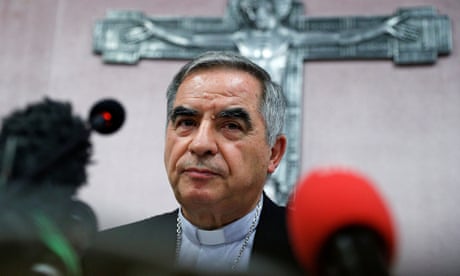
On Tuesday, the trial of 10 people in connection with its purchase, including the prominent cardinal Angelo Becciu, starts in the Vatican. They are charged with financial crimes including embezzlement, money laundering, fraud, extortion and abuse of office.

Father Juan Antonio Guerrero Alves, head of the Vatican’s secretariat for the economy (SPE), told the official Vatican News website that the building would be sold soon.

He said the trial would be a “turning point” in the Vatican’s credibility in economic matters and that a similar event could not be repeated because of measures put into place since.

Last year, Pope Francis stripped the Secretariat of State of control over its funds, transferring them to Apsa and with oversight by the SPE.

A separate consolidated financial statement for the Holy See issued on Saturday showed a €64.8m (£55m) deficit in 2020, down from a €79.2m deficit in 2019.

The Holy See budget includes the central administration of the Roman Catholic church, known as the Curia, that oversees the governing of the 1.3 billion-member worldwide church, its global diplomatic representations and media operations.

Vatican City, including the Vatican Museums and the Vatican bank, has a separate budget.

To plug the 2020 deficit, about €50m was taken from Peter’s Pence, a fund of donations to help the pope carry out the church’s worldwide work.

The Covid-19 pandemic hit Vatican revenues hard in 2020. St Peter’s Basilica and the Vatican museums, the latter a cash cow that received about 6 million paying visitors in 2019, were closed or only partially open for much of 2020.