Saturday, February 27, 2021

An aggressive plan to really grow the Catholic faith in east Texas


Massive Catholic Center Planned for East Texas

‘Veritatis Splendor’ will enliven the faith of Catholics in the Lone Star State and around the world.

On nearly 600 acres of land, the Catholic center of Veritatis Splendor will be built near Tyler, Texas.
On nearly 600 acres of land, the Catholic center of Veritatis Splendor will be built near Tyler, Texas. (photo: Veritatis Splendor website)

“This is the choice of our moment: whether to be Catholic in the fullest sense or to let that option fade, for the foreseeable future, into darkness.” — from the foreword to Light and Leaven: The Challenge of the Laity in the Twenty-First Century, by Bishop Joseph Strickland of Tyler, Texas


A grand oratory, seven Catholic institutes, a retreat center, residences, multilevel educational programs: These are among the ambitious projects about to launch in the bucolic east Texas countryside of Winona, outside of Tyler. Called Veritatis Splendor (The Splendor of Truth), after the encyclical by Pope St. John Paul II on the Church's moral teaching, the center will bring together a community of believers whose goal is to safeguard the deposit of faith through uncompromising fidelity to sacred Scripture and sacred Tradition. Now in the planning stages, Veritatis Splendor will be a spiritual home where Christians can develop, nurture and preserve all of the chief truths and teachings of Christendom. 

The seven institutes of Veritatis Splendor will encompass a range of issues that concern Catholics in the modern world, including life, education, liberty, human rights, law, media and culture. The founders' vision is that directors of the institutes will live and work in the community and will, by virtue of the offices they hold, become missionaries in the world to transmit Catholic values in a way that promotes truth, goodness and beauty and, in so doing, restore Christ in society.


On nearly 600 acres of land, dotted with forests and pastures and lakes, Veritatis Splendor, a $22-million capital campaign, will build its headquarters, opening its doors to the faithful and planting seeds for other Veritatis Splendor locations regionally and globally. Plans for the headquarters include offices for the institutes, housing (individual residential lots; there are 71 lots in Phase 1. There are plans for Phase 2 and 3 development for residences if there is a strong demand), educational facilities for grades K-12 as well as plans for a university, recreational activities for residents and guests, such as swimming, hunting, fishing, horseback riding, outdoor sports, hiking, prayer gardens/Stations of the Cross, and food cooperative services supported by a large greenhouse and organic farming. 

Veritatis Splendor Catholic Center 2
The ambitious plans are showcased at the Veritatis Splendor website.


In addition, there will be a retreat center, as well as clergy and guest housing. 

At the center of Veritatis Splendor will be the grand oratory, led by a community of Catholic priests who will live under a particular charism of apostolic life. These priests will reside in the community as permanent members of Veritatis Splendor in east Texas and will not be subject to transfers or reassignments. 

Overall, with Veritatis Splendor, the idea is to “protect, preserve and proclaim the truth of the faith given to us by Jesus.”


The Birth of a Catholic Dream

Kari Beckman, founder of the hybrid home-school organization Regina Caeli Academy, first envisioned the center as she struggled with the effects of social isolation during the pandemic. “The COVID crisis was a time of great illumination for Catholics,” Beckman told the Register. During that time, Beckman explained, Catholics had the opportunity to take inventory, reflecting on what the faith means, the importance of the sacraments, and the stark loneliness when mandatory lockdowns separated the faithful from that source of sacramental grace and strength. 

“It became very clear to me,” Beckman said of the pandemic and recent cultural pressures, “... that we must preserve the faith right now. This is just round No. 1 of the crisis, and what the future holds could be much worse. If we as laypeople don't preserve what we have and truly guard it as the precious gift that it is, with every ounce of our being, then we’re going to lose it.” 


Beckman’s home Archdiocese of Atlanta, like many dioceses around the country, had taken a cautious approach to safeguarding against COVID-19. The Archdiocese of Atlanta followed legal restrictions imposed by the government and shuttered its churches, permitting only online or televised Masses. Now, there is gradual reopening. Similarly, many home-school families around the country from Regina Caeli faced the prospect of months with no opportunity to attend Mass, or to receive the Eucharist or other sacraments. 

But Beckman was aware that Bishop Joseph Strickland of Tyler, Texas, had permitted the churches in his diocese to remain open for liturgy and worship. Would he, she wondered, offer Regina Caeli's member families the sacraments if they came to the Tyler Diocese? 

So Beckman emailed Bishop Strickland and asked if she and her husband, Rich, could meet with him. Bishop Strickland agreed, and the Beckmans drove to Tyler to meet face-to-face with the bishop for the first time. 

Kari’s first question was whether Regina Caeli families could come to Tyler to receive the sacraments. But that was just the beginning, as she envisioned a large and beautiful oratory. Beyond that, she had begun to envision the institutes as a means of restoring right thinking and right philosophy in an increasingly confused society. 


“Right now we have a lot of people who want to ‘fix’ politics,” she said, “and that’s noble. But, unfortunately, that’s way down the river. Before that, these institutes will help people to embrace right thinking, and from that, right philosophy.” She thinks the beginning is key, changing the way people think so that there will follow a change in the way they act.

When the Beckmans had dinner with Bishop Strickland, he confirmed that he had never closed the churches in his diocese. Following safety protocols, he had made Eucharistic adoration available for the faithful despite the surge of COVID-19 cases. Then Kari began to describe her vision for the oratory and how its lights would illuminate the Texas sky. Bishop Strickland asked: What would this  effort be called?

So Kari repeated the name that God had put on her heart, as she and her husband made the long drive to Tyler from Atlanta. Recalling Pope St. John Paul II’s encyclical Veritatis Splendor, Kari had decided that, since fostering truth was their goal, Veritatis Splendor should be the name of the center. As she repeated the name, Bishop Strickland and Deacon Keith Fournier, general counsel and director of deacon formation for the Diocese of Tyler, who had joined them in the meeting, stared in surprise. Just a week and a half before, she learned, the two men had discussed the encyclical Veritatis Splendor — how important its message is to the culture right now and how they needed someone to carry its profound message to the world. The seven institutes which will form the structure for Beckman's proposed project are designed to do just that: to carry the splendor of truth to the world. 

That God had put the message on their hearts in two different cities was obvious to all gathered at that dinner. In addition, Kari suggested that the oratory, which is planned as the heart of the community, should be named after St. Joseph, as guardian of humanity. Bishop Strickland, too, has a deep devotion to St. Joseph, and his personal chapel in the Tyler Diocese is named after the beloved saint. 


Bringing the Vision to Life

Plans are moving forward. The Beckmans, confident that their plans will bear fruit, have already sold their Georgia home; and when the school year ends for their daughter, they plan to officially move to Winona and take up residence at Veritatis Splendor. 

The site is about 20 minutes from the cathedral in downtown Tyler. The site was previously owned by a local businessman who is Catholic and who has helped the planners through the process.

Lisa Wheeler, founder and director of the Roswell, Georgia-based Carmel Communications and a friend of Kari’s, had also been considering how her family might benefit from an intentional Catholic community. Lisa and her husband, Tim, are parents to five children adopted through the foster-care system, and they were seeking a community of people to help instill strong Catholic values. 

On a summer road trip with the children, the Wheeler family had prayed the Consecration to St. Joseph. Lisa and Tim at first believed that God was calling them to build a community for foster care; but then Kari Beckman invited them to dinner to discuss her conversation with Bishop Strickland. After prayer and careful reflection, the Wheelers understood that their vision melded easily with Beckman’s, and they have joined the effort as co-founders. They will be moving to Texas later this year.

Bishop Strickland will serve as spiritual adviser to the community and enthusiastically welcomes them to the diocese. While Veritatis Splendor is located within the Diocese of Tyler, it is not an official diocesan project; rather, it is an independent, lay-inspired Catholic organization. But in today’s world, Bishop Strickland noted, this is both a blessing and an opportunity. He strongly encourages this effort designed to strengthen the domestic church. 

“I’m the benevolent bishop who is happy to welcome this lay-run effort to build a community of faith,” he told the Register. 


Once the oratory is constructed, Veritatis Splendor will celebrate traditional Catholic feasts with processions and celebrations. 

For example, Kari Beckman reported that, on June 24, for the feast commemorating the Nativity of St. John the Baptist, the community at Veritatis Splendor will celebrate like the people of Italy, with bonfires on the hillsides. John the Baptist, Beckman explained, was the first proclaimer of Christ; similarly, they plan a fiery proclamation of the Gospel with bonfires and fireworks. The goal is for time-honored Catholic traditions to take hold in eastern Texas.

Kari Beckman is confident that the Veritatis Splendor project is of God and that it will move forward. 

Some may view the plans for this community as “circling the wagons.” 

But the opposite is the goal.

Bishop Strickland sees Veritatis Splendor supporting families in seeking to live their faith in a meaningful way; fathers and mothers will flourish in their roles as Godly men and women, in turn supporting their children. 

“I see it not as a ‘circling the wagons,’” Bishop Strickland said, “but as a community of support — almost the opposite of the ‘Benedict Option,’” as described in Rod Dreher’s book, in which Christians separate themselves from a post-Christian society in order to preserve the faith.

Residents of the Veritatis Splendor community, the bishop believes, will offer families the support they need to live their faith in a meaningful way. “It’s the responsibility of parents,” Bishop Strickland emphasized, “... to shield their children from the craziness that’s out there and also to prepare them to face that craziness with the light of Christ. ... There are a lot of crazy ideas. But Christ says, ‘Be not afraid.’ So we act not out of fear, but strongly, joyfully, believing what the message of Christ is about.” 

Friday, February 26, 2021

Saturday Saint of the Day


St. Leander of Seville


St. Leander of Seville, Bishop (Feast - February 27th) Leander was born at Cartagena, Spain, of Severianus and Theodora, illustrious for their virtue. St. Isidore and Fulgentius, both bishops were his brothers, and his sister, Florentina, is also numbered among the saints. He became a monk at Seville and then the bishop of the See. He was instrumental in converting the two sons Hermenegild and Reccared of the Arian Visigothic King Leovigild. This action earned him the kings's wrath and exile to Constantinople, where he met and became close friends of the Papal Legate, the future Pope Gregory the Great. It was Leander who suggested that Gregory write the famous commentary on the Book of Job called the Moralia. Once back home, under King Reccared, St. Leander began his life work of propagating Christian orthodoxy against the Arians in Spain. The third local Council of Toledo (over which he presided in 589) decreed the consubstantiality of the three Persons of the Trinity and brought about moral reforms. Leander's unerring wisdom and unflagging dedication let the Visigoths and the Suevi back to the true Faith and obtained the gratitude of Gregory the Great. The saintly bishop also composed an influential Rule for nuns and was the first to introduce the Nicene Creed at Mass. Worn out by his many activities in the cause of Christ, Leander died around 600 and was succeeded in the See of Seville by his brother Isidore. The Spanish Church honors Leander as the Doctor of the Faith.

First Lenten Sermon at Vatican by Cardinal Cantalamessa


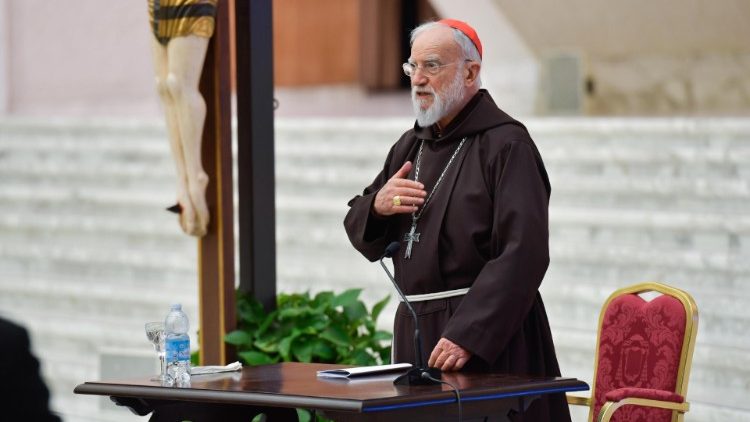
Cardinal Cantalamessa makes the sign of the Cross at the beginning of his first sermon for Lent, delivered in the Paul VI HallCardinal Cantalamessa makes the sign of the Cross at the beginning of his first sermon for Lent, delivered in the Paul VI Hall  (ANSA)

Cardinal Cantalamessa delivers first sermon for Lent 2021

In his first sermon for Lent 2021, the Preacher to the Papal Household, the newly-created Cardinal Raniero Cantalamessa, O.F.M. Cap., gives an overview of the season, and reflects on the Jesus’ call to repentance.

By Vatican News staff reporter

Capuchin Father Raniero Cantalamessa, who was created Cardinal by Pope Francis in the consistory of 28 November 2020, delivered his first sermon for Lent 2021 in the Paul VI Hall at the Vatican. The theme for this year’s Lenten reflections is “Who do you say that I am?”, taken from the Gospel of St Matthew.

For his introductory sermon, the Preacher to the Papal Household offered an overview of the season of Lent, focusing on the passage “Repent, and believe in the Gospel!”

Three moments of conversion

Repentance, or conversion, said Cardinal Cantalamessa, is mentioned in “three different moments and contexts” in the New Testament, corresponding to different moments in our own lives.

The first is founded in the words spoken by Jesus at the beginning of His ministry: “Repent, and believe in the Gospel!” This does not have a primarily moral sense, according to Cardinal Cantalamessa, but instead consists first of all in having faith, in believing, in changing how we see our relationship with God.

The second New Testament call to conversion comes when Jesus invites His disciples to “turn and become like children.” Here, “Jesus puts forward a genuine revolution,” calling them – and us – “to shift the centre from yourself, and to re-centre yourself on Christ.” Becoming like children, said Cardinal Cantalamessa, means going back to the time we first truly encountered Jesus.

Finally, in the book of Revelation, Jesus calls those who are neither hot nor cold to “be earnest… and repent.” “The focus here,” said Cardinal Cantalamessa, is on conversion from being mediocre and lukewarm to being fervent. This is not our own work, he insisted, but rather the work of the Holy Spirit.

From being lukewarm to being fervent

Cardinal Cantalamessa recalled the experience of the disciples when they were filled with the Spirit at the first Pentecost. The Fathers of the Church described this experience with the image of “sober drunkenness” – the disciples were not drunk with wine, as the people imagined, but instead, having received the Holy Spirit, were spiritually inebriated.

“How can we take up this ideal of sober drunkenness and embody it in the present situation in history and in the Church?” Cardinal Cantalamessa asked. Beyond the ordinary means of Eucharist and the Scriptures, the Cardinal, citing Saint Ambrose, points to a third, “extraordinary” means, that is not institutional, but instead involves “reliving the experience of the apostles on the day of Pentecost.”

One way this occurs, he said, is in the “so-called ‘Baptism in the Spirit',” which involves “a renewal with fresh awareness not only of Baptism and Confirmation, but also of the entire Christian life… the most important fruit is the discovery of what it means to have a ‘personal relationship' with Jesus risen and alive.”

Cardinal Cantalamessa emphasized the importance of “a true conversion from being lukewarm to being fervent, inviting his listeners to pray for Mary’s intercession for this grace.

You can read the full text of Cardinal Raniero Cantalamessa's Sermon on his website.

Thursday, February 25, 2021

Friday Saint of the Day


St. Isabel of France


Sister of St. Louis and daughter of King Louis VIII of France and Blanche of Castile, she refused offers of marriage from several noble suitors to continue her life of virginity consecrated to God. She ministered to the sick and the poor, and after the death of her mother, founded the Franciscan Monastery of the Humility of the Blessed Virgin Mary at Longchamps in Paris. She lived there in austerity but never became a nun and refused to become abbess. She died there on February 23, and her cult was approved in 1521.

Pope Francis' Iraq visit both act of bravery and madness


Iraqi priest says Pope’s visit an act of ‘bravery’ and ‘madness’


ROME – Father Naim Shoshandy has plenty of reasons to be angry: On March 23, 2014, the terrorist organization known as Islamic State murdered his 27-year-old brother, for no other reason other than the fact that he was a Christian.

Today, he welcomes Pope Francis’s “bravery” in deciding to visit the “martyred nation” of Iraq.

“The country is burning, but he is still going,” the priest told Crux over the phone. “It’s an act of bravery, for him to go to Iraq, the land of Abraham, as an apostle.”

An act of bravery, Shoshandy said, without denying it could also be considered an act of “madness.”

There have been three rockets attacks in the past 10 days in Iraq, including one on the United States embassy in Baghdad, and another at a U.S. base in the airport of Erbil, the capital of Kurdistan, the autonomous northern region Pope Francis will also be visiting and using as his base to go to the Nineveh Plain.

Shoshandy is from this plain, specifically Qaraqosh. However, odds are against him being there when the pope visits: After his brother was murdered, he was forced to flee Iraq, and today lives in Albacete, Spain, where he has been the parish priest of the church of Santa Ana since 2016.


Francis will visit Erbil, Mosul and Qaraqosh on March 7. His March 5-8 trip to Iraq also includes stops in the Plain of Ur — the homeland of the biblical patriarch Abraham — and Najaf, where he will meet with Ayatollah Ali al-Sistani.

The encounter between the pontiff and one of the chief figures of Shi’a Islam will be just another landmark moment during the history-making visit, the first ever by a pope to Iraq.

St. John Paul II tried to go to Iraq in 1999 to kickstart a pilgrimage that took him to the holiest sites of Christianity, but negotiations with the government of Saddam Hussein failed, and the visit never materialized.

“We hope that this visit will open the eyes of many in Iraq, serve as a reminder that we are all siblings,” Shoshandy said.

“And we also hope it will bring something of extreme importance: the hope of religious freedom,” Shoshandy, noting that the pope’s meeting with al-Sistani will be historic.

The Syriac Catholic priest was ordained Sept. 12, 2013 in the Cathedral of the Immaculate Conception in Qaraqosh, and he worked as a priest in several Iraqi parishes until he was forced to flee his diocese, threatened by ISIS. The cathedral was destroyed, but with the help of papal charity Aid to the Church in Need, it was rebuilt and is ready for the papal visit.

He often refers to August 6, 2014, as the day of “evil and cruelty.” The memory of the bombs that covered the city and the image of himself removing the lifeless bodies of his own neighbors from under the rubble after ISIS invaded his city is still fresh in his mind.

Regardless, he has hopes for the pope’s visit: “We are all brothers, as the motto for the visit says. Hopefully, people in Iraq will understand this.”

He wants to go to Iraq for the visit, and is trying to get all his paperwork in order, but he’s afraid he could have problems reentering Spain from Iraq if he were to leave the European Union. He is not giving up, however, and until the very last day he will tell anyone he asks that “he is hoping to be in Iraq when the pope is there.”

If he can’t go, he will still follow the visit from Spain, much like the hundreds of thousands of Christians forced to flee Iraq in a diaspora that began after the U.S. invasion in 2003, but which worsened in 2014, after the rise of ISIS.

Shosandy met with the pope on March 20, 2019, in the Vatican: “My legs were shaking, and I could barely get any words out, but he grabbed my hands and told me to be at ease.”

“I introduced myself as what I am: A priest from Iraq who is also a victim of Daesh [another name for ISIS],” he said. “I told him that I represent the persecuted Christians of my country, and asked him to pray for us. In his eyes I could see the reflection of his compassion with my family’s history, particularly the suffering we’ve gone through since my brother’s murder.”

The pope’s closeness, Shosandy said, is something that will be with him “throughout my life. I thank God for these moments he has gifted me with.”

This will be the pontiff’s first international trip since Nov. 2019, when he visited Japan and Thailand. He had a trip scheduled to Malta last May, but it was canceled due to the COVID-19 pandemic. When the Vatican announced the trip to Iraq last December, it did so with the warning that the international COVID-19 situation would be monitored closely.

Last week Iraq announced a series of restrictions, including the closure all houses of worship, until March 8, the last day of the papal visit, in an attempt to curb the spread of the coronavirus, with some 3,000 new cases reported daily.

Over 13,295 people having died of COVID-19, in a country with a very compromised health care system due to years of war and violence.

The martyred church of Iraq, Shoshandy said, welcomes the pope’s visit, and it is expected “bring support to a suffering people.”

“From the first day of my priesthood, I have understood the meaning of pain, generally caused by silence, indifference and loneliness, suffered both during the war in Iraq, and also during the war against the coronavirus,” the priest told Crux.

“Iraq is a nation that needs the visit from the Holy Father, but when he lands in Baghdad, he won’t only be visiting Iraq: all of the Christians in the Middle East await this pilgrimage,” he said.

“Everyone is very excited and happy with the visit of His Holiness,” he added. “It is a sacred visit for us, and the only cloud above it is that of the coronavirus, but everything possible is being done to ensure all are safe.”

For instance, even though the stadium where the pope will say Mass in Erbil can comfortably host 20,000 people, only 10,000 will be allowed to attend.

“Christians and all the people of good will in the Middle East have been living for some time in a state of doubt and fear, facing too many problems,” Shoshandy said. “But the pope comes to us to support and encourage us. We all, even those living abroad, look forward to welcoming him.”

Bishops continue to warn against the "Equality Act"


Equality Act would ‘discriminate against people of faith,’ bishops say


WASHINGTON (CNS) — If the House of Representatives passes the Equality Act, its mandates will “discriminate against people of faith” by adversely affecting charities and their beneficiaries, conscience rights, women’s sports, “and sex-specific facilities,” said the chairmen of five U.S. bishops’ committees.

The bill, known as H.R. 5 and recently reintroduced in the House, also will provide for taxpayer funding of abortion and limit freedom of speech, the chairmen said in a Feb. 23 letter to all members of Congress.

H.R. 5 would amend the Civil Rights Act of 1964 to prohibit discrimination on the basis of sexual orientation and gender identity in employment, housing, public accommodations, public education, federal funding, the credit system and jury duty. The House was expected to vote on the measure before Feb. 26.

“Human dignity is central to what Catholics believe because every person is made in the image of God and should be treated accordingly, with respect and compassion,” they said. “This commitment is reflected in the church’s charitable service to all people, without regard to race, religion or any other characteristic.”

“It means we need to honor every person’s right to gainful employment free of unjust discrimination or harassment, and to the basic goods that they need to live and thrive,” they continued. “It also means that people of differing beliefs should be respected. In this, we wholeheartedly support nondiscrimination principles to ensure that everyone’s rights are protected.”

H.R. 5 “purports to protect people experiencing same-sex attraction or gender discordance from discrimination. But instead, the bill represents the imposition by Congress of novel and divisive viewpoints regarding ‘gender’ on individuals and organizations,” they said.

“This includes dismissing sexual difference and falsely presenting ‘gender’ as only a social construct,” they said. “As Pope Francis has reflected, however, ‘biological sex and the sociocultural role of sex — gender — can be distinguished but not separated.'”

Signing the letter were: Bishop Michael C. Barber of Oakland, California, chairman of the U.S. Conference of Catholic Bishops’ Committee on Catholic Education; Archbishop Paul S. Coakley of Oklahoma City, chairman of the USCCB Committee on Domestic Justice and Human Development; Cardinal Timothy M. Dolan of New York, chairman of the USCCB Committee for Religious Liberty; Bishop David A. Konderla of Tulsa, Oklahoma, chairman of the USCCB Subcommittee for the Promotion and Defense of Marriage; and Archbishop Joseph F. Naumann of Kansas City, Kansas, chairman of the USCCB Committee on Pro-Life Activities.

“It is one thing to be understanding of human weakness and the complexities of life, and another to accept ideologies that attempt to sunder what are inseparable aspects of reality,” the bishops said, further quoting Pope Francis.

“Tragically, this act can also be construed to include an abortion mandate, a violation of precious rights to life and conscience,” the committee chairmen added.

“Rather than affirm human dignity in ways that meaningfully exceed existing practical protections, the Equality Act would discriminate against people of faith,” they said. “It would also inflict numerous legal and social harms on Americans of any faith or none.”

The measure first passed the House May 17, 2019, in a bipartisan 236–173 vote, but the Senate did not act on the bill after receiving it. President Donald Trump had threatened to veto the measure if it ever reached his desk.

House leadership pledged to see it reintroduced in the 117th Congress. On Feb. 18, Rep. David Cicilline, D-Rhode Island, reintroduced it. Democratic Sens. Jeff Merkley of Oregon, Cory Booker of New Jersey and Tammy Baldwin of Wisconsin are expected to reintroduce a Senate version soon.

A group of faith leaders who support the Equality Act who held a webinar for the media Feb. 24 included Sister Simone Campbell, a Sister of Social Service, who is the outgoing executive director of Network, a Catholic social justice lobby organization.

Network has long supported the measure, she said. “It’s critically important to ensure there is no discrimination in our nation especially with regard to the LGBTQ community.”

In the Catholic faith, all are welcome, she said, “and if all are welcome, all need to be protected. I think the bedrock position of our faith is to welcome and secure safety and the ability to flourish for all.”

Campbell and representatives of other faiths, including Jewish, Muslim and other Christian leaders, said in the webinar that the measure “will not reduce religious liberty,” as protected by the First Amendment and religious exemptions in current law, “but it will reduce religious bigotry.”

However, the U.S. bishops’ committee chairmen said in their Feb. 23 letter that if passed, the Equality Act will “discriminate against individuals and religious organizations based on their different beliefs by partially repealing the bipartisan Religious Freedom Restoration Act, an unprecedented departure from that law and one of America’s founding principles.”

The Religious Freedom Restoration Act, or RFRA, is a 1993 law that protects religions against government intrusion.

Among its other provisions, the bishops said, the measure would expand “the government’s definition of public places into numerous settings, even forcing religiously operated spaces, such as some church halls and equivalent facilities owned by synagogues or mosques, to either host functions that violate their beliefs or close their doors to their broader communities.”

The USCCB on its website posted an “Action Alert” — https://bit.ly/3qVHIkL — asking Catholics to write to their representatives and senators to urge them to vote against the Equality Act.

Some state Catholic conferences have done the same, including the Montana Catholic Conference. In a Feb. 24 “Call to Action,” it said: “Everyone deserves to be treated with respect and dignity. The Equality Act, which is being voted on in the U.S. House of Representatives soon, in many ways does the opposite and needs to be opposed.”

Wednesday, February 24, 2021

Is Roe v Wade still facing a date with the Supreme Court after Biden's harsh remarks


As Biden pushes to codify ‘Roe v. Wade,’ the Supreme Court waits

 
U.S. SUPREME COURT
Pro-life activists gather outside the U.S. Supreme Court in Washington June 29, 2020. (CNS photo/Carlos Barria, Reuters)

Russell ShawWhat is President Joe Biden talking about when he speaks of “codifying Roe v. Wade“? Biden has used the expression many times and conspicuously repeated it two days after the Inauguration in a joint statement with Vice President Kamala Harris.

Roe v. Wade, of course, is the Supreme Court decision in which the court struck down all state laws against abortion and legalized the practice nationwide. In a notably nasty touch, the Biden-Harris statement was released on the 48th anniversary of that infamous ruling.

As for “codifying” Roe, Biden almost certainly means pushing Congress to enact a sweeping pro-abortion bill called the Women’s Health Protection Act. The legislation, which has been kicking around in Congress for years, has little do with protecting women’s health and everything to do with making America the world’s pacesetter in permissive abortion.

The bill is best described as a kind of abortion rights catchall. Along with establishing a federal statutory right to abortion, it would sweep aside any and all state enactments that set limits to abortion and establish conditions for it to be performed. That includes measures barring late-term abortions, prescribing pre-abortion waiting periods and ultrasounds, and requiring that parents of minors who are seeking abortions be notified.

Biden’s promise to push for enactment of this frightful bill comes as the pro-life and pro-abortion sides wait to see whether the Supreme Court will agree to review a case that many people think could produce a landmark ruling significantly modifying the Roe decision.

The case, Dobbs v. Jackson Women’s Health Organization, comes from Mississippi and involves a state law called the Gestational Age Act that was passed in 2018 and bars virtually all abortions after the 15th week of pregnancy. Dobbs is Dr. Thomas E. Dobbs, the state’s chief medical officer. The Women’s Health Organization, located in Jackson, is Mississippi’s only abortion facility.

The state is asking the Supreme Court to review and reverse a December 2019 ruling by the 5th Circuit U.S. Court of Appeals that upheld a district court decision that overturned the law. Among the groups supporting Mississippi in its appeal are the state’s two Catholic dioceses, Jackson and Biloxi.

In its petition to the Supreme Court, the state argues that the Gestational Age Act is consistent with several of the court’s own abortion-related decisions. Barring late-term abortions, it further adds, is an important measure for the protection of women’s health inasmuch as the maternal mortality rate is far higher in late-term abortions than in abortions performed earlier in pregnancy.

The Dobbs case presents an early test of the widely held belief that the Supreme Court, with three justices appointed by former President Donald Trump, now has a pro-life majority. The three, Justices Neil Gorsuch, Brett Kavanaugh and Amy Coney Barrett, join the pro-life members already on the court — Justices Clarence Thomas, Samuel Alito and, presumably Chief Justice John Roberts. The court’s liberals — Justices Stephen Breyer, Sonia Sotomayor and Elena Kagan — are all firmly pro-choice and sure not to budge in this case or any other.

Supposing the court agrees to consider Dobbs, it’s an interesting question whether, given Biden’s support for abortion, his administration will intervene in opposition to a law that offers limited but real protection to unborn children. Chances are good it will. And if so, we will be left to wonder how our president can square his repeated calls for national unity with a determination to pursue an egregiously disruptive and divisive policy on a practice — abortion — that millions of Americans rightly judge abhorrent..

Russell Shaw is a contributing editor for Our Sunday Visitor.

Thursday Saint of the Day


St. Walburga


St. Walburga, Virgin (Feast day - February 25) Walburga was born in Devonshire England, around 710. She was the daughter of a West Saxon chieftain and the sister of St. Willibald and Winebald. Walburga was educated at Wimborne Monastery in Dorset, where she became a nun. In 748, she was sent with St. Lioba to Germany to help St. Boniface in his missionary work. She spent two years at Bishofsheim, after which she became Abbess of the double monastery at Heidenheim founded by her brother Winebald. At the death of Winebald, St. Walburga was appointed Abbess of both monasteries by her brother Willibald, who was then Bishop of Eichstadt. She remained superior of both men and women until her death in 779. She was buried first at Heidenheim, but later her body was interred next to that of her brother, St. Winebald, at Eichstadt. at a small church called Holy Cross around which a group of canonesses were gathered.

Lent: faith, hope and love


Lent: a time for renewing faith, hope and love

In this period of preparation leading to Easter, and starting from themes tied to the Lenten journey, we offer reflections of Pope Francis. To experience Lent in hope, the Pope writes in his Message for Lent 2021, means "receiving the hope of Christ, who gave His life on the Cross".

By Amedeo Lomonaco

"Lent is a time for believing, for welcoming God into our lives and allowing Him to ‘make his dwelling’ among us", the Pope writes in his Lenten message for 2021. “In our Lenten journey towards Easter, let us remember the One who ‘humbled Himself and became obedient unto death, even death on a cross’”.

These words from the Pope’s message not only refer to the memorial dimension of remembrance, but also invite us to live, even today, a favorable time to renew faith, hope and charity. All are called to grow "in the realization that, in Jesus Christ, we are witnesses of new times, in which God is ‘making all things new’".

Throughout his pontificate, Pope Francis has often described the meaning of the journey that leads to Easter. "During the Season of Lent", he said Sunday 21 February at the Angelus, "the Holy Spirit drives us too, like Jesus, into the desert. It is not…a physical place, but rather an existential dimension in which we can be silent and listen to the word of God”.

The core of the Lenten journey

"Lent", the Pope explained in his homily during the Ash Wednesday Mass celebrated in St. Peter's Basilica on February 17, "is a journey that involves our whole life, our entire being.

It is a time to reconsider the path we are taking, to find the route that leads us home and to rediscover our profound relationship with God, on whom everything depends. Lent is not just about the little sacrifices we make, but about discerning where our hearts are directed. This is the core of Lent”

“Tuning in” to the Gospel frequencies

In his General Audience of 26 February 2020, Pope Francis affirmed, "Lent is a favourable time to make room for the Word of God. It is the time to switch off the television and open the Bible. It is the time to separate from mobile phones and connect to the Gospel". He explained, "When I was a child there was no television but there was the habit of not listening to the radio.

Lent is a desert. It is a time to give up something, to distance ourselves from mobiles and connect to the Gospel. It is the time to give up useless words, gossip and slander and to talk to and be informal with the Lord. It is the time to dedicate ourselves to a healthy ecology of the heart, to cleanse it.”

Living as Jesus calls us

“We need to free ourselves", the Pope underscored at the Ash Wednesday Mass celebrated at the Basilica of Santa Sabina on 6 March 2019, "from the clutches of consumerism and the snares of selfishness, from always wanting more, from never being satisfied, and from a heart closed to the needs of the poor.

Jesus on the wood of the cross burns with love, and calls us to a life that is passionate for Him, which is not lost amid the ashes of the world; to a life that burns with charity and is not extinguished in mediocrity. Is it difficult to live as he asks? Yes, it is difficult, but it leads us to our goal. Lent shows us this".

“Pause in order to look and contemplate!”

"Pause, in order to look and contemplate", the Pope said at the Ash Wednesday Mass in the Basilica of Santa Sabina on 14 February 2018. "See and contemplate the real face of Christ crucified out of love for everyone, without exception…Return without fear, to experience the healing and reconciling tenderness of God.”