Monday, December 28, 2020

A very hopeful tone at Christmas Eve Mass in Bagdad, Iraq


At Christmas Mass, Iraq’s Muslim president calls for Christians to be protected

At Christmas Mass, Iraq’s Muslim president calls for Christians to be protected

Iraqi President Barham Salih speaks during Christmas Eve Mass at St. Joseph's cathedral in Baghdad on Thursday, December 24, 2020. (Credit: Courtesy of Iraqi President's Office.)

ROME – Iraq’s Sunni Muslim President Barham Salih attended a Christmas Eve Mass Thursday, telling faithful the country’s government not only should make every effort to defend Christians and help them return, but to clamp down on extremist violence and root out government corruption.

Speaking from St. Joseph’s Cathedral in Baghdad Dec. 24, Salih said the government “must make serious efforts to enable Iraqi Christians to return, and to live a secure and dignified life in their homeland.”

Iraqi President Barham Salih and Cardinal Luis Raphael Sako enter St. Joseph’s cathedral in Baghdad on Thursday, December 24, 2020. (Credit: Courtesy of the Iraqi President’s Office.)

“Their religious and cultural rights must be protected. As the country’s history shows, they are a major and important part of Iraq’s people,” he said, noting that Iraq is an extremely diverse country, and without Christians, “the strength given us by our diversity of religions and ethnicities, would surely be lost.”


Salih, who processed in alongside Iraqi Cardinal Luis Raphael Sako, Patriarch of Babylon of the Chaldeans, spoke shortly after the decision was announced by Iraqi parliament to declare Christmas an annual national holiday.

Previously, Christians had been given Dec. 25 off but it was not considered a holiday for the rest of the population in the Muslim-majority nation. Christmas had been granted a “one-time” holiday in 2008, but that decision was never renewed.


Already being hailed as a direct result of Pope Francis’s decision to visit Iraq from March 5-8, 2021, the decision on Christmas and Salih’s presence at Mass are no doubt signs of goodwill ahead of the pope’s trip, but they may send a message to Iraqi Christians that after decades of discrimination and persecution, there might be a reason for hope.

Under Iraq’s constitution, the presidency is largely a symbolic role with real power invested in parliament and the prime minister.

Iraq faces significant challenges over regional geopolitical tensions and an economic crisis tied to systematic corruption which is hampering efforts to rebuild villages destroyed by ISIS during its 3-year insurgency of the Nineveh Plain, and which has thrown swaths of the population into poverty.

In his speech at Mass, Salih thanked Iraqi parliament for its decision on Christmas, and hailed traditional values taught by Jesus Christ, such as “love, cooperation and tolerance for the sake of humanity, in the spirit of peace and co-existence.”

“We need the language of love instead of hate speech. We need peace instead of conflict and dispute. We need reconciliation, solidarity and unity instead of fighting and division,” he said, insisting on the need to fight for these values in a world marred by war, violent conflict, and extremism.

Recalling the economic and security challenges Iraq has faced in 2020, which were exacerbated by the coronavirus pandemic, Salih pledged to “do as much as is humanly possible” to promote peace going into the new year.

He called the upcoming papal visit to Iraq a source of optimism, citing all the ancient cultures and religions present in the country.

“Over recent years, Iraq’s Christians have suffered because of extremism and terrorism here. This has seen the country lose their human capital as they have been forced to leave their homes, or have been murdered or displaced, by primitive and backward groups,” he said.

“Their brothers from other parts of Iraqi society share in this tragedy,” Salih said, adding, “Terrorism and extremism do not distinguish between religion or nationality. They target all humanity.”

As a new year approaches, Salih said “bold steps” are needed to build “a decent and just government that guarantees a free and dignified life for all its citizens.”

What is needed for this to happen is “a capable and sovereign state able to defend citizens’ rights, to serve its citizens and to restore the leading role Iraq has historically played in the region, and in the world,” he said, stressing the need for vigilance when it comes to the ongoing fight against extremist violence and corruption.

“These cannot be tolerated because they are the true face of terrorism,” he said. “Extremism steals people’s choices and their free will. Corruption steals their livelihoods and erodes the state from within, corroding institutions and the state’s reputation, until it crumbles altogether.”

Calling extremism and corruption are “two sides of the same coin,” Salih praised efforts already made by Iraq to resist terrorism and extremism, saying a “total victory” cannot happen without a deep structural reform.

Christmas Eve Mass being celebrated by Cardinal Luis Raphael Sako at St. Joseph’s cathedral in Baghdad on Thursday, December 24, 2020. The Mass was attended by Iraqi President Barham Salih. (Credit: Courtesy of the Iraqi President’s Office.)

“We are optimistic about the new year. We hope that it will see the end of the coronavirus pandemic. It should mark the beginning of a new phase of peace and harmony in the region and the world,” he said, saying, “Peace will prevail if righteousness spreads. And we can achieve peace and security, through a spirit of togetherness.”

A new Bishop for San Bernardino

Bishop Alberto Rojas - Diocese Of San Bernardino

Pope Francis Appoints New Bishop of San Bernardino, California

Bishop Alberto Rojas Served as Coadjutor Bishop

Share this Entry

Pope Francis has accepted the resignation of Bishop Gerald R. Barnes, 75, from the Office of Bishop of San Bernardino, California. Bishop Alberto Rojas, up until now coadjutor bishop of the same diocese, will succeed him as bishop of San Bernardino.

Bishop Rojas was born January 5, 1965, in Aguascalientes, Mexico, a small state in the central part of the country. His parents are Fidel Rojas (deceased) and Maria De la Cruz Garcia. He has three sisters and four brothers.

Bishop Rojas was raised in a devoutly Catholic household and attended Catholic elementary school and high school in his community. He heard the call to the priesthood in his early teens and entered the Diocesan Seminary of Santa Maria de Guadalupe in Aquascalientes at the age of 15. During his seminary formation in Aguascalientes, he also attended Colegio de Ciencias y Humanidades.

Following a visit with family members in California, Bishop Rojas made the decision to complete his seminary formation in the United States. He entered the University of St. Mary of the Lake Seminary in Mundelein, Illinois where he would complete his theological studies and earn a master’s degree in Divinity. He was ordained a priest of the Archdiocese of Chicago by Francis Cardinal George on May 24, 1997, at Holy Name Cathedral in Chicago.

In the first years of his priestly ministry, Bishop Rojas served as Associate Pastor of St. Gregory the Great parish and then St. Ita parish in Chicago. “I was involved in many pastoral programs and doing ministry with people of all ages from many cultures was a great learning and joyful experience,” he recalls of his years as a parish priest. In 2002, Cardinal George asked him to join the faculty of the University of St. Mary of the Lake Seminary where he taught for the next eight years.

He was ordained a bishop on August 10, 2011, at Holy Name Cathedral and is the only man that Cardinal George ordained both a priest and a bishop. He chose as his Episcopal Motto, Nos basta el amor de Dios (God’s love is all we need).

In his service to the Archdiocese of Chicago as Auxiliary Bishop, Bishop Rojas served as the Episcopal Vicar of Vicariate III and later Vicariate I. He worked extensively in Hispanic ministry, serving as Cardinal George’s Liaison to Hispanic Catholics and the Archbishop’s Delegate to Consejo Pastoral Arquidiocesano Hispano-Americano. At the national level, he has served as a Spiritual Assessor for the National Catholic Association of Diocesan Directors for Hispanic Ministry (NACDDHM).

Bishop Rojas has served on five committees of the United States Conference of Catholic Bishops – Catholic Home Missions, Hispanic Affairs, Liturgy, the Church in Latin America, and, most recently, V Encuentro as the Lead Bishop for Region VII.

On December 2, 2019, the Apostolic Nuncio to the United States announced that Pope Francis had appointed Bishop Rojas as the Coadjutor Bishop of San Bernardino.

Reflecting on his journey as a bishop at the time of his appointment as Coadjutor, Bishop Rojas stated, “Becoming a bishop has been a powerful, humbling, and learning experience because I never thought I would be one. However, in serving the people of God along with my brother priests, religious sisters, parish leaders, other auxiliary bishops, Cardinals, lay ecclesial movements, and lay people in general, I have become more aware of who we are as Catholic Church. There is a beauty and a challenge in becoming part of the Church Jesus Christ founded once we understand the purpose of His mission which is the salvation of souls. But we also know Jesus is in charge, He is with us, and has given us the Holy Spirit to lead our steps along the way.”

The Diocese of San Bernardino comprises 27,293 square miles in the state of California. It has a population of 4,622,361 people of whom, 1,797,173 are Catholic. 

Objectives of Amoris Laetitia Family Year


Meeting With Families In Santiago De Cuba © L'Osservatore Romano

Objectives and Initiatives of ‘Amoris Laetitia Family’ Year

Explanations of the Organizing Dicastery

Share this Entry

The “Amoris Laetitia Family” Year (March 19, 2021- June 26, 2022) has five objectives, pointed out the Dicastery for the Laity, the Family, and Life on December 27, 2020. “To spread the Document’s content,” “to proclaim that the Sacrament of Marriage is a gift,” to render families actors of the family pastoral,” “to make young people conscious of the importance of formation to the truth of love and of the gift of oneself,” “to broaden the gaze and action of the family pastoral . . . so as to include spouses, children, young people, the elderly and situations of family fragility.”

Among the “initiatives” already planned, is a “day for grandparents and elderly people,” but also a Forum in June 2021, and ten videos of Pope Francis on the Document, testimonies of handicapped people, pastoral proposals, preparatory catecheses for Rome’s 10th World Meeting of Families in June 2022.


The Dicastery quotes first of all the Post-Synodal Document: “The Christian proclamation concerning the family is truly good news” (Amoris Laetitia, 1).

 Opening and Closing

 Pope Francis will open the “Amoris Laetitia Family” Year on March 19, 2021. On that day the Church will celebrate the fifth anniversary of the publication of the Apostolic Exhortation Amoris Laetitia “on the beauty and the joy of family love.” He will close it on June 26, 2022, on the occasion of the 10th World Meeting of Families in Rome.

This is how the organizing Dicastery explains the “project.” The “Amoris Laetitia” Year is an initiative of Pope Francis, which intends to touch the world’s families through different proposals of a spiritual, pastoral and cultural nature, able to be implemented in parishes, dioceses, Universities, Ecclesial Movements, and family Associations.”

“The pandemic experience has made evident the central role of the family as domestic Church and the importance of community links between families, which make the Church a “family of families” (AL 87),” underscores the Dicastery.

This is why the family “merits a year of celebrations because it is placed at the center of the engagement and care of the whole pastoral and ecclesial reality.”

There are five objectives:

“1. To spread the content of the Apostolic Exhortation Amoris Laetitia,” to have people experience that the Gospel of the family is a joy that fills the heart and our whole life” (AL 200). A family that discovers and experiences the joy of having a gift and of being a gift to the Church and the society, “can become a light in the darkness of the world” (AL 66). And today the world is in need of that light!

“2. To proclaim that the Sacrament of Marriage is a gift and that it has in itself a transforming power of human love. To this end, it is necessary that Pastors and families walk together in pastoral co-responsibility and complementarity between the different vocations in the Church (cf. AL 203).

“3. To make families protagonists in the Family Pastoral. To this end, “an effort of evangelization and of catechesis directed to the heart of the family” (AL 200) is necessary because a disciple family also becomes a missionary family.

“4. To sensitize young people to the importance of being formed in the truth of love and in the gift of oneself with initiatives dedicated to them.

“5. To broaden the gaze and action of the family pastoral so that it becomes transversal to the family, to include the spouses, the children, the young people, the elderly and situations of family fragility.”

Initiatives and Resources

 “1. Forum “Where are we with Amoris Laetitia? Strategies for the implementation of Pope Francis’ Apostolic Exhortation,” from June 9 to 12, 2021, with leaders of the family pastoral of Episcopal Conferences, and international family Movements and Associations.

“2. Project “10 Amoris Laetitia Videos”: The Holy Father will recount the chapters of the Apostolic Exhortation, with families that will give witness of certain aspects of their daily life. Every month a video will be diffused to awaken the pastoral interest of the family in the dioceses and parishes of the whole world.

“3. #IamChurch: diffusion of some video testimonies on ecclesial leadership and the faith of handicapped people.

“4. To walk as a family”: 12 concrete pastoral proposals to walk as a family inspired by Amoris Laetitia.

 “5. In view of the 10th World Meeting of Families in Rome in 2022, the dioceses and families of the whole world are invited to spread and reflect further on the catecheses that will be made available by the diocese of Rome and to engage in ad hoc pastoral initiatives.

“6. Celebration of a day for grandparents and elderly people.”

 “Tools of family spirituality, of formation and pastoral action in preparation for marriage, education to affection of young people, on the sanctity of spouses and families that live the grace of the Sacrament in their daily life, will be diffused,” adds the same source.

In addition, the Dicastery announces that international “University symposiums will be organized to explore the content and the implications of the Apostolic Exhortation in relation to the topical questions that affect families of the whole world”

The 2022 World Meeting in Rome

 “Family love: vocation and way of holiness” is the theme chosen by Pope Francis for the next World Meeting of Families, which will be held in Rome in June 2022.

“On the occasion of the fifth anniversary of the Apostolic Exhortation Amoris Laetitia and three years after the promulgation of Gaudete et Exsultate,” explains the Dicastery, “this meeting intends to put forward family love as vocation and way of holiness, to understand and share the profound and salvific meaning of family relations in daily life.”

The meeting will be organized by the diocese of Rome and the Roman Dicastery and, initially planned for the fifth anniversary of Amoris Laetitia as well as three years after Gaudete et Exsultate, that is, in 2021. It was moved to 2022 because of the pandemic.

“On giving form to the concrete experience of love,” explains the Dicastery, “ marriage and the family manifest the lofty value of human relations, in the sharing of joys and trials, in the unfolding of daily life, in guiding people to the encounter with God. This path, lived with fidelity and perseverance, reinforces love and realizes the vocation to sanctity proper to each person that is concretized in conjugal and family relations. In this sense, Christian family life is a vocation and a path of sanctity, an expression of the “most beautiful face of the Church” (Gaudete et Exsultate 9).”

A Papal Motu Proprio aimed at financial transparency


© Vatican Media

Better Oversight of Spending & Investments at Heart of Pope’s New Motu Proprio

“A Better Organization” establishes a greater control and a better visibility of Saint Peter’s Pence and of the funds that come from donations of the faithful

Share this Entry

As Pope Francis works toward greater financial transparency and accountability in the Vatican, he has given a new mandate to improve oversight of spending and investments, including of Peter’s Pence.

The Pope’s new Motu Proprio “A Better Organization,” published today, Dec. 28, by the Holy See Press Office, continues the attempt at overhauling Vatican finances.

Converting into law what he already wrote in his Aug. 25 letter to the Secretary of State, this Motu Proprio, a statement from the Press Office underscored, “represents another important step in the reform of the Curia.”

Noting the decision comes before Jan. 11, for the implementation of the 2021 budget, the Vatican clarified “the Commission instituted by the Holy Father for the passing of the economic and financial functions of the Secretariat of State to the Administration of the Patrimony of the Holy See, for the management, and to the Secretariat for the Economy, for the control, which was worked on over the last weeks, will continue, as was foreseen, to specify some technical details until February 14.”

The new law will reduce the number of economic managers in the Holy See and concentrate administrative, management, economic and financial decisions in the Dicasteries.

“With the motu proprio,” the Vatican explained, “the Holy Father wishes to proceed to a better organization of the Roman Curia and to a more specialized functioning of the Secretariat of State, which will be able to help him and his Successors with greater freedom on questions of greater importance for the good of the Church.”

The functions of the so-called “Administrative Office” of the Secretariat of State, the press  release noted, are reduced, given that it will no longer have to manage or decide on funds and investments.

“The Motu Proprio,” it stated, “establishes a greater control and a better visibility of Saint Peter’s Pence and of the funds that come from donations of the faithful.”

In addition, specific controls–the mandate said–are reinforced on some entities related to the Holy See, which manage funds that come from donations.

“With these decisions,” the Holy See Press Office’s statement concluded, “the Holy Father expresses his personal commitment and that of the Roman Curia, for greater transparency, a clearer separation of functions, greater efficacy in controls and greater adjustment of the economy of the Holy See to the mission of the Church,” so that “the People of God who help with their generosity to support the mission of the Bishop of Rome, can do so with the confidence that their contributions are administered appropriately and transparently with the exercise of the due controls.”

Link to full Italian text: https://press.vatican.va/content/salastampa/it/bollettino/pubblico/2020/12/28/0694/01624.html

Sunday, December 27, 2020

In the octave of Christmas we approach the Feast of the Holy Innocents


Christmas: December 28th

Feast of the Holy Innocents, martyrs


MASS READINGS

December 28, 2020 (Readings on USCCB website)

COLLECT PRAYER

O God, whom the Holy Innocents confessed and proclaimed on this day, not by speaking but by dying, grant, we pray, that the faith in your which we confess with our lips may also speak through our manner of life. Through our Lord Jesus Christ, your Son, who lives and reigns with you in the unity of the Holy Spirit, one God, for ever and ever.

show

RECIPES (5)

show

ACTIVITIES (4)

show

PRAYERS (13)

show

LIBRARY (2)

BLOG (0)

» Enjoy our Liturgical Seasons series of e-books!

Old Calendar: The Holy Innocents

“A voice is heard in Ramah, weeping and great mourning, Rachel weeping for her children and refusing to be comforted, because they are no more.”

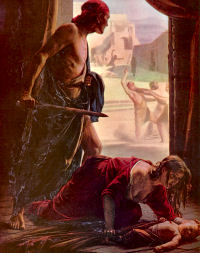
During this octave of Christmas the Church celebrates the memory of the small children of the neighborhood of Bethlehem put to death by Herod. Sacrificed by a wicked monarch, these innocent lives bear witness to Christ who was persecuted from the time of His birth by a world which would not receive Him. It is Christ Himself who is at stake in this mass-murder of the children; already the choice, for or against Him, is put clearly before men. But the persecutors are powerless, for Christ came to perform a work of salvation that nothing can prevent; when He fell into the hands of His enemies at the time chosen by God it was to redeem the world by His own Blood.

Our Christmas joy is tempered today by a feeling of sadness. But the Church looks principally to the glory of the children, of these innocent victims, whom she shows us in heaven following the Lamb wherever He goes.

Feast of the Holy Innocents - Day Four
The Holy Innocents saved the Child Jesus from death by King Herod by the shedding of their own blood. The Holy Innocents are the special patrons of small children, who can please the Christ Child by being obedient and helpful to parents, and by sharing their toys and loving their siblings and playmates.
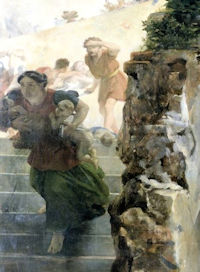
The feast of the Holy Innocents is an excellent time for parents to inaugurate the custom of blessing their children. From the Ritual comes the form which we use on solemn occasions, such as First Communion. But parents can simply sign a cross on the child's forehead with the right thumb dipped in holy water and say: May God bless you, and may He be the Guardian of your heart and mind—the Father, + Son, and Holy Spirit. Amen.

The Holy Innocents

Today, dearest brethren, we celebrate the birthday of those children who were slaughtered, as the Gospel tells us, by that exceedingly cruel king, Herod. Let the earth, therefore, rejoice and the Church exult — she, the fruitful mother of so many heavenly champions and of such glorious virtues. Never, in fact, would that impious tyrant have been able to benefit these children by the sweetest kindness as much as he has done by his hatred. For as today's feast reveals, in the measure with which malice in all its fury was poured out upon the holy children, did heaven's blessing stream down upon them.
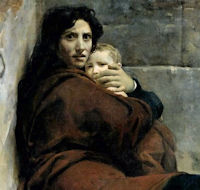
"Blessed are you, Bethlehem in the land of Judah! You suffered the inhumanity of King Herod in the murder of your babes and thereby have become worthy to offer to the Lord a pure host of infants. In full right do we celebrate the heavenly birthday of these children whom the world caused to be born unto an eternally blessed life rather than that from their mothers' womb, for they attained the grace of everlasting life before the enjoyment of the present. The precious death of any martyr deserves high praise because of his heroic confession; the death of these children is precious in the sight of God because of the beatitude they gained so quickly. For already at the beginning of their lives they pass on. The end of the present life is for them the beginning of glory. These then, whom Herod's cruelty tore as sucklings from their mothers' bosom, are justly hailed as "infant martyr flowers"; they were the Church's first blossoms, matured by the frost of persecution during the cold winter of unbelief.

— St. Augustine

Has the church's reaction to Covid19 killed off the obligation to go to Mass on Sundays?

Sunday Mass Obligation Was a Casualty of 2020

COMMENTARY: While public controversy focused on whether the government considered worship an ‘essential activity,’ the far more important question is whether the Catholic faithful consider Sunday Mass as ‘essential activity.’

A family prays June 28, 2020, in New York during St. Patrick’s Cathedral’s first public Mass since March, when the pandemic stopped large gatherings, including public Mass.
A family prays June 28, 2020, in New York during St. Patrick’s Cathedral’s first public Mass since March, when the pandemic stopped large gatherings, including public Mass. (photo: lev radin / Shutterstock.com)

For many years now, the Sunday obligation — observed by a minority of Catholics — was in the intensive care unit. It died this past pandemic year. A resurrection is not on the horizon.

The Code of Canon Law is clear enough: “On Sundays and other holy days of obligation, the faithful are obliged to participate in the Mass” (1247). A minority of baptized Catholics observe that; in many countries, it is a tiny minority.

Leave aside those of the baptized who have had no religious upbringing or formation; it is likely they do not even know of the Sunday obligation. Yet many of those who would consider themselves practicing Catholics do not consider Sunday Mass to be a canonical obligation, much less mandated by the Third Commandment, which ranks higher in importance than “Thou shalt not kill” or “Thou shalt not commit adultery.” 

Before the pandemic, the Sunday obligation was in poor shape. Then, for good reason, bishops the world over suspended the Sunday obligation. It could hardly be otherwise; with public Masses canceled, churches closed or operating at much-reduced capacity, the obligation would not have been in force anyway. Canon law does not oblige the impossible, which is why, for example, the sick, hospitalized and homebound are not obliged by Canon 1247. 


The formal suspension of the Sunday obligation thus changed very little. Yet the experience of the pandemic changed the default settings. Whereas before the default for an observant Catholic would have been to go to Sunday Mass, the pandemic changed that default toward not going, especially in those areas where people were encouraged not to come to church if they were elderly, sick, caring for the sick, in contact with the sick or worried about becoming sick themselves.

It followed, then, that parish priests reported, after the churches reopened, that parishioners who had come to daily Mass for decades were remaining at home to watch Mass online. Churches limited to 50%, 30% or 20% capacity had plenty of room left over on Sundays. Many pastors who were worried about how to register people for Mass to abide by the reduced-capacity requirements quickly realized that it was not going to be a problem. While public controversy focused on whether the government considered worship an “essential activity,” the far more important question is whether the Catholic faithful consider Sunday Mass as “essential activity.” The formal suspension of the Sunday obligation promoted, unintentionally, a shift in the default setting toward Sunday Mass as not essential, or optional. 

During this past year, countless statements about the pain of going without Sunday Mass have quoted the fourth-century Martyrs of Abitene: Sine dominico non possumus (“We cannot live without Sunday”). Yet it is evidently possible for far too many Catholics to get used to living “without Sunday.”

The formal suspension of the Sunday obligation has meant that, for a time, the Church has taken the view we must live without Sunday. It is not that there were viable alternatives, but the effect remains. It is certain that bishops are eager to lift the suspension of the Sunday obligation, but whatever residual culture of Sunday obligation existed is not coming back. It was sick before; it is dead now.


A few canons after the Sunday obligation, the Code of Canon Law shifts from feast days to fast days. Canon 1250 specifies all Fridays and the entire season of Lent as “penitential days.” Canon 1251 speaks of “abstinence from meat or some other foods according to the prescripts of the conference of bishops” on penitential days. 

Even among priests, let alone the faithful, there is little familiarity with what those “prescripts” might be. Practically, Friday abstinence from meat became a generalized Friday penance, of which abstinence from meat was one option. Friday penance has now become optional altogether. I do not permit Friday meat in my chaplaincy, but that requires introducing students to entirely new thinking. I have been served meat on Fridays at apostolic nunciatures, watched bishops scarf down bacon and eggs on Friday morning, stood in line behind priests in Friday buffet lines where a meat option was available and much availed of, been at Catholic schools were the cafeteria serves meat on Friday — or even Ash Wednesday.

Nothing prevents a Catholic from abstaining from meat on Fridays — and nothing mandates it either. But that recommended and highly venerable practice long ago disappeared as a default setting in Catholic culture, and, with it, the obligation for a Friday penance was also forgotten. The same happened in 2020 regarding the Sunday obligation; we will see that play out in 2021.

Of course, many Catholics will go to Mass on Sundays, particularly in those initial months after life begins to return to normal. Yet it will mainly be viewed as a preferred option, not thought of as an obligation mandated by the Third Commandment and specified by ecclesial authority. 


The first decision will be taken by bishops, on when to end the suspension of the Sunday obligation. That will come, sooner or later. 

The second decision will be for parishes, on whether they will end their livestreams, as Pope Francis did once churches in Italy reopened. 

The third decision will be for parishioners, on whether they will return. That, too, remains to be seen. A great many will not. A massive evangelical challenge will remain.

A principal challenge for 2021 will be to get Catholics back to Mass after a year of lockdowns, closures and restrictions. But it will be an uphill climb, as the pandemic killed off whatever remained of that mainstay of a previous Catholic culture, the Sunday obligation.