Wednesday, March 28, 2018

All about Holy Thursday

Holy Thursday

Note:  For my local readers Holy Thursday Mass will begin at 7 pm at St Jane de Chantal Church and will include the washing of feet.  Since this Mass does not truly end, the Blessed Sacrament will be processed from the Church to the Altar of Repose and Adoration will continue until midnight.


The Last Supper

The Last SupperHoly Thursday is the commemoration of the Last Supper of Jesus Christ, when he established the sacrament of Holy Communion prior to his arrest and crucifixion. It also commemorates His institution of the priesthood. The holy day falls on the Thursday before Easter and is part of Holy Week. Jesus celebrated the dinner as a Passover feast. Christ would fulfill His role as the Christian victim of the Passover for all to be saved by His final sacrifice.
The Last Supper was the final meal Jesus shared with his Disciples in Jerusalem. During the meal, Jesus predicts his betrayal.
The central observance of Holy Thursday is the ritual reenactment of the Last Supper at Mass. This event is celebrated at every Mass, as party of the Liturgy of the Eucharist, but it is specially commemorated on Holy Thursday.
He also establishes the special priesthood for his disciples, which is distinct from the "priesthood of all believers." Christ washed the feet of his Disciples, who would become the first priests.
This establishment of the priesthood reenacted at Mass with the priest washing the feet of several parishioners.
During the Passover meal, Jesus breaks bread and gives it to his Disciples, uttering the words, "This is my body, which is given for you." Subsequently, he passes a cup filled with wine. He then says, "This is my blood..." It is believed those who eat of Christ's flesh and blood shall have eternal life.
During the Mass, Catholics rightly believe, as an article of faith, that the unleavened bread and wine are transformed into the body and blood of Jesus Christ through a process known as transubstantiation. There have been notable Eucharistic miracles attributed to this event, such as bleeding hosts (communion wafers).
The Last Supper is celebrated daily in the Catholic Church as part of every Mass for it is through Christ's sacrifice that we have been saved.
On the night of Holy Thursday, Eucharistic Adoration of the Blessed Sacrament takes place where the faithful remain in the presence of the Eucharist just as the Disciples kept a vigil with Christ.
Following the Last Supper, the disciples went with Jesus to the Mount of Olives, where he would be betrayed by Judas.
The Last Supper has been the subject of art for centuries, including the great masterpiece by Leonardo Da Vinci.
The cup used by Jesus is known as the Holy Grail. Although it has been rumored to exist throughout history, it is almost certainly lost to time. There is no reason to believe the cup would have been outstanding in any way, and was likely a typical drinking vessel, indistinguishable from many others. Still, many myths continue to revolve around the artifact, and it remains a target for treasure seekers and a subject of entertainment. There is an incalculable abundance of art and tradition surrounding the Last Supper which has been celebrated by Christians since the last days of Christ until now.
At every hour of every day, somewhere around the world, Mass is being said and Communion taken. This has been happening incessantly for at least several hundred years. For nearly the past two thousand years, not a single day has gone by without a Mass being celebrated in some fashion. Therefore, anyone who celebrates the Mass participates in a daily tradition that is essentially two thousand years old.

During Lent, we should; live as children of the light, performing actions good, just and true - (see Ep 5:1-9).
Nos autem gloriari oportet in cruce Domini nostri Iesu Christi,
in quo est salus, vita et resurrectio nostra per quem salvati et liberati sumus.

We should glory in the cross of our Lord Jesus Christ, for he is our salvation,
our life and our resurrection; through Him we are saved and made free. (cf. Galations 6:14)

Entrance Antiphon for Holy Thursday

HOLY THURSDAY is the most complex and profound of all religious observances, saving only the Easter Vigil. It celebrates both the institution by Christ himself of the Eucharist and of the institution of the sacerdotal priesthood (as distinct from the 'priesthood of all believers') for in this, His last supper with the disciples, a celebration of Passover, He is the self-offered Passover Victim, and every ordained priest to this day presents this same sacrifice, by Christ's authority and command, in exactly the same way. The Last Supper was also Christ's farewell to His assembled disciples, some of whom would betray, desert or deny Him before the sun rose again.
On Holy Thursday there is a special Mass in Cathedral Churches, attended by as many priests of the diocese as can attend, because it is a solemn observance of Christ's institution of the priesthood. At this 'Chrism Mass' the bishop blesses the Oil of Chrism used for Baptism and Confirmation. The bishop may wash the feet of twelve of the priests, to symbolize Christ's washing the feet of his Apostles, the first priests.
The Holy Thursday liturgy, celebrated in the evening because Passover began at sundown, also shows both the worth God ascribes to the humility of service, and the need for cleansing with water (a symbol of baptism) in the Mandatum, or washing in Jesus' washing the feet of His disciples, and in the priest's stripping and washing of the altar. Cleansing, in fact, gave this day of Holy Week the name Maundy Thursday.
The action of the Church on this night also witnesses to the Church's esteem for Christ's Body present in the consecrated Host in the Adoration of the Blessed Sacrament, carried in solemn procession to the flower-bedecked Altar of Repose, where it will remain 'entombed' until the communion service on Good Friday. No Mass will be celebrated again in the Church until the Easter Vigil proclaims the Resurrection.
And finally, there is the Adoration of the Blessed Sacrament by the people during the night, just as the disciples stayed with the Lord during His agony on the Mount of Olives before the betrayal by Judas.
There is such an abundance of symbolism in the solemn celebration of the events of Holy Thursday layer upon layer, in fact that we can no more than hint at it in these few words. For many centuries, the Last Supper of Our Lord has inspired great works of art and literature, such as the glorious stained glass window in Chartres cathedral (above), Leonardo's ever popular (and much imitated) Last Supper in the 16th century, and the reminiscence called Holy Thursday, by the French novelist, Franasois Mauriac, written in the 1930s. (A chapter of Mauriac's meditation was reprinted in Voices, Lent-Easter 2002, with permission from Sophia Institute Press).

Saints who witnessed the Passion

5 Saints who witnessed Jesus’ Passion

JESUS WITH MARY
"The death of the Lord our God should not be a cause of shame for us; rather, it should be our greatest hope, our greatest glory. In taking upon himself the death that he found in us, he has most faithfully promised to give us life in him, such as we cannot have of ourselves."

--St. Augustine

Of course we know that Mary was there, yes, she is a Saint, Saint John, St Mary Magdalen and others..

These holy men and women were forever changed by what they saw on Good Friday.

While many present at Jesus’ crucifixion were part of the crowd who put him to death, there were several men and women who were fundamentally changed after encountering the suffering Christ.
Some are mentioned by name in the Bible, but others are spoken of only in reference to what they did or said on that day. Of these, various traditions continue their story and explain how they led a saintly life and are now venerated as “saints.”
Here are five familiar characters from the Passion narrative who became disciples of Christ after witnessing his passion.
St. Veronica
By tradition, she is known as the woman who wiped Jesus’ face as he was led to Calvary. Various legends explain where she went afterwards, all of which regard her as a holy woman. There are also relics that claim to be Veronica’s veil, bearing a miraculous image of Christ on it. (The name Veronica comes from the Latin/Greek phrase vera icon, “true image.”) One of these relics is kept in St. Peter’s Basilica in Rome and is often displayed on the 5th Sunday of Lent. Her feast day is July 12.
St. Simon of Cyrene
It is believed that Simon, at first a reluctant bystander when he was pressed into service to help Jesus carry his burden, became a changed man after bearing the wood of the cross and gazing into the eyes of the suffering Jesus. Little is known of what happened to Simon after the crucifixion, but tradition says that he and his sons became faithful disciples. This is deduced from the fact that Mark mentions the sons, Alexander and Rufus, by name (Mark 15:21), which seems to indicate that they were known figures in the early Church.  His feast day is December 1.
St. Dismas
Only mentioned in the Gospel of Luke, the “good thief” defended Jesus on the cross from the mockery of the other thief. Jesus saw the faith and repentance of the thief and boldly proclaimed, “Truly, I say to you, today you will be with me in Paradise” (Luke 23:43). Based on this statement of Jesus, the early Church recognized he was in heaven and therefore, a saint. Unnamed in the Gospel, he is given the name Dismas in an apocryphal account. His feast day is March 25, which was considered the traditional date of the crucifixion.
St. Longinus
After Jesus expired on the cross, a centurion pierced the side of Jesus and blood and water flowed out. It is believed that at that moment he became a faithful Christian. He is recorded in Mark as saying, “Truly this man was the Son of God!” (Mark 15:39) His name is not mentioned in Scripture, but he was given the name Longinus in later accounts. Various legends surround his life and some believe he was martyred by order of Pontius Pilate. His feast day is March 15.
St. Joseph of Arimathea
A wealthy man of Israel, he provided his own prepared tomb for Jesus’ body. The tomb became the site of Jesus’ resurrection. It is recorded in John that he was, “a disciple of Jesus, but secretly, for fear of the Jews” (John 19:38). Some traditions claim he traveled to Britain with the Holy Grail and founded a monastery at Glastonbury. His feast day is March 17

Follow the Passion of Jesus hour by hour

Follow the events of Jesus’ Passion with this timeline

JESUS WITH THE CROSS


An hour-by-hour narration of Jesus' way of the cross.

The final days of Holy Week are a special time in the Church year. We follow closely the Gospel narrative and accompany Jesus during the last 24 hours before his death.
One pious tradition is to assign specific hours to the various events the occur during Jesus’ Passion, starting on Holy Thursday and ending on Good Friday. In this way a person can unite themselves in a unique way to the suffering and death of Jesus.
Below is an hour-by-hour narration of Jesus’ final moments so as to facilitate your prayer during the next few days.
*Note: All hours are approximate and based on scripture and tradition.
Holy Thursday
Mid-Day – Jesus’ disciples prepare for the passover
And the disciples did as Jesus had directed them, and they prepared the passover. (Matthew 26:19)
6:00 p.m. – Jesus begins the “Last Supper”
And when the hour came, he sat at table, and the apostles with him. And he said to them, “I have earnestly desired to eat this passover with you before I suffer; for I tell you I shall not eat it until it is fulfilled in the kingdom of God.” (Luke 22:14-16)
8:00 p.m. – Jesus leads his disciples to the Garden of Gethsemane
And he came out, and went, as was his custom, to the Mount of Olives; and the disciples followed him. And when he came to the place he said to them, “Pray that you may not enter into temptation.” (Luke 22:39-40)
9:00 p.m. – 3:00 a.m. – Jesus is betrayed by Judas and arrested by soldiers. He is taken first to Annas, former High Priest, and then to Caiaphas, current High Priest, where he spends the night in a dungeon.
Good Friday
6:00 a.m. – Jesus is taken in front of the Sanhedrin and sent to Pilate
When day came, the assembly of the elders of the people gathered together, both chief priests and scribes; and they led him away to their council … Then the whole company of them arose, and brought him before Pilate. (Luke 22:66; 23:1)
7:00 a.m. – Jesus stands trial in front of Pilate and sent to Herod Antipas
[Pilate] asked whether the man was a Galilean. And when he learned that he belonged to Herod’s jurisdiction, he sent him over to Herod, who was himself in Jerusalem at that time. (Luke 23:6-7)
8:00 a.m. – Jesus stands before Herod Antipas and is mocked
Herod with his soldiers treated him with contempt and mocked him; then, arraying him in gorgeous apparel, he sent him back to Pilate. (Luke 23:11)
8:30 a.m. – Jesus is brought back to Pilate and tries to release him
“You brought me this man as one who was perverting the people; and after examining him before you, behold, I did not find this man guilty of any of your charges against him.” (Luke 23:14)
9:00 a.m. – 10:00 a.m. – Jesus is scourged and then starts the ascent to Mount Calvary
“I will therefore chastise him and release him” … And as they led him away, they seized one Simon of Cyrene, who was coming in from the country, and laid on him the cross, to carry it behind Jesus. (Luke 23:16, 26)
12:00 p.m. – 3:00 p.m. – Jesus is nailed to the cross and hangs there for three hours
And when they came to the place which is called The Skull, there they crucified him, and the criminals, one on the right and one on the left.  And Jesus said, “Father, forgive them; for they know not what they do.” (Luke 23:33-34)
3:00 p.m. – Jesus dies on the cross
It was now about the sixth hour, and there was darkness over the whole land until the ninth hour, while the sun’s light failed; and the curtain of the temple was torn in two. Then Jesus, crying with a loud voice, said, “Father, into thy hands I commit my spirit!” And having said this he breathed his last. (Luke 23:44-46)

A beautiful reflective homily by Cardinal O'Malley at the Chrism Mass

March 27, 2018 - Cardinal Seán P. O'Malley Chrism Mass Homily

SOM Chrism Mass 2018
 
Immaculate Conception Church, Malden, MA
When I was studying at Saint Fidelis of Sigmaringen Seminary, there were of course no computers or internet. In fact there were no televisions or radios and very seldom was a seminarian allowed to make a telephone call. The one concession to modernity was the practice of showing a movie on the eve of big feast days, in part because we would not have to rise at 4:30 the next day. All the movies had something in common: John Wayne. The Dean of students was a very strict censor and was not about to let any worldly films corrupt his seminarians. John Wayne films were considered safe and appropriate.
Father Maurice’s diligence in screening the films puts me in mind of the pastor in the movie, Cinema Paradiso, which takes place in a village in Sicily a few decades ago. In Italy there are still many communities where the venue for the local cinema is the parish hall and is under the supervision of the priest. In Cinema Paradiso, the pastor would review the films ahead of time, and when he rang a little bell, that was a signal to the projectionist to stop the film and edit out the love scenes, which in those days consisted of a kiss. When the pictures were shown, the parishioners would routinely boo every time one of these spliced and edited scenes would be projected on the screen.
Father Maurice did not have to cut out any scenes, because in John Wayne movies there were no kisses. In contrast to John Wayne, the Catholic priest in the performance of his duties is called upon by the church to kiss on various significant occasions. Today as we gather to celebrate priesthood, I would like to reflect on some of the priests’ kisses. There are four kisses of the Catholic priest. The priest kisses the altar. The priest kisses the Gospel. The priest gives a kiss of peace to his people. The priest kisses the cross.
One of the principles of Catholic theology is lex orandi lex credendi. Literally: the law of praying is the law of believing. In other words, the liturgy reveals a lot about what we believe. Looking at the kiss in the liturgy helps us to discover those loves that define the heart of a priest.
The Altar
The celebration of Mass always begins with a priest drawing near to kiss the altar. This liturgical custom dates from the first centuries of the Church.
In our tradition the altar is a symbol of Christ, who is the rock, the cornerstone on which our Church is built. We describe Christ as being the priest, the victim, and the altar.
Hence, when the priest is about to kiss the altar, he is kissing Christ. The same gesture is repeated at the conclusion of the Eucharist.
The priest must be the friend of the Bridegroom, John the Baptist said: “I am not the Messiah, I am but the friend of the Bridegroom.” Yes, Jesus is the Bridegroom, never the widower. He does not exist separate from his Bride, the Church. Like John the Baptist, the priest must be the friend of the Bridegroom.
The basis for our ministry in life has to be our friendship with Christ. Kissing the altar cannot be a formalistic or empty gesture. It must betoken our attachment to Christ, our loyalty to him, our friendship.
In the liturgy of St. John Chrysostom before receiving Communion, the priest prays: “Of thy mystic supper receive me today, O Son of God, as a partaker; for I will not speak of the mystery to thine enemies; I will not kiss Thee as did Judas; but as the thief, I will confess Thee: “Lord, remember me in thy kingdom.”
Judas’s kiss was a lie. It did not betoken friendship and love for Christ, but rather love of power and money. The authentic priestly kiss is one that betokens self-emptying and renunciation for the sake of the Beloved. I always like to say that poverty does not always lead to love. But love always leads to poverty. Our love of Christ must lead us to embrace his kenosis.
As we renew our priestly vows today, let us be mindful of how these promises can deepen our friendship with Jesus. Our fidelity to prayer and to our commitment to celibacy can draw us closer to Christ, the High Priest and Bridegroom. Ironically enough, in today’s world where fewer people are getting married, more people attack the Church’s practice of celibacy.
Often times in our culture the avoidance of marriage is based on a will to live for oneself and therefore is a no to the bond of marriage. Celibacy is meant to be the opposite: it is a definitive yes. It is to give oneself into the hands of the Lord. And therefore, it is an act of loyalty and trust, and that also implies the fidelity of marriage. Celibacy is a sign of the presence of God in the world, a reminder that God is to be loved above all else. The pastoral life of the Church has benefited greatly from the generous availability of men and women who have embraced a vocation of celibacy.
I know of a wonderful, faith-filled, young couple who are both doctors and want to be missionaries. They asked me to suggest different missions where they might go to offer their gifts and serve the poor. I put them in touch with bishops in Papua New Guinea and in Paraguay. In the end they came to me and said it would be impossible for them to go to those countries because they want to have children and they worried about zika. I certainly understand the logic.
When I was in seminary and three of my classmates left for Papua New Guinea, they were told: “you are going to get malaria, dengue, leeches, and fleas. Not necessarily in that order, but you will get them all.” I daresay if my classmates had wives and children, they would have had to think long and hard before answering the call to go to Papua New Guinea.
Our celibacy is to make us even more available to love Christ and serve His people. Theologically it is meant to be the sign of Jonah, the sign of the Resurrection. That we are all called to live forever and therefore it is not necessary for everyone to have children in order to live on in their posterity.
A priest is above all, a friend of Christ. Our love for Him is what draws us to our vocation and allows us to find meaning and purpose in our ministry. We kiss the altar as we approach and we kiss it as we leave, just as a husband kisses his wife when he comes home and kisses her when he leaves.
In the Maronite liturgy there is a beautiful apostrophe the priest addresses to the altar before leaving at the end of Mass. The priest says:
“Remain in peace, O holy altar of God. I hope to return to you in peace. May the offering I have received from you forgive me my sins and prepare me to stand blameless before the throne of Christ. I know not whether I shall be able to return to you again to offer sacrifice. Guard me, O Lord, and protect your Holy Church, that she may be the way to salvation and the light of the world. Amen.”
And when a Maronite priest dies, his brother priests carry the coffin, walking around the altar praying this prayer of farewell to the altar.
Gospel Book
The next kiss a priest bestows is after the proclamation of the Gospel. He kisses the Word of God as he prays: “Per evangelica dicta deleantur nostra delicta.” “May the reading of the Gospel cleanse me of my sins.”
The priest is a man of the Gospel. Jesus’ words and actions are what must mold the priest’s heart so that he may become an icon of the Good Shepherd.
In today’s Gospel Jesus tells us that He has been anointed to announce the Gospel to the poor and the downtrodden. We priests are also anointed to be heralds of the same Gospel. We are ordained to be missionaries on fire with the desire to share the good news with everyone. Christ has called us to be fishers of men and too often we are keepers of the aquarium.
We must meditate on the Gospels frequently so that the words and the inflections of the voice of the Good Shepherd become our own. Our role as preacher and teacher is crucial. We must be constantly preparing for this responsibility by our life of prayer, study, and reflection. Everything a priest does should teach the Gospel. Our words, our actions, our attitudes. Being a missionary is born of a constant struggle to deepen our own conversion; so that like the Baptist we can say, I must decrease, He must increase.
Kiss of Peace
Having kissed the Altar, and the Gospels, the next kiss is bestowed on the Bride of Christ, the People of God, our brothers and sisters whom we are called to serve. We must love our people and share their life. It is not a matter of being popular, but of being a spiritual father.
In the film Ryan’s Daughter, there is a touching portrayal of a parish Priest, Father Hugh Collins, who demonstrates such concern for his people in an Irish village during the uprising. His constant companion is a man who is developmentally challenged, Michael. When the village rises up against Rosy Ryan, accusing her of being a collaborator with the British, they beat her and cut off her hair. It is her pastor who protects and consoles her. As priests we need to have a special love for those on the margins, on the periphery as Pope Francis is wont to say.
We need to love our people and help them find meaning in life, to discover their purpose and embrace their mission. We must emulate the Curé of Ars who used to pray to the Lord: “Grant me the conversion of my parish, and I accept to suffer all you wish for the rest of my life.” St. John Vianney did everything he could to pull people away from their own lukewarm attitude in order to lead them back to love.
The Kiss of Peace is part of the liturgy from the earliest centuries and is a stark reminder that we are priests not for ourselves, but for our people. We must love them as the Good Shepherd who lays down His life. It is only when they know that we love them that they be willing to listen to us and accept our message.
Yes, even the message of the Gospel can be rejected because of the messenger who does not know how to communicate the Gospel with love, with a kiss.
The Cross
The last kiss is at the veneration of the Cross which is part of the Good Friday service.
We live in a culture that sees pain and suffering as the greatest evil. This attitude has helped spur the opiate crisis. We are often like Peter who tries to keep Jesus from even talking about the Cross. Jesus rebukes St. Peter: “Get behind me Satan. Thou savorest of the things of men and not of God.” And like Peter we often flee from Gethsemane and Calvary.
To savor the Cross is to savor the things of God. At our ordinations we all received the chalice and paten as the Bishop said: “Understand what you do, imitate what you celebrate, and conform your life to the mystery of the Lord’s Cross.”
On the Cross Jesus is offering Himself with the very compassion that transforms the suffering of the world into a cry to the Father. We must learn to accept more profoundly the sufferings of pastoral life which is entering into the mystery of Christ. Rejection of the cross breeds mediocrity.
On Good Friday the Bishop and Priests are invited to kiss the Cross first, to give our people an example of faithful discipleship that takes up the Cross each day to follow Christ our Master.
I am also mindful that when a man is installed as a bishop, the first thing the Church demands of him is to kiss the Cross.  Indeed when I think of my own installation here in the Cathedral of the Holy Cross, everything is kind of a blur. On that fateful day, I entered the Church passing through demonstrators and a crowd of reporters. Then, following the ancient ritual, I banged on the door with the crosier and stepped into a packed Cathedral. I was in a daze. However, I can still hear plainly the voice of a Master of Ceremonies, trying to rouse me from a state of stupor, saying in a stage whisper: “Kiss the Cross!” Outside there was so much turmoil. The love and faith of the people in the cathedral gave me the courage to kiss the cross.  
Jesus didn’t suffer and die so that we wouldn’t have to. He suffered and died in order to endow our sufferings with the redemptive value, something they would never possess on their own. He suffered and died in order to invest his love with us. He did this so that our love, while not diminishing our suffering or sparing us from pain, will transform pain into holy passion, suffering into sacrifice. 
Yet it is not the magnitude of Christ’s suffering that saved us, but rather the magnitude of His love. Love turned His suffering into an offering at the Last Supper, and that love is the Eucharist. It is the Eucharist that transforms Calvary into a sacrifice rather than merely an execution. There the Cross of Jesus turned death upside down. Death is the moment we usually associate with loss of life, but Jesus made it the occasion of giving life. Jesus gave His life freely and fully. He transformed it into a gift, a prayer, and a sacrifice.
As we continue to kiss the Altar, the Gospel, the People of God and the Cross, let us not allow our kisses to be routine or perfunctory, but rather let our kiss be a striking gesture of the profound loves that define us as Catholic priests.

Why today is called Spy Wednesday

What is Spy Wednesday / Holy Wednesday?

Question: "What is Spy Wednesday / Holy Wednesday?"

Answer:
In Christianity, Holy Wednesday or Spy Wednesday is the last Wednesday prior to Easter Sunday; it is the fourth day of Holy Week after Palm Sunday, Holy Monday, and Holy Tuesday. Depending on the denomination, this particular day may or may not be celebrated at all. Those that do observe Holy Wednesday, such as Eastern Orthodox churches, typically mark it with readings of particular scriptures and the singing of relevant hymns.

According to the traditional interpretation of the Bible, Holy Wednesday is the day on which Jesus was anointed with spikenard during a meal (Matthew 26:6–13). The day is sometimes called “Spy Wednesday” since it is traditionally thought of as the day Judas conspired with local authorities to betray Jesus (Matthew 26:14–16). The following day is sometimes referred to as Maundy Thursday, the fifth day of Holy Week.

Holy Week Wednesday General Audience

General Audience: Pope: May This Holy Week Lead Us to Celebrate the Lord’s Resurrection
Pope Also Greets Delegates of UNISPACE +50 Conference Organized by Vatican Observatory

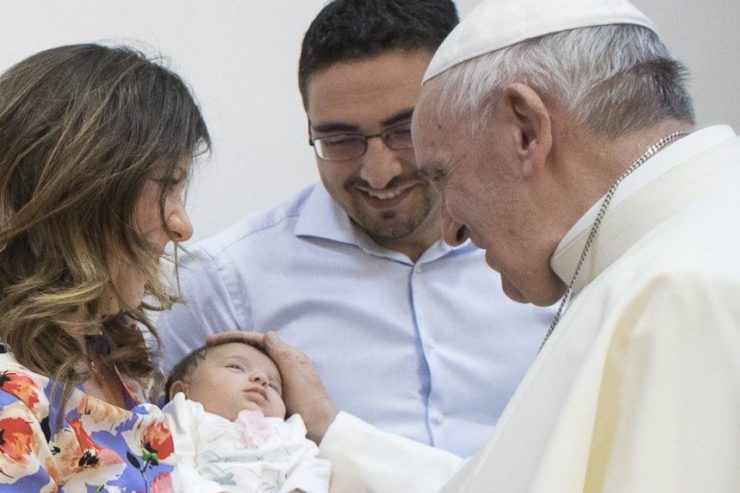
Pope with a family © Vatican Media
Here is the Vatican-provided English-language summary of the Pope’s address at the General Audience this morning:
***
Speaker: Dear brothers and sisters: Tomorrow begins the Church’s celebration of the Paschal Triduum, in which we re-live the great mystery of the Lord’s death and resurrection. The Gospel message that Jesus died for our sins and rose to new life is a source of joy and hope for all the world. At the same time, it is a summons to our responsibility and mission as the Lord’s followers to proclaim the victory of the Risen Jesus by our lives. In Baptism, we were given a share in Christ’s passover from death to life. Each of us has been called to live fully this new life in union with him and in imitation of his loving concern for the least of our brothers and sisters. In the poor, the suffering, the lonely and all those in need, we are asked to see the face of Jesus, and to become, in him, a means of redemption and hope, life and resurrection for our world. May Mary, who knew both the sufferings of the cross and the joy of the resurrection, obtain for us the grace to be united ever more fully to the Risen Lord and to reflect in our lives the reconciling and transforming power of his divine love.Speaker: I greet the English-speaking pilgrims and visitors taking part in today’s Audience, particularly those from England, Ireland, Finland, the Netherlands, Ghana, South Africa, Australia, Japan, Indonesia, the Philippines and the United States of America. I offer a special greeting to the delegates taking part in the Seminar organized by the Vatican Observatory in preparation for the forthcoming UNISPACE+50 Conference. May this Holy Week lead all of us to celebrate the resurrection of the Lord Jesus with hearts purified and renewed by the grace of the Holy Spirit. God bless you!

Tuesday, March 27, 2018

Wednesday Saint of the Day

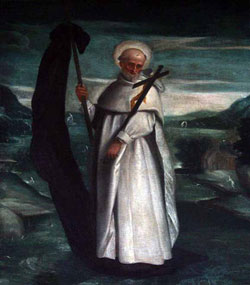
St. Venturino of Bergamo

Image of St. Venturino of Bergamo

Facts

Feastday: March 28
Birth: 1304
Death: 1346


Dominican preacher and missionary crusader. A native of Bergamo, Italy, he joined the Dominicans in 1319 and soon distinguished himself as a brilliant preacher, attracting huge crowds throughout northern Italy. Pleased with his ability to reach large numbers of believers, he announced in 1335 his intention to go on a pilgrimage to Rome. When Pope Benedict XII (r. 1334-1342) learned of the pilgrimage, he feared Venturino might be planning to crown himself pope, and so forbade the friar to proceed. This decree was joined by one issued by the Dominicans themselves at the Chapter in London (1335). Ignorant of these bans, Venturino proceeded to Rome and then to Avignon where he was arrested and imprisoned until 1343. He is also known for helping to organize a crusade, at the behest of Pope Clement VI (r. 1342-1352), against the Turks who were then menacing Europe.

A look at the 98 year old nun who is chaplain for a final four basketball team

Chicago: A Nun in Wolf’s Clothing
Sister Jean Dolores Schmidt has Gone Viral

Photo from Sister Jean's Facebook Page
It reads like a sappy script for a made-for-TV movie. A small school that hasn’t won a championship in half a century goes on a Cinderella tear and makes it to the Final Four of the NCAA Men’s Basketball Tournament.
The school is Catholic and coached by a Catholic-educated man who reminds every television interviewer that it is by the grace of God that he is able to do the work he does and whatever success the team has is to God’s credit. And the team chaplain is an elderly nun who turns in scouting reports, leads the team in prayer, and lectures the players on sportsmanship.
The thing is, this isn’t a script, but real life.  And at the center of all the trip to the championship is Sister Jean Dolores Schmidt of Loyola University Chicago.
Sister Jean, as she is known on campus, has gone viral.  You can see videos of her being interviewed on every major American television network.  She is in all the newspapers, on radio and all over social media.
But don’t get the idea Sister Jean is just an overnight sensation.  She has been a member of the religious order of the Sisters of Charity of the Blessed Virgin (BVM) for 81 years and served at Loyola for more than 50 years.  For the past decade, she has been the chaplain of the Loyola Men’s Basketball Team, nicknamed the Ramblers (the mascot is a wolf and a wolf is the image of a Rambler).  These days, Sister Jean is sporting full Ramblers regalia.
By the way, Sister Jean is 98 years old.
Sister went viral because the team really has experienced a Cinderella season, racking up a 32-5 record, winning the Missouri Valley Conference and surviving to the last four standing in the NCAA tournament that started with 128 teams.  They won their first three games by a total of four points before rolling up a 16-point margin of victory in their fourth game of the tournament.
“Sport is a universal language, which brings peoples close and can contribute to having individuals meet and overcome conflicts,” Pope Francis reflected during his general audience on April 6, 2016.
The Holy Father’s universal prayer intention for August 2016 was, “That sports may be an opportunity for friendly encounters between peoples and may contribute to peace in the world.”
This past December, Archbishop Ivan Jurkovič, Permanent Observer of the Holy See to the United Nations and Other International Organizations in Geneva, explained that sports bring three lessons that can be applied in the broader context:
  • A tool for human development: “The Church has often used the metaphor of sportsmanship as an image of maturation.”
  • Integration and international solidarity: “Sport…constitutes a tool to educate people about the importance of sharing, friendship and respecting others, as of the immense value of solidarity.”
  • Overcome economic interests and selfishness: “in sport, as in life, competing for the result is important, but playing well and fairly is even more important!” (Pope Francis, 2016)
“In our day, we seem to place much more emphasis on the final outcome of our efforts rather than on the journey to reach our goals,” Archbishop Jurkovic said. “Most people seem to give more value to the goals in themselves with little attention to the important and essential steps indispensable to achieve them.
“Nevertheless, most of us understand that reaching an objective requires training, practice, hard work, and much determination and dedication.”
In Loyola’s case, Sister Jean is putting a Catholic face on the NCAA Tournament.  And she makes no apologies about being a partisan fan:  “I ask God to be especially good to Loyola so that, at the end of the game, the scoreboard indicates a big ‘W’ for us. These kids play with their hearts and their heads because they love their school and because they love basketball.”
In addition to going viral, Sister Jean has created a huge demand for “Sister Jean” t-shirts, other apparel and even bobblehead dolls.  Several dozen products are rushing to market.
Someone with a different outlook on life might have seen this as an opportunity to cash in financially on the sudden name recognition.  But Sister Jean gave the university permission to sign the licensing agreements; royalties will go to the Loyola Athletic Fund.
Sister Jean asked nothing for herself, but portions of bobblehead sales will go to her Charity of the Blessed Virgin Mary.

Early Easter greetings from one Pope to another Pope(emeritus that is)

Pope Francis Visits Benedict XVI to Offer Early Easter Greetings
Argentine Pontiff Makes Stop at Residence of Pope Emeritus to Commemorate Lord’s Resurrection

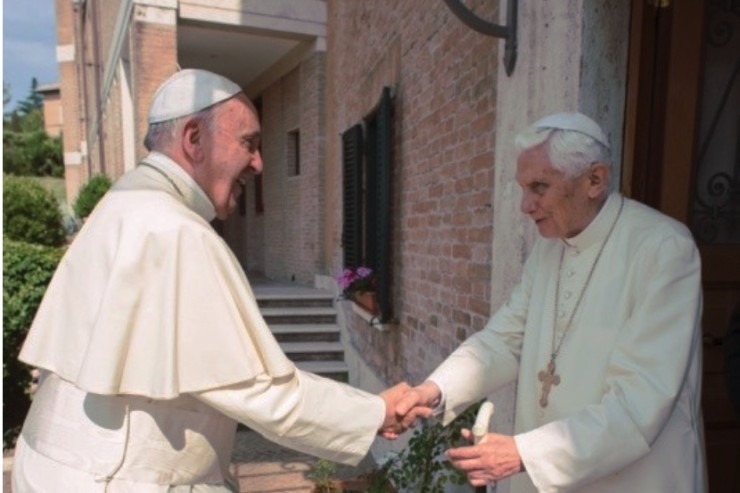
Photo Archivo, Copyright Osservatore Romano

The Easter season had an extra moment of joy when Pope Francis greeted his predecessor, Pope Emeritus Benedict XVI.
According to a note from the Holy See Press Office, the Argentine Pontiff visited the Pope Emeritus at his residence, Mater Ecclesiae monastery in the Vatican gardens on Tuesday afternoon to offer Easter greetings.