Monday, April 28, 2025

On this Monday we have powerful Saint #2


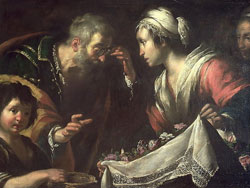
St. Louis de Montfort


Louis Mary Grignion was born to a poor family on January 31, 1673, at Montfort, France. He was educated at the Jesuit college in Rennes and was ordained there in 1700. He was assigned as chaplain to a hospital at Poitiers, and his much-needed reorganization of the hospital staff caused great resentment, leading to his resignation. However, during his stay there he organized a group of women into the Congregation of the Daughters of Divine Wisdom.

Eventually Louis went to Rome where Pope Clement XI appointed him missionary apostolic, and he began to preach in Brittany. His emotional style caused much reaction, but he was successful, especially in furthering devotion to the Most Blessed Virgin through the Rosary. He also wrote a very popular book, True Devotion to the Blessed Virgin. In 1715, Louis organized several priests and formed the Missionaries of the Company of Mary. He died in 1716 at Saint-Laurent-sur-Sever, France, and was canonized in 1947 by Pope Pius XII.

St. Louis de Montfort was a very able preacher, yet his emotional style along with his appeal to the poor caused much opposition. Undaunted by his critics, he continued his preaching. In addition, he expended great effort in spreading devotion to the Most Blessed Virgin, both through preaching and by the written word. Eventually he founded the clerical institute known more popularly today as the Montfort Fathers who carry on the work of preaching the Word and spreading devotion to Mary. Louis' perseverance in the face of opposition benefits the Church today in its faith struggle. His feast day is April 28.

On this Monday we have several powerful Saint days: #1 Saint Gianna Molla


St. Gianna Beretta Molla

Feastday: April 28
Patron: of mothers, physicians, and unborn children
Birth: October 4, 1922
Death: April 28, 1962
Beatified: April 24, 1994 by Pope John Paul II
Canonized: May 16, 2004 by Pope John Paul II


St. Gianna Beretta Molla was an Italian pediatrician born in Magenta in the Kingdom of Italy on October 4, 1922. She was the tenth of thirteen children in her family.

At three-years-old, Gianna and her family moved to Bergamo, and she grew up in the Lombardy region of Italy.

As a young girl, Gianna openly accepted her faith and the Catholic-Christian education provided to her from her loving parents. She grew up viewing life as God's beautiful gift and found the greatest necessity and effectiveness in prayer.

In 1942, Gianna began her study of medicine in Milan. She was a diligent and hardworking student, both at the university and in her faith.

As a member of the St. Vincent de Paul Society, Gianna applied her faith in an apostolic service for the elderly and needy.

She received degrees in both medicine and surgery from the University of Pavia in 1949, and in 1950 she opened a medical office in Mesero, near her hometown of Magenta.

In 1952, Gianna specialized in pediatrics at the University of Milan and from there on, she was especially drawn toward mothers, babies, the elderly and the poor.

Gianna considered the field of medicine to be her mission and treated it as such. She increased her generous service to Catholic Action, a movement of lay Catholics dedicated to living and spreading the Social Teaching of the Catholic Church in the broader culture. The Catholic Action movement is still at work today, throughout the world.

Gianna hoped to join her brother, a missionary priest in Brazil, where she intended to offer her medical expertise in gynecology to poor women.

However, her chronic ill health made this impractical, and she continued her practice in Italy.

She chose the vocation of marriage and considered this to be a gift from God. Gianna embraced this gift with all her being and completely dedicated herself to "forming a truly Christian family."

In December 1954, Gianna met Pietro Molla, an engineer who worked in her office. They were officially engaged the following April, and married in September 1955, making Gianna a happy wife.

Gianna wrote to Pietro, "Love is the most beautiful sentiment that the Lord has put into the soul of men and women."

In November 1956, Gianna became a mother to her first child, Pierluigi. Their second child, Maria Zita, in December 1957, and their third, Laura, in July 1959.

Gianna handled motherhood with grace and was able to harmonize all aspects of her demanding life.

In 1961, Gianna became pregnant with her fourth child. Toward the end of her second month of pregnancy, Gianna was struck with an unimaginable pain.

Her doctors discovered she had developed a fibroma in her uterus, meaning she was carrying both a baby and a tumor.

After examination, the doctors gave her three choices: an abortion, which would save her life and allow her to continue to have children, but take the life of the child she carried; a complete hysterectomy, which would preserve her life, but take the unborn child's life, and prevent further pregnancy; or removal of only the fibroma, with the potential of further complications, which could save the life of her baby.

Catholic teaching affirms what medical science, the Natural Law, the Bible and unbroken Christian tradition affirm, the child in the womb has a fundamental Human Right to Life. Wanting to preserve her child's life, Gianna opted for the removal of only the fibroma.

In fact, she was willing to give her own life to save the life of her child.

Gianna pleaded with the surgeons to save her child's life over her own. She sought comfort in her prayers and her living faith.

The child's life was saved, for which Gianna graciously thanked the Lord.

After the operation, complications continued throughout her pregnancy, but Gianna spent the remainder of her pregnancy with an unparalleled strength and insistent dedication for her tasks as a mother and a doctor.

A few days before the baby was to be born, Gianna prayed the Lord take any pain away from the child. She recognized she may lose her life during delivery, but she was ready.

Gianna was quite clear about her wishes, expressing to her family, "If you must decide between me and the child, do not hesitate: choose the child? I insist on it. Save the baby."

On April 21, 1962, Gianna Emanuela Molla successfully delivered by Caesarean section.

The doctors tried many different treatments and procedures to ensure both lives would be saved. However, on April 28, 1962, a week after the baby was born, Gianna passed away from septic peritonitis. She is buried in Mesero.

Gianna was beatified by Pope John Paul II on April 24, 1994, and officially canonized as a saint on May 16, 2004. Her husband and their children, including Gianna Emanuela, attended her canonization ceremony, making this the first time a husband witnessed his wife's canonization.

In 2003, mother-to-be Elizabeth Comparini experienced a tear in her placenta when she was 16-weeks pregnant. Her womb was drained of all amniotic fluid. She was told the chances of her baby's survival was little to none. Elizabeth is said to have prayed to Gianna Molla and asked for her intercession. Elizabeth was able to give birth to a healthy baby.

During Gianna's canonization ceremony, John Paul II described her as, "a simple, but more than ever, significant messenger of divine love."

St. Gianna is the inspiration behind the first pro-life Catholic healthcare center for women in New York, the Gianna Center.

St. Gianna Beretta Molla is the patron saint of mothers, physicians, and unborn children. Her feast day is celebrated on April 28.

Second Vespers on Sunday was prayed at the tomb of Pope Francis


Cardinals visit the tomb of Pope Francis, pray Second Vespers

Members of the College of Cardinals pay homage to Pope Francis visiting his tomb at the papal Basilica of Saint Mary Major, followed by praying Second Vespers together.

Vatican News

During the late afternoon of the Second Sunday of Easter, Divine Mercy Sunday, members of the College of Cardinals went to the papal Basilica of Saint Mary Major to pay their homage to Pope Francis at his tomb open to the public since seven in the morning.

They then gathered there for evening prayer, Second Vespers, led by the Basilica's Coadjutor Archpriest, Lithuanian Cardinal Rolanda Makrickas.

Behind them, groups of worshippers joined in, while others continued to arrive during the celebration to pay their respects to Pope Francis. An estimated twenty thousand people had already visited the tomb since the early morning.

The date for the start of the conclave is set for May 7th


Conclave to elect new Pope to begin on May 7th

The conclave to elect the 267th Pope will begin on May 7th, following the conclusion of the Novemdiales Masses to pray for the eternal repose of the late Pope Francis.

By Lisa Zengarini & Devin Watkins

The Cardinals present in Rome have agreed to begin the conclave on May 7th, 2025.

The date was set on Monday morning by the approximately 180 cardinals present (just over a hundred of whom are electors) gathered for the fifth General Congregation in the Vatican. 

The conclave will take place in the Vatican’s Sistine Chapel, which will remain closed to visitors during those days.

What happens during the conclave?

The conclave will be preceded by a solemn Eucharistic celebration with the votive Mass Pro Eligendo Papa, attended by the Cardinal electors.

In the afternoon, the Cardinal electors proceed in a solemn procession to the Sistine Chapel, where the Conclave begins to elect the new Pope.

At the end of the procession inside the Sistine Chapel, each Cardinal elector takes the oath as prescribed in paragraph 53 of Universi Dominici Gregis.

Through this oath, they commit, if elected, to faithfully fulfill the Munus Petrinum as Pastor of the Universal Church.

They also pledge to maintain absolute secrecy regarding everything related to the election of the Roman Pontiff and to refrain from supporting any attempts of external interference in the election.

At this point, the Master of Pontifical Liturgical Celebrations proclaims extra omnes, meaning that all individuals who are not part of the Conclave must leave the Sistine Chapel.

Only the Master himself and the ecclesiastic designated to deliver the second meditation remain.

This meditation focuses on the grave responsibility that rests upon the electors and the necessity of acting with pure intentions for the good of the Universal Church, keeping only God before their eyes.

Once the meditation is delivered, both the ecclesiastic and the Master of Pontifical Liturgical Celebrations leave.

The Cardinal electors then recite prayers according to the Ordo Sacrorum Rituum Conclavis and listen to the Cardinal Dean, who asks whether they are ready to proceed with voting or if any clarifications regarding the rules and procedures.

All election procedures take place exclusively in the Sistine Chapel within the Vatican Apostolic Palace, which remains completely sealed off until the election is concluded.

Throughout the election process, the Cardinal electors must refrain from sending letters or engaging in conversations, including phone calls, except in cases of extreme urgency.

They are not allowed to send or receive messages of any kind, receive newspapers or magazines of any nature, or follow radio or television broadcasts.

How many votes are required to elect a Pope?

To validly elect a new Pope, a two-thirds majority of the electors present is required.

If the total number of electors is not evenly divisible by three, an additional vote is necessary.

If voting begins on the afternoon of the first day, there will be only one ballot. On subsequent days, two ballots are held in the morning and two in the afternoon.

After the votes are counted, all ballots are burned. If the ballot was inconclusive, a chimney positioned over the Sistine Chapel emits black smoke. If a Pope is elected, white smoke will billow out of the chimney.

If the electors fail to reach an agreement on a candidate after three days of inconclusive voting, a break of up to one day is allowed for prayer, free discussion among voters, and a brief spiritual exhortation by the Cardinal Proto-Deacon (Cardinal Dominique Mamberti).

What happens immediately after a new Pope is elected?

Once the Cardinals have elected a new Pope, the last of the Cardinal Deacons calls the Secretary of the College of Cardinals and the Master of Pontifical Liturgical Celebrations into the Sistine Chapel.

The Dean of the College, Cardinal Giovanni Battista Re, speaking on behalf of all the electors, asks for the elected candidate’s consent with the following words: “Do you accept your canonical election as Supreme Pontiff?”

Upon receiving consent, he then asks: “What name do you wish to be called?”

The functions of a notary, with two Ceremonial Officers as witnesses, are carried out by the Master of Pontifical Liturgical Celebrations, who drafts the document of acceptance and records the chosen name.

From this moment, the newly-elected Pope acquires full and supreme authority over the universal Church. The Conclave ends immediately at this point.

The Cardinal electors then pay homage and pledge obedience to the new Pope, and thanks are given to God.

The Cardinal Proto-Deacon then announces to the faithful the election and the name of the new Pontiff with the famous line: “Annuntio vobis gaudium magnum; Habemus Papam.”

Immediately afterward, the new Pope gives the Apostolic Blessing Urbi et Orbi from the Loggia of St. Peter’s Basilica.

The final step required is that, after the solemn inauguration ceremony of the Pontificate and within a suitable time, the new Pope formally takes possession of the Patriarchal Archbasilica of St. John Lateran.

Sunday, April 27, 2025

Jubilee of Teenagers held in Rome despite funeral for Pope Francis and cancellation of canonization for Bl. Carlo Acutis


Young people participating in the second "Novemdiales" (nine days of mourning) on 27 April 2025Young people participating in the second "Novemdiales" (nine days of mourning) on 27 April 2025 

Teenagers gathered in Rome experience an historic Jubilee

As the Jubilee Year continues in Rome under a modified schedule due to Pope Francis' death, the Jubilee of Teenagers still took place on April 25-27, with tens of thousands of young people from around the world gathered in the Eternal City for the events.

By Vatican News

"Historic" is the word most often heard from the teenagers gathering over the past few days in the streets of Rome, where they are visiting the city on pilgrimage, easily noticed with their backpacks and duffel bags.

Béatrice is French, 14-years-old, and she came from Lyon with her diocese for the Jubilee, which had originally included the canonization Mass for Italian teenager, Blessed Carlo Acutis.

"When we learned of the Pope’s death, we wondered whether the Jubilee would still take place... Luckily, it did! Every time I come back from a pilgrimage, I feel free again," she told Vatican News. Next to her were Arthur and Zoé, all from the Charles de Foucauld Middle School in Lyon, smiling.

"The Pope fulfilled his mission," commented Arthur, grateful to be able to attend the funeral Mass of the late Pope.

"We already went to Assisi," added Zoé energetically. "Now we understand what 

“All we've ever known is this Pope,” they said, praising Pope Francis, who knew how to speak to them and give them attention.

At the funeral Mass on Saturday, April 26, Anna, who came from Geneva, Switzerland, shared: “The Jubilee for young people became a time of mourning and thanksgiving. This Pope was very close to young people. I remember his smile and the way he gently touched the hearts of all.”

Béatrice shared that she appreciates being here among the crowd of faithful who paid tribute to the late Bishop of Rome.

For the group leaders who made it possible for young people to live this unique experience, adjustments had to be made.

A vigil had been planned with the late Pope, but all were able to attend the funeral to pay their final respects.

Though the canonization of Blessed Carlo Acutis, another scheduled highlight of this Jubilee of Teenagers, has been postponed, tens of thousands of teenagers full of joy participated on Sunday in the second "Novemdiales" (nine days of mourning) Mass in honor of Pope Francis.

Cardinal Parolin offers Mass for Divine Mercy Sunday and day two of the Novemdiales


Cardinal Parolin at Novemdiales Mass: ‘Mercy takes us to heart of faith’

Cardinal Pietro Parolin celebrates Mass on Divine Mercy Sunday in suffrage for Pope Francis, and recalls that mercy offers Christians the golden thread that unites our lives to one another and to Christ.

By Devin Watkins

At Mass on the second day of the Novemdiales, or “nine days” of mourning for the late Pope Francis, Cardinal Pietro Parolin invited Christians to look to Christ’s infinite mercy for peace in the world and in our hearts.

In his homily, the 70-year-old Italian-born Cardinal drew inspiration from the day’s Gospel, which recalls the fear and sadness of the Apostles as they huddled in the Upper Room after Jesus’ death.

He said this image represents the Church’s state of mind at this moment, as Christians mourn the late Pope, who died on Easter Monday and was buried on Saturday.

“The grief at his departure, the sense of sadness that assails us, the turmoil we feel in our hearts, the sense of bewilderment,” he said, “we are experiencing all of this, like the Apostles grieving over the death of Jesus.”

Yet, said Cardinal Parolin, Christ comes precisely in this darkness to reveal Himself in the glory of His resurrection and illumine our hearts.

“Pope Francis reminded us of this since his election and often repeated it to us, placing at the centre of his pontificate that joy of the Gospel,” he said.

Many young people were present at the second Novemdiales Mass, which took place during the scheduled Jubilee for Teenagers.

Cardinal Parolin urged young people to welcome the joy of Easter, even amid the pain of loss, reminding them that Jesus always gives us the “courage to live.”

Recalling the Feast of Divine Mercy, the Cardinal said Pope Francis’ teaching put great emphasis on God’s mercy, which has no limits and works to raise us up and renew us.

“Our affection for him, which is being manifested in this time,” he said, “must not remain a mere emotion of the moment. We must welcome his legacy and make it part of our lives, opening ourselves to God’s mercy and also being merciful to one another.”

Mercy, added Cardinal Parolin, “takes us back to the heart of faith,” and helps us interpret our relationship with God and our identity as the Church according to God’s categories, rather than those of the world.

“The good news of the Gospel is first and foremost the discovery of being loved by a God who has compassionate and tender feelings for each one of us, regardless of our merits,” he said. “It also reminds us that our life is woven with mercy: we can only get back up after our falls and look to the future if we have someone who loves us without limits and forgives us.”

Cardinal Parolin, who served as Secretary of State under Pope Francis, noted that only mercy heals and creates a new world, extinguishing the fires of hatred and violence.

“The risen Lord directs His disciples, His Church, to be instruments of mercy for humanity for those willing to accept God’s love and forgiveness,” said the Cardinal. “Pope Francis was a shining witness of a Church that bends down with tenderness towards those who are wounded and heals with the balm of mercy.”

The late Pope, he added, believed strongly that peace is not possible without recognition of one another and mutual forgiveness.

Turning to employees of the Roman Curia and Vatican City State, Cardinal Parolin thanked them for their untiring service to the Holy See.

“We entrust ourselves to the Blessed Virgin Mary, to whom he was so devoted that he chose to be buried in the Basilica of Saint Mary Major,” concluded Cardinal Parolin. “May she protect us, intercede for us, watch over the Church, and support the journey of humanity in peace and fraternity.”

Sunday Saint of the Day


St. Zita


St. Zita was born into a poor but holy Christian family. Her older sister became a Cistercian nun and her uncle Graziano was a hermit whom the local people regarded as a saint. Zita herself always tried to do God's will obediently whenever it was pointed out to her by her mother. At the age of twelve Zita became a housekeeper in the house of a rich weaver in Lucca, Italy, eight miles from her home at Monte Sagrati. As things turned out, she stayed with that family for the last forty-eight years of her life. She found time every day to attend Mass and to recite many prayers, as well as to carry out her household duties so perfectly that the other servants were jealous of her. Indeed, her work was part of her religion! She use to say: "a servant is not holy if she is not busy; lazy people of our position is fake holiness." At first, her employers were upset by her generous gifts of food to the poor, but in time, they were completely won over by her patience and goodness and she became a very close friend. St. Zita was given a free reign over her working schedule and busied herself with visits to the sick and those in prison. Word spread rapidly in Lucca of her good deeds and the heavenly visions that appeared to her. She was sought out by the important people, and at her death in 1278 the people acclaimed her as a saint. She is the patroness of domestic workers. Her feast day is April 27.

Saturday, April 26, 2025

While attending funeral for Pope Francis, Trump & Zelensky talked peace in St. Peter's Basilica


Presidents Trump and Zelensky hold a discussion in St Peter's BasilicaPresidents Trump and Zelensky hold a discussion in St Peter's Basilica 

Trump and Zelensky discuss peace plans in St Peter's

Just before the Pope's funeral, the Presidents of Ukraine and the United States met for a "very productive" discussion on the ongoing war in Ukraine.

By Joseph Tulloch

From the very beginning of the war in Ukraine, Pope Francis continuously offered to mediate to help bring about peace. 

He appealed for an end to the war at almost every public appearance, and his prayers for "tormented Ukraine" became a familiar refrain.

The Pope's calls were, above all, calls for dialogue - for the involved parties to come together and find a way to put an end to the conflict.

Today, just before the Pope's funeral Mass, such a dialogue took place. Photos show Ukraine's President Zelensky deep in conversation with President Trump, the pair seated across from each other in St Peter's Basilica. 

A spokesperson for the White House called the discussion "very productive". President Zelensky, meanwhile, said that it had been a "good meeting", and the pair had "discussed a lot one on one".

"Hoping for results on everything we covered", Zelensky wrote on social media. "Protecting the lives of our people. Full and unconditional ceasefire. Reliable and lasting peace that will prevent another war from breaking out."

Recently, that ceasefire deal has looked less and less likely.

The last time Trump and Zelensky met in person, the discussion devolved into an acrimonious verbal brawl. Earlier this month, President Trump and US Secretary of State Marco Rubio threatened to "walk away" from efforts to broker a peace deal. And just two days ago, Russia carried out its deadliest air attack on Kyiv since the beginning of the year.

Today, however, the discussion seemed far more productive. It was, said Zelensky, a "very symbolic meeting, with the potential to become historic, if we achieve joint results."

If those results do materialise - if the "just peace" so often spoken of by the late Pope is achieved -  it might just be Francis' first miracle.

Burial of Pope Francis at St. Mary Major


Pope Francis is buried in St Mary Major

After funeral mass, Pope Francis’ mortal remains were carried through Rome to the Basilica of Saint Mary Major, where he was laid to rest near the icon of Mary Salus Popoli Romani.

By Francesca Merlo

After a solemn but beautiful mass, Pope Francis’ mortal remains made their way across the Eternal City to his final resting place: the Basilica of Saint Mary Major.

150,000 people lined the streets to bid a final farewell to Pope Francis, who on Sunday, the day before he died, had driven around St. Peter's Square in his popemobile, where he, perhaps unknowingly said goodbye to the faithful.

The procession travelled through the ancient ruins of Rome, past the monument of the fallen soldiers in Piazza Venezia - this Pope who so tirelessly advocated for peace; past the ancient Roman Forum and the Colosseum, where his beautiful meditations for the Via Crucis, denouncing the economy of indifference and calling for an economy of peace, had been read out just one week ago. Then, up to the Basilica of Saint Mary Major, where his coffin was raised towards the crowd for a final goodbye. Inside the Basilica, too, the Pope’s coffin was held for a few moments before the Pauline chapel, facing the icon of Mary Salus Popoli Romani, before being taken to the chapel next door, to be buried.

At 1.00pm, the Rite of the Burial of the Roman Pontiff's casket began.
The rite took place according to the prescriptions of the Ordo Exsequiarum Romani Pontificis, presided over by the Cardinal Camerlengo, in the presence of those indicated in the relevant Notice from the Office for the Liturgical Celebrations and the family members of the deceased Pope. It concluded at 1.30pm.

Pope Francis now lies to rest in the burial niche in the side aisle between the Sforza Chapel and the Pauline Chapel holding the icon of Mary Salus Popoli Romani. We can be sure that the two of them will never leave each other’s sides.