Thursday, August 29, 2024

Saint of the Day for Friday


St. Jeanne Jugan


Feastday: August 30
Patron: of the destitute elderly
Birth: October 25, 1792
Death: August 29, 1879
Beatified: Pope John Paul II on October 3, 1982
Canonized: Pope Benedict XVI on October 11, 2009


St. Jeanne Jugan, also known as Sister Mary of the Cross, L.S.P. was born on October 25, 1792 in the French region of Brittany during the French Revolution.

Jeanne grew up as the sixth of eight children to Joseph and Marie Jugan surrounded by a lot of religious and political upheavals. Her father became lost at sea when Jeanne was just four-years-old, and her mother struggled to provide for all the Jugan children.

Her mother worked diligently to make sure her children had everything they needed, including secret religious instruction when anti-Catholic persecutions were taking place.

From a young age, Jeanne learned to knit and spin wool and became a shepherdess. Barely able to read or write, Jeanne took a job as a kitchen maid for a noble family when she was 16.

Jeanne accompanied the Viscountess de la Choue when she visited the poor and the sick. As she matured, Jeanne began finding her passion in working with these people and turned down multiple marriage proposals. She told her mother God had other plans for her.

At 25, Jeanne became an Associate of the Congregation of Jesus and Mary, which was founded by St. John Eudes. She spent her time praying and working as a nurse in the town hospital. She stayed at the hospital for many years until her own health issues prevented her from performing her physically demanding tasks.

After leaving her job at the hospital, Jeanne became the servant of a member of the Eudist Third Order for 12 years. While working as a servant, Jeanne and her master found the same Catholic faith in each other and set out to begin teaching catechism to the town's children and caring for the poor.

In 1837, Jeanna and Francoise Aubert rented part of a small cottage and were joined by a 17-year-old orphan, Virgine Tredaniel. Together, they formed a small community of prayer devoted to helping the poor and teaching the catechism.

Two years later, Jeanne was approached by an elderly, blind and partially paralyzed woman named Anne Chauvin. With no one there for the woman, Jeanne carried her to her apartment and took it upon herself to begin caring for her. She let Anne have her bed and Jeanne slept in the attic.

A short time later, Jeanne took in two more old women in need of help and by 1841, she rented another space to house a dozen of elderly people. The next year, she attained an open convent and housed 40 more people.

With approval from her peers, Jeanne began focusing her attention on her new mission - assisting abandoned elderly women. This marked the beginning of the religious congregation known now as The Little Sisters of the Poor.

Jeanne constructed a simple Rule of Life for her new community of women. Each day they went around town requesting food, clothing and money for those in their care. Jeanne's carried on with her new life's work for the next four decades of her life.

More young women started to hear about Jeanne's mission and joined her. Through begging on the streets, Jeanne was able to open four more homes for her needy within those 10 years. By 1850, over 100 women had joined the congregation.

Jeanne was soon forced out of the leadership role, though. The local bishop appointed Abbe Auguste Le Pailleur as Superior General of the congregation. Jeanne was assigned to strictly begging on the streets until she was sent to retire in a life of obscurity for her final 27 years of life.

After The Little Sisters of the Poor communities began expanding throughout France, their work spread to England in 1851 and the United States founded five of their own communities from 1866 to 1871.

By 1879, Jeanne's community had over 2,400 Little Sisters. On March 1, 1879, Pope Leo XIII approved the Constitution for the congregation for seven years.

At the time of Jeanne's death, on August 29, 1879, most of the Little Sisters had no idea Jeanne was the real founder of the congregation. However, Le Pailleur was investigated and dismissed in 1890 and Jeanne became acknowledged once again as the foundress.

St. Jeanne Jugan passed away at the age of 86. She was beatified by Pope John Paul II on October 3, 1982 and canonized by Pope Benedict XVI on October 11, 2009.

During her canonization Pope Benedict XVI expressed, "In the Beatitudes, Jeanne Jugan found the source of the spirit of hospitality and fraternal love, founded on unlimited trust in Providence, which illuminated her whole life."

She is the patron saint of the destitute elderly and her feast day is celebrated on August 30.

Florida Bishops ask for stay of execution from Gov. DeSantis


DeSantis urged to stay execution of inmate

abused decades ago as teen at 

state reform school


ORLANDO, Fla. (OSV News) — Florida’s first execution of 2024, scheduled for Aug. 29, has been deemed “hypocrisy” because the death warrant is for a victim of abuse suffered decades ago at a state-run reform school for boys and comes as the state agreed to pay compensation for many of those abused at the school.

Gov. Ron DeSantis signed the death warrant for Loran Cole, 57, on the heels of signing into law a measure to divide $20 million in compensation among survivors of abuse that took place at the Arthur G. Dozier School for Boys in north Florida between 1940 and 1975.

Cole was 17 when he was housed at the Dozier School for five and a half months in 1984, when he endured daily beatings that resulted in two broken legs and being raped by guards.

Florida’s Catholic bishops are among those who have implored DeSantis to stay Cole’s execution and commute his sentence to life without possibility of parole.

Cole was sentenced to death in 1995, for the murder of John Edwards, an 18-year-old Florida State University student. Cole was also convicted of robbing, raping and kidnapping Edwards’ sister Pam, who was with her brother camping in the Ocala National Forest. Cole’s execution warrant comes nearly 10 months after Florida’s last execution, which was the last of the state’s six executions carried out in 2023. The co-defendant in the Edwards murder was given life in prison.

In its 111-year history, investigations and former students’ accounts have chronicled how the Dozier School, in both Marianna and Okeechobee, was not so much a reform school but rather a place where physical, sexual and mental abuse was rampant.

In June, DeSantis quietly signed a bill — without any press present and with only a handful of Dozier survivors and three representatives who sponsored HB 21 — to provide $20 million in compensation to abuse victims.

This followed years of investigation, including in 2008 when then-Gov. Charlie Crist directed the Florida Department of Law Enforcement to investigate the Dozier School and the deaths alleged there, and a federal investigation that closed the school in 2011, which was under the control of the Florida Department of Juvenile Justice.

One moniker from the institution in Marianna was the “White House Boys,” which according to News Service of Florida derived from the white concrete building where boys were beaten and raped by school workers.

In post-conviction appeals, Cole’s lawyers have chronicled the neglect, abuse and trauma their client experienced and argued it changed the entire trajectory of his life and led to the commission of his crime. Cole’s lawyers argued his “post-1984 criminal record also goes to show the effect that life in Dozier had on his psyche. That horrible place helped create the Loran Cole who sits on death row today.”

Cole “was beaten, raped and tormented at Dozier,” Michael Sheedy, executive director of the Florida Conference of Catholic Bishops, said in an Aug. 14 letter to DeSantis on behalf of the bishops of Florida.

“He witnessed torture and daily beatings of other students. He was once forced to clean up the remains of another student who died by suicide after jumping off a building,” Sheedy wrote. “He had his legs broken after trying to escape. Mr. Cole’s jury never heard about the physical and mental abuse he endured at the hands of officers at Dozier.”

Survivors of Dozier tell stories of beatings with leather belts, students being tied to a bed, students being put in dryers, forced labor and rape. Various news reports indicate between 80 and 100 children died at Dozier, with the location of their remains unknown. A graveyard near the school has several unmarked crosses, which survivors believe are boys killed by staffers.

In 2010, while on death row, Cole watched a documentary about Dozier and was flooded with memories of his time there. He shared his memories with a prison mental health counselor.

“Never having received mental health and trauma treatment until his arrival on death row in his late 20s, Mr. Cole, at age 57, is not the same person who committed the grave crimes for which he was convicted,” Sheedy stated in his letter.

Maria DeLiberato, executive director of Floridians for Alternatives to the Death Penalty, said there are a “half dozen other men on Florida’s death row who survived the abuse at Dozier, as well as countless others in the Florida Department of Corrections.” She described the governor’s signing of a death warrant on a Dozier survivor as “hypocrisy,” and said the “state-sanctioned cycle of abuse” must stop.

“Horrifically, shortly before Loran was released from Dozier, he was forced to clean up a smattering of blood and brain matter from another child who had jumped off the roof of one of the cottages and died by suicide,” DeLiberato said. “In passing the compensation bill for Dozier survivors, the state of Florida recognized its direct responsibility for the profound and lifelong impact of the horrific torture and abuse those men suffered there. For the State of Florida to turn around less than a month later and say they are justified in killing one of those survivors is unconscionable.”

Before Cole’s scheduled execution, Floridians will gather across the state to pray for him and his victims, for DeSantis as he considers the request to stay the execution, “and for an end to the death penalty and the cycle of violence in society,” Sheedy said.

Jean Gonzalez is editorial/online director for Florida Catholic Media.

Wednesday, August 28, 2024

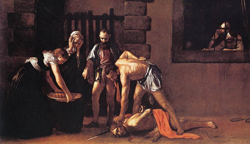
August 29th is the Feast of the Martyrdom of St. John the Baptist

 The Feast of the Martyrdom of St. John the Baptist - God's Call to the New Evangelization


WASHINGTON, DC (Catholic Online) - On August 29 we will celebrate the Memorial of the Martyrdom of St. John the Baptist. Seen as the last prophet of the Old Testament and the first prophet of the New, St. John has always been an icon of one who not only spoke the truth but also challenged his hearers with a call to action. He knew that truth always demanded a decision.
Like his successor, St. Paul, who described his own vocation in Galatians 1:15, John the Baptist was set apart by God from his mother's womb and called by His grace. Even before his birth, he leaped for joy as he came into the presence of the Son of God within Mary's womb.
Truly he was, as Isaiah said, one crying in the wilderness to prepare the way of the Lord. His burden was to awaken the people to this incredible good news, letting them know that the one for whom they had been waiting - the Messiah - would be coming soon.
St. John the Baptist also wanted to be sure that the way was prepared for His coming - recognizing the way that had to be prepared was not a road of stones and dirt, but a highway of the heart. He called for people to repent and be baptized, washed of the burdens of this life that they could hear the Words of the Master when He came.
This baptism was only a foreshadowing of the one to come in Christ's Church. While his prepared the way, the sacrament would be a conveyor of grace.
On this feast day, however, we are focused on martyrdom, his beheading. He died for the faith for which he lived. The consequences of his heralding the good news and a call to righteousness cost him his life.
He was condemned by the decree of King Herod, who himself was caught in the clutches of a vengeful wife, Herodias, formerly the wife of his brother, Philip. He was also held captive by the throws of lust toward the daughter of Herodias. The account of Herod's treachery contains more drama than a modern day soap opera.
St. John's martyrdom reminds us that the most important vocation for all Christians, Catholic and Protestant alike, is living out the Gospel. We are called to proclaim the Good News of Christ both in word and deed, which sometimes can put us in some tense situations.
Let's face it, the Gospel can become inflammatory and even more so as a culture moves farther and farther away from core values of moral living. For this reason we are reminded by the Apostle Paul in Ephesians 4 that we must speak the truth in love.
For several decades both Pope John Paul II and Pope Benedict XVI have been calling upon Catholic Christians be become involved in the New Evangelization. In fact, Pope Benedict has made this the theme for World Youth Day 2013 in Brazil.
Over the years, evangelization has been stereotyped as an attempt by self-righteous individuals to impose their values on others. Nothing could be further from the truth!
Evangelization is a movement that begins in the heart, where a Christian, whose life has been given over to Jesus Christ, eagerly shares that good news of the coming of Christ and His Kingdom into the world.
The believer also wants to let all know of Christ's passion, death and resurrection which has overcome the world, the flesh and the devil. More than anything, he or she wants others to be able to participate in this glorious and wondrous relationship with the living God, the fullness of which is found in the Catholic faith.
Such a testimony doesn't come from self-righteous individuals, but those who have encountered the living Christ through His Word and Sacraments.
From the Gospel reading appointed for the Memorial in Mark 6:17-29, we read "Herod feared John, knowing him to be a righteous and holy man, and kept him in custody. When he heard him speak he was very much perplexed, yet he liked to listen to him."
The King, although living a life of debauchery, felt something kindle in his heart when John preached. The truth was making an impact. As with any move of grace, the devil is quick to distract by re-ignited the fires of passion that the soul might be once again consumed with lust.
How like today, where the people who are hearing the Gospel and also being bombarded by messages laced with sensuality and images that inflame. It's no wonder they condemn the messenger as self-righteous as everything in them is being drawn away from the righteousness of God.
However we find the world, giving up on sharing the gospel is not an option. I'm an example of one who was touched by God's grace as my life was moving in the opposite direction.
Bill Bright was a Protestant minister who gave rise to the largest college movement for Christ in America as well as other parts of the world - Campus Crusade for Christ. He used to say, "success in witnessing [Ed - evangelization] is simply sharing Christ in the power of the Holy Spirit and leaving the results to God."
While we may not be able to control the recipient, we can prepare ourselves for the work of evangelization. The keys are found in Herod's assessment of St. John the Baptist. He was holy and righteous.
By living our faith on a daily basis, through such disciplines as prayer, reading Scripture, attending daily Mass, praying the Offices of the Church and the Rosary, we can become equipped with His love and grace for this work. Our sharing of His Gospel can come through the power of His Spirit.
Many have described the results of evangelization as being a new birth - as men and women of all ages are "born again" by water and the Spirit. How does this new birth begin? By those in the womb of life encountering the One in Mary's womb and leaping for joy.

African Archbishop says it's Biblical and not cultural why they oppose LGBTQ issues as well as female deacons


Archbishop says Africa’s opposition to LGBTQ+ rights not ‘cultural’ but Biblical


Archbishop Andrew Nkea Fuanya. (Credit: Ngala Killian Chimtom/Crux.)

YAOUNDÉ, Cameroon – A leading African archbishop has refuted claims that cultural factors are the primary reasons behind Africa’s emphatic rejection of issues such as LGBTQ+ rights and the ordination of female deacons.

Archbishop Andrew Nkea Fuanya of Cameroon’s Bamenda archdiocese addressed this topic during the August 23 session of the ongoing weekly synodal discussions, organized by the Pan-African Catholic Theology and Pastoral Network (PACTPAN) in collaboration with the Conference of Major Superiors of Africa and Madagascar (COMSAM).

Issues around gay relationships and the ordination of female deacons and priests are some of the hot-button issues being discussed around the ongoing multi-year Synod on Synodality, which Pope Francis extended to 2024.

“When we went to the Synod, it was clear that Africa had to take responsibility for its own destiny. We knew we had to make our voice heard in the first phase of the Synod,” Nkea said.

He explained that making Africa’s voice heard was “not talking purely from a cultural background.”

The archbishop said Africa was talking “from the background of the traditions of our fathers and from the background of the teachings of the Church.”

“In presenting our points at the Synod, therefore, we did not want to be seen as presenting points of Africa because of the culture from which we came. Our stand had nothing to do with culture; it was about fidelity to the truth; fidelity to what Christ taught. It was about fidelity to what the Apostles handed down to generations,” he said.

Johan Viljoen, the Director of the Denis Hurley Institute of the Bishops’ Conference of Southern Africa agrees with the Cameroon archbishop, saying Africa’s stance on the controversial issues isn’t necessarily a function of culture.

“Look back 40 years. The same debate raged in Europe and North America. But if these issues are rejected there, it is blamed on homophobia and misogyny, not culture,” he told Crux.

Nkea suggested that there has even been a perception that Africans don’t really have the mental capacity to understand their own culture and civilization.

“Theologians here, you must tell us whether the African brain is inferior when it comes to reflecting on African culture and civilization,” the archbishop said.

Nkea, who is also the President of the Cameroon Episcopal Conference, further explained Africa’s rejection of the blessing of gay marriages – an issue that came up in the synodal conversations in Rome.

“Africa was not defending a cultural idea. Africa was defending the teaching that the Church has had for 2,000 years,” and that explains Africa’s “vehement no” on that specific question.

He said that rejection includes Fiducia Supplicans, the document which came out last year after the first session of the Synodal gathering in Rome. The document was seen to authorize the blessing of “same-sex couples” and couples in other “irregular situations.”

“We are going back to the second session with the same vehement rejection of that document,” Nkea said.

Addressing the issue of the ordination of women, Nkea highlighted Church tradition to explain the stance of Africa at the Synod on Synodality.

“We therefore do not buy the idea that people tell us that we are arguing from culture. And that we come from a culture that is still developing, and that is why we do not understand certain things,” the archbishop said.

The pushback comes against the backdrop of a perception even by the leadership of the Catholic Church that Africa’s position on these issues was informed only by its allegiance to culture.

Pope Francis for one talked up this narrative, saying in an interview that Africa’s stance on homosexuality was culturally driven.

The pope had suggested that for Africans, “homosexuality is something ‘bad’ from a cultural point of view.”

One other point of discord is the image of the tent proposed in the synthesis report – the image of the tent used as a prism through which to comprehend our synodal mandate.

Nkea said Africa rejects that image for one simple reason: It portrays conquest and capture.

“We come from a broken continent, a continent where everybody comes to do fishing, yet those who live in that continent have no fish to eat. It is a broken, battered continent. It is a continent which has been harassed and dejected, and yet, this continent sees tents only in the backdrop of when we are running around carrying boxes on our heads as refugees,” the Cameroonian archbishop said.

“We are not running as refugees in the Catholic Church, and therefore, tents for us have a very derogatory meaning. For us, tents mean refugees who are running, pursued by predators and those who want to steal our wealth. We rejected the tent,” he said.

The second session of the Synod on Synodality will take place in Rome from October 2-29.

Has the Communion Chalice returned to your Church?


The pandemic is officially over, but will Communion

chalices make a comeback at Mass?


CHICAGO (OSV News) — After the federal government declared a health emergency in 2020 over the COVID-19 pandemic, Catholic churches in the U.S. scrambled to figure out how to provide the Eucharist, the sacrament that is the “source and summit of the Christian life” while keeping people safe from contagion.

In that process, most Catholic churches decided to suspend the Communion chalice at Mass, while allowing people to receive just the host. That prudential judgment by church officials to restrict holy Communion to just one kind only was possible for Catholics, because the church teaches Jesus Christ is “wholly and entirely present” — body, blood, soul and divinity — in the Eucharist. Whether one receives either the host, the body of Christ (which retains the appearance of bread), or the blood of Christ (which retains the appearance of wine) at holy Communion, that person receives the same Christ and can “receive all the fruit of Eucharistic grace.”

But the Catechism of the Catholic Church also teaches “the sign of communion is more complete when given under both kinds, since in that form the sign of the Eucharistic meal appears more clearly.”

By the time the federal government completely lifted all health restrictions related to the COVID-19 pandemic in May 2023, Catholics were routinely receiving the host, the body of Christ, at holy Communion.

While some dioceses allowed distribution of the blood of Christ from the Communion chalice as early as June 2022, residual fears about the virus have left their mark long after the Centers for Disease Control and Prevention established the risk of COVID-19 contagion from surfaces was actually low and that vaccination was the most effective protective measure against contracting the airborne disease.

With the exception of Eastern Catholic churches (where Catholics receive the Eucharist under both kinds commingled from the priest), the return of the faithful routinely receiving the blood of Christ in Communion chalices has proceeded far more slowly in parishes of the Latin Church.

“I was looking forward for it to come back,” said Edward Zampinella, who receives Communion under both kinds at St. Thomas the Apostle Church in Chicago. The pastor there confirmed to OSV News that his parish started to distribute the blood of Christ again at weekly Mass in mid-May.

Zampinella, 67, told OSV News he has been receiving the Eucharist from the Communion chalice “for as long as I’ve been living” but that he had to stop during the pandemic.

“With COVID people got scared and stuff. Now it’s coming back. People are coming out of their shells. Some people are still a little scared, but we (should) just be an example, make people feel comfortable” receiving the blood of Christ again, he said.

During the pandemic, hesitant reception of the blood of Christ raised concern among church officials that the practice of offering holy Communion under both kinds to the faithful might go by the wayside in churches. The Washington-based Federation of Diocesan Liturgical Commissions included in a February 2024 survey, answered by 99 (arch)dioceses nationwide, a question of whether offering the Communion chalice has been “restored to the faithful.” It found 50 said “yes,” but 47 left it up to individual pastors to decide and two said “no.” (There are 196 archdioceses and dioceses in the United States.)

Rita Thiron, the federation’s executive director, told OSV News in an email, “as the pandemic fears lessened, there was a fear that the distribution of the Precious Blood would be restricted, lost or forgotten. Many in the church hierarchy, diocesan leaders and parish priests were anxious to restore the cup to the faithful after the pandemic — for theological, liturgical and pastoral reasons.”

At Sacred Heart Church in Prescott, Arizona, associate pastor Father Gaspar Masilamani said his church started to offer Massgoers the blood of Christ again at the end of December last year. He said Sacred Heart is just one of five parishes in the fast-growing Phoenix Diocese that offer Communion under both kinds.

Claretian Father Masilamani told OSV News that after the pandemic disrupted church life, when the Vatican in September 2020 urged a return to in-person Mass participation as soon as anti-COVID measures permitted, the parish wanted to take part. After receiving multiple requests to return to offering the Communion chalice to communicants and seeking feedback from parishioners, the parish reinstated it.

“Honestly, I was thrilled. Especially whenever I finish Mass, people come up and they say, ‘Wow, we are really happy and are privileged that we started this,'” he said. The priest noted seeing in the faithful “that emotional and sentimental satisfaction of getting both species” in holy Communion.

Father Michael Witczak, a liturgy and sacramental theology professor at The Catholic University of America in Washington, said that receiving holy Communion under both kinds speaks to the integrity of the church as the body of Christ.

“To receive Communion under both kinds is a reinforcement of the underlying unity of the body of Christ,” Father Witczak explained to OSV News, “which is hierarchically organized: the bishops and the priests representing Christ the head for the local communicants and local congregations, but that all those who are baptized are members of the body of Christ and participate in their own way as … members of the church.”

Father Witczak pointed to different periods in the Latin Church’s history when the blood of Christ was not distributed to the lay faithful for various reasons, such as for not giving it proper dignity with careless distribution and the potential for spilling, stealing the chalice and also fears of infection from plague and disease.

At times in the Middle Ages, for example, Latin Church authorities stopped offering the chalice to the laity to prevent disrespect for the Eucharist. The Council of Constance in 1415 prohibited the use of the chalice for the laity. The Council of Trent (1545–1563) limited Communion for the faithful to reception of the body of Christ only.

But in 1963, the Second Vatican Council (1962-1965) issued the constitution on the sacred liturgy “Sacrosanctum Concilium” authorizing the reception of Communion under both kinds by the faithful. In the U.S., the bishops’ conference gave permission to distribute the Eucharist under both kinds during weekday Masses in 1970 and this was extended to Sundays in 1978.

“I’m glad for those who missed (the Communion chalice), that they are able to go back and have it,” said Elizabeth Watson, who assists in the distribution of holy Communion at St. Thomas the Apostle in Chicago. However, she told OSV News that when the blood of Christ was available again for the faithful, she decided to stop being involved in its distribution as a precaution.

“I don’t want to spill it or anything because it’s the precious blood. … You have to make sure to clean (the chalice) off and do something extra,” said Watson. Because she has grown physically unsteady due to declining health, she expressed concern over the possibility of not being able to carry out new health protocols of cleaning the lip of the chalice and turning it a specific way after each communicant receives the blood of Christ.

In Louisiana at least two dioceses brought back offering the Communion chalice in November 2022. In a statement sent to OSV News from the Baton Rouge Diocese, officials said since then, “those who regularly partook of the Precious Blood seem to have resumed their practice.”

“They value the ability to receive under both forms,” said Father Tom Ranzino, director of the diocese’s Office of Worship. “The full act of eating and drinking is in the tradition of the church the best way to do what Jesus said to do.”

But even after COVID, he recognized there is still some trepidation.

“The pandemic really shook up our Communion practice,” he said.

Father Nile Gross, director of the Office of Worship at the New Orleans Archdiocese, said anecdotally — as of this June — he estimated about 90% of the parishes in the archdiocese have brought back the blood of Christ for the faithful. But he suspected that not as many who used to receive it have gone back to receiving from the Communion chalice, likely due to residual fears from the pandemic.

At his church, St. Francis of Assisi in New Orleans, which started offering the chalice at Communion in June 2023, Father Gross told OSV News the Masses now have just two persons offering the blood of Christ to Mass goers. There used to be four at Communion before the pandemic.

“That we know of, in the year since we’ve brought it back … we have no even hints, or suggestions, that anyone has gotten sick from receiving the precious blood,” he said, “which goes with what we were hearing from health officials locally.”