Monday, April 29, 2024

Papal trip to Verona planned for May 18th


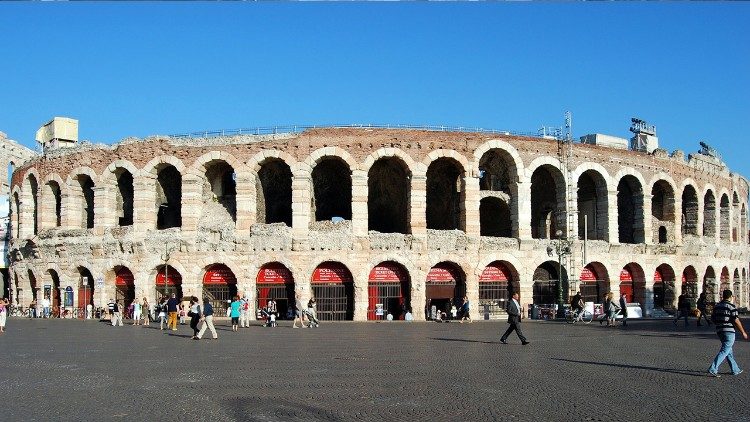
The Arena of VeronaThe Arena of Verona 

Vatican releases schedule for Pope's visit to Verona

The Holy See Press Office releases the itinerary for Pope Francis' pastoral visit to Verona on May 18, featuring meetings with the local Church, children, and prisoners.

By Vatican News

On Saturday, May 18, the eve of Pentecost, Pope Francis will visit the northern Italian city of Verona for a one-day pastoral visit.

His visit has been given the theme "Justice and peace will embrace," a quotation from Psalm 85.

Priests, consecrated persons, and young people

Pope Francis will depart from the Vatican heliport at 6:30 a.m. on May 18, landing in Verona at 8:00 a.m.

He will be greeted by the city's (and wider region’s) main political and religious figures: Bishop Domenico Pompili, Bishop of Verona; Luca Zaia, President of the Veneto Region; and, Demetrio Martino and Damiano Tommasi, prefect and mayor of Verona, respectively.

Immediately after his arrival, the Pope will travel to the Basilica of St. Zeno of Verona for a meeting with priests and consecrated persons, delivering his first speech.

Following this, in the square in front of the church, the Pope will meet with a group of children and young people.

‘Arena of Peace’ and prison visit

At 10:15 a.m., the Pope is scheduled to arrive at Verona’s Arena, where he will preside at a gathering entitled "Arena of Peace - Justice and Peace Will Embrace." During the event, he will answer some questions from attendees.

The Arena of Peace is an initiative organised by Church and civil society groups, active since 1986.

After the gathering, Pope Francis will travel by car to the Montorio Prison, where he will greet the prison officers, detainees, and volunteers, to whom he will deliver a speech.

Following lunch with the detainees at 2:30 p.m., the Pope will leave the prison to travel by car to the Bentegodi Stadium to preside over Mass at 3:00 p.m.

At 4:45 p.m., he will depart for his return to the Vatican, where he is scheduled to arrive at 6:15 p.m.

Parish Priests from around the world meet in Italy to discuss synodality


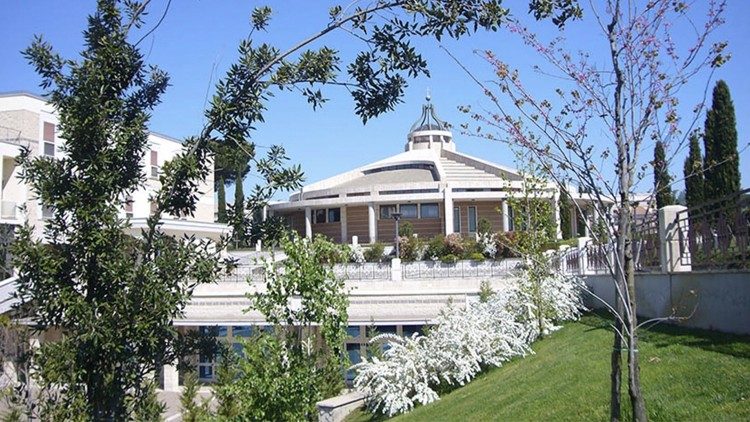
The "Fraterna Domus" retreat house in Sacrofano, ItalyThe "Fraterna Domus" retreat house in Sacrofano, Italy 

Parish priests meet to share experiences of synodality

Parish priests from around the world gather in Sacrafano, outside Rome, for an International Meeting dedicated to the question of “How to be a local synodal Church on Mission.”

By Christopher Wells

Some three hundred parish priests from around the world have gathered in Sacrofano, outside of Rome, for a meeting dedicated to listening, prayer, and discernment to address the question of how to be a local synodal Church on mission.

The five-day gathering will feature five days of discussions, culminating in an Audience with Pope Francis on Thursday.
 

Organized by the General Secretariat of the Synod and the Dicastery for the Clergy, in collaboration with the Dicasteries for Evangelization and for the Oriental Churches, the International Meeting is aimed at “listening to and valuing the experience parish priests live in their respective local Churches” and offering them the opportunity “to experience the dynamism of synodal work at a universal level.”

The Meeting comes in response to the desire expressed by the Synod Fathers to “develop ways for a more active involvement of deacons, priests, and bishops in the synodal process,” following criticism that parish priests were notably absent from the General Assembly.

Sharing stories

In his opening remarks to the assembled fathers, Cardinal Mario Grech, the Secretary General of the Synod said, “You have not come here to receive some teaching or exposition about synodality,” but “to tell us your story, because the story of each and every one of you is important.”

“We want to hear your stories, we want to hear how Jesus is still working today.”

“We want to hear your stories, we want to hear how Jesus is still working today,” the Cardinal explained, saying that the days in Sacrofano are about “the sharing of stories, helping one another see God’s presence in our own stories, understanding that his providence is still writing the story of the Church today.”

Listening: the methodology of the Synod

For his part, the Prefect of the Dicastery for the Clergy, Cardinal Lazarus You Heung sik, emphasized that the Meeting is not focused primarily on speechmaking, but on listening to one another and to the Holy Spirit.

He expressed his hope that this approach, which has already begun to bear fruit locally, “will also be the case in these days” in Sacrofano.

Cardinal You highlighted the Second Vatican Council’s ecclesiology of communion in the dimensions of mystery, communion and mission, saying, “There is still much to discover in this very vital way of conceiving and being Church.”

“There is still much to discover in this very vital way of conceiving and being Church”

Finally, recalling that “the synodal style” intends to “fully involve all the baptized,” the Prefect said he hoped that the service of pastors can bear fruit “so that our parish communities might become places where we experience the joy of the Risen Lord walking with us.”

‘The face of a synodal Church’

After the initial introductory speeches, the Meeting of parish priests focused on the first day's theme, “The face of the Synodal Church.” The morning began with spiritual and theological contributions from expert-accompanists, followed by “synodal conversations” in small groups.

In the afternoon, participants will come together for a plenary presentation of the work of the small groups. The first day of the Meeting will conclude with the celebration of the Holy Eucharist, followed by recreation and community sharing – the latter involving a sharing of typical products brought by the priests from their local communities.

Over the coming days, the priests will continue their conversations, focusing on the topics of “All Disciples All Missionaries” (Tuesday) and “Teaching Ties, Building Communities” (Wednesday).

The Meeting will conclude on Thursday with a “meeting dialogue” with Pope Francis, followed by the celebration of Mass with the Holy Father in St Peter’s Basilica.

Sunday, April 28, 2024

Monday Saint of the Day


St. Catherine of Siena


St. Catherine of Siena was born during the outbreak of the plague in Siena, Italy on March 25, 1347. She was the 25th child born to her mother, although half of her brothers and sisters did not survive childhood. Catherine herself was a twin, but her sister did not survive infancy. Her mother was 40 when she was born. Her father was a cloth dyer.

At the age of 16, Catherine's sister, Bonaventura, died, leaving her husband as a widower. Catherine's parents proposed that he marry Catherine as a replacement, but Catherine opposed this. She began fasting and cut her hair short to mar her appearance.

Her parents attempted to resist this move, to avoid marriage, but they were unsuccessful. Her fasting and her devotion to her family, convinced them to relent and allow her to live as she pleased. Catherine once explained that she regarded her father as a representation of Jesus and her mother as Our Lady, and her brothers as the apostles, which helped her to serve them with humility.

Despite Catherine's religious nature, she did not choose to enter a convent and instead she joined the Third Order of St. Dominic, which allowed her to associate with a religious society while living at home.

Fellow Dominican sisters taught St. Catherine how to read. Meanwhile, she lived quietly, isolated within her family home.

St. Catherine developed a habit of giving things away and she continually gave away her family's food and clothing to people in need. She never asked permission to give these things away, and she quietly put up with their criticisms.

Something changed her when she was 21. She described an experience she referred to as her "mystical marriage to Christ." There are debates over whether or not St. Catherine was given a ring with some claiming she was given a bejeweled ring, and other claiming the ring was made of Jesus's skin. St. Catherine herself started the rumor of the latter in her writings, but she was known to often claim the ring itself was invisible.

Such mystical experiences change people, and St. Catherine was no exception. In her vision, she was told to reenter public life and to help the poor and sick. She immediately rejoined her family and went into public to help people in need.

She often visited hospitals and homes where the poor and sick were found. Her activities quickly attracted followers who helped her in her mission to serve the poor and sick.

St. Catherine was drawn further into the world as she worked, and eventually she began to travel, calling for reform of the Church and for people to confess and to love God totally. She became involved in politics, and was key in working to keep city states loyal to the Pope. She was also credited with helping to start a crusade to the Holy Land. On one occasion, she visited a condemned political prisoner and was credited with saving his soul, which she saw being taken up to heaven at the moment of his death.

St. Catherine allegedly was given the stigmata, but like her ring, it was visible only to herself. She took Bl. Raymond of Capua has her confessor and spiritual director.

From 1375 onwards, St. Catherine began dictating letters to scribes. She petitioned for peace and was instrumental in persuading the Pope in Avignon to return to Rome.

She became involved in the fractured politics of her time, but was instrumental in restoring the Papacy to Rome and in brokering peace deals during a time of factional conflict and war between the Italian city states.

She also established a monastery for women in 1377 outside of Siena. She is credited with composing over 400 letters, her Dialogue, which is her definitive work, and her prayers. These works are so influential that St. Catherine would later be declared a Doctor of the Church. She is one of the most influential and popular saints in the Church.

By 1380, the 33-year-old mystic had become ill, possibly because of her habit of extreme fasting. Her confessor, Raymond, ordered her to eat, but she replied that she found it difficult to do so, and that possibly she was ill.

In January of 1380, her illness accelerated her inability to eat and drink. Within weeks, she was unable to use her legs. She died on April 29, following a stroke just a week prior.

St. Catherine's feast day is April 29, she is the patroness against fire, illness, the United States, Italy, miscarriages, people ridiculed for their faith, sexual temptation, and nurses.
Pope begins visit to Venice at the women's prison


Pope encourages women inmates at start of his visit to Venice

Pope Francis begins his pastoral visit to Venice at the Giudecca Women’s Prison, where he tells female inmates that he very much wanted to meet them to tell them they hold a special place in his heart.

By Thaddeus Jones

Pope Francis arrived in Venice via helicopter from the Vatican early on Sunday, 28 April, making the first stop of his pastoral visit to a women's penitentiary institution, the Venice Giudecca Women's Prison.

The Pope greeted over 80 of the inmates, as well as prison staff, security, and volunteers. He greeted each person one-by-one, gave a brief address and then listened attentively to groups of them as they came forward to thank him and offer gifts they made for the occasion.

Special place in his heart

In his address, Pope Francis explained how he wished to be with them on this first event of his visit to Venice to assure them that they hold a "special place" in his heart. And he suggested that this moment be experienced less as an "official visit" and more as a special encounter together where "thanks be to God, we can give each other time, prayer, closeness and fraternal affection" allowing for precious mutual enrichment. He added that God knows each one of us and that here today we each have something unique to give and receive that can benefit us all. 

The Lord brings us together

The Pope said it is the Lord who brings us together, and while the paths from which we have come vary, "some are very painful," also due to mistakes that have led to wounds and scars each carries within.

He acknowledged the "harsh reality" of prison also due to overcrowding, the lack of facilities and resources, and incidents of violence that add to the difficult reality. 

At the same time, he noted that prison can also offer a time for moral and physical rebirth where the dignity of women and men is not left in isolation, but "promoted through mutual respect and the nurturing of talents and abilities" each person has. He said sometimes these talents can be "dormant" or "isolated" by life's challenges, but they "can re-emerge for the good of all" with due attention and perseverance. He added that "no one can take away a person's dignity, no one!"

New beginnings

Despite it all, prison time can allow for new beginnings through the "rediscovery of the undiscovered beauty in us and in others," the Pope said, "as symbolized by the artistic event you are hosting and the project to which you actively contribute." 

Prison can become the worksite for rebuilding lives, the Pope went on to say, by thinking about one's life and, with courage, doing away what is not needed, harmful, or dangerous. By planning, one can start again, creating a new foundation, and in light of experience, rebuild brick by brick with determination, he said.

The Pope underscored how important it is for prison systems to offer possibilities "for human, spiritual, cultural and professional growth" that favour "healthy reintegration" in society, offering "new possibilities" that will benefit everyone.

We have all made mistakes that need to be forgiven and wounds to heal, he pointed out, and when that happens the forgiven can themselves bring forgiveness to others, the reborn can bring rebirth, and the healed can be healers.

Trust and hope in the future

In conclusion, the Pope encouraged everyone to renew their trust in the future and "always look to the horizon, always look to the future, with hope."

“I like to think of hope as an anchor, you know, that is anchored in the future, and we hold the rope in our hands and go forward with the rope anchored in the future.”

In thanking those present before leaving, the Pope gave the inmates an icon of the Blessed Mother and Child, explaining how you can see the tenderness Mary has with all of us as "she is the Mother of tenderness."

Groups of inmates then came forward to greet the Pope, offering words of gratitude for his visit and expressing hopes for a better future for them and our world. They gave the Pope fruits of their efforts working in the prison-run cooperatives where they produce a variety of goods ranging from soaps, clothing and flowers.

Pope has special meeting with the youth of Venice Italy


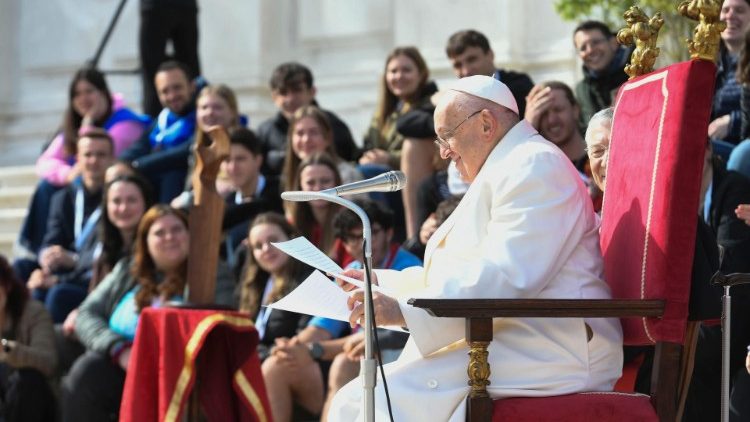
Pope Francis speaks to young people in VenicePope Francis speaks to young people in Venice

Pope to youth in Venice: Get off your phones and pay attention to others

As he visits the Italian city of Venice, Pope Francis urges young people to make themselves a gift for other people by focusing on how we can help someone else instead of complaining about being alone or misunderstood.

By Devin Watkins

Pope Francis met on Sunday morning with young people in Venice in the square in front of the Basilica of St. Mary of Good Health.

The encounter marked the third event of his one-day pastoral visit to the northern Italian city for the Venice Art Biennale.

Speaking to young people, the Pope recalled that we have all received the great gift of being God’s beloved children and are therefore called to share His joy with others.

“We are here today,” he said, “to rediscover in the Lord the beauty that we are and to rejoice in the name of Jesus, a youthful God who loves young people and always surprises us.”

He reflected on two verbs that characterize the Blessed Virgin Mary’s action as soon as she heard she would become the Mother of God: “She arose and went.”

God sees us as children to lift up

“Arise,” said Pope Francis to young people in Venice. “Get up from the ground, because we are made for Heaven. Rise from sadness to lift your gaze upward. Rise to stand in front of life, not to sit on the couch.”

The first thing each of us should do when we wake up each morning, he added, is to thank God for the gift of our lives by saying a little prayer: “My God, thank you for life. My God, make me fall in love with my life. My God, You are my life.”

The Pope recognized that young people must fight an “oppressive inertia” that turns our world into shades of gray.

“May we allow the Lord to take us by the hand, since He never disappoints those who trust in Him, but always lifts up and forgives,” said Pope Francis.

Even when we fall or make mistakes, he added, God is there to pick us up as a Father, since He only sees us as “children to lift up, not as evildoers to punish.”

Look at others, not at your smartphone

After we have arisen from our slumber or sin, said the Pope, we must “remain” in Jesus through the virtue of perseverance.

Rather than living on quick emotions and momentary satisfaction, Christians are called to persevere together in faith and love by praying in community at Mass.

“You might say, ‘But all around me, everyone is on their own with their cell phone, glued to social media and video games,’” said Pope Francis. “Yet, you must fearlessly go against the current: take life into your hands, get involved; turn off the TV and open the Gospel; get off your cell phone and encounter people!”

Like the gondolas that ply the canals of Venice, young people should row against the current by letting God help them. “Rowing requires regularity,” said the Pope. “But perseverance brings rewards, even if the path is difficult.”

We are a gift for others

Pope Francis then turned to the second verb that describes Mary: “go.”

“If rising is welcoming oneself as a gift, going means making oneself a gift,” he said. “If life is a gift, I am called to live by giving myself for others.”

The Pope invited young people gathered in Venice to embrace God’s call to participate in His creation.

“Creation invites us to be creators of beauty ourselves, to create something that did not exist before,” he said. “Life asks to be given, not managed; we must break out of the hypnotic world of social media that numbs the soul.”

Paint the streets of life with the Gospel

In conclusion, Pope Francis urged young people to create a simple prayer from the heart and offer a “gesture of love to someone who cannot reciprocate.”

“Open your heart to God, thank Him, and embrace the beauty that you are; fall in love with your life,” he concluded. “Then go! Go out, and walk together with others; look for those who are alone, color the world with your creativity, and paint the streets of life with the Gospel. Arise and go.”

Pope Francis adds Haiti to list of countries in need of prayers for peace


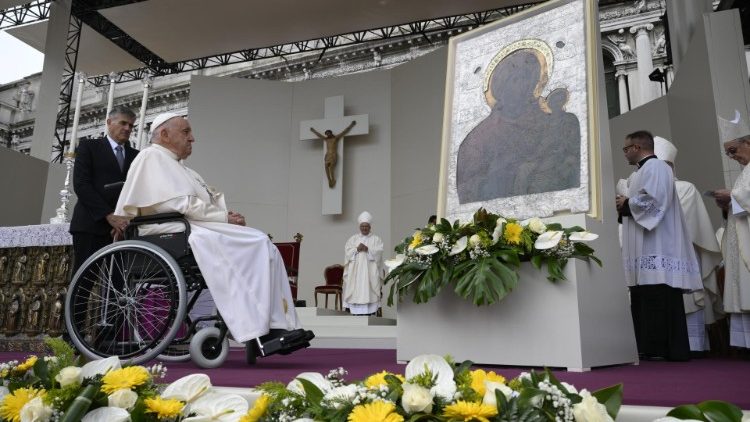
Pope Francis in prayer during Mass in Venice's St. Mark's SquarePope Francis in prayer during Mass in Venice's St. Mark's Square  (VATICAN MEDIA Divisione Foto)

Pope prays for peace and stability in Haiti and all war-torn countries

Pope Francis invokes the intercession of Our Lady for the many situations of suffering in the world, turning his attention in particular to Haiti where a transitional Council has just been asked to appoint a new head of government.

By Linda Bordoni

Pope Francis called for prayers for the people of Haiti who are in desperate need of peace and stability following months of political turmoil, rampant criminality and the collapse of infrastructure and security.

Speaking before the recitation of the Regina Coeli prayer after Holy Mass in Venice on Sunday, the Pope thanked the Patriarch of Venice and all those who worked to make his half-day visit to the lagoon city possible and invoked the intercession of the Virgin Mary for the many situations of suffering in the world.

Prayers for Haiti 

“I am thinking of Haiti, where a state of emergency is in force and the population is desperate because of the collapse of the health system, the shortage of food, and the violence that drives people to flee,” he said.

And noting that just this week a transitional government was sworn in in the Caribbean island nation, the Pope entrusted the work of that Council to the Lord and appealed for the support of the international community.

“We entrust to the Lord the work of the new Transitional Presidential Council that took office last Thursday in Port au Prince, so that with the renewed support of the international community, it may lead the country to achieve the peace and stability it so badly needs,” he said.

Ukraine, Palestine, Israel, Myanmar

And as he always does, the Holy Father turned his thoughts and prayers to other countries and peoples affected by conflict.

“I am thinking of “the tormented Ukraine, Palestine, Israel, the Rohingya and so many peoples suffering from war and violence,” he said.

May the God of peace enlighten hearts so that the will for dialogue and reconciliation may grow in all.