Saturday, March 30, 2024

Day 2 of the Divine Mercy Novena


The Chaplet of The Divine Mercy Novena

Second Day:

Today bring to Me THE SOULS OF PRIESTS AND RELIGIOUS, and immerse them in My unfathomable mercy. It was they who gave Me strength to endure My bitter Passion. Through them as through channels My mercy flows out upon mankind.

Most Merciful Jesus, from whom comes all that is good, increase Your grace in men and women consecrated to Your service,* that they may perform worthy works of mercy; and that all who see them may glorify the Father of Mercy who is in heaven.

Eternal Father, turn Your merciful gaze upon the company of chosen ones in Your vineyard—upon the souls of priests and religious; and endow them with the strength of Your blessing. For the love of the Heart of Your Son in which they are enfolded, impart to them Your power and light, that they may be able to guide others in the way of salvation and with one voice sing praise to Your boundless mercy for ages without end. Amen.

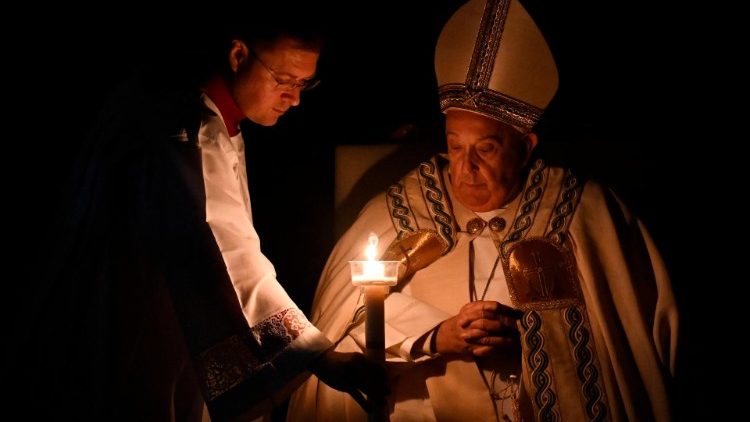
Pope Francis presides at the Easter Vigil


2024.03.30 Veglia Pasquale nella Notte Santa

Pope at Easter Vigil: ‘With Jesus no tomb will suppress the joy of life’

At the Vigil Mass in the Holy Night of Easter in St. Peter's Basilica, Pope Francis invites us to “look up” to Jesus, the God of life, and reminds us that by welcoming Him no failure will doom us to despair.

By Lisa Zengarini

Pope Francis presided over the traditional Easter Vigil in the Holy Night of Easter in Saint Peter's Basilica on Saturday evening. The celebration started at the entrance of the Basilica with the evocative rite of the blessing of fire followed by the candlelight procession while Lumen Christi was sung and the Basilica lights came on in all their brilliance. The celebration included the baptism and confirmation of eight catechumens from Italy (4), South Korea (2), Japan (1) and Albania (1).

“Who will roll away the stone from the tomb?”

In his homily, Pope Francis reflected on the Gospel account of the women visiting the empty tomb of Jesus, drawing attention to two crucial moments of that event.

At first the grieved women are troubled by a question: “Who will roll away the stone from the tomb?”.

“That stone, an overwhelming obstacle,” said the Pope, “symbolized what the women felt in their hearts.  It represented the end of their hopes, now dashed by the obscure and sorrowful mystery that put an end to their dreams.”

The tombstones we encounter in our lives

Sometimes in life, the Pope observed, we too experience this feeling of being overwhelmed  by sorrow and despair: “We encounter these tombstones in the emptiness left by the death of our loved ones, in the failures and fears that hold us back from accomplishing the good we mean to do”, but also “in all the forms of self-absorption that stifle our impulses to generosity and sincere love, in the rubber walls of selfishness and indifference that hold us back in the effort to build more just and humane cities and societies, in all our aspirations for peace that are shattered by cruel hatred and the brutality of war.”

The victory of life over death

Yet, Pope Francis remarked, the same women who bore this darkness in their hearts tell us something quite extraordinary: when they looked up, they saw that that heavy stone had already been rolled back, revealing God’s power: “the victory of life over death, the triumph of light over darkness, the rebirth of hope amid the ruins of failure.”

Let us look up to Jesus, our Pasch

Pope Francis, therefore invited the faithful to “look up” to Him: “If we allow Jesus to take us by the hand,” he said, “no experience of failure or sorrow, however painful, will have the last word on the meaning and destiny of our lives. 

“If we allow ourselves to be raised up by the Risen Lord, no setback, no suffering, no death will be able to halt our progress towards the fullness of life.”

By welcoming Jesus, “our Pasch”, the “God of life,” into our lives, and saying “yes” to Him,  the Pope added, “no stone will block the way to our hearts, no tomb will suppress the joy of life, no failure will doom us to despair.” 

“Let us lift our eyes to him, the Risen Lord,” he  concluded, “and press forward in the certainty that, against the obscure backdrop of our failed hopes and our deaths, the eternal life that he came to bring is even now present in our midst.”

“The Man of Sorrows is no longer in prison: he has opened a breach in the wall; he is hastening to meet you. In the darkness, let an unexpected shout of joy resound: He is alive; he is risen!”

For Holy Saturday: An Ancient Homily


from an ancient homily for Holy Saturday – 2nd century

Something strange is happening—there is a great silence on earth today, a great silence and stillness.  The whole earth keeps silence because the King is asleep.  The earth trembled and is still because God has fallen asleep in the flesh and he has raised up all who have slept ever since the world began.  God has died in the flesh and hell trembles with fear.

He has gone to search for our first parent, as for a lost sheep. Greatly desiring to visit those who live in darkness and in the shadow of death, he has gone to free from sorrow the captives Adam and Eve, he who is both God and the son of Eve.  The Lord approached them bearing the cross, the weapon that had won him the victory.  At the sight of him, Adam, the first man he had created, struck his breast in terror and cried out to everyone: “My Lord be with you all.”  Christ answered him: “And with your spirit.”  He took him by the hand and raised him up, saying:  “Awake, O sleeper, and rise from the dead, and Christ will give you light.”

I am your God, who for your sake have become your son.  Out of love for you and for your descendants I now, by my own authority, command all who are held in bondage to come forth, all who are in darkness to be enlightened, all who are sleeping to arise.  I order you, O sleeper, to awake.  I did not create you to be held a prisoner in hell.  Rise from the dead, for I am the life of the dead.  Rise up, work of my hands, you who were created in my image.  Rise, let us leave this place, for you are in me and I am in you; together we form only one person and we cannot be separated.

For your sake I, your God, became your son; I, the Lord, took the form of a slave;  I, whose home is above the heavens, descended to the earth and beneath the earth.  For your sake, for the sake of man, I became like a man without help, free among the dead.  For the sake of you, who left a garden, I was betrayed to the Jews in a garden, and I was crucified in a garden.

See on my face the spittle I received in order to restore to you the life I once breathed to you.  See there the marks of the blows I received in order to refashion your warped nature in my image.  On my back see the marks of the scourging I endured to remove the burden of sin that weighs upon your back.  See my hands, nailed firmly to a tree, for you who once wickedly stretched out your hand to a tree.

I slept on the cross and a sword pierced my side for you who slept in paradise and brought forth Eve from your side.  My side has healed the pain in yours.  My sleep will rouse you from your sleep in hell.  The sword that pierced me has sheathed the sword that was turned against you.

Rise, let us leave this place.  The enemy led you out of the earthly paradise.  I will not restore you to that paradise, but I will enthrone you in heaven.  I forbade you the tree that was only a symbol of life, but see, I who am life itself am now one with you.  I appointed cherubim to guard you as slaves are guarded, but now I make them worship you as God.  The throne formed by cherubim awaits you, its bearers swift and eager.  The bridal chamber is adorned, the banquet is ready, the eternal dwelling places are prepared, the treasure houses of all good things lie open.  The kingdom of heaven has been prepared for you from all eternity.

The Way of the Cross from Rome; Pope Francis did not attend, following from his residence


Pope prays Way of the Cross from Casa Santa Marta

Pope Francis follows the Way of the Cross held at Rome’s Colosseum on Good Friday from his residence at the Casa Santa Marta, while still leading the faithful in reflecting on our Christian journey of prayer.

By Devin Watkins

“We now take this time to be with you. We want to spend it in closeness to you. On the way from Gethsemane to Calvary, you never stopped praying.”

Pope Francis introduced his reflections on the Good Friday Via Crucis with an invitation to reflect on the centrality of prayer in the Christian life, especially during the Year of Prayer leading up to the 2025 Jubilee.

According to the Holy See Press Office, the Pope chose not to attend the Way of the Cross at the Colosseum in person.

“To preserve his health for tomorrow's Vigil and the Holy Mass on Easter Sunday,” said the statement, “Pope Francis will follow the Way of the Cross at the Colosseum this evening from the Casa Santa Marta.”

Last year, too, Pope Francis was not present at the Colosseum. Cardinal Angelo de Donatis, the Vicar General of the Diocese of Rome, offered the final blessing, both in 2023 and this year.

Carrying the cross in all walks of life

However, the Pope was present in his words and reflections on the 14 Stations of the Cross.

Each Station saw a different group carry the Cross through and near the ancient Flavian Amphitheatre, each of which represented various expressions of the Church’s life.

These included several cloistered nuns, people in financial difficulty, a family, people with disabilities, a prayer group, priests, women carrying out healthcare ministry, migrants, catechists, parishioners, young people, consecrated women, university students, and people serving in the diocesan Caritas.

‘Prayer can change the world’

In his reflections, Pope Francis recognized the difficulty of living in prayer amid the struggles and difficulties of life.

Prayer, he said, is “entrustment and offering,” as we seek to draw near to the Lord in intimacy and dialogue.

“Rouse us, Lord!” he prayed. “Awaken our hearts from their lethargy, for today too – today above all – you count on our prayer.”

The full text of the Pope’s reflections can be found here.

Pope Francis at the Solemn Liturgy of Good Friday


Pope presides at Solemn Liturgy of Lord’s Passion on Good Friday

As Pope Francis presides at the Liturgy of the Lord's Passion on Good Friday, Cardinal Raniero Cantalamessa, the Preacher of the Pontifical Household, preaches on the passage “When you lift up the Son of Man, then you will realize that I Am”.

By Deborah Castellano Lubov

Pope Francis presided over the liturgy of the Passion and Death of Our Lord Jesus Christ in St. Peter’s Basilica on Good Friday afternoon. Good Friday is the only day of the year on which Holy Mass is not celebrated. 

The Church celebrates the Solemn Liturgy of the Passion of the Lord, consisting of three parts: the Liturgy of the Word, culminating in the chanting of the Passion according to St. John; the Adoration of the Cross; and reception of Holy Communion.

After the proclamation of the Passion, Cardinal Raniero Cantalamessa, the Preacher of the Pontifical Household, delivered the homily, taking as his starting point the passage: “When you lift up the Son of Man, then you will realize that I Am” (Jn 8:28).

‘I Am’

This, Cardinal Cantalamessa said, is what Jesus said at the end of a heated dispute with His opponents, observing a sort of "crescendo" compared to the previous 'I Am' pronounced by the Lord in St. John's Gospel.

“He no longer says, 'I Am' this or that: the bread of life, the light of the world, the resurrection and the life, and so on. He simply says 'I Am' without further specification," Cardinal Cantalamessa said, noting that this gives His declaration an "absolute, metaphysical dimension."

He said it also intentionally recalls when God Himself proclaims His divine 'I Am' in Exodus 3:14 and Isaiah 43:10-12.

The shocking novelty of Jesus making this affirmation, the Cardinal explained, "is discovered only if we pay attention to what precedes Christ’s self-affirmation: 'When you lift up the Son of Man,' it is then that you will know that I Am.” As if to say: What I am—and, therefore, what God is!—will only be manifested on the Cross."

He underscored the significance of the expression "to be lifted up," in St. John's Gospel, referring to the event of the Lord on the Cross.

"We are faced with a total reversal of the human idea of God and, in part, also of that of the Old Testament. Jesus did not come to improve and perfect the idea that people have of God, but, in a certain sense," he explained, "to overturn it and reveal the true face of God."  St. Paul, he acknowledged, was the first to understand this.

Universal significance of Christ's Word

Understood in this light, he observed, "the word of Christ takes on a universal significance that challenges those who read it, in every era and situation, including our own."

In our unconscious mind, the Cardinal reflected, we continue to carry on this very idea of God that Jesus came to change.

"God is all-powerful, no doubt, but what kind of power is it?" he asked. "Faced with human creatures, God finds himself devoid of any capacity, not only coercive, but also defensive. He cannot intervene with authority to impose himself on them. He cannot but respect, to an infinite degree, the free choice of human beings."

Omnipotence in God's Son

"And so, the Father," he explained, "reveals the true face of His omnipotence in His Son."

"It takes little power to show off; it takes a lot of power to put oneself aside and to conceal oneself," he marveled. "God is this unlimited power of self-concealment! Exinanivit semetipsum: He emptied Himself."

To our “will to power,” God has opposed His voluntary powerlessness," he said. "What a lesson for us who, more or less consciously, always want to show off. What a lesson for the powerful of the earth!"

Different kind of triumph

The Cardinal acknowledged that one may think the triumph of Christ in His resurrection, overturns this vision, restoring the invincible omnipotence of God, which the Cardinal said, is true, "but in a very different sense than what we usually think."

"It is very different from the 'triumphs' that were celebrated upon the emperor’s return from victorious campaigns, along a street that is still called 'Via Trionfale' in Rome today," he said.

Rather, he recalled, the Resurrection occurs in mystery, without witnesses.

The Lord's death was seen by a large crowd and involved the highest religious and political authorities, but once He had resurrected, Jesus appeared only to a few disciples, out of the spotlight. "In this way, He wanted to tell us that after having suffered, we should not expect an external, visible triumph, such as earthly glory."

The example of the martyrs

"The triumph is given in the invisible, and is of an infinitely superior order, because it is eternal!" he said. "The martyrs of yesterday and today are examples of it.​"

The Risen One manifests Himself, Cardinal Cantalamessa recalled, through His apparitions, "which suffice to provide for a very solid foundation for faith for those who do not from the start refuse to believe."

Love Christ wanted to bear witness

“But," he clarified, "it is not an act of revenge to humiliate his opponents. He does not appear in their midst to prove them wrong or to mock their impotent anger."

"Any such revenge," the papal preacher insisted, "would be incompatible with the love that Christ wanted to bear witness to in His Passion.”

As in His "annihilation" on Calvary, the Cardinal noted that the Lord behaved humbly in the glory of the Resurrection.

The concern of the Risen Jesus, he reiterated, is not to confuse his enemies, but to go and reassure His dismayed disciples, and, before them, the women who had never stopped believing in Him.

‘Come to me, all who are burdened’

The Cardinal went on to emphasize the Lord's reassuring words to the faithful.

"Let us accept," he invited, "the invitation that Jesus addresses to the world from His Cross: 'Come to me, all you who labor and are burdened, and I will give you rest'."

He acknowledged that this exhortation would almost be thought of "as irony and a mockery."

"One who Himself does not have a stone on which to lay His head, one who has been rejected by His people, condemned to death, one 'before whom one covers one’s face so as not to see,'" he observed, "dares to address all humanity, of all places and all times, and say: 'Come to me, all of you, and I will give you rest!'”

Regardless, he insisted, the Lord meaningfully offers this consolation for everyone.

"Come to me, you who are old, sick, and alone, you whom the world lets die in poverty, hunger, or while under bombardment; you who languish in prison cells because of your faith in me, or your battle for freedom, come to me, you woman victim of the violence," the Lord says, the preacher reassured.

The Lord gives us rest and consolation

Cardinal Cantalamessa concluded his sermon by saying the Lord's invitation excludes no one, as evidenced by His reassurance: "'Come to me, and I will give you rest! Didn’t I promise you: 'When I am lifted up from the earth, I will draw everyone to myself.'" 

Cardinal Cantalamessa concluded by marveling at the incredible consolation and rest the Lord offers us.

"Ask those who have experienced it!" he said.

Friday, March 29, 2024

On Good Friday we begin the Divine Mercy Novena


The Divine Mercy Novena:  Good Friday-Divine Mercy Sunday


I desire that during these nine days you bring souls to the fount of My mercy, that they may draw there from strength and refreshment and whatever graces they need in the hardships of life and, especially, at the hour of death. On each day you will bring to My Heart a different group of souls, and you will immerse them in this ocean of My mercy, and I will bring all these souls into the house of My Father. You will do this in this life and in the next. I will deny nothing to any soul whom you will bring to the fount of My mercy. On each day you will beg My Father, on the strength of My bitter Passion, for graces for these souls.


DAY 1 (Good Friday)

Today bring to Me ALL MANKIND, ESPECIALLY ALL SINNERS, and immerse them in the ocean of My mercy. In this way you will console Me in the bitter grief into which the loss of souls plunges Me.

Thursday, March 28, 2024

Pope Francis travels to women's prison in Rome to celebrate Holy Thursday Mass and washing of the feet


Pope on Holy Thursday: 'The Lord never tires of forgiving'

At the Mass of the Lord's Supper at the women's section of Rebibbia prison in Rome, Pope Francis reminds us to never tire of asking the Lord for forgiveness and learning to serve as He did.

By Lisa Zengarini

Continuing his custom of celebrating the Mass of the Lord’s Supper in a prison, Pope Francis visited the female section of the Rebibbia correctional facility in Rome on Holy Thursday afternoon.

He presided over Mass and the ritual of the washing of the feet for dozens of inmates, guards, chaplains and officials gathered in an outdoor area of the prison.

In his brief off-the-cuff homily, the Pope focused on two episodes of Jesus’ Last Supper on the eve of His Passion.


The path of service

During the meal, Jesus humbled Himself to wash the feet of the disciples.

By doing so, Pope Francis explained, “He makes us understand what He meant when He said: ‘I did not come to be served, but to serve’.”

That humble gesture, said the Pope, “teaches us the path of service.”

Jesus always forgives

Pope Francis then spoke about the betrayal of Judas, motivated by greed and selfishness. Judas’ story, the Pope said, shows us that the Lord always forgives our sins, and “He only asks that we ask for forgiveness.”

Indeed, he insisted, "Jesus never tires of forgiving: we are the ones who get tired of asking for forgiveness."

“We all have our small or big failures – everyone has their own story. But the Lord always awaits us, with His arms open, and never tires of forgiving.”

Concluding Pope Francis, therefore, encouraged the faithful to ask the Lord for the grace not to tire of imploring His forgiveness, and to make us grow in the vocation to serve.

Washing of the feet of twelve inmates 

Following the homily, Pope Francis washed the feet of twelve women prisoners of different nationalities.

At the conclusion of the Mass, he met with the inmates and staff of the penitentiary and was greeted with farm products produced in the facility, along with a rainbow-colored rosary made with crochet and pearls, two stoles with the image of two welcoming hands, and a sunflower, made by the inmates working in the necklace and sewing workshops in the prison.

The Pope gave the director and staff of Rebibbia a painting of the Madonna he had received as a gift.

Pope Francis' first visit to Rebibbia prison in 2015

Pope Francis has celebrated Holy Thursday Mass at a prison, care facility, or refugee centre since becoming Pope in 2013, while his recent predecessors customarily washed the feet of priests in St. Peter's Basilica or the Basilica of St. John Lateran in Rome.

This was his second visit to the Rebibbia complex on this occasion. He first went there in 2015, meeting male and female prisoners and washing the feet of 12 inmates and a toddler.