Tuesday, October 31, 2023

Papal Prayer intention for the month of November


Pope's November prayer intention: For the Pope

Pope Francis releases his prayer intention for the month of November, asking the faithful to pray that the Lord will bless him.

By Vatican News

In “The Pope Video” for November, Pope Francis asks the faithful to “Pray to the Lord that He will bless me,” saying, “Your prayer gives me strength and helps me to discern and to accompany the Church, listening to the Holy Spirit.”

Each month the Pope offers a specific prayer intention, inviting men and women of good will to pray with him for a particular cause. Recent intentions have included prayers for the Synod, for people living on the margins, and for World Youth Day.

Pope Francis reminds the faithful in this month’s video that “The fact that someone is Pope doesn’t mean they lose their humanity. On the contrary, my humanity grows each day with God’s holy and faithful people.”

He adds, “Being Pope is also a process. The person becomes aware of what it means to be a pastor. And in this process, he learns how to be more charitable, more merciful, and, above all, more patient, like God our Father, who is so patient.”

Knowing that popes are often “judged harshly” and will have to render “a serious account” of their ministry to God, Pope Francis asks his listeners “to judge benevolently” and “pray that the Pope, whoever he might be – today it is my turn – may receive the help of the Holy Spirit, that he may be docile to that help.”

Specifically, he asks for prayers for the Pope “so that in the exercise of his mission, he may continue to accompany in the faith the flock entrusted to him by Jesus, always with the help of the Holy Spirit.”

And, hearkening back to the night of his election ten years ago, Pope Francis repeats his request for a “silent” prayer over him, concluding “And pray for me! Favorably!”

Monday, October 30, 2023

Saint of the Day for Halloween


St. Wolfgang


Wolfgang (d. 994) + Bishop and reformer. Born in Swabia, Germany, he studied at Reichenau under the Benedictines and at Wurzburg before serving as a teacher in the cathedral school of Trier. He soon entered the Benedictines at Einsiedeln (964) and was appointed head of the monastery school, receiving ordination in 971. He then set out with a group of monks to preach among the Magyars of Hungary, but the following year (972) was named bishop of Regensburg by Emperor Otto II (r. 973-983). As bishop, he distinguished himself brilliantly for his reforming zeal and his skills as a statesman. He brought the clergy of the diocese into his reforms, restored monasteries, promoted education, preached enthusiastically, and was renowned for his charity and aid to the poor, receiving the title Eleemosynarius Major (Grand Almoner). He also served as tutor to Emperor Henry II (r. 1014-1024) while he was still king. Wolfgang died at Puppingen near Linz, Austria. He was canonized in 1052 by Pope St. Leo IX (r. 1049-1054). Feast day: October 31.

Vatican's representative talks directly to Iran's Foreign Minister


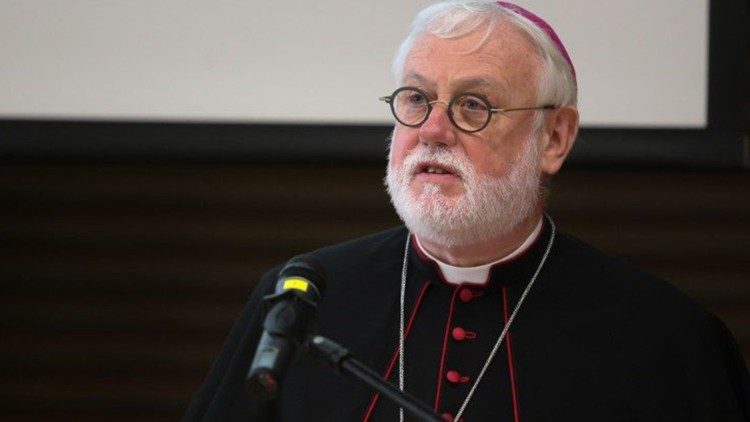
File photo of Archbishop Paul Richard GallagherFile photo of Archbishop Paul Richard Gallagher 

Archbishop Gallagher speaks with Iran’s Foreign Minister by phone

Archbishop Paul Richard Gallagher, the Vatican’s Secretary for Relations with States, speaks by phone with the Foreign Minister of Iran about the need to avoid escalation in the Middle East.

By Vatican News

Hossein Amir-Abdollahian, Minister of Foreign Affairs of the Islamic Republic of Iran, had requested to speak by phone with Archbishop Paul Richard Gallagher, the Vatican’s Secretary for Relations with States and International Organizations.

The Holy See Press Office announced on Monday that the telephone conversation took place between the two counterparts earlier in the morning.

“During the conversation,” read a press release, “Archbishop Gallagher expressed the Holy See's serious concern about what is happening in Israel and Palestine, reiterating the absolute necessity to avoid escalating the conflict and to achieve a two-state solution for a stable and lasting peace in the Middle East.”

Did the Synod reach any conclusions?


Women Deacons, Sex Abuse, and Gender Identity: What Did the Synod on Synodality Conclude?

The 42-page report, published in Italian Oct. 28, divides topics into ‘convergences,’ ‘matters for consideration’ and ‘proposals.’


VATICAN CITY — The Synod on Synodality, the monthlong assembly convened by Pope Francis at the Vatican, released its final document containing the discussion of several hot-button issues which it calls “controversial”: the idea of women deacons, optional priestly celibacy, and the accompaniment of people struggling with their gender or sexual identity.

The 42-page report, published in Italian Oct. 28, divides topics into “convergences,” “matters for consideration,” and “proposals.”

Among the proposals made by the Synod, held Oct. 4-29 at the Vatican, was the request for continued theological study of the possibility of women deacons, and for the results of such a study to be shared at the next session of the Synod on Synodality, to be held in October 2024.

For the first time in a Synod of Bishops, laypeople, including women, took part in the vote on the final document.  

The document also acknowledged that there were differing views among Synod members about the possibility of a female diaconate.

It said people who feel excluded because of their sexuality or gender identity want accompaniment and for the Church to defend their dignity.

During the meeting of the 16th Ordinary Assembly of the Synod of Bishops, hundreds of delegates and other participants met to discuss issues and personal experiences in the Church, all with the goal of becoming a more synodal Church. The “synthesis” document was released at the conclusion of the monthlong meeting.

The report was voted on paragraph by paragraph by Synod delegates in the early evening on Oct. 28. While all sections received some votes of opposition, the two-thirds majority needed to include the portion in the final text was met by a wide margin in every vote.

The section of the report about the need to further study women deacons received the most opposition — 69 people voted against its inclusion in the document, while votes in favor numbered 277.

Women’s Participation

In addition to asking for further theological study of the permanent diaconate and the possibility of access to the ministry by women, the Synod report proposed incorporating language more inclusive of women and women’s experiences in liturgical and other Church texts. 

It asked if new ministries are needed for women, or if it is adequate to create more space for women in existing ministries. It also proposed that women with proper training be allowed to be judges in Church trials.


Gender Identity

The report said a point of “convergence” in the assembly was that “some issues, such as those related to gender identity and sexual orientation, the end of life, difficult marital situations, and ethical issues related to artificial intelligence, are controversial not only in society but also in the Church because they raise new questions.”

It said anthropological categories are not always sufficient to cover the complexity of elements “emerging from experience or knowledge in the sciences …” and the Church should reflect and work on this “without giving in to simplifying judgments that hurt people and the Body of the Church.”

Church teaching can be “translated into appropriate pastoral initiatives,” it continued, noting that even where “further clarification is needed,” we should follow the example of Jesus.

People who feel marginalized or excluded from the Church because of their “marital situation, identity and sexuality,” the document said, “ask to be heard and accompanied, and that their dignity be defended.”

Those who feel hurt or neglected by the Church long for a place where they feel listened to and respected without fear of judgment, it said, adding that “listening is a prerequisite for walking together in search of God’s will.”

The document also said the synodal assembly is close to those who feel lonely because they have chosen to stay faithful to the Church’s teaching on marriage and sexual ethics, and Christians should listen to and accompany those who have made that commitment.


Sex Abuse

On the topic of sex abuse, the report said the Church should listen with special attention to victims of sexual, spiritual, economic, institutional, power and conscience abuse by clergy members or people in the Church.

“Authentic listening,” it said, “is a fundamental element of the journey toward healing, repentance, justice and reconciliation.” 

In an apparent reference to the case of the accused abuser and former Jesuit Father Marko Rupnik, the report said “cases of abuse of various kinds against consecrated persons and members of lay associations, particularly women, signal a problem in the exercise of authority and require decisive and appropriate actions.”

The document also called for “structures and processes” to oversee the comportment of bishops on a variety of issues, including safeguarding against different forms of abuse.


Priestly Celibacy

The report asked whether it is necessary to maintain the discipline of priestly celibacy in the Latin rite of the Catholic Church and asked that the question be taken up again, while noting that “different assessments were expressed” on the topic.

Another proposal about the priestly ministry was to “consider, on a case-by-case and context-by-context basis, the appropriateness of including priests who have left the ministry [been laicized] in a pastoral service that values their formation and experience.”

Cupich and McElroy supported women deacons; now say the Permanent Diaconate needs to be reimagined


Exclusive: Cardinals Cupich, McElroy say 'impossible to go back' to synods without lay voters


Two U.S. cardinals said one of the immediate results of Pope Francis' major summit on the future of the Catholic Church is that it should now be "impossible" to return to an era where lay men and women are not given both a voice and vote in major Vatican meetings. 

"It would seem to me impossible to go back now," said San Diego Cardinal Robert McElroy on Oct. 29. "It would be wrenching to go back if you just had bishops there or just bishops voting." 

Chicago Cardinal Blase Cupich concurred. He said that Catholics' common experience of baptism means: "We all have authority, and that means that we all have something to say."

The two cardinals spoke in an exclusive joint interview with National Catholic Reporter on Oct. 29, just hours after Francis' celebrated the concluding Mass for the four-week Synod of Bishops. 

The assembly, which discussed an enormous range of issues facing the global church, including the possibility of women serving in ordained ministry and better inclusion of LGBTQ Catholics, was the first in history where women were granted rights of full membership and voting.

The synod assembly's closing marked the end of only the first part of discussions. A second assembly is due to take place in October 2024. Both Vatican meetings follow a multi-phase consultation process with Catholics across the globe.

The 45-minute interview with Cupich and McElroy took place at the Pontifical North American College, the primary residence for U.S. seminarians studying in Rome, and where the majority of the U.S. delegation participating in the synod stayed during the month.

During the wide-ranging interview, the two cardinals reflected on the synod's newly published final report, which postponed action on the possibility of ordaining women as deacons and largely glossed over concerns about better inclusion of LGBTQ Catholics. They also shared their respective experiences of the assembly, and offered thoughts about what comes next for both the global synod process and the U.S. church.

Women deacons, 'urgent' need for women's leadership 

In the lead-up to this month's Rome meeting, expectations were high that the synod might offer concrete proposals about the possibility of ordaining women as deacons — something that the Vatican's 2019 synod for the nine-nation Amazon region had previously proposed

In the end, the 2023 synod largely punted on the issue, calling for the results of earlier papal and theological commissions on women deacons to be presented for further consideration at next year's assembly. Moreover, the vote counts for proposals expressing forward movement on the issue received the highest level of "no" votes of any of the document's 81 proposals. 

But McElroy said that, of those propositions, "There's only one that's called urgent. And that is bringing women into greater roles of leadership at all levels of the church. Not a single one has the word urgent or any equivalent word except for that one."

In a new format for the synod, the more than 450 delegates participating in the gathering sat at roundtables together, and primarily discussed the issues at hand in small group settings.

"There was really at our tables, a very broad sense that we need to have a sea change in our removal of barriers, our invitation and embrace of women in these new roles," said McElroy.

On the question of women deacons, both Cupich and McElroy said that what emerged during this session of the synod was a question of whether the diaconate needed to be "reimagined" as a whole.

Cupich recalled Pope Benedict XVI's 2009 decision to revise church law to make a clear distinction between the purposes for ordination to the priesthood and episcopacy, versus the purposes for ordination to the diaconate.

Referring to the current practice of ordaining seminarians studying for the priesthood first as deacons, the Chicago cardinal said Benedict's change specifying the difference between priestly and diaconal ministry "opens the door to reimagining what the diaconate should be."

"Does it uncomplicate some of the theological questions that some people have?" Cupich asked. "It's valid to ask, if that's the case … why are we ordaining candidates for the priesthood to the diaconate? It's a legitimate question to ask. And if, if you start with that, then maybe you can begin reimagining what the diaconate is about."

As questions were raised at the roundtables about the permanent diaconate as a whole, San Diego's McElroy — who has previously expressed his support for the ordination of women to the diaconate — said the issue took on a "wider focus" at the synod. 

"I think there was a lot of feeling that [the diaconate] should be focused not on liturgical things, as much as on serving the poor and the marginalized," he said, asking: "So do we need to reimagine the diaconate as a whole?"

McElroy continued: "As a result of those sets of issues coming up, the question looked much different to a lot of us after. Now, I'm in favor of having women as deacons as it is presently, but there may be a pathway here that would be very promising that would, I think, invigorate in many important ways the diaconate as a whole and perhaps provide a pathway."


LGBTQ Catholics, synod confidentiality

Although the synod assembly is known to have spoken at length about how the church can better include LGBTQ Catholics — with one testimony even focusing on a bisexual woman who died by suicide after feeling rejected by the church — the final document largely overlooked those discussions. 

It also did not refer to LGBTQ or gay Catholics by name, instead referring generally to issues involving sexuality that raise "new questions" for the church.

Cupich said the decision not to use the term LGBTQ was informed by some synod members from the global south, who spoke about having negative experiences in dealing with conditions on foreign aid from western countries that use that terminology. 

The cardinal also pointed to the text's affirmation that "Christians must always show respect for the dignity of every person," calling that a "major contribution." 

"There was no intention of wanting to hurt anybody" by not using the terms LGBTQ or gay, said Cupich. 

"I do think we have to go back to the question: Do we call people the way they want to be called?" he said. "And I think that … that's a sign of respect; that also has to be a part of the discussion going forward in the future."

McElroy pointed to the final document's 15th and 16th chapters, which focus on issues of discernment and accompaniment. 

"Jesus meets people in the uniqueness of their personal story and situation," the text states at one point. "He never begins from the perspective of prejudices or labels, but from the authenticity of relationship to which he commits himself wholeheartedly."

Said McElroy: "We need to adopt the pastoral message of Jesus Christ: Christ, who encounters people, who embraces them, who meets the problems that are going on, and then calls them to conversion."

"It is not that doctrine comes first," he said. "Doctrine stands in service to the pastoral mission of the church."

Reflecting on those same chapters, Cupich said "there are aspects about human life in which our anthropological view does not have the power to fully grasp the situation." 

"We have to look at that," he said. "There is a real humility there in terms of what we should decide on and take for granted, realizing that there … are some things that we don't know very well."


On other subjects, both Cupich and McElroy largely defended the synod's unexpected request that assembly members refrain from giving media interviews during the four weeks of discussions, and keep confidentiality about the individual speeches, even after the assembly is over.

McElroy said he was initially "very skeptical" about the request but "came to the conclusion that it was very helpful to our process." Cupich said he found the rules "very liberating" because "there was no discussion at any time that I came across about what people outside the room were saying about us."

"If, in fact, there was a lot of coverage about information or misinformation going on, it could have invaded the freedom of people to begin to talk," said Cupich. "There wasn't any of that that invaded the room." 

As for the synod assembly as a whole, Cupich said he would leave Rome "with a sense of hope, joy that I was a part of this [and] more enthused about my ministry than I have been in a long time."

"We had actual lay people there talking with bishops about the issues, and that gave it a new energy and a freshness that we've not had before," he said, comparing this synod to earlier assemblies. "I think the document tried to convey that very much that freshness, that there was no issue that was left off the table."

McElroy likewise expressed positivity about the experience. "I would be very positive about the method of discernment that was utilized," he said. "It's demanding but it yielded tremendous fruits of engagement." 

With regard to the presence of lay voting members, McElroy said: "The presence of non-bishops in active roles became very natural, very early on."

"Within the first few days, it seemed axiomatic that non-bishops should be there, that laypeople should be there, that consecrated religious should be there as voting members and not just priests and deacons," said the cardinal.

This story appears in the Synod on Synodality feature series. View the full series.

Complete details of the parish mergers in the Archdiocese of New Orleans


N.O. Archdiocese announces church mergers affecting 11 area parishes

The mergers affect parishes in New Orleans, Metairie, Waggaman, Avondale, Des Allemands, Paradis, and Harvey


Sunday afternoon, Archbishop Gregory Aymond announced the merger of 11 area parishes, taking effect on July 1, 2024.

There are four instances where two parishes will merge into one, and one instance where the merger will include three parishes.

“Our Lady of the Angels in Waggaman will merge with St. Bonaventure in Avondale to become one new parish,” the Archbishop wrote in his letter. “St. Gertrude in Des Allemands and St. John the Baptist in Paradis will merge to become one new parish. St. John Bosco and St. Rosalie both in Harvey will become one parish. St. Mary of the Angels and Our Lady Star of the Sea both in New Orleans will come together as one new parish, and Transfiguration of the Lord, St. James Major, and St. Gabriel in New Orleans will merge together as one new parish.”

The archbishop said the decision was made due to many factors, including COVID-19, natural disasters, inflation, and insurance costs being among them.

The letter in its entirety is as follows:

October 29, 2023

To the Clergy, Religious, & Laity of the Archdiocese of New Orleans:

Dear Sisters and Brothers in Christ,

https://www.youtube.com/watch?v=pynOzt2myj8

Over a year ago we began a parish pastoral planning process in the Archdiocese of New Orleans. Building on the priorities of the Ninth General Synod, our goal has been and continues to be to support the parishes of the archdiocese in a manner that provides the people of God with opportunities to grow in their relationship to Jesus Christ and form a deeper connection to their faith.

It is my fervent prayer that all of our parishes are sustainable and full of vitality. Parish vitality is a healthy sign of life in Christ and something that must be continually strived for in all parishes. In light of this, a Parish Sustainability Committee was formed to provide each parish with a profile that highlighted its strengths and weaknesses.

There is no doubt that our parishes, in fact our entire area, have been affected by many factors out of our control. Natural disasters such as floods and hurricanes over the past decade, the COVID pandemic, the challenges of Hurricane Ida recovery, inflation, and sky-rocketing property insurance rates impact our church communities just as they impact our families and our businesses. These are not issues we can ignore in prudent pastoral planning.

When we announced this process, we indicated that there were parishes with significant challenges that would begin an intense period of discernment to evaluate their future needs. With the guidance of the Catholic Leadership Institute, the work of the Parish Sustainability Committee, and using real data on the sacramental, pastoral programming, and temporal realities of each parish’s unique situation, pastors, lay parish leadership, and parishioners were invited into dialogue to determine how to address the challenges facing them.

Today, following a period of prayer, review, and consultation, we announce the decisions that are the conclusions of this discernment.

The final decisions are unique to each parish situation. It was incredibly important to us, and to me personally, that each parish knows their recommendations and desires for their future were not only heard, but considered. In light of this, I am pleased to be able to announce that two parishes, Our Lady of Divine Providence in Metairie and Christ the King in Terrytown have made significant progress in addressing and planning for their challenges and will remain open.

There are four situations where two parishes are merging into one and one case where three parishes are merging into one. Our Lady of the Angels in Waggaman will merge with St. Bonaventure in Avondale to become one new parish. St. Gertrude in Des Allemands and St. John the Baptist in Paradis will merge to become one new parish. St. John Bosco and St. Rosalie both in Harvey will become one parish. St. Mary of the Angels and Our Lady Star of the Sea both in New Orleans will come together as one new parish, and Transfiguration of the Lord, St. James Major, and St. Gabriel in New Orleans will merge together as one new parish.

In two cases, the parish territory will be merged into neighboring parishes. The first is St. Theresa of Avila Parish in New Orleans, which will have its territory divided and merged into St. Patrick on Camp St. in the Warehouse District and St. Alphonsus on Constance St. in the Lower Garden District of New Orleans. The other is St. Hubert in Garyville, which will be merged into St. Peter in Reserve. St. Hubert Church will remain open for one Mass each weekend.

All of these mergers will be effective beginning July 1, 2024.

These are difficult and painful decisions for everyone involved. When I returned home to New Orleans in 2009, I never imagined I would be in the situation of having to merge parishes. This is something we must do for the good of the local church, and something that is being done in Catholic dioceses around the country. I have prayed about this a great deal and have spoken with many trusted advisors and truly believe the Holy Spirit is leading us for the good of the people of God in the Archdiocese of New Orleans.

In closing, I ask that you join me in prayer for these communities as they move through these transitions. Let us pray too for all of us as a local church, may the Holy Spirit continue to guide each of us as we strive for holiness, seek a deeper encounter with Christ each day, and witness with joy in our parish life.

May God bless you and those you hold dear in your heart.

Wishing you God’s blessings, and asking for your prayers in this time of transition, I am,

Respectfully in Christ,

Most Reverend Gregory M. Aymond

Archbishop of New Orleans

A Note Regarding the Archdiocese of New Orleans Chapter 11 Reorganization

Parish Pastoral Planning is an important issue separate from the Archdiocese of New Orleans Chapter 11 Reorganization. Conversations around Parish sustainability and vitality began with the Ninth General Synod in 2016 and have been ongoing. External factors such as storms and floods and their subsequent recovery that have caused demographic shifts coupled with economic challenges such as inflation and sky-rocketing insurance rates directly impact parish sustainability and vitality.

The impact of the Chapter 11 Reorganization on Parish pastoral planning is limited to the fact that the administrative offices of the archdiocese, because of its own financial situation and its need to maintain a balanced budget, can no longer supplement parishes and ministries that are struggling financially. For decades the Archdiocese has simply paid bills that could not be paid or forgiven debts that could not be met at the parish or ministry level. The administration as well as all parishes and ministries of the Archdiocese of New Orleans must strive for vitality - being fully alive in Christ - including financial responsibility.

Parish Information

Christ the King, Terrytown and Our Lady of Divine Providence, Metairie

Both Christ the King in Terrytown and Our Lady of Divine Providence in Metairie participated in this pastoral planning process. Both parishes have shown significant improvement in the sacramental, pastoral programming, and financial issues that needed to be addressed. In light of this success, decisions regarding the futures of Christ the King and Our Lady of Divine Providence have been deferred to a later date for ongoing review and to ensure their progress is sustainable.

Our Lady of the Angels, Waggaman & St. Bonaventure, Avondale

Our Lady of the Angels Parish in Waggaman and St. Bonaventure in Avondale are both small parishes that face significant uncertainty in regards to their futures. In order to create a more vibrant community with resources to enable the people to grow in relationship with Jesus Christ through active participation in parish life, these two parishes will be merged into one parish, erected with a new name, and to be located at the current Our Lady of the Angels campus with consideration given for a new pastor effective July 1, 2024.

St. Gertrude, Des Allemands & St. John the Baptist, Paradis

Beyond the effects of Hurricane Ida on the demographics and recovery of the area, both St. Gertrude and St. John the Baptist parishes have sustained significant declines in pastoral programming and sacramental life that have led to financial challenges for both. The parish communities are currently engaging each other socially and beginning the work of becoming one parish. Additionally, the Parish Sustainability Committee emphasized the importance of maintaining a Catholic presence in that area of St. Charles Parish and strongly recommended that by combining St. Gertrude and St. John the Baptist, the new parish will be sustainable and have a level of vitality. Therefore, these two parishes will be merged into one parish, erected with a new name, and be located at the current St. John the Baptist campus with consideration given for a new pastor effective July 1, 2024.

St. John Bosco, Harvey and St. Rosalie, Harvey

St. John Bosco and St. Rosalie parishes, both in Harvey, are sharing a pastor and other resources while worshiping as two separate parishes. Given all data and pastoral considerations, these two parishes will be merged into one parish. We ask that the community come together to propose the name of the merged parish and the campus at which the parish is to be located by March 1, 2024. The new parish will formally begin July 1, 2024.

Transfiguration of the Lord, St. James Major, and St. Gabriel, New Orleans

Transfiguration of the Lord, St. James Major, and St. Gabriel all in the Gentilly neighborhood of New Orleans are in pastoral programming and sacramental decline and posting financial losses. In order to provide for vibrant and active parish life, these three parishes will need to merge into one parish. With the assistance of a local, outside facilitator, the communities will come together to propose a name for the new parish and propose the location of the new parish with any of the three parish campuses as options by March 1, 2024. The new parish will formally begin July 1, 2024.

St. Mary of the Angels and Our Lady Star of the Sea, New Orleans

St. Mary of the Angels and Our Lady Star of the Sea in New Orleans have both struggled with sustainability for a number of years. Therefore, they will be merged into one parish to create a larger more sustainable and vibrant community. The communities will come together to propose a name for the new parish to be located at St. Mary of the Angels by March 1, 2024. The new parish will formally begin on July 1, 2024.

St. Hubert, Garyville

St. Hubert Parish in Garyville has experienced a decline in pastoral programming and sacramental statistics, along with some financial uncertainties. Therefore, St. Hubert Parish will be merged into the territory of St. Peter Parish in Reserve. Given that the parishioners strongly desire to have Sunday Mass in Garyville, and their commitment to financially sustain the church building as well as the desire to have a Catholic presence in that area of St. John the Baptist Parish, St. Hubert Church will remain open as a non-parochial Church with one Mass on weekends. This arrangement is effective July 1, 2024.

St. Theresa of Avila, New Orleans

St. Theresa of Avila Parish in New Orleans has experienced significant decline in recent years. Given the low number of parishioners, most of whom live outside of the parish, and the large financial losses the parish is experiencing, the territory of St. Theresa of Avila Parish north of the Pontchartrain Expressway will be merged with St. Patrick Parish on Camp St. and the territory south of the Pontchartrain Expressway will be merged with St. Alphonsus Parish on Constance St. effective July 1, 2024.

Sunday, October 29, 2023

Monday Saint of the Day


St. Alphonsus Rodriguez


Confessor and Jay brother, also called Alonso. He was born in Segovia, Spain, on July 25, 1532, the son of a wealthy merchant, and was prepared for First Communion by Blessed Peter Favre, a friend of Alphonsus' father. While studying with the Jesuits at Alcala, Alphonsus had to return home when his father died. In Segovia he took over the family business, was married, and had a son. That son died, as did two other children and then his wife. Alphonsus sold his business and applied to the Jesuits. His lack of education and his poor health, undermined by his austerities, made him less than desirable as a candidate for the religious life, but he was accepted as a lay brother by the Jesuits on January 31, 1571. He underwent novitiate training and was sent to Montesion College on the island of Majorca. There he labored as a hall porter for twenty-four years. Overlooked by some of the Jesuits in the house, Alphonsus exerted a wondrous influence on many. Not only the young students, such as St. Peter Claver, but local civic tad and social leaders came to his porter's lodge for advice tad and direction. Obedience and penance were the hallmarks of his life, as well as his devotion to the Immaculate Conception. He experienced many spiritual consolations, and he wrote religious treatises, very simple in style but sound in doctrine. Alphonsus died after a long illness on October 31, 1617, and his funeral was attended by Church and government leaders. He was declared Venerable in 1626, and was named a patron of Majorca in 1633. Alphonsus was beatified in 1825 and canonized in September 1888 with St. Peter Claver.

Archdiocese of New Orleans announces parish mergers which will result in 8 closures

 A Message from Archbishop Aymond

 
To the Clergy, Religious, & Laity of the Archdiocese of New Orleans:Dear Sisters and Brothers in Christ,Over a year ago we began a parish pastoral planning process in the Archdiocese of New Orleans. Building on the priorities of the Ninth General Synod, our goal has been and continues to be to support the parishes of the archdiocese in a manner that provides the people of God with opportunities to grow in their relationship to Jesus Christ and form a deeper connection to their faith.It is my fervent prayer that all of our parishes are sustainable and full of vitality.  Parish vitality is a healthy sign of life in Christ and something that must be continually strived for in all parishes. In light of this, a Parish Sustainability Committee was formed to provide each parish with a profile that highlighted its strengths and weaknesses.There is no doubt that our parishes, in fact our entire area, have been affected by many factors out of our control. Natural disasters such as floods and hurricanes over the past decade, the COVID pandemic, the challenges of Hurricane Ida recovery, inflation, and sky-rocketing property insurance rates impact our church communities just as they impact our families and our businesses. These are not issues we can ignore in prudent pastoral planning.When we announced this process, we indicated that there were parishes with significant challenges that would begin an intense period of discernment to evaluate their future needs. With the guidance of the Catholic Leadership Institute, the work of the Parish Sustainability Committee, and using real data on the sacramental, pastoral programming, and temporal realities of each parish’s unique situation, pastors, lay parish leadership, and parishioners were invited into dialogue to determine how to address the challenges facing them.Today, following a period of prayer, review, and consultation, we announce the decisions that are the conclusions of this discernment.The final decisions are unique to each parish situation. It was incredibly important to us, and to me personally, that each parish knows their recommendations and desires for their future were not only heard, but considered. In light of this, I am pleased to be able to announce that two parishes, Our Lady of Divine Providence in Metairie and Christ the King in Terrytown have made significant progress in addressing and planning for their challenges and will remain open. There are four situations where two parishes are merging into one and one case where three parishes are merging into one. Our Lady of the Angels in Waggaman will merge with St. Bonaventure in Avondale to become one new parish. St. Gertrude in Des Allemands and St. John the Baptist in Paradis will merge to become one new parish. St. John Bosco and St. Rosalie both in Harvey will become one parish. St. Mary of the Angels and Our Lady Star of the Sea both in New Orleans will come together as one new parish, and Transfiguration of the Lord, St. James Major, and St. Gabriel in New Orleans will merge together as one new parish. In two cases, the parish territory will be merged into neighboring parishes. The first is St. Theresa of Avila Parish in New Orleans, which will have its territory divided and merged into St. Patrick on Camp St. in the Warehouse District and St. Alphonsus on Constance St. in the Lower Garden District of New Orleans. The other is St. Hubert in Garyville, which will be merged into St. Peter in Reserve. St. Hubert Church will remain open for one Mass each weekend. All of these mergers will be effective beginning July 1, 2024. These are difficult and painful decisions for everyone involved. When I returned home to New Orleans in 2009, I never imagined I would be in the situation of having to merge parishes. This is something we must do for the good of the local church, and something that is being done in Catholic dioceses around the country. I have prayed about this a great deal and have spoken with many trusted advisors and truly believe the Holy Spirit is leading us for the good of the people of God in the Archdiocese of New Orleans. In closing, I ask that you join me in prayer for these communities as they move through these transitions. Let us pray too for all of us as a local church, may the Holy Spirit continue to guide each of us as we strive for holiness, seek a deeper encounter with Christ each day, and witness with joy in our parish life.May God bless you and those you hold dear in your heart.Wishing you God’s blessings, and asking for your prayers in this time of transition, I am,Respectfully in Christ, Most Reverend Gregory M. AymondArchbishop of New Orleans

The end of the summit: no women deacons and no same-sex blessings; Thanks be to God


Pope's major Vatican summit ends without action on women deacons, mention of LGBTQ Catholics


Pope Francis' high-stakes summit on the future of the Catholic Church concluded on Oct. 28 by postponing action on the possibility of ordaining women as deacons and failing to acknowledge deep tensions that surfaced in a month of debates over how the global institution should care for its LGBTQ members. 

A 41-page report, approved and published that evening, called for the results of earlier papal and theological commissions on women deacons to be presented for further consideration at the next assembly of the Synod of Bishops, to be held in October 2024. 

The report, titled "A synodal church in mission," follows an intense month of debates at the Vatican among some 450 participants over a range of big issues, including the role of women in church ministries, clergy sexual abuse and better inclusion of LGBTQ Catholics.

While previous documents leading up to the closely watched meeting were marked by candor and openness, the synthesis report for the Oct. 4-29 assembly takes a much more cautious tone. Although it makes 81 proposals, they are often quite open-ended or general, and the text calls for further theological or canonical study, evaluation or consideration at least 20 times.

Francis officially launched his "synod on synodality," a multiyear, multi-phase process meant to examine how the church's ministries and structures might become more inclusive, in 2021. The newly released report outlines areas of convergence, matters for consideration and proposals discussed during this month's assembly that are expected to set the stage for further debate throughout the year ahead of next year's assembly. 

Participants voted on the final text paragraph by paragraph through the early evening of Oct. 28. The threshold for passage for each paragraph was a two-thirds majority of the voting members.

The paragraphs that received the most no votes were two of the primary paragraphs addressing the possibility of women deacons. One passed by a vote of 277-69; the other by a vote of 279-67. A paragraph addressing the question of clerical celibacy also received substantial no votes, but passed 291-55.

At a press briefing shortly after the text was published, Cardinal Jean-Claude Hollerich, one of the synod's lead organizers, said he was "full of wonder that so many people have voted in favor" of the paragraphs about women's leadership in the church. "That means that the resistance is not so great as people have thought," he said.

On the question of LGBTQ Catholics, Cardinal Mario Grech, who heads the Vatican's synod office, told the briefing that the assembly felt a need to "respect everyone's pace." He added: "It doesn't mean if your voice is stronger it will prevail."

Jesuit Fr. James Martin, a popular spiritual author and editor of the LGBTQ Catholic publication Outreach who took part in the synod as a voting member, told NCR he was "disappointed but not surprised" by the result for LGBTQ Catholics.

"There were widely diverging views on the topic," said Martin. "I wish, however, that some of those discussions, which were frank and open, had been captured in the final synthesis."

For the first time since the establishment of the church's Synod of Bishops in 1965, about 50 women were granted voting rights by Francis at this assembly. While the final report they helped approve did not call immediately for the ordination of women as deacons, and did not even mention calls for priestly ordination for women, it did offer some pointed language about the role of women in church leadership.

In one example, the text says women in the assembly "spoke of a Church that wounds" through "clericalism, a chauvinist mentality and inappropriate expressions of authority continue to scar the face of the Church and damage its communion."

The text also states that there was a "clear request" from the assembly that women's contributions "would be recognized and valued, and that their pastoral leadership increase in all areas." It also asks how the church can include more women in existing ministries, and poses an open-ended question: "If new ministries are required, who should discern these, at what levels and in what ways?" 

On the possibility of ordaining women to the diaconate — an issue discussed at the 2019 synod on the nine-nation Amazon region, which, in its final text, proposed moving the idea forward — the new report takes a stark tone.

The possibility of ordaining women, it says, was considered "unacceptable" by some assembly members "because they consider it a discontinuity with Tradition."

"For others, however, opening access for women to the diaconate would restore the practice of the Early Church," it states. "Others still, discern it as an appropriate and necessary response to the signs of the times, faithful to the Tradition, and one that would find an echo in the hearts of many who seek new energy and vitality in the Church."

Francis has previously established two special commissions to examine the historical questions surrounding the ordination of women to the diaconate, though neither commissions' work has been made public. In 2002, the International Theological Commission also concluded a study of the diaconate that considered the question women deacons

"Theological and pastoral research on the access of women to the diaconate should be continued, benefiting from consideration of the results of the commissions specially established by the Holy Father, and from the theological, historical and exegetical research already undertaken," the report states. "If possible, the results of this research should be presented to the next session of the assembly."

The report goes on to state the need for the church to address employment injustices and unfair remuneration for women in the church, "especially for women in consecrated life, who are too often treated as cheap labor." 

Proposals also include a review of liturgical texts and church documents so that language will be considerate to both men and women and to also include "a range of words, images and narratives that draw more widely on women's experience."

LGBTQ Catholics, clergy sexual abuse

While emotional debate took place during the synod over the church's response to LGBTQ Catholics — including the testimonial of a bisexual women who died by suicide after feeling rejected by the church — the report largely glosses over the tensions that emerged over how the church should respond to such persons. 

Issues involving sexuality and identity, the report notes, raise "new questions." The report says that such individuals or couples must be "heard and accompanied" and that language or "simplistic judgements" that "hurt individuals and the Body of the Church" should be avoided.

"There was a deep sense of love, mercy and compassion felt in the assembly for those who are or feel hurt or neglected by the church, who want a place to call 'home' where they can feel safe, be heard and respected, without fear of feeling judged," it states.  

The final report, however, did not use the acronym "LGBT" or the word "gay," despite the fact that Vatican documents have regularly used "LGBT" as a common acronym to refer to the gay community for at least five years, and the pope himself has regularly used the term "gay." 

As NCR reported on Oct. 13, there was active debate during the synod discussions over whether the use of such language was appropriate. 

In confronting the ongoing crisis of clergy sexual abuse, the report proposes the creation of further structures to prevent abuse, including the possibility of establishing a new body to review abuse cases that does not rely on bishops.

"The sensitive issue of handling abuse places many bishops in the difficult situation of having to reconcile the role of father with that of judge," it states. "The appropriateness of assigning the judicial task to another body, to be specified canonically, should be explored."

In addition, the report recommends that women receive the necessary formation "to enable them to be judges in all canonical processes."

"Cases of abuse of various kinds experienced by those in religious life and members of lay associations, especially of women, signal a problem in the exercise of authority and demand decisive and appropriate interventions," the report states, adding that the "concrete gestures of penitence" are required to adequately respond the decades-long crisis.


Role of lay people, clerical celibacy

On other issues, the report stresses the role of lay people in advising church leaders, makes some pointed recommendations for Vatican officials and briefly discusses the issue of clerical celibacy.

The section on the role of bishops says a bishop's ministry is synodal only "when governance is accompanied by co-responsibility, preaching by listening to the faithful People of God, and sanctification and celebration of the liturgy by humility and conversion."

One proposal in that section calls for episcopal councils, lay-led groups that advise bishops in the leadership of their dioceses, to be made mandatory. Bishops currently have the option of creating such groups, but are not required to do so.

That section also calls "for a review of the criteria" for how priests are selected to become bishops, and notes "requests to expand consultation with the faithful People of God, and to involve a greater number of lay people and consecrated persons in the consultation process."

The document also reflects specifically on the role of the pope and Vatican in governing the global church. It suggests that Vatican offices should "enhance" their consultation with local bishops. It also says the church needs to "carefully evaluate" whether curial officials, who typically are appointed by the pope as cardinals, need even to be bishops.

On social issues, the text mentions the ongoing impacts of climate change and praises Laudate Deum, Francis' recent apostolic exhortation on environmental issues. The text also highlights the church's relationships with Indigenous peoples, migrants and refugees, and those who are economically impoverished.

The text also addresses the issue of persistent racism and calls for "continued engagement in dialogue and discernment regarding racial justice."

"Systems within the Church that create or maintain racial injustice need to be identified and addressed," it says. "Processes for healing and reconciliation should be created, with the help of those harmed, to eradicate the sin of racism."

Among other proposals in the synod's final text:

  • Creation of "new paradigms" in terms of pastoral engagement with Indigenous peoples, "along the lines of a journey together and not an action done to them or for them;"
  • Establishment of a "permanent council" of the leaders of Eastern RIte Catholic Churches to advise the pope on issues facing their communities;
  • Invitation of more delegates from other Christian denominations to the October 2024 assembly;
  • Expression of "a keen desire" by the assembly for the Catholic and other Christian churches to set a common date to celebrate Easter.

On clerical celibacy, the text says that "different opinions" were expressed about the topic.

"Its value is appreciated by all as richly prophetic and a profound witness to Christ; some ask, however, whether its appropriateness, theologically, for priestly ministry should necessarily translate into a disciplinary obligation in the Latin Church," the text states. "This discussion is not new but requires further consideration."