Sunday, January 30, 2022

Pope remembers World Leprosy Day


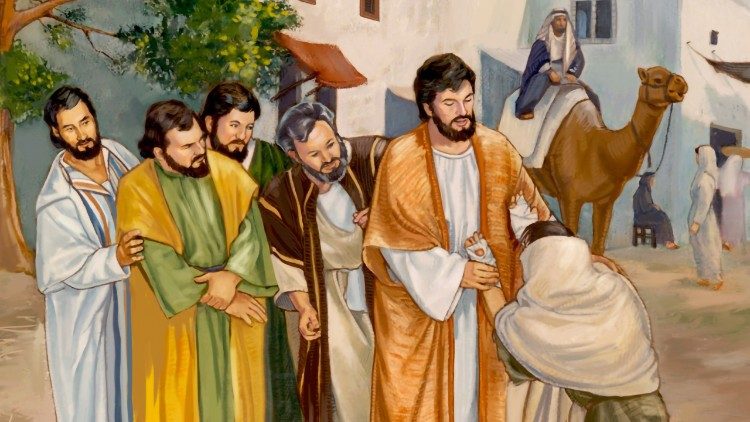
Jesus heals the leprosy patientJesus heals the leprosy patient 

Angelus: Pope Francis recalls World Leprosy Day

In remarks following the recitation of the Angelus on Sunday, Pope Francis recalls World Leprosy Day, expressing his closeness to those who suffer from the disease.”

By Vatican News staff reporter

Following the recitation of the Angelus in St Peter’s Square on Sunday, the Pope recalled that this 30th January marks the World Leprosy Day.

This date was chosen by French philanthropist and writer Raoul Follereau, and dates back to 1954.

The day aims to increase the public awareness of leprosy or Hansen's Disease.  This year’s theme is “United for Dignity.”

Pope Francis expressed his closeness “to those who suffer from this disease” and prayed that they “will not lack spiritual support and health care.”

It is necessary, he said, “to work together for the full integration of these people, overcoming any discrimination associated with a disease that unfortunately still affects so many, especially in the most disadvantaged social contexts.”

Lunar New Year

The Pope also recalled that Tuesday 1 February marks the Lunar New Year which will be celebrated throughout the Far East, as well as in various parts of the world.

On this occasion, Pope Francis extended his cordial greetings and expressed the wish that in the New Year all may enjoy “peace, health and a peaceful and secure life.”  

“How beautiful it is when families find opportunities to gather together and experience moments of love and joy! Many families, unfortunately, will not be able to get together this year because of the pandemic. I hope that we will soon be able to overcome this test," he said.

The Pope went on to say that thanks to the “good will of individuals and the solidarity of peoples, the entire human family will be able to achieve with renewed dynamism goals of material and spiritual prosperity.”

St John Bosco

On the eve of the feast of Saint John Bosco, which is celebrated on 31 January, the Pope greeted the Salesian men and women “who do so much good in the Church."

“We think of this great saint, father and teacher of youth. He did not shut himself up in the sacristy, he did not shut himself up in his things. He went out into the streets to look for young people, with that creativity that was characteristic of him," Pope Francis said.

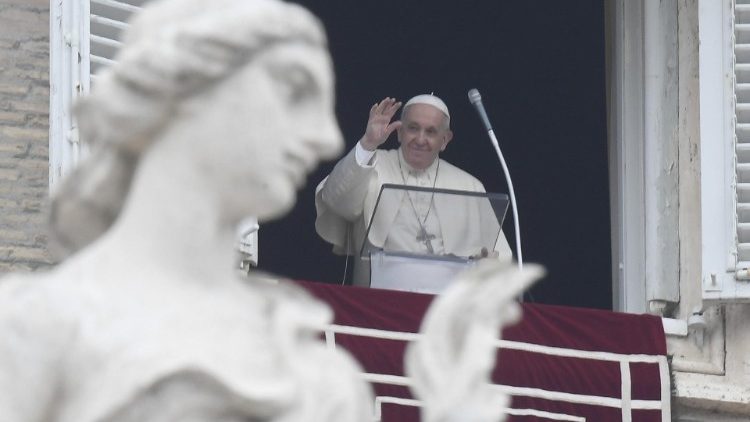
Papal Sunday Angelus Address 01.30.2022


Pope Francis during the Sunday AngelusPope Francis during the Sunday Angelus  (Vatican Media)

Pope at Angelus: Find Jesus in those who are close to you every day

Pope Francis reflects on the Gospel reading of the day inviting believers to be humble and willing and never to reject the ways of the Lord.

By Linda Bordoni

Reflecting on the passage from the Gospel of Luke that tells of how Jesus met with incomprehension and hostility when he gave his first sermon in his home town, Nazareth, Pope Francis invited Christians to believe in good, even when faced with closures and rejection (Lk 4:21-30).

Speaking during the Sunday Angelus, the Pope recalled that in Nazareth, Jesus is received with incomprehension and hostility. Rather than a word of truth, he explained, his fellow villagers “wanted miracles and prodigious signs.”

They reject him, he said, and “Jesus therefore utters a phrase that has become proverbial: “No prophet is acceptable in his own country.”

The Pope explained that these words reveal “that Jesus’ failure was not entirely unexpected. He knew his people, he knew the risk he was running, he took rejection into account.”

“And, so, we might wonder: why, if he foresees a failure, does he go to his hometown all the same? Why do good to people who are not willing to accept you?”

This, Pope Francis continued, is  a question that we too often ask ourselves. But it is a question that helps us understand God better: “Faced with our closures, he does not withdraw: he does not put brakes on his love.”

Leave no stone unturned in doing good

He noted that this is exemplified by the unconditional love of parents who are aware of the ingratitude of their children, but do not cease to love them and do good to them. God, he added, “is the same, but at a much higher level. And today he invites us too to believe in good, to leave no stone unturned in doing good.”

Readiness and humility

Something else, the Pope said, is revealed by what happens in Nazareth that causes us to ask ourselves questions pertaining to our own hostility and unwelcoming attitudes.

“Let us look at the models of acceptance that Jesus proposes today,” he said, noting that “They are two foreigners: a widow from Sarepta of Sidon and Naaman, the Syrian.”

Both of them, he recalled welcomed prophets: “the first Elijah, the second Elisha.” But neither was an easy reception, and both went through trials.

The widow and Naaman, in short, accepted through willingness and humility, the Pope said, explain that faith passes through readiness and humility.

“The widow and Naaman did not reject the ways of God and his prophets; they were docile, not rigid and closed.”

Jesus asks us to accept him in our daily reality

Jesus, the Pope said, also goes the way of the prophets: he presents himself as we would not expect. “He is not found by those who seek miracles, new sensations, a faith made up of power and external signs. He is found instead by those who accept his ways and his challenges, without complaint, without suspicion, without criticism and long faces.”

In other words, he said, “Jesus asks you to accept him in the daily reality that you live; in the Church of today, as it is; in those who are close to you every day; in the reality of those in need. He is there, inviting us to purify ourselves in the river of availability and in many healthy baths of humility.”

Our Lady shows us the way to welcome Jesus

Perhaps, Pope Francis concluded, “after many years as believers, we think we know the Lord well, with our ideas and our judgments. The risk is that we get used to Jesus, we close ourselves up to his newness, frozen in our positions. Instead, the Lord asks us for an open mind and a simple heart.

“May Our Lady, model of humility and willingness, show us the way to welcome Jesus.”

Saturday, January 29, 2022

Sunday Saint of the Day


St. Mutien-Marie Wiaux


Christian Brother praised as a model teacher. He was born the son of a blacksmith in Mellet, Belgium, in 1841. Entering the Christian Brothers, he changed his baptismal name, Louis, to Mutien. In 1859 he was assigned to St. Bertuin's School in Maloone, where he taught for fifty-eight years. Mutien specialized in art and music. He was canonized in 1989 by Pope John Paul II.


Preparing for World Day of Consecrated Life


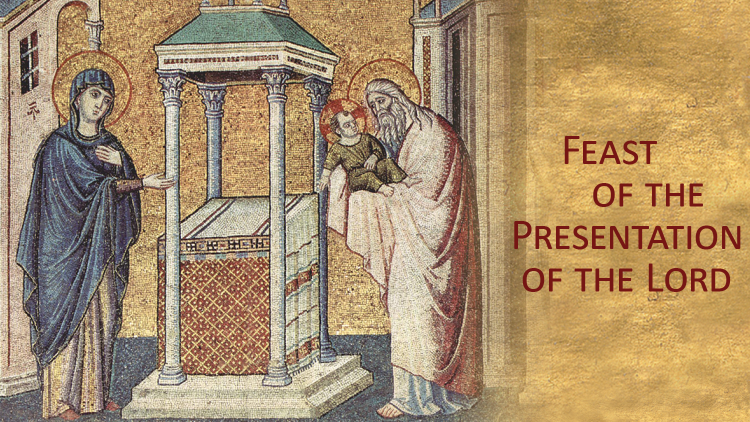
World Day for Consecrated Life is observed by the Church on Feast of the Presentation of the LordWorld Day for Consecrated Life is observed by the Church on Feast of the Presentation of the Lord 

World Day for Consecrated Life: Invitation to the synodal spirit of participation

On the occasion of the World Day for Consecrated Life, 2 February, the Vatican Congregation for Institutes of Consecrated Life and Societies of Apostolic Life has addressed a letter to the world’s consecrated men and women.

By Vatican News staff reporter

Pope Francis will mark the World Day for Consecrated Life on Wednesday with a Eucharistic celebration in Rome’s St. Peter's Basilica.

Pope Saint John Paul II instituted the annual observance of the Catholic Church, marking it for the first time in 1997.  He designated its celebration on February 2, the Feast of the Presentation of the Lord. 

For the 26th edition of the celebration this year, the Congregation for Institutes of Consecrated Life and Societies of Apostolic Life has addressed a letter to the world’s consecrated men and women inviting them to walk together as a community in the synodal spirit of participation, where members exercise responsibility for one another through mutual listening, excluding no one.

The joy of ‘we’

The Prefect of the Congregation, Cardinal Joao Braz de Aviz and Secretary, Archbishop Jose Rogriguez Carballo, who signed the letter, explain that this year’s message focuses on ‘participation”, the second word of the theme of the 2023 Synod: Communion, Participation and Mission.

Recalling the exhortation of Pope Francis, the message says, “no one, no one, should be excluded or feel excluded from this journey; no one, no one, should think ‘it doesn't concern me’.”

The message recalls that, by going back to their vocational call, consecrated persons will rediscover the enthusiasm, amazement and joy of feeling and being part of a project of love, for which others like them have also made their lives available for the good of humanity.  The Vatican Congregation thus invites consecrated persons to revive this memory, warning that “over time it risks losing its strength, especially when we replace the attractiveness of ‘we’ with the strength of ‘I’”.

Participation of all

The first proof of participation is belonging, the message says, adding, “I cannot participate if I conceive of myself as the whole and do not recognize myself as part of a shared project.”  Hence the importance of asking ourselves what this listening in the community consists of: “Who are  the brothers and sisters we listen to and, before that, why do we listen to them?”

“We cannot call ourselves a vocational community, and even less a community of life, if the participation of some or others is missing.”

The Congregation invites consecrated men and women to the synodal journey of participation “strong in the conviction that we can only receive and give Good” because, as Pope Francis says, consecrated life is born, grows and can give evangelical fruits only in the Church, the living communion of the faithful People of God.

Responsibility

Participation thus becomes responsibility, whereby “we cannot but be among others and with others”.  And even before that, synodality begins within us from a "change of mentality, from a personal conversion, in the community or fraternity, in our homes, workplaces and structures structures to expand into ministries and mission".

Thus, nourishing the synodal journey together that begins with listening, means making room for the other in our lives, taking seriously what is important to him or her.

Participation also means co-responsibility, especially in the missionary dream of reaching out to all, of caring for all, of feeling that we are all brothers and sisters, together in life and in history, which is the history of salvation.

Friday, January 28, 2022

The Church honors Mary on Saturdays


Why are Saturdays dedicated to the Virgin Mary?


The Church has honored the Mother of God on Saturdays for centuries, dating back to the early Middle Ages.

In the Catholic Church Saturdays are special days in the liturgy devoted to the Blessed Virgin Mary. On most Saturdays of the year, priests can offer a votive Mass in honor of the Virgin Mary and in the Liturgy of the Hours there is a specific set of prayers and readings that can be prayed in her honor as well.

Why is Saturday dedicated to the Virgin Mary?

The tradition of setting aside Saturdays to honor the Mother of God is an ancient one, going back hundreds of years. According to the Catholic Encyclopedia, a “special Mass already assigned to the Blessed Virgin on Saturdays in the Leofric Missal,” which dates to the 10th century.

The Dictionary of Mary confirms that, “This liturgical attribution of Saturday to Mary was largely the work of Alcuin (735-804) … [who] composed six formularies for Votive (that is, devotional) Masses – one for each day of the week. And he assigned two formularies to Saturday in honor of Our Lady.”

Nevertheless, while this asserts the historicity of the devotion, it doesn’t tell us why Saturday was chosen.

According to St. Thomas Aquinas (as quoted by Fr. John Hardon), the choice was connected to Jesus’ resurrection on Sunday and the unshaken faith of Mary on the previous day.

Since the Resurrection took place on a Sunday, we keep holy this day instead of the Sabbath as did the Jews of old. However, we also sanctify Saturday in honor of the glorious Virgin Mary who remained unshaken in faith all day Saturday after the death of her Divine Son.

Others have postulated that since Sunday is devoted to Jesus, it would be fitting to dedicate the day prior to his Mother.

Whatever the exact origins were, this devotion to the Virgin Mary on Saturdays was most recently confirmed by the private revelations of Our Lady of Fatima.

On December 10, 1925, the Blessed Virgin Mary appeared to Sister Lucia at a convent in Pontevedra, Spain. Sister Lucia had previously been the recipient of Marian visions in Fatima, Portugal, along with her cousins Jacinta and Francisco. In this new private revelation eight years after the visions at Fatima, Mary requested the institution of the five consecutive First Saturday devotions in reparation to her Immaculate Heart.

This revelation further cemented the connection of Saturdays to devotion to the Virgin Mary, which is always focused on drawing Christians closer to Jesus, her Son.

Saturday is a “preparation day,” and Mary is the “preparer” who helps us reap the fruit of our labor on Sunday, the day of the Resurrection.

Saturday Saint of the Day


St. Dallan


Dallan Forgaill (6th.cent.) A kinsman of St. Edan of Ferns, born in Connaught and a great scholar who, through his application to study, became blind. He wrote a poem in honour of St. Columba, called Ambra Choluim Kille which was only published after St. Columba's death. The legend averring that on its publication Dallan's sight was restored to him is found in several authors. St. Dallan was murdered at Triscoel by pirates (AD 598) and his head thrown into the sea. It was recovered and miraculously reunited to his body.

From Fr. Z's blog; the words of a great Saint on worthy distribution and reception of Holy Communion


St. John Chrysostom – Patron Saint of Telling It Like It Is: On giving the Eucharist to UNWORTHY PUBLIC FIGURES


“I speak not only to the communicant, but also I say to the priest who ministers the Sacrament: Distribute this gift with much care. There is no small punishment for you, if being conscious of any wickedness in any man, you allow him to partake of the banquet of the table: ‘Shall I not now require his blood at your hand?’ (2 Sam. 4:11). If some public figure, or some wealthy person who is unworthy, presents himself to receive Holy Communion, forbid him. The receive? I am speaking here not of some unknown sinner, but of a notorious one. If someone who is not a disciple, through ignorance, comes to Communion, do not be afraid to forbid him. Fear God, not man. If you fear man, you will be scorned and laughed at even by him; but if you fear God, you will be an object of respect even to men. But if you cannot do it, bring that sinner to me, for I will not allow anyone to dare do these things. I would give up my life rather than give the Lord’s Blood to the unworthy.

“If, however, a sinful person receives Communion, and you did not know his character, you are not to blame, however. I say the things above concerning only those who sin openly. For if we amend these, God will speedily reveal to us the unknown also; but if we let these flagrant abuses continue, how can we expect Him to make manifest those that are hidden? I say these things, not to repel sinners or cut them off, but I say it in order that we may bring them to repentance, and bring them back, so that we may take care of them. For thus we shall both please God and lead many to receive worthily. And for our own diligence, and for our care for others, we will receive a great reward. May we attain that reward by the grace and love that God gives to man through Our Lord Jesus Christ, to whom be glory, world without end. Amen.”

Actor and director Mel Gibson says Church needs housecleaning


Mel Gibson Says Catholic Church Needs 'Housecleaning' After Series of Scandals


Hollywood actor Mel Gibson has stated that the Catholic Church needs to undergo "housecleaning," after being mired in scandal over the years.

The Catholic Church has faced a number of unflattering headlines recently, most prominently for its record of handling sexual abuse cases.

And The Passion of the Christ director Gibson, who was raised a Sedevacantist traditionalist Catholic, believes a clean-up behind the scenes would greatly help the image of the church. Sedevacantists believe that since the death of Pope Pius XII in 1958 (or, in some cases, the death of Pope John XXIII in 1963) subsequent popes have been neither true Catholics nor true popes, but rather heretics because they espoused Modernism.

In an interview with Extra host Billy Bush, Gibson was asked if his decision to team up with fellow Catholic Mark Wahlberg for the upcoming faith-themed biopic Father Stu was part of an effort to "get back to the good" of the church.

"Back to basics," Gibson, 66, responded. "Of course, it's lamentable all the stuff that's gone on. Like any institution, it's capable of being corrupt. And, you know, it is sad to see, but as always, I don't think it's the institution that's at fault.

"I think it's a lot of people they get in it. Institutions are as good or as bad as the people in it, running it. It is having a bit of a rugged time right now."

Gibson—whose self-built Malibu church, The Church of the Holy Family, is not affiliated with the Roman Catholic archdiocese—added: "I think there's going to need to be a housecleaning. It is going to have to come back to some sort of equilibrium in the future."


It is not the first time that Gibson has spoken out about certain aspects of the church. In September 2021, the National Catholic Reporter published an article that quoted him speaking out against the Second Vatican Council.

According to the report, the screen star endorsed the Coalition for Canceled Priests, whose bishops have removed the clerics from ministry for expressing opinions seen as controversial by the church.

"And my question is, who's hiring [the bishops]? I don't think it's Jesus. Is it [Pope] Francis? Who's hiring Francis? Is it Pachamama?" Gibson said.

Gibson said that "there was nothing wrong" with the Catholic Church before Vatican II's reforms, adding: "It didn't need to be fixed. It was doing pretty well."

While Gibson is known to be a devoted Catholic, he has faced a large number of detractors amid accusations of antisemitism and racism. Actor Joshua Malina branded him a "Jew-hater" in an impassioned op-ed for The Atlantic last month.

Catholic media must remain faithful to the truth and respect individuals; good advice for all media


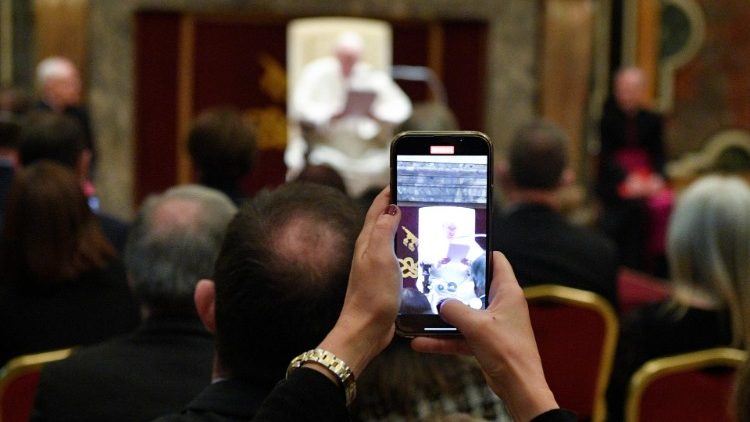
A journalists takes a picture of the Pope during Friday's audienceA journalists takes a picture of the Pope during Friday's audience  (Vatican Media)

Pope to Catholic media: Check facts but always respect people

Pope Francis meets with members of the International Catholic Media Consortium, and urges journalists to remain faithful to the truth by always checking facts and respecting individuals.

By Devin Watkins

As misinformation continues to swirl regarding the Covid-19 pandemic, Pope Francis is calling on journalists, especially Catholic media professionals, to verify the facts they report while adopting a respectful attitude toward those who produce and consume fake news.

Meeting with members of the International Catholic Media Consortium on Friday, the Pope reflected on the theme of communications and truth.

The consortium—run up by Aleteia and I Media, two news websites, and Verificat, a fact-checking agency—set up the “Catholic FactChecking” website in early 2021.

Unmasking fake news

Pope Francis lauded the organization’s goal of seeking to unmask “fake news and partial or misleading information” about Covid-19 vaccines and ethical questions related to them.

The group includes a scientific committee that draws upon the work of experts in epidemiology, theology, and bioethics.

The Pope noted that people are increasingly influenced by mass media and that reporters must therefore employ a rigorous method.

“Communicators must observe facts carefully, check their accuracy, make a critical evaluation of the sources of their information, and finally, pass on their findings. The burden of responsibility is all the greater when, as often happens, the reporter is called upon not only to give the simple facts of a case but also to explain its implications by providing commentary and the elements needed for a fair assessment. (Pope St. Paul VI’s 1972 message for World Communications Day)”

Together

Pope Francis then reflected on the Catholic consortium’s stated goal of being “together for truth”.

Taking the first word of the slogan—“together”—he said Christian communicators who network and share knowledge are already offering “an initial form of witness.”

He lamented the “infodemic” plaguing the world alongside the pandemic, calling it “a distortion of reality based on fear, which in our global society leads to an explosion of commentary on falsified if not invented news.”

“To be properly informed, to be helped to understand situations based on scientific data and not fake news, is a human right. Correct information must be ensured above all to those who are less equipped, to the weakest and to those who are most vulnerable.”

For, not against

Turning to the second word—“for”—the Pope recalled that Christians are always “against injustice and lies, but always for persons.”

He urged members of the Catholic consortium to never overlook the “fundamental distinction between information and people”, even as they combat disinformation.

“Fake news has to be refuted, but individual persons must always be respected, for they believe it often without full awareness or responsibility.”

This approach calls for Christian reporters to be “evangelical in style, a builder of bridges, a promoter of peace, also and above all, in search for truth.”

Pope Francis also warned against a conflictual demeanor and “fideism” to science which is always in the process of “advancing towards the solution of problems.”

“Reality is always more complex than we think and we must respect the doubts, the concerns and the questions that people raise, seeking to accompany them without ever dismissing them.”

He therefore urged Christian journalists to try to accompany people by providing answers in “a serene and reasonable way”.

Truth, toward communion

Pope Francis then took up the final word—“truth”—to encourage the group’s goal of fact-checking, while warning against giving in to vested interests or commercial gains.

“The antidote to every type of falsification is to let ourselves be purified by the truth. For Christians, truth is never merely a concept having to do with judgment about things. Truth regards life as a whole.”

The Pope concluded his speech to the Catholic Media Consortium by recalling the pandemic’s victims and offering his encouragement for their work.

“To work in service to truth,” he said, “means to seek the things that foster communion and promote the good of all, not those that isolate, divide and oppose.”