Wednesday, September 30, 2020

Pope Francis pens apostolic letter about St. Jerome

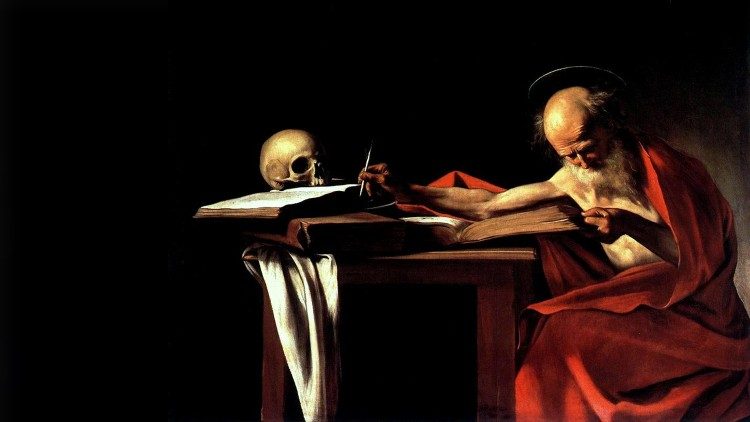
2019.09.30 San Girolamo -o Gerolamo- Sacerdote e dottore della Chiesa Saint Jerome by Caravaggio 

New Apostolic Letter highlights St Jerome’s love of Scripture

Pope Francis has written an Apostolic Letter for the 1600th anniversary of the death of Saint Jerome the “great doctor and father of the Church, who put the Bible at the centre of his life.”

By Vatican News

St Jerome bequeathed to the Church “devotion to the Sacred Scripture, a ‘living and tender love’ for the written word of God,” says Pope Francis in a new Apostolic Letter on the 1600th anniversary of the death of the great Doctor and Father of the Church.

“Jerome’s profound knowledge of the Scriptures, his zeal for making their teaching known, his skill as an interpreter of texts, his ardent and at times impetuous defence of Christian truth, his asceticism and harsh eremitical discipline, his expertise as a generous and sensitive spiritual guide”, the Pope writes in Scripturae Sacrae affectus ("Devotion to Sacred Scripture"), “all these make him, sixteen centuries after his death, a figure of enduring relevance for us, the Christians of the twenty-first century.”

A life devoted to Christ and His word

Reviewing the life of the fourth century saint, Pope Francis notes that Jerome devoted himself entirely “to Christ and His word,” working unceasingly “to make the divine writings accessible to others. The Pope highlighted two dimensions of the saint’s life especially: his “absolute and austere consecration to God,” and “a commitment to diligent study, aimed purely at an ever deeper understanding of the Christian mystery.”

Pope Francis dwells on Jerome’s love of Scripture, which focused on the “humble character of God’s revelation,” more than on “the narrative and poetic genius of the Bible.” Jerome approached the Scriptures in an even “more systematic and distinctive way” than the other early Christian Fathers, emphasizing the necessity of knowing the Bible in order to know Christ.


Study steeped in obedience

Jerome’s study of the Scripture, the Pope says, was steeped in obedience, both to God Himself and “to those in the Church who represent the living Tradition that interprets the revealed message.” But, Pope Francis insists, “The ‘obedience of faith’ is not, however, a mere passive reception of something already known; on the contrary it demands an active personal effort to understand what was spoken.”

Pope Francis notes that many people find the Bible difficult to read—not because of illiteracy, but because they have not learned the skills necessary to make the sacred text intelligible.

“This shows the need for an interpreter,” writes Pope Francis, adding, “Jerome can serve as our guide… because he leads every reader to the mystery of Jesus.”

The Vulgate translation


The Pope notes that Jerome’s translation of the Scriptures into Latin helped to shape western culture. “Jerome’s work of translation teaches us that the values and positive forms of every culture represent an enrichment for the whole Church,” while at the same time witnessing “to the fact that the Bible continually needs to be translated into the linguistic and mental categories of each culture and generation.”

Pope Francis also explains the importance of translation as a form of “hospitality”: a translator, he writes, “is a bridge builder,” helping people of different languages and cultures not only communicate with, but also understand one another.

Devotion to Rome and the Popes

Saint Jerome was also known for his deep devotion to Rome and to the Popes. “At a turbulent time in which the seamless garment of the Church was often torn by divisions among Christians, Jerome looked to the Chair of Peter as a sure reference point.”

 Jerome himself “was often involved in bitter disputes for the cause of the faith,” which he often carried out with great passion. Nonetheless, although willing to fight vehemently for the faith, Jerome loved and desired peace. “Today more than ever,” writes Pope Francis, “our world needs the medicine of mercy and peace.”


Example of love for the Scriptures

Concluding his Letter, Pope Francis appeals to everyone to take Saint Jerome as an example of love for Sacred Scripture and devotion to study. “I would like to pose a challenge to young people in particular,” he writes: “Begin exploring your heritage. Christianity makes you heirs of an unsurpassed cultural patrimony of which you must take ownership. Be passionate about this history which is yours. Dare to fix your gaze on the young Jerome, who, like the merchant in Jesus’ parable, sold all he had in order to buy the ‘pearl of great price’.”

Pope Francis expresses his hope that we might “love what Jerome loved,” rediscover his writings, and allow ourselves “to be touched by his robust spirituality.” He points to the Blessed Virgin Mary as “the model of prayerful reading of the Scriptures,” encouraging us to “entrust ourselves to Our Lady who, more than anyone, can teach us how to read, meditate, contemplate, and pray to God, who tirelessly makes Himself present in our lives.”

Wednesday Papal General Audience 09.30.2020

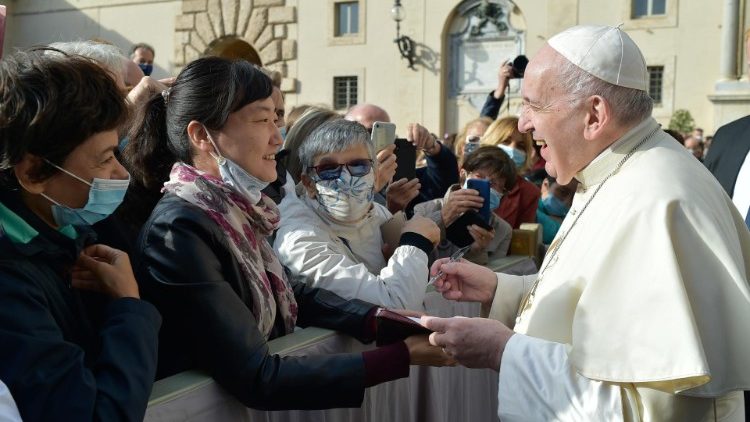
Pope Francis greets the faithful during his weekly General Audience Pope Francis greets the faithful during his weekly General Audience  (Vatican Media)

Pope at Audience: 'Make love go viral in the light of faith'

Concluding his series of catecheses on the effects of the coronavirus pandemic, Pope Francis reflects on the path of hope and love, as the world continues to suffer.

By Vatican News

Pope Francis began his General Audience on Wednesday noting that in recent weeks “we have reflected together” on how to heal the world from the suffering highlighted by the pandemic.

As disciples of Jesus, “allowing ourselves to be guided by faith, hope and charity”, he said, we have proposed to follow in His steps, opting for the poor, rethinking the use of material goods and taking care of our common home.

May the path continue

The Pope continued by expressing his hope that we “keep our eyes fixed on Jesus” who saves and heals the world and takes care of all “without distinction on the basis of race, language or nation”. In order to do this, and follow in his footsteps, he explained, we must “contemplate and appreciate the beauty of every human being and of every creature”, all conceived in the heart of God.

In this way can we recognise Christ present in our poor and suffering brothers and sisters, to encounter them and to listen to their cry and the cry of the earth that echoes, continued the Pope.

“Normality”

In recognising Christ we will be able to regenerate society and not return to so-called “normality”, said the Pope, explaining that the normality we once knew was “sick with injustice”. The virus has highlighted so many injustices, all of which are the result of humankind, he continued, instead, we are called to the normality of the Kingdom of God, “where there is bread for all and more to spare, social organisation is based on contributing, sharing and distributing, not on possessing, excluding and accumulating”.

“To come out of the pandemic, we must find the cure not only for the coronavirus, but also for the great human and socio-economic viruses”, said the Pope.

Viralise love, globalise hope

Finally, Pope Francis noted that “a fair and equitable society is a healthier society” and that together we can work towards the Kingdom that Christ inaugurated for us: “a Kingdom of light in the midst of darkness, of justice in the midst of so many outrages, of joy in the midst of so much pain, of healing and salvation in the midst of sickness and death”. Lets make love "go viral" and lets globalise” hope in the light of faith".

Tuesday, September 29, 2020

Translated the Bible into Latin; taught ignorance of Scripture is ignorance of Christ

St. Jerome

Feastday: September 30
Patron: of archaeologists, Biblical scholars, librarians, students and translators
Birth: 342
Death: 420

Image of St. Jerome


Before he was known as Saint Jerome, he was named Eusebius Sophronius Hieronymus. He was born around 342 AD, in Stridon, Dalmatia. Today, the town, which ceased to exist in Jerome's time, would likely be in Croatia or Slovenia.

The young Jerome was educated by Aelius Donatus, who was a famous Roman grammarian. From him, the young Jerome learned Latin and Greek. Little else is known of his childhood other than his parents were probably well-to-do and Christian. Despite their efforts to raise Jerome properly, the young man behaved as he chose.

Around the age of 12 or so, Jerome traveled to Rome to study grammar, philosophy and rhetoric. It is likely that due to his training in rhetoric, he may have considered a career in law. By his own admission, he quickly forgot his morals. While he was not studying, Jerome pursued pleasure. In particular, he pursued women, even though he knew his behavior was wrong.

To alleviate the feelings of guilt he often felt afterwards, Jerome would visit the crypts in Rome and imagine himself in hell. He did so every Sunday, even though he was not a Christian. Jerome succeeded in frightening himself, but not in changing his ways.

Fortunately, Jerome had as a companion, Bonosus, who was a Christian influence. His influence is part of what persuaded Jerome to become a Christian and change his ways for the better.

In or around the year 366, Jerome decided to become a Christian and was baptized by Pope Liberius.

Now interested in theological matters, Jerome set aside secular matters to pursue matters of the faith. He traveled with Bonosus to Trier where there were schools for him to gain ecclesiastical training.

In 370, he traveled close to home, ending up in a monastery at Aquileia. The monastery was overseen by Bishop St. Valerian, who had attracted some of the greatest minds in Christendom. While in Aquileia, Jerome met Rufinus and the two men became friends. Rufinis was a monk who became renown for his translations of Greek works into Latin. Jerome himself was developing his skills as a translator, a skill he developed during his time in the Roman catacombs, translating the inscriptions on the tombs.

Following his time in Aquileia, Jerome traveled next to Treves, Gaul where he began to translate books for his own use. His goal was to build a personal library.

After a time in Gaul, he returned to Aquileia in 373. While there, Jerome and his friend Bonosus had a falling out and decided to part ways. Bonosus departed for an island in the Adriatic where he would live as a hermit for a time.


Jerome traveled to the east, bound for Antioch by way of Athens.

In 374, Jerome finally reached Antioch, after making several lengthy stops along the way. While in that city, Jerome began writing his first work, "Concerning the Seven Beatings."

During that same year, disease made Jerome ill while taking the lives of some of his companions. It is unclear what disease was responsible, or if different illnesses had taken his friends. During his illness, Jerome had visions which made him even more religious.

Jerome went into the desert to live for four years, living as a hermit southwest of Antioch. He was frequently ill during this time.

After he emerged from his hermitage, Jerome was quickly embroiled in conflicts within the Church at Antioch. This was not something Jerome wanted to be associated with. Jerome made clear that he did not want to become a priest, preferring instead to be a monk or a hermit. But Church officials in Antioch as well as Pope Damasus wanted him to be ordained. Jerome relented on the condition he would not be expected to serve in any ministry and would still be allowed to pursue his monastic life. He was subsequently ordained.

Making the most of his freedom as a priest, Jerome traveled to Constantinople where he studied under St. Gregory of Nazianzus, who was renown as a great theologian.

After St. Gregory left Constantinople in 382, Jerome traveled to Rome for a council of the Church and met Pope Damasus. Following the council, Pope Damsus kept Jerome in Rome and made him his secretary.

While serving as secretary to the pope, Jerome also promoted the ideal of asceticism to everyone around him. Included in this group were women of the city of Rome who wanted to live saintly lives.

Pope Damasus died in 384, and this exposed Jerome to criticism and controversy. Jerome was a sarcastic man of great wit. He became unpopular because of his attitude and made a number of enemies. While Pope Damasus was alive, he could shield Jerome from criticism, but now Jerome faced the vengeance of the enemies he made. Both prominent pagans who resented his promotion of the faith and fellow Christians who lacked his wit attacked him with vicious rumors. Among the rumors were accusations that he was behaving inappropriately with the woman we now know as Paula. At that time, she was one of his students in asceticism.


Paula was a widow with four children who deeply mourned the loss of her husband. Jerome provided counseling and instruction to her and she became a lifelong friend and follower of Jerome, assisting him in his work.

Eventually, Jerome decided to return to the Holy Land to escape the calumny in Rome. He headed east and arrived in Antioch in 386. Shortly after, Jerome was met by Paula, her daughter, and several other followers. The group went first to Jerusalem, then on to Alexandria, Egypt. They settled in Bethlehem and had a monastery built there which included dormitories for women.

Jerome was a hard worker and he wrote extensively defending the virginity of Mary, which some clerics dared to question. He also engaged in several debates against various other heresies including a lengthy battle with his old friend Rufinus. Jerome was easily upset, and even the venerable St. Augustine exchanged words with him. Eventually, Jerome and Augustine repaired their relationship and were able to correspond as friends and colleagues.

Of all the things that made Jerome famous, nothing was so legendary as his translation of the Bible. Jerome began work while he was still in Rome under Pope Damasus. He spent his entire life translating the scriptures from Hebrew and Old Latin.

In the year 404 Paula died, later to become a saint of the Church. Rome was sacked by Alarc the Barbarian in 410. These events distressed Jerome greatly. Violence eventually found its way to Bethlehem disrupting Jerome's work in his final years.

Jerome died on September 30, 420. His death was peaceful and he was laid to rest under the Church of the Nativity. His remains were later transferred to Rome.

Saint Jerome is the patron saint of archaeologists, Biblical scholars, librarians, students and translators.

His feast day is September 30.


USCCB says more help needed for Covid19 recovery

US Catholic Leaders Call on President and Congress to Support Additional COVID-19 Relief for Those in Need

Urge Passage of Legislation in Letter to President Trump

Share this Entry

In light of the current needs affecting our nation as a result of the COVID-19 pandemic, Archbishop José H. Gomez of Los Angeles, president of the U.S. Conference of Catholic Bishops (USCCB), signed a joint letter along with leaders of the Catholic Health Association of the United States, Catholic Charities USA, the National Catholic Educational Association, Catholic Relief Services, the United States Society of St. Vincent de Paul, and the Association of Catholic Colleges and Universities urging immediate action to provide relief for those in need.

Their letter to President Trump and congressional leaders emphasized the great hardships caused by COVID-19. Our nation is suffering a profound crisis, the leaders say, with over 200,000 lives lost and millions of Americans facing uncertainly about how to provide for their basic needs which include food, housing, healthcare, and education. The letter calls lawmakers to action, “For those in need here and abroad, as well as for the common good, our nation’s leaders must do more.”

Catholic ministries remain committed to providing aid, healthcare, education, and spiritual care, but the letter recognizes that “all this is not enough.” A new COVID-19 stimulus bill is needed to alleviate people’s suffering. Underscoring the urgency of their request, the letter implores our nation’s leaders to “put aside partisan politics and prioritize human life and the common good by expediting negotiations to ensure not another day is lost in providing security and hope to people in need at home and abroad.”

Read the full letter here.