Wednesday, April 29, 2020

Wednesday General Audience with Pope Francis

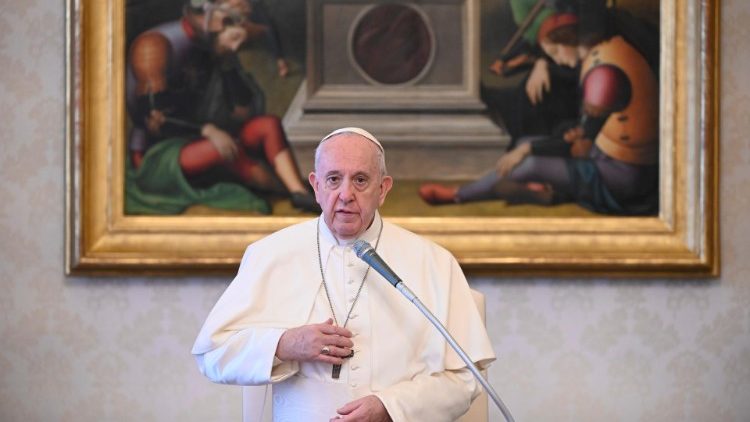
2020.04.29 Udienza Generale Pope Francis at the General Audience on Wednesday  (Vatican Media)


Pope at General Audience: Love the world that persecutes you


At his General Audience on Wednesday, Pope Francis concludes his series of catecheses on the Beatitudes, focusing on the final Beatitude, “Blessed are those who are persecuted for righteousness’ sake, for theirs is the kingdom of heaven”.


By Christopher Wells
Pope Francis concluded his catechesis on the Beatitudes during his General Audience on Wednesday, 29 April. His reflection focused on the last of the Beatitudes: “Blessed are those who are persecuted for righteousness’ sake, for theirs is the kingdom of heaven”.

A unified journey

The Holy Father noted that the happiness promised in this final Beatitude is the same as that of the first: the Kingdom of Heaven. “Thus we understand that we have arrived at the end of a unified journey” that gradually unfolded as Christ proclaimed each succeeding Beatitude, the Pope explained. “The Path of the Beatitudes is an Easter journey that leads from a life according to the world to a life according to God”.
 
This evangelical path, however, cannot be approved by “the world, with its idols, its compromises, and its priorities”. The all-too-human “structures of sin” that we find in the world can only reject the Gospel values of poverty, or meekness, or purity, “and declare that a life lived according to the Gospel is an error and a problem”.

The drama of persecution

So, the Pope said, when the world sees people living the beatitudes, there is discomfort that calls for a decision: either to be open to discussion and goodness; or “to refuse that light and harden the heart, even to the point of opposition and rage”.
This shows “the drama of persecution”, the Pope said, but also reveals “the place of liberation from subjugation to success, vainglory, and the compromises of the world”.
Those who reject the trappings of worldliness because of Christ are happy and blessed, Pope Francis said, “because they have found something more valuable than the whole world”.

Modern persecution of Christians

The Holy Father once more noted, with sorrow, the ongoing persecution of Christians, which is greater now than it was even in the early centuries of Christianity. He said, “we must hope and pray that their tribulation will be ended as soon as possible”, and urged Christians to express their closeness to their persecuted brothers and sisters, “the bleeding members of the Body of Christ, which is the Church”.
He warned us, though, that hearing the final Beatitude should not lead to a self-pitying attitude, or a victim mentality. When Christians are despised by others, it is not always synonymous with persecution. Sometimes we are at fault, he said, because “we have lost the taste of Christ and of the Gospel”.
Pointing to the example of St Paul, Pope Francis noted that when Paul thought he was righteous, he was in fact a persecutor. It was only after he realized that he was such that he converted, and became “a man of love, who faced gladly the persecution he suffered”.

Made to resemble Christ crucified

Pope Francis concluded by saying that facing exclusion and persecution, “if God grants us the grace”, will make our lives resemble the life of Christ, Who for our sake was “despised and rejected by men”.
Accepting Christ’s Spirit in our lives can lead us to truly love the world, even to the point of offering our lives, “without compromising with its deceptions, and even accepting its rejection” of us. This, said Pope Francis, “is the life of the Kingdom of Heaven, the greatest joy, and true happiness”. 

Pope Francis Wednesday Morning Mass and Homily

Pope at Mass prays for unity in Europe


Pope Francis offers his Wednesday morning Mass in the Casa Santa Marta for unity on the continent of Europe, and reflects in his homily on the grace of concreteness.


By Fr. Benedict Mayaki, SJ
At the start of Mass at the Casa Santa Marta on Wednesday, the Feast of Saint Catherine of Siena, Virgin and Doctor of the Church, Pope Francis prayed for Europe.
“Let us pray for Europe, for the unity of Europe, for the unity of the European Union, so that everyone together might move forward as brothers and sisters,” said the Pope.

Call to concreteness

In his homily, Pope Francis noted that the First Reading (1 Jn 1:5–2:2) contains contrasts between light and darkness, falsehood and truth, sin and innocence. As Christians, however, we are called to concreteness, since we cannot be in union with Jesus and walk in darkness. We cannot be in a grey area between the two.
The danger with the grey area, the Pope explained, is that “the grey makes you think that you are walking in the light because you are not in the darkness, and this soothes you.” The grey area, in this sense, is “treacherous.”

All of us have sinned

Citing the First Reading, Pope Francis said: “If we say ‘we are without sin,’ we deceive ourselves.”
However, the Pope noted that we tend to admit that we are sinners out of habit, in the same way that we say "good morning". But, he said, we often do not express the concreteness that should accompany the admission of our sinfulness. The truth is always concrete as opposed to lies that cannot be defined. Being concrete involves saying “I did this” or, “I thought this way”, and not trying to excuse ourselves during Confession.

Be like Children

The Holy Father remarked that little children have the gift of being concrete. It is for this reason that Jesus blessed the Father for “hiding these things from the learned and the clever and revealing them to little ones" (Matthew 11:25).
During Confession, explained the Pope, the simplicity of children makes them say things as they are. He went on to give the example of a child who confessed in detail how he had been rude to his aunt who refused his request to go out to play instead of doing his homework.
The Pope gave another example of a letter he received on Tuesday from a child named Andrea from Caravaggio. Andrea reproved the Pope for asking that the faithful gathered at Mass exchange a sign of peace, citing concerns about spreading the coronavirus.

Concreteness brings humility

“Concreteness brings us to humility because humility is concrete,” said Pope Francis.
To say that all of us are sinners is abstract. When we admit that we are sinners, we should be able to give the reason for that admission. In that way, we feel the reality of our sins and we come to Jesus for forgiveness. This is the true attitude of a sinner. 
Pope Francis explained that the spiritual life is not complicated but we make it so created a lot of shades of gray. He notes that the devil wants us to be tepid and to live in the grey area that is “neither good nor bad, white nor black.”
We therefore need concreteness so as not to become liars. Just like Peter after the miraculous catch of fish, concreteness should move us to recognize our sin and say “Leave me Lord, for I am a sinful man!” 
Concluding his homily, the Pope prayed that we might receive the grace to know who we are before God. “Let us ask the Lord for the grace of simplicity that He might grant us the grace that He gives to the simple and to children who say what they feel, even if it is wrong.”

Tuesday, April 28, 2020

She helped save the Papacy and carried the stigmata

St. Catherine of Siena


Image of St. Catherine of Siena


St. Catherine of Siena was born during the outbreak of the plague in Siena, Italy on March 25, 1347. She was the 25th child born to her mother, although half of her brothers and sisters did not survive childhood. Catherine herself was a twin, but her sister did not survive infancy. Her mother was 40 when she was born. Her father was a cloth dyer.
At the age of 16, Catherine's sister, Bonaventura, died, leaving her husband as a widower. Catherine's parents proposed that he marry Catherine as a replacement, but Catherine opposed this. She began fasting and cut her hair short to mar her appearance.
Her parents attempted to resist this move, to avoid marriage, but they were unsuccessful. Her fasting and her devotion to her family, convinced them to relent and allow her to live as she pleased. Catherine once explained that she regarded her father as a representation of Jesus and her mother as Our Lady, and her brothers as the apostles, which helped her to serve them with humility.
Despite Catherine's religious nature, she did not choose to enter a convent and instead she joined the Third Order of St. Dominic, which allowed her to associate with a religious society while living at home.


Fellow Dominican sisters taught St. Catherine how to read. Meanwhile, she lived quietly, isolated within her family home.
St. Catherine developed a habit of giving things away and she continually gave away her family's food and clothing to people in need. She never asked permission to give these things away, and she quietly put up with their criticisms.
Something changed her when she was 21. She described an experience she referred to as her "mystical marriage to Christ." There are debates over whether or not St. Catherine was given a ring with some claiming she was given a bejeweled ring, and other claiming the ring was made of Jesus's skin. St. Catherine herself started the rumor of the latter in her writings, but she was known to often claim the ring itself was invisible.
Such mystical experiences change people, and St. Catherine was no exception. In her vision, she was told to reenter public life and to help the poor and sick. She immediately rejoined her family and went into public to help people in need.
She often visited hospitals and homes where the poor and sick were found. Her activities quickly attracted followers who helped her in her mission to serve the poor and sick.
St. Catherine was drawn further into the world as she worked, and eventually she began to travel, calling for reform of the Church and for people to confess and to love God totally. She became involved in politics, and was key in working to keep city states loyal to the Pope. She was also credited with helping to start a crusade to the Holy Land. On one occasion, she visited a condemned political prisoner and was credited with saving his soul, which she saw being taken up to heaven at the moment of his death.
St. Catherine allegedly was given the stigmata, but like her ring, it was visible only to herself. She took Bl. Raymond of Capua has her confessor and spiritual director.
From 1375 onwards, St. Catherine began dictating letters to scribes. She petitioned for peace and was instrumental in persuading the Pope in Avignon to return to Rome.
She became involved in the fractured politics of her time, but was instrumental in restoring the Papacy to Rome and in brokering peace deals during a time of factional conflict and war between the Italian city states.
She also established a monastery for women in 1377 outside of Siena. She is credited with composing over 400 letters, her Dialogue, which is her definitive work, and her prayers. These works are so influential that St. Catherine would later be declared a Doctor of the Church. She is one of the most influential and popular saints in the Church.


By 1380, the 33-year-old mystic had become ill, possibly because of her habit of extreme fasting. Her confessor, Raymond, ordered her to eat, but she replied that she found it difficult to do so, and that possibly she was ill.
In January of 1380, her illness accelerated her inability to eat and drink. Within weeks, she was unable to use her legs. She died on April 29, following a stroke just a week prior.
St. Catherine's feast day is April 29, she is the patroness against fire, illness, the United States, Italy, miscarriages, people ridiculed for their faith, sexual temptation, and nurses.


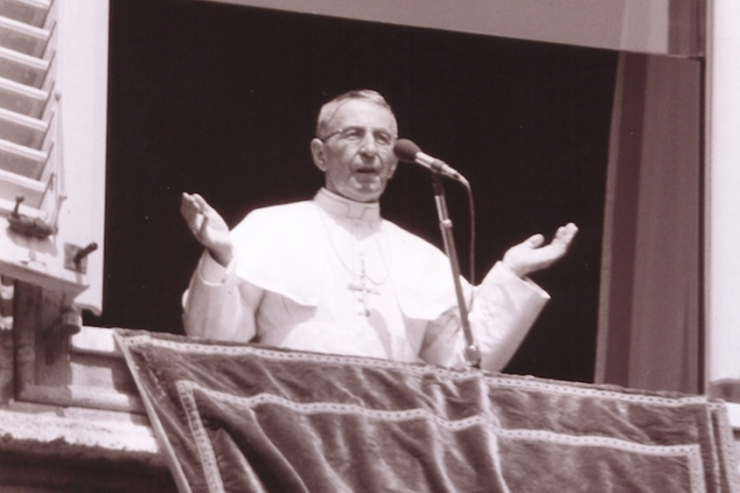
The John Paul I Vatican Foundation to allow deeper study of the 33 day Pontiff

John Paul I © Wikimedia Commons / Sentinelle del mattino

Pope Francis Creates John Paul I Vatican Foundation

Cardinal Pietro Parolin to Serve as Foundation’s President

Pope Francis, with Rescriptum ex audientia Ss.mi of February 17, 2020, has instituted the John Paul I Vatican Foundation, in accordance with the Code of Canon Law and the fundamental Law of the Vatican City State, thus accepting the proposal to create a body intended to study further the person, thought and teachings of his venerable Predecessor, Pope John Paul I – Albino Luciani (26 August 1978 – 28 September 1978) – and to promote the study and dissemination of his writings (cf. Statute, art. 1).
More particularly, the Foundation aims to:
– protect and preserve the cultural and religious heritage of Pope John Paul I;
– promote initiatives such as conferences, meetings, seminars and study sessions;
– establish prizes and scholarships;
– to carry out editorial activity through the publication of both the results of its own studies and research and the works of third parties;
– to propose itself as a point of reference, in Italy and abroad, for those working in the same field and with the same aims (Statute, art. 2).
At the same time, the Supreme Pontiff appointed Cardinal Pietro Parolin, Secretary of State, as President of the Foundation. In implementation of the provisions of art. 4, paragraph 1 of the Statute, the same President appointed the members of the Board of Directors, for a period of five years, in the persons of Dr. Stefania Falasca, who also assumes the role of Vice-President of the Foundation; His Eminence Cardinal Beniamino Stella; the Reverend Msgr. Andrea Celli; the Reverend Don Davide Fiocco; Dr. Lina Petri; and Dr. Alfonso Cauteruccio.
In order to carry out its activities, the Foundation avails itself of a Scientific Committee, composed of six members, chosen among personalities of proven competence and experience, but with the possibility of being temporarily expanded for particular initiatives, projects, studies, research, or consultations.
Cardinal Parolin shared his thoughts on the new foundation in the following article published inL’Osservatore Romano, April 28, 2020.
******
Article of H.E. Cardinal Secretary of State Pietro Parolin
On the Institution of the John Paul I Vatican Foundation

Birth of the John Paul I Vatican Foundation
Topicality of Pope Luciani

Meeting the proposal to give life to an entity destined to reflect further on the figure, thought and teachings of John Paul I (August 26, 1978 – September 28, 1978), last February 17 the Holy Father Francis constituted the John Paul I Vatican Foundation.
Pope John Paul I was and remains a point of reference in the history of the universal Church, whose importance — as Saint John Paul II observed — is inversely proportional to the duration of his very brief pontificate: magis ostentus quam datus.”
 Albino Lucian’s story is that of a Pastor close to the people, focused on the essentials of the faith and with an extraordinary social sensibility. His teaching is current. Proximity, humility, simplicity, insistence on God’s mercy, love of neighbor, and solidarity are the salient traits.
He was a Bishop that lived the experience of the Vatican II Ecumenical Council; he applied it in his brief pontificate and he made the Church progress along the ways indicated by it: the return to the sources of the Gospel and a renewed missionary endeavor, Episcopal Collegiality, service in ecclesial poverty, the search for Christian unity, inter-religious dialogue, dialogue with contemporaneity and international dialogue conducted with perseverance and determination, in favor of justice and peace.
I think, for instance, of his General Audiences and the insistence on ecclesial poverty, on universal fraternity and on active love for the poor: he wished to insert, among the traditional precepts of the Church, a command on the works of solidarity and he proposed it to the Italian Bishops.
I think of his appeal at the Angelus of September 10, 1978, in favor of peace in the Middle East, with the invitation to prayer addressed to the Presidents of different faiths. An appeal that he had already expressed in his address to the Diplomatic Corps held on August 31, in which, freeing himself from presumptions of geopolitical protagonism, he defined the nature and the peculiarity of the Holy See’s diplomatic action from a look of faith. Then, receiving the more than a hundred representatives of the international missions present at the inauguration of his pontificate, he stressed how “our heart us open to all peoples, to all cultures and to all races,” to then affirm: “We certainly don’t have miraculous solutions for the great global problems; however, we can give something that is very precious: a spirit that helps to dissolve these problems and place them in the essential dimension, that of openness to the values of universal charity so that the Church, humble messenger of the Gospel to all the peoples of the earth,  can contribute to create  an atmosphere of justice, brotherhood, solidarity and hope without which the world can’t live.” And thus, in the wake of the Conciliar Constitution Gaudium et Spes, as in many messages of Saint Paul VI, he moved in the furrow of the great diplomacy that has given many fruits to the Church, being nourished with charity.
With his sudden death, this history of the Church was not interrupted, so bent to serve the world. The prospect marked by his brief pontificate was not a parenthesis. Although the government of the Church of John Paul I could not unfold in history, yet he competed — explevit tempora multa — in reinforcing the design of a Church close to the pain of the people and of its thirst for charity. Carried out today, through the cause of John Paul I’s Canonization, was the acquisition of the sources, initiating a work of research and of important elaborations from a historical and a historiographical point of view. Hence, possible now is a proper return to the memory of Pope Luciani, so that his historical value can be fully restored in the historical contingencies crossed with the analytical rigor that is due to him and to open new prospects of study on his work.
In this connection, the constitution of a new ad hoc Foundation can dutifully carry out the task not only to protect the whole patrimony of the writings and work of John Paul I, but also motivate the systematic study and diffusion of his thought and of his spirituality. Motivated all the more by the consideration of how his figure and his message are extraordinarily current.