Thursday, January 30, 2020

Pope Francis addresses and thanks the CDF

Copyright: Vatican Media

‘Continue Firmly, With Rigor & Transparency, in Task to Protect the Little Ones,’ Pope Francis Tells CDF

Thanks Vatican’s Congregation for the Doctrine of the Faith for “Promoting & Protecting Integrity of Catholic Doctrine on Faith and Morals”

Continue firmly with this task, always with rigor and transparency, to protect the little ones…
Pope Francis suggested this during his address this afternoon to the participants in the plenary session of the Congregation for the Doctrine of the Faith, Jan. 30, in the Vatican.
Greeting those present, Francis began expressing his gratitude “for all the work you do at the service of the universal Church, in aid of the Bishop of Rome and the Bishops of the world, in the promotion and protection of the integrity of Catholic Doctrine on faith and morals.”
“Christian Doctrine,” Francis pointed out, “isn’t a rigid system closed in itself, but neither is it an ideology that changes with the passing of seasons. It is a dynamic reality that, remaining faithful to its foundation, is renewed from generation to generation and can by summed up in a face, in a body and in a name: Jesus Christ Risen.”
Sanctity of Sacraments, Protecting the Little Ones
The Holy Father expressed his appreciation for the study they have undertaken regarding the revision of the norms on delicta graviora, reserved to their dicastery, contained in John PauI II’s Motu Proprio “Sacramentorum Sanctitatis Tutela.”
“Your commitment,” he said, “is placed in the right direction to update the normative in view of greater efficiency in the procedures, to make it more orderly and organic, in the light of the new situations and problems in the present socio-cultural context.”
“At the same time,” Pope Francis appealed, “I exhort you to continue firmly in this task, to offer a valid contribution, in a realm in which the Church is directly involved, to proceed with rigor and transparency in protecting the sanctity of the Sacraments and violated human dignity, especially of little ones.”
Faith Makes Us Pay Attention to Our Neighbors & Their Needs
The transmission of the faith, Francis said, calls for taking into account its recipient, “that he be known and loved actively.” In this context, he applauded the plenary’s reflection on the care of people in the critical and terminal phases of life.
“The present socio-cultural context,” the Pope lamented, “is eroding progressively awareness regarding what makes human life precious. It, in fact, is valued ever more often by reason of its efficiency and usefulness, to the point of considering “discarded lives” or “unworthy lives” those that don’t respond to such criteria. In this situation of loss of authentic values, the imperative human and Christian duties of solidarity and fraternity also fail.”
“In reality,” the Holy Father stressed, “a society merits the qualification of “civil” if it develops antibodies against the throwaway culture; if it recognizes the intangible value of human life; if solidarity is actively practiced and safeguarded as foundation of coexistence.”
Never Abandon Anyone in Presence of Incurable Illness
Francis reminded “the duty” to “never abandon anyone in the presence of incurable illnesses.”
“Human life, given its eternal destiny, keeps all its value and all its dignity in any condition, also of precariousness and fragility, and, as such, is always worthy of the greatest consideration,” the Pontiff said. “Saint Teresa of Calcutta, who lived the style of proximity and sharing, keeping up to the end the recognition and respect of human dignity, and rending dying more human, said thus; ‘One who in the path of life has lighted even just one torch in someone’s dark hour has not lived in vain.'”
“I think,” Francis reflected, “of how much good hospices do for palliative care, where the terminally sick are accompanied by qualified medical, psychological and spiritual support, so that they can live with dignity, comforted by the closeness of dear persons, the final phase of their earthly life. I hope that such centers will continue to be places in which the “therapy of dignity” is practiced with commitment, thus nourishing love and respect for life.”
The Holy Father concluded, congratulating them for their recent publication of the document elaborated by the Pontifical Biblical Commission regarding fundamental topics of biblical anthropology. .
Pope Francis thanked all the members and collaborators of the CDF for the “precious service” they carry out, blessing them and reminding them to pray for him.
***

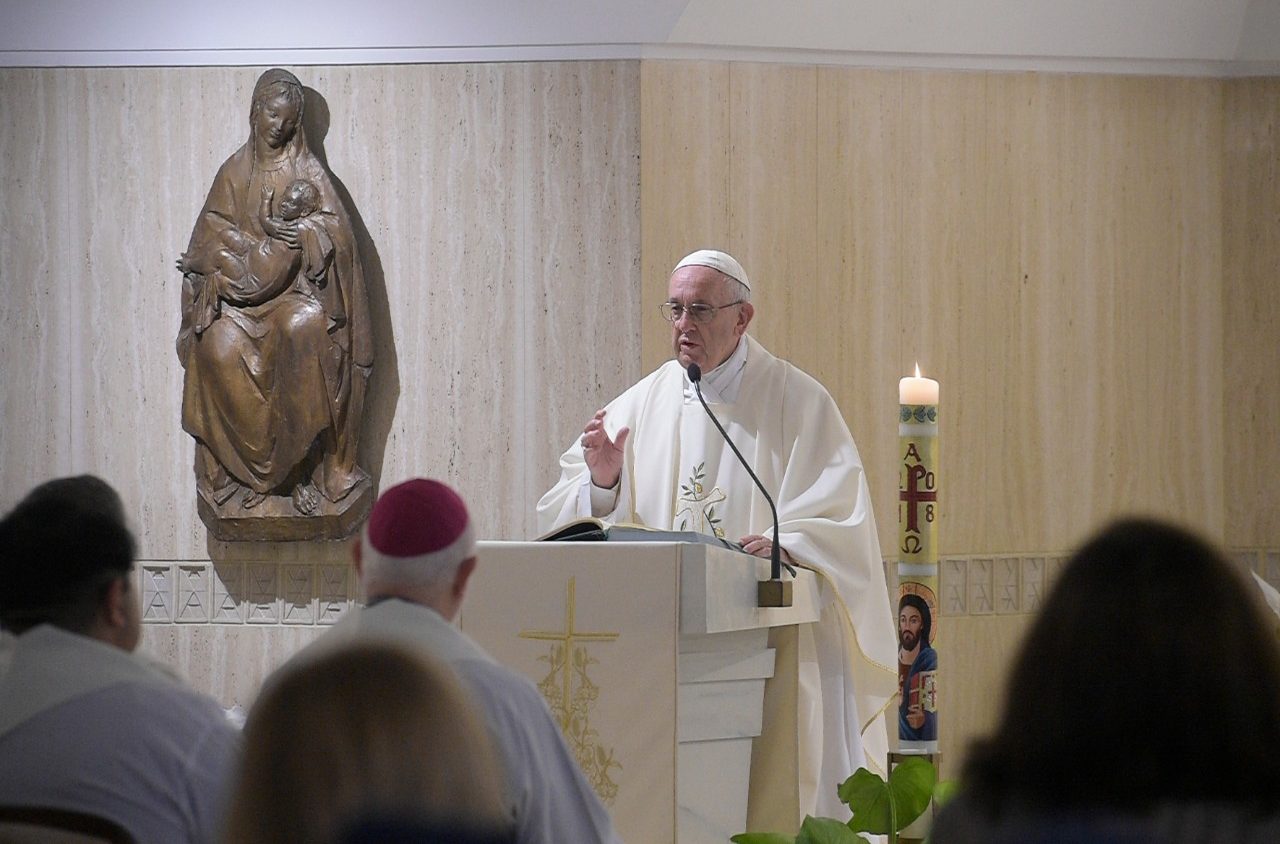
Thursday Morning Papal Homily

© Vatican Media

Pope: The Measure With Which You Measure Will Be Measured Out to You

At Morning Mass, Calls on Faithful to Take Stock of How They Live Their Lives & Treat Others

‘The measure with which you measure will be measured out to you…’
According to Vatican News, Pope Francis reflected on this quote from the Gospel of Mark during his daily morning Mass at Casa Santa Marta, today, Jan. 30, 2020.
Francis pointed out that in Chapter 25 of Matthew’s Gospel, the Apostle tells us “what we have to do,’ whereas today’s, tells us “the style with which we have to live.”
Yesterday, Pope Francis, at his weekly General Audience, began a new series of catecheses dedicated to the Beatitudes, and underscored, that living them out, brings true and great joy.
The Holy Father, in today’s homily, reminded that it is not as much what good and bad things we have done, but how we live and treat others, as well as the attitudes we have.
“By what measure do I measure others?” the Pontiff said we should be asking ourselves. “By what measure do I measure myself? Is it a generous measure, full of God’s love? Or is it a low level measure?”
Eventually, he reminded, God will judge us on the same criteria.
Those in life who “are capable of trampling on everyone’s head”, will be judged “without pity,” Pope Francis said.
For this reason, the Holy Father highlighted, we all must think of whether we have been living up to Jesus’ example and if we have been falling short, we must try to bridge the gap.
Pope Francis concluded, urging faithful to be compassionate and live “in a truly Christian way.”

Wednesday, January 29, 2020

Thursday Saint of the Day

St. Mutien-Marie Wiaux

Image of St. Mutien-Marie Wiaux


Christian Brother praised as a model teacher. He was born the son of a blacksmith in Mellet, Belgium, in 1841. Entering the Christian Brothers, he changed his baptismal name, Louis, to Mutien. In 1859 he was assigned to St. Bertuin's School in Maloone, where he taught for fifty-eight years. Mutien specialized in art and music. He was canonized in 1989 by Pope John Paul II.

Wednesday General Audience 01.29.2020


General Audience - Vatican Media

‘For Guaranteed Happiness? Consult & Live the Beatitudes,’ Pope Says at General Audience

Holy Father Says They Point Us Beyond Our Limitations & Tears Toward Paschal Joy in Christ

Guaaranteed happiness? Consylt often, and live out the Beatitudes…
Today, Pope Francis made this observation to faithful gathered at the General Audience, which took place this morning in the Vatican’s Paul VI Hall.
Francis started a new series of catechesis, following his last series on the Acts of the Apostles, on the Beatitudes in Matthew’s Gospel.
Jesus, the Holy Father underscored, does not impose them but instead proposes them as the path to true happiness in the future that God promises to his faithful people.
“It will do us good,” the Jesuit Pontiff encouraged, “to take Matthew’s Gospel today, Chapter Five, verses one to eleven and read the Beatitudes — perhaps once more during the week — to understand this very beautiful way, so certain of bringing happiness, which the Lord proposes to us.”
God, the Argentinian Pope recognized, often chooses unthinkable ways to give Himself to us, perhaps those of our limitations, of our tears, of our defeats. “The Beatitudes,” he reminded, “always lead us to joy; they are the way to attain joy.”
Christ’s teaching of these “new commandments” from a hillside, Francis says, resembles how Moses gave the Commandments on Mount Sinai.
They are, Francis repeated as he has underscored in the past, are an “identity card” for Christians.  They also, the Pontiff noted, explain that we are blessed not by our present situation, but rather by the new condition that is ours by God’s grace.
“This first sermon of Jesus thus presents eight ‘doors’ through which we can encounter the power of God’s love to transform our lives and history. The Beatitudes point us beyond our limitations, tears and failures towards that Paschal joy born of Christ’s own victorious passage from death to life.”
The Holy Father gave a special greeting to English-speaking pilgrims, reminding “upon all of you and your families, I invoke the joy and peace of our Lord Jesus,” he said.


Below is the Vatican-provided text of the Pope’s summary.


Speaker:
Today we begin a new series of catechesis on the Beatitudes in Matthew’s Gospel. Jesus’ teaching provides a kind of “identity card” for Christians. Like Moses on Sinai, Jesus gives these “new commandments” from a hillside. He does not impose them but instead proposes them as the path to true happiness in the future that God promises to his faithful people. Each Beatitude is composed of three parts: the opening word “Blessed”, followed by the situation in which those who are called blessed find themselves – poor in spirit, mourning, thirsting for justice – and finally the reason for which they are blessed. The Beatitudes teach that we are blessed not by our present situation, but rather by the new condition that is ours by God’s grace. This first sermon of Jesus thus presents eight “doors” through which we can encounter the power of God’s love to transform our lives and history. The Beatitudes point us beyond our limitations, tears and failures towards that Paschal joy born of Christ’s own victorious passage from death to life.
Speaker:
I greet the English-speaking pilgrims and visitors taking part in today’s Audience, especially the groups from the United States of America. Upon all of you and your families, I invoke the joy and peace of our Lord Jesus Christ. May God bless you!

Tuesday, January 28, 2020

Wednesday Saint of the Day

Bl. Boleslava Lament

Image of Bl. Boleslava Lament


Feastday: January 29
Birth: 1862
Death: 1946
Beatified: Pope John Paul II


Boleslava Lament, virgin, in the midst of political upheaval founded the Congregation of the Missionary Sisters of the Holy Family to promote Christian unity, help the poor and train the girls to Christian life.

Tuesday Morning Preaching with the Pope

© Vatican Media

Pope’s Morning Homily: Celebrate God’s Nearness & Be Joyous

Reminds That Being With the Lord & Remembering His Presence, Makes Us Happy & Fruitful

We are happy and fruitful, when we are truly ‘with’ God…
According to Vatican News, Pope Francis suggested this during his daily morning Mass at Casa Santa Marta, today, Jan. 28, as he reflected on today’s First Reading, which speaks of the joy with which David and all the people of Israel were celebrating the return of the Ark of the Covenant to Jerusalem following its capture.
The people felt that God was close to them and they celebrated, the Pope said, pointing out that King David was leading the procession. He also danced expressing his joy, like the others, without inhibitions.
“David loves the Lord, and he is happy and joyful to bring back the ark of the Lord with dancing and singing like all the people,” the Holy Father noted.
Never, Francis suggested to the faithful, be ashamed of expressing their joy of meeting God and feeling His closeness. Only evangelizers full of joy, the Pontiff said, will bring the Gospel forward.
The Pope pointed out that we also experience this joy and celebrate when “when we are with the Lord” in our parishes or villages.
Turning back to David’s story, the Pope said that one of his wives, Michal, Saul’s daughter, reproached him saying it was inappropriate that he was celebrating like the people. David, Francis recalled, explained to Michal that he was rejoicing in the Lord, as the ark was back home. Yet, Michal, the Pope remember, was punished for this and did not bear children.
“Without joy in the heart,” he said, “a Christian is not fruitful.”
In the Apostolic Exhortation Evangelii Nuntiandi of his predecessor, Saint Pope Paul VI said–Pope Francis cited–“the Gospel will not go forward with boring, bitter evangelizers.”
“It will only go forward,” he underscored, “with joyful evangelizers, full of life.”
Pope Francis concluded, urging faithful to live the joy of receiving the Word of God, “the joy of being Christians, the joy of going ahead, the ability to celebrate without being ashamed and not being like Michal, formal Christians, prisoners of formalities.”

Monday, January 27, 2020

The Angelic Doctor

St. Thomas Aquinas

Image of St. Thomas Aquinas
Thomas is believed to have been born in the castle of Roccasecca in the old county of the Kingdom of Sicily, which is now known as the Lazio region of Italy, in 1225. His parents were well-off, but as the youngest son Thomas was expected to enter the monastery.
At 5-years-old, Thomas began his education at Monte Cassino, where he remained until the military conflict between Emperor Frederick II and Pope Gregory IX reached the abbey. He was then transferred and enrolled at the studium generale in Naples.
It is believed that Thomas was introduced to his philosophical influences - Aristotle, Averroes, and Maimonides - at the university, where he also met John of St. Julian, a Dominican preacher, who influenced him to join the recently founded Dominican Order.
When Thomas' family learned of his decision, his mother Theodora arranged for him to be moved to Paris. When Thomas was travelling to Rome, his brothers captured him and returned him to their parents at the castle of Monte San Giovanni Campano.
Thomas was held captive in the castle for one year as his family tried to keep him from joining the Dominican Order. In the year he was held, Thomas tutored his sisters and communicated with members of the Dominican Order.

In an effort to change Thomas' mind, two of his brothers hired a prostitute to seduce him, but legends claim Thomas drove her off with a fire iron. That night, two angels appeared to him in a dream and strengthened his resolve to remain celibate.
When Theodora realized she could not sway her son, she tried to preserve the family name by arranging for his escape through a window. She believed a secret escape was better than appearing to accept his decision.
Following his escape in 1244, Thomas turned to Naples, then to Rome and met the Master General of the Dominical Order, Johannes von Wildeshausen.
The next year, Thomas went to study at the Faculty of the Arts at the University of Paris, where he is believed to have met Dominican scholar Albertus Mangus, the Chair of Theology at the College of St. James.
In 1248, Thomas chose to follow Mangus to the new studium generale at Cologne rather than accepting Pope Innocent IV's offer to appoint him abbot of Monte Cassino as a Dominican. Though Thomas hesitated, when they reached the university, Mangus appointed him magister studentium.
Thomas was quiet and seldom spoke at the university, leading other students to believe he was mentally delayed, but Mangus prophetically said, "You call him the dumb ox, but in his teaching, he will one day produce such a bellowing that it will be heard throughout the world."
Following the conclusion of his education, Thomas taught in Cologne as an apprentice professor and instructed students on the books of the Old Testament. It was during this time he wrote Expositio super Isaiam ad litteram, Postilla super Ieremiam, and Postilla super Threnos.
In 1252, Thomas returned to Paris to earn his master's degree in theology. As an apprentice professor, he lectured on the Bible and devoted his final three years of his education to Peter Lombard's Sentences.
Thomas composed a commentary on Sentences, titled Scriptum super libros Sententiarium and wrote De ente et essentia.
The spring of 1256 saw Thomas appointed regent master in theology at Paris, and one of his first works after assuming the office was Contra impugnantes Dei cultum et religionem, in defense of mendicant orders, which William of Saint-Amour had been attacking.
Between 1256 to 1259, Thomas spent his tenure writing several books, such as Questiones disputatae de veritate, Quaestiones quodlibetales, Expositio super librum Boethii De trinitate, and Expositio super librum Boethii De hebdomadibus. At the conclusion of his regency, Thomas was in the process of writing one of his most famous works, Summa contra Gentiles.


In 1259, Thomas completed his first regency and returned to Naples, where he was appointed general preacher. In September 1261, he was asked to lecture in Orvieto, and during his stay he finished Summa contra Gentiles, as well as Catena aurea, and Contra errores graecorum.
In 1265, Thomas was summoned to Rome to serve as the papal theologian and was later ordered by the Dominican Chapter of Agnani to teach at the studium conventuale, which was the first school to teach the full range of philosophical subjects of both moral and natural natures.
While teaching, Thomas wrote his most famous work, Summa theologiae, which he believed was particularly useful to beginning students "because a doctor of Catholic truth ought not only to teach the proficient, but to him pertains also to instruct beginners."
He continued to write and released several more books until 1268, when he was called to Paris for a second teaching regency. He was named regent master again and stayed until 1272. During this time, he wrote De virtutibus and De aeternitate mundi.
At the conclusion of his regency, the Dominicans called Thomas to establish a university wherever he wanted with a staff of whomever he wished. He established the university in Naples and took the regent master post. In 1273 Thomas was seen by the sacristan Domenic of Caserta to be crying and levitating in prayer before an icon of the crucified Christ at the Dominican convent of Naples, in the Chapel of Saint Nicholas.
During this prayer, Christ is said to have told him, "You have written well of me, Thomas. What reward would you have for your labor?"
Thomas replied, "Nothing but you, Lord."
Following this exchange, something happened but Thomas never wrote or spoke of it. He abandoned his routine and, when begged to return to work, replied, "I cannot, because all that I have written seems like straw to me."
In May of 1274, Thomas was called to the Second Council of Lyon, where his works for Pope Urban IV would be presented. While journeying to the meeting, Thomas hit his head on the branch of a fallen tree and fell ill. He was escorted to Monte Cassino to recover, then he set out again.
Unfortunately, he became ill once again and stopped at the Cistercian Fossanova Abbey, where the monks cared for him for several days.
He received his last rites and prayed, "I receive Thee, ransom of my soul. For love of Thee have I studied and kept vigil, toiled, preached and taught..."


Thomas died on March 7, 1274 during a commentary on the Song of Songs. Thomas' remains were placed in the Church of the Jacobins in Toulouse on January 28, 1369.
It is not known who beatified Thomas, but on July 18, 1323, Pope John XXII canonized him.
His original feast day was March 7, the day of his death, but because the date often falls within Lent, in 1969, a revision of the Roman Calendar changed his feast day to January 28, the date his relics were moved to Toulouse. Pope Pius V declared Saint Thomas a doctor of the church, saying Thomas was "the most brilliant light of the Church."
Saint Thomas' remains were moved to the Basilique de Sant-Sernin, Toulouse between 1789 and 1974. They were then returned to the Church of the Jacobins.
In the 16th century, the university in Paris, that Thomas often taught at, was renamed the College of Saint Thomas, and in the 20th century it was relocated to the convent of Saints Dominic and Sixtus before being transformed into the Pontifical University of Saint Thomas Aquinas.
Saint Thomas' comments and philosophical writings are still debated today, and his aesthetic theories, such as the concept of claritas, deeply influenced the literary writings of James Joyce and Italian semiotician Umberto Eco. Saint Thomas is often depicted with an open book or writing with a quill.

Important reminder for all especially Catholics; never stop praying for the dead and all souls in purgatory

My Dying Wish: Don’t Canonize Me at the Funeral


I’m not planning on dying any time soon. I’m nearly 53 years old, and life expectancy statistics tell me that I have at least another 20 to 25 years left on this Earth. And research shows that people of faith tend to be healthier and live longer than those who don’t — about seven years longer, in fact, according to one study. That’s not the reason why I believe, but it is a factor in my favor.
But just in case things don’t work out that way, there’s one temporal affair I’d like to set in order right now. It involves my interment rites.
Simply put, I don’t want to be canonized at my own wake or funeral Mass.
I’m putting it in writing now — no milquetoast platitudes about how “he’s in Heaven now” or “he’s in a better place.” This is a person’s soul we’re talking about — namely, mine — and it is not the time for such fluffy sentimentalities. This “eternal spiritual destination” stuff is far too serious business for that.
Nothing to the effect of “he’s in Heaven now” is to be said at my wake service; during the homily or any other part of the funeral; at any social gathering prior to my funeral or after it; or at any other time in the days, weeks, months, years, or even decades following my death. Unless there are miracles occurring that are clearly and undeniably occurring due to my intercession, or unless I undoubtedly died a martyr for the Faith, nobody knows that I’m Heaven.
Well-meaning but hasty thoughts about me being in Heaven are not going to help my soul in the slightest.  Instead, I’m asking now — and will repeat this plea as many times as I have to, until I die — that everyone who remembers me assume that I am in Purgatory.
And that means I will need prayers, and lots of them — not pronouncements of canonization, including ones that are meant to make me wife feel better, assuming that I “check out” before she does.
It’s a grave mistake to automatically assume that someone who’s died is definitely in Heaven now. That may seem unkind or heartless, but in fact, it’s uncharitable to assume that someone is already “set” eternally and that he doesn’t need our prayers anymore. That’s what “canonizing” someone by saying “he’s in Heaven” or “he’s in a better place” amounts to. It’s an act of concluding that we don’t need to pray for him.
What is Purgatory? The Catechism (no. 1030) explains it thus: “All who die in God’s grace and friendship, but still imperfectly purified, are indeed assured of their eternal salvation; but after death they undergo purification, so as to achieve the holiness necessary to enter the joy of heaven.” It goes on to say that Purgatory’s purpose is the “final purification of the elect, which is entirely different from the punishment of the damned” (CCC 1031).
Every soul in Purgatory will be admitted to Heaven eventually — with the help of us Catholics here on Earth, which is why the Church has always stressed “the practice of prayer for the dead, already mentioned in Sacred Scripture” and calls for “almsgiving, indulgences, and works of penance undertaken on behalf of the dead” (CCC 1032).
Is praying for the dead still a priority in modern Catholicism? Do we Catholics as a group even believe very strongly, or at all, in Purgatory anymore? The answer to both questions seems to be “not really,” given the frequent habit of “canonizing” those who have died at their own funeral Masses, with the aforementioned “he is in Heaven now” declarations and the constant “better place” references.
Do we think it’s just too unpleasant for many of us to imagine that our relatives, friends, and loved ones are suffering in Purgatory? We shouldn’t think that way; instead, we should look at the bright side. Purgatory isn’t a pleasant place, but it sure beats being in Hell — which is not only far more unpleasant, but is, unlike Purgatory, also eternal. And the suffering that exists in Purgatory has a purifying point to it, one from which God draws goodness and beauty. Not to mention our salvation.
One priest, in a funeral homily, analogized Purgatory to mining for precious metals. Only with a furnace can gold or diamonds be separated from the useless ore in which they’re found so that they can be made perfect and pure. Without the furnace, the metals couldn’t be made precious; likewise, without Purgatory, it can be reasonably argued that few of our souls could be admitted to Heaven, where Scripture tells us nothing unclean is allowed (Revelation 21:27).
Think about it: if we die with no mortal sins on our souls, and even if we’ve made the best confession possible right before death, how many of us would be so free from the effects of or attachments to sin that our souls would meet Revelation 21:27’s requirements? It’s reasonable to believe that not many of us would qualify. Even the non-Catholic 18th-century literary luminary Samuel Johnson, “arguably the most distinguished man of letters in English history,” saw this: asked about the Catholic belief in Purgatory, Johnson said, “It is a very harmless doctrine. They [Catholics] are of opinion that the generality of mankind are neither so obstinately wicked as to deserve everlasting punishment, nor so good as to merit being admitted into the society of blessed spirits; and therefore that God is graciously pleased to allow of a middle state, where they may be purified by certain degrees of suffering.”
So there it is — Purgatory, not Heaven, is what we should be thinking about first when someone we know passes away, even a close family member or friend, because there’s every good chance that his soul will be in need of purification there. Just as we should not implode an old building until we know absolutely that no one is inside, we should err on the side of caution when we are not sure that someone who has died is in Heaven. Souls in Heaven don’t need our prayers, but those in Purgatory do, and that’s where we must presume a departed soul is — again, absent a clear-cut case of martyrdom for the Faith or miracles due to the person’s intercession.
So when I die, please pray for me — don’t canonize me. Do I hope to go straight to Heaven after my time on Earth runs out? Of course I do, but unless they know for sure that I have, I hope people don’t bet on it. That’s why I offer each of the individual prayers in my rosary for one soul in Purgatory. I ask that others pay it forward after I die — or in this case, maybe I should say pay it backward — by assuming the very real possibility of my being in Purgatory, and thus praying for my soul’s release into the eternal glory of God’s Presence.