Dallas beat the Saints in everyway possible tonight; they were more physical, tougher and so much more determined tonight to win. As good as Dallas was, the Saints were that bad. No one is immune. The offense line got it's ass kicked. Drew Brees; worst game in years, looked scared. The great running backs; they did nothing. Receivers not much better. Hey, where was Ben Watson tonight? Never heard his name. Defensively, better than the offense but spotting the Cowboys a 10-0 lead was just enough to pour gas on the fire. And what about tackling; tonight they suffered numerous broken tackles. Eli Apple looked like crap and Lattimore must have spent the offseason reading his press clippings. He has become very average in 2018.
Pure out physical toughness caught the Saints on a bad night and cost them dearly. But wait, are not the Saints a great 10-2 and up by 3+ games in the south? Yep. all true. But the Rams have a much more favorable schedule than the Saints.
So what do you do now. Well hopefully, you pull your head out of your butt and regroup to show some character and power the rest of the way. Next week it's the Buccaneers who beat us up in week 1. Will we return the favor? We should. Then we have 2 out of 3 with Carolina; we best win at least one of those or this magical season could potentially not be so magical. In between the Panthers is the very good Pittsburgh Steelers.
Here is the deal; the Saints should, I stress should, easily go 2-2 and possibly 3-1 down the road. And sadly, that might not be enough. The Rams indeed have the goods to finish 15-1 or 14-2. The Saints already have 2 losses; I doubt they sweep the final 4. However, I do have confidence, based off the balance of the season, that these Saints can finish 13-3 and that is a great year. But then we look up at the Rams.
I can sum it up so simply: 10-2, their record tonight, never felt so bad!
Thursday, November 29, 2018

Feast Day of an Apostle
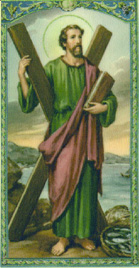
St. Andrew, also known as Andrew the Apostle, was a Christian Apostle and the older brother to St. Peter.
According to the New Testament, Andrew was born in the village of Bethsaida on the Sea of Galilee during the early first century. Much like his younger brother, Simon Peter, Andrew was also a fisherman. Andrew's very name means strong and he was known for having good social skills.
In the Gospel of Matthew, it is said Jesus was walking along the shore of the Sea of Galilee and saw Andrew and Simon Peter fishing. It is then he asked the two to become disciples and "fishers of men."
In the Gospel of Luke, Andrew is not initially named. It describes Jesus using a boat, believed to be solely Simon's, to preach to the multitudes and catch a large amount of fish on a night that originally was dry. Later, in Luke 5:7, it mentions Simon was not the only fisherman on the boat, but it is not until Luke 6:14 that there is talk of Andrew being Simon Peter's brother.
However, the Gospel of John tells a separate story, stating Andrew was a disciple of John the Baptist. When Jesus walked by one day, John the Baptist stated, "Behold, the Lamb of God!" It is then that Andrew and another made the decision to follow Jesus.
Little else is said about Andrew in the Gospels, but it is believed Andrew was one of the closer disciples to Jesus. It was he who told Jesus about the boy with the loaves and fishes, according to John 6:8. When Philip wanted to speak to Jesus about Greeks seeking him, he spoke to Andrew first. Andrew was also present at the last supper.
Per Christian tradition, Andrew went on to preach the Good News around the shores of the Black Sea and throughout what is now Greece and Turkey. Andrew was martyred by crucifixion in Patras. He was bound, rather than nailed, to a cross, as is described in the Acts of Andrew. He was crucified on a cross form known as "crux decussata," which is an X-shaped cross or a "saltire." Today this is commonly referred to as "St. Andrew's Cross." It is believed Andrew requested to be crucified this way, because he deemed himself "unworthy to be crucified on the same type of cross as Jesus."
Andrew's remains were originally preserved at Patras. However, some believe St. Regulus, who was a monk at Patras, received a vision telling him to hide some of Andrew's bones. Shortly after Regulus' dream, many of Andrew's relics were transferred to Constantinople by order of Roman emperor Constantius II around 357. Regulus later received orders in a second dream telling him to take the bones "to the ends of the earth." He was to build a shrine for them wherever he shipwrecked. He landed on the coat of Fife, Scotland.
In September 1964, Pope Paul VI had all of St. Andrew's relics that ended up in Vatican City sent back to Patras. Now, many of Andrew's relics and the cross on which he was martyred are kept in the Church of St. Andrew in Patras.
St. Andrew is venerated in Georgia as the first preacher of Christianity in that territory and in Cyprus for having struck the rocks creating a gush of healing waters upon landing on the shore.
His saltire cross is featured on the flag of Scotland and is represented in much of his iconography. He is commonly portrayed as an old man with long white hair and a beard, often holding the Gospel book or a scroll.
St. Andrew is the patron saint of fishermen and singers. He is also the patron saint to several countries and cities including: Scotland, Romania, Russia, Ukraine and Patras and his feast day is celebrated on November 30.
Papal morning homily: against paganization

© Vatican Media
Santa Marta: Pope Warns Against the ‘Paganization’ of Christian Life
Live the World’s Trials in Hope
During the Mass in the chapel of Casa Santa Marta on November 29, 2018, Pope Francis warned against the “paganizaiton” of Christian life.
In his homily, reported by Vatican News, the Holy Father commented on the First Reading (Revelation 18:1-2.21-23; 19:1-3.9a) on the destruction of Babylon, city “of luxury, of self-sufficiency, of the power of this world,” “dwelling place of demons, haunt of all impure spirits”; and the Gospel (Luke 21:20-28) of the devastation of Jerusalem, the Holy City.
“The sound of the players of zithers and of musicians, of flute and trumpet players, shall be heard in thee no more,” quoted the Pontiff. There will no longer be beautiful celebrations, no . . . “craftsman of any craft shall be found in thee no more . . . because you are not a city of work but of corruption — and the sound of the millstone shall be heard in thee no more; and the light of a lamp shall shine in thee no more — it will be, perhaps, an enlightened city, but without light, not luminous; it is a corrupted civilization – the voice of the bridegroom and bride shall be heard in thee no more. There are numerous couples, numerous persons, but there is no longer love.”
“This destruction begins in the interior and ends when the Lord says: ‘That’s enough.” There will come a day when the Lord will say: ‘Enough of this world’s appearances.’ It’s the crisis of a civilization that believes itself proud, sufficient, dictatorial and which ends thus,” explained the Holy Father.
The ruin of Jerusalem, in revenge, is due to “the corruption and infidelity to love; it was not able to recognize the love of God in His Son.” The Holy City “will be trampled by the pagans,” noted Pope Francis
And it is too denounce “the paganization of life, in our case, of the Christian life.” “Do we live as Christians? It seems we do, but in reality our life is pagan . . . when one enters in Babylon’s seduction, and Jerusalem lives like Babylon. There is a wish to do a synthesis that cannot be done. And both will be condemned. Are you a Christian? Do you live like a Christian? Water and oil can’t be mixed; they are always different. It’s the end of a contradictory civilization, which says it’s Christian but which lives as a pagan.”
“There are tragedies, also in our life but in face of them, it’s necessary to look at the horizon, because we have been saved and the Lord will come to save us. And this teaches us to live the world’s trials not in a pact with worldliness or with paganism, which leads us to destruction, but in hope, detaching ourselves from this worldly and pagan seduction and looking at the horizon, while waiting for Christ, the Lord. Hope is our strength: let us go on, but we must ask this of the Holy Spirit,” continued the Pontiff.
By way of conclusion, Pope Francis invited to think of present-day Babylons. “Today’s great cities will end thus and so will our life, if we continue to lead it on the path of paganism. Let us open our heart with hope and move away from the paganization of Christian life.”
A great "shout out" to Permanent Deacons from the Archdiocese of Atlanta


Deacons often take on roles outside their own parishes. In this 2016 file photo, Deacon Michael Bickerstaff of St. Peter Chanel Church, Roswell, conducts a session on church history during a Friday morning Bible study class for a group of senior residents at neighboring St. George Village. Photo By Michael Alexander
Atlanta
Celebrating deacons: Servants drawn to the ministry of Charity and Word
By NICHOLE GOLDEN, Staff Writer | Published November 21, 2018
ATLANTA—This year marks the 50th anniversary of the renewal of the permanent diaconate in the United States.
The bishops of the Second Vatican Council (1962-1965) voted to affirm the diaconate as noted in several Council documents to complete the sacramental character of the Church. In 1968, bishops in the U.S. were given permission to renew the permanent Order of Deacons by St. Pope Paul VI.
In a September letter to pastors in the Archdiocese of Atlanta, Archbishop Wilton D. Gregory, urged parishes to celebrate the anniversary of the restoration of the permanent diaconate.
“As you know, we are richly blessed by the steadfast service of over 250 permanent deacons in our local church,” wrote Archbishop Gregory. “Their work supports the pastoral efforts of you as pastors, me as archbishop, and the good people that all of us are ordained to serve.”

Deacon Chester Griffin of Our Lady of Lourdes Church, Atlanta, was ordained by the late Archbishop John F. Donoghue on Feb. 8, 2003. This year marks the 50th anniversary in which St. Pope Paul VI called for the reinstitution of the permanent diaconate “as an active, permanent order of ministry.” Photo By Michael Alexander
The archbishop encouraged parishes to set aside time on Sunday, Nov. 25, the Feast of Christ the King, to celebrate the ministry of deacons at the parish level and thanked deacons publicly for “their responding to the call to serve the lord and His Church in the ministry of Charity and Word.”
Deacons have existed in the church since the earliest days of Christianity. According to the National Association of Diaconate Directors (NADD), the roles of deacons evolved and were diminished to the point that the diaconate became only a stepping stone toward priesthood (transitional deacon).
At the Council of Trent (1545-1563), there was interest in restoring a permanent diaconate, but no action was taken. Interest was revived in the 1900s with theologians recognizing the need for deacons to help spread the ministry of the church into the world.
A 2015 study by the Center for Applied Research in the Apostolate at Georgetown University indicates that there are over 18,500 permanent deacons in the United States today, accounting for more than half of the world’s 30,000 deacons.
Deacon Dennis Dorner, director of the permanent diaconate in the Archdiocese of Atlanta, said there is something special about the inclusion of the full experience of Holy Orders when deacons are included in the church’s liturgies and ceremonies.
“The deacon has a unique role, as do the bishops and priests. These roles are complementary,” explained Deacon Dorner. “The reality of the deacon being both clergy and yet living and working in the secular world allows us to be a bridge between the two. The deacon is often referred to as the ‘Icon of Jesus the Servant’ and our diaconal role is just that, in service to the entire church.”
He said the fact that most deacons are married with families also brings added dimensions to the role as ordained clergy, enhancing connection to the people served.
Thursday Saint of the Day
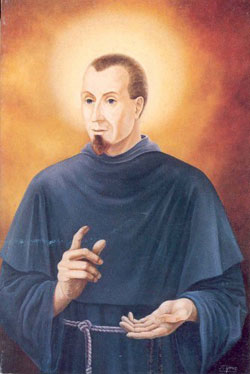
St. Francis Fasani
Facts
Franciscan mystic, born Antony Fasani in 1681. He entered the Franciscans and was ordained in 1775. While serving as provincial and in other administrative positions, he was known for prayer and for supernatural gifts. Francis was canonized in 1986.
Wednesday, November 28, 2018
Wednesday Papal General Audience 11.28.2018
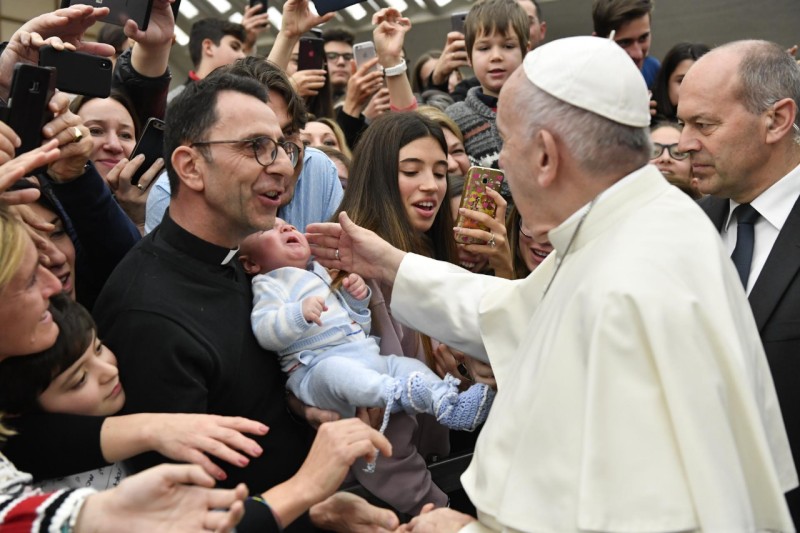
© Vatican Media
General Audience: Pope Concludes Series on Ten Commandments
‘The new law in Christ and desires according to the Spirit’
The Holy Father’s November 28, 2018, General Audience was held in Paul VI Hall, where Pope Francis met with groups of pilgrims and faithful from Italy and from all over the world.
Concluding the series of catecheses on the Ten Commandments, in his address in Italian the Pope focused his meditation on the theme: “The new law in Christ and desires according to the Spirit” (Biblical passage: From Saint Paul the Apostle’s Letter to the Galatians, 5:16-18. 22-23).
After summarizing his catechesis in several languages, the Holy Father expressed special greetings to groups of faithful present.
The General Audience ended with the singing of the Pater Noster and the Apostolic Blessing.
* * *
The Holy Father’s Catechesis
Dear Brothers and Sisters, good morning!
In today’s catechesis, which concludes the course on the Ten Commandments, we can use as the key theme that of desires, which enables us to go over the journey made and summarize the stages accomplished reading the Decalogue’s text, always in the light of the full revelation in Christ.
We began with gratitude as the basis of the relationship of trust and obedience: we saw that God does not ask for anything before having given much more. He invites us to obedience to rescue us from the deceit of the idolatries that have so much power over us. In fact, to seek one’s fulfillment in the idols of this world empties us and enslaves us, whereas what gives stature and consistency is the relationship with Him, who renders us children in Christ beginning by His paternity (Cf. Ephesians 3: 14-16). This implies a process of blessing and liberation, which is true, genuine rest. As the Psalm says: “For God alone, my soul waits in silence; from Him comes my salvation” (Psalm 62:2).
This liberated life becomes the acceptance of our personal story and reconciles us with what we have lived from childhood to the present, making us adults and capable of giving the right weight to the realities and persons of our life. By this path, we enter in the relationship with our neighbor that, beginning from the love that God shows in Jesus Christ, is a call to the beauty of fidelity, of generosity and of authenticity.
 However, to live thus — namely in the beauty of fidelity, of generosity and of authenticity — we are in need of a new heart, inhabited by the Holy Spirit (Cf. Ezekiel 11: 19; 36:26)). I ask myself: how does this “transplant” of the heart happen, from the old heart to the new heart? It happens through the gift of new desires (Cf. Romans 8:6); which are sown in us by the grace of God, particularly through the Ten Commandments, brought to fulfilment by Jesus, as He teaches in the “discourse of the mountain” (Cf. Matthew 5:17-48). In fact, in the contemplation of the life described by the Decalogue, which is a grateful, free, genuine, benedictory, adult existence, custodian and lover of life, faithful, generous and sincere we, find ourselves, almost without realizing it, before Christ. The Decalogue is His “X-ray,” He describes it as a photographic negative that lets His face appear — as in the Holy Shroud. And so the Holy Spirit fertilizes our heart, putting in it desires that are a gift of His, desires of the Spirit. To desire according to the Spirit, to desire to the rhythm of the Spirit, to desire with the music of the Spirit. Looking at Christ we see the beauty, the good, the truth. And the Spirit generates a life that, seconding these desires of His, triggers in us hope, faith and love.
So we discover better what it means that the Lord Jesus didn’t come to abolish the Law but to bring it to fulfillment, to make it grow, and whereas the Law according to the flesh was a series of prescriptions and prohibitions, according to the Spirit this same Law becomes life (Cf. John 6:63; Ephesians 2:15), because it’s no longer a norm but the very flesh of Christ, who loves us, seeks us, forgives us, consoles us and, in His Body, recomposes communion with the Father, lost by the disobedience of sin. And thus the literal negativity, the negativity in the expression of the Commandments — “do not steal,” “do not insult,” “do not kill” — that “not” is transformed into a positive attitude: to love, to make room in my heart for others, all desires that sow positivity. And this is the fullness of the Law that Jesus came to bring us.
In Christ, and only in Him, the Decalogue stops being condemnation (Cf. Romans 8:1) and becomes the authentic truth of human life, namely, desire of love — born here is the desire of the good, to do good — desire of joy, desire of peace, of magnanimity, of benevolence, of goodness, of fidelity, of meekness, of self-mastery. From that “no” one passes to this “yes”: the positive attitude of a heart that opens with the strength of the Holy Spirit.
 See why it is useful to seek Christ in the Decalogue: to fertilize our heart so that it’s fraught with love, and opens itself to God’s work. When man seconds the desire to live according to Christ, then he is opening the door to salvation, which cannot but arrive, because God the Father is generous and, as the Catechism says, “God thirsts that we may thirst for Him” (n. 2560).
If there are evil desires that ruin man (Cf. Matthew 15:18-20), the Spirit deposits in our heart His holy desires, which are the germ of the new life (Cf. 1 John 3:9). The new life, in fact, isn’t a titanic effort to be consistent with a norm, but the new life is the Spirit of God Himself who begins to guide us to its fruits, in a happy synergy between our joy of being loved and His joy of loving us. The two joys meet: God’s joy in loving us and our joy in being loved. See what the Decalogue is for us Christians: to contemplate Christ to open ourselves to receive His heart, to receive His desires, to receive His Holy Spirit.
© Libreria Editrice Vatican
[Original text: Italian] [ZENIT’s translation by Virginia M. Forrester]
In Italian
A warm welcome goes to the Priests of the Sacred Heart of Jesus-Dehonians; the Priests taking part in the “Project According to the Announcement,” with the Bishop of Albano, Monsignor Marcello Semeraro and the members of the Claretian Family.
I greet the parishes, especially those of Canosa di Puglia and of Barletta; the Multiple Sclerosis Italian Association; the New Facility Group of Treviso; the New Special Talents Association of Verona and the Association for the Fight against Beast Tumours.
A particular thought goes to young people, the elderly, the sick and newlyweds.
Next Sunday we will begin the liturgical season of Advent. Let us prepare our hearts to receive Jesus the Saviour; we acknowledge in Christmas Christ’s encounter with humanity, especially that humanity that still today lives on the margins of society, in need and in suffering.
Subscribe to:
Posts (Atom)