Wednesday, October 31, 2018

The Wednesday Papal General Audience of 10.31.2018

Pope at General Audience: We Are to Live Fully Our Original Calling to That Pure & Faithful Spousal Love Revealed in Jesus Christ’

‘As men and women, body and spirit, we are called to love in ways that leave no room for lust or promiscuity’

Here is the Vatican-provided English-language summary of the Pope’s address at the General Audience this morning:
***
Speaker: Dear brothers and sisters: In our continuing catechesis on the Ten Commandments, we are discussing the sixth commandment: “You shall not commit adultery”. The commandment deals specifically with marital fidelity, yet it also speaks to every human relationship and vocation. In the light of Christ, we see that all love is meant to be pure, faithful, generous and fruitful. True love enables us to find ourselves by giving ourselves away. Hence, authentic love is always spousal, life-giving and self-sacrificing. The undying love of Christ that is the basis of marital fidelity is likewise reflected in the spousal love and spiritual parenthood that mark the vocations to priestly ministry and consecrated virginity. In the mystery of Christ and his love, we come to understand the full meaning of the gift of our human sexuality and the fidelity demanded by the marriage covenant. As men and women, body and spirit, we are called to love in ways that leave no room for lust or promiscuity. The command – “You shall not commit adultery” – is thus an invitation to live fully our original calling to that pure and faithful spousal love revealed in Jesus Christ.

Tuesday, October 30, 2018

Pope Francis November Prayer Intention and a reflection

Pope’s November Prayer Intention: In the Service of Peace

That the language of love and dialogue may always prevail over the language of conflict.

Pope Francis’ November 2018 prayer intention is “In the Service of Peace: That the language of love and dialogue may always prevail over the language of conflict.”
Pope Francis’ prayer intention is promoted throughout the world by the Pope’s Worldwide Prayer Network.  
The Prayer Network offers a reflection to accompany the monthly intention. This month’s reflection is given by Deacon Ted Penton. Born and raised in Ottawa, Canada, Ted Penton, SJ first met the Society of Jesus when he served in the Jesuit Volunteer Corps, working at Legal Aid of North Carolina. He went on to become a lawyer, and after working two years at the Department of Justice, entered the Jesuits. Ted currently serves as the Secretary of the Office of Justice and Ecology of the Jesuit Conference of Canada and the United States and will be ordained a priest in May 2019.
We live in a world of much violence—wars around the world, in our communities, and even in our homes. Seeing and experiencing this violence provokes fear and anger within us, often tempting us to respond with more violence. But this isn’t God’s answer to violence. We find God’s answer on the cross. Jesus didn’t allow Peter to defend him from an arrest by use of the sword. Nor did he call down legions of angels to save him from the Romans who tortured and executed him. Instead, he submitted to death on the cross. In some mysterious way, the Father used the death and resurrection of his Son for far greater purposes than any of his followers could have imagined. As Pope Francis eloquently stated, “In the silence of the cross, the uproar of weapons ceases and the language of reconciliation, forgiveness, dialogue, and peace is spoken.”
The words we use matter and can move us towards greater peace, or towards more conflict. Our words are an expression of who we are, just as Jesus Himself, the Word made flesh, is the incarnate expression of who the Father is. When our words are hostile and aim to put others down, we aren’t imitating Jesus, and reconciliation becomes impossible. When instead we use the language of love and peace, this enables us to enter into dialogue with others, even with those who are very different from us. Through that dialogue we begin to better understand one another, enabling us to follow Jesus in building a more peaceful world.

The Halloween Saint


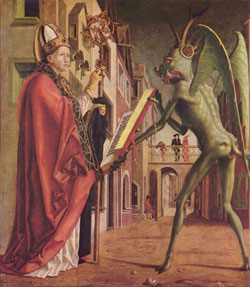
St. Wolfgang


Image of St. Wolfgang

Facts

Feastday: October 31
Death: 994

Wolfgang (d. 994) + Bishop and reformer. Born in Swabia, Germany, he studied at Reichenau under the Benedictines and at Wurzburg before serving as a teacher in the cathedral school of Trier. He soon entered the Benedictines at Einsiedeln (964) and was appointed head of the monastery school, receiving ordination in 971. He then set out with a group of monks to preach among the Magyars of Hungary, but the following year (972) was named bishop of Regensburg by Emperor Otto II (r. 973-983). As bishop, he distinguished himself brilliantly for his reforming zeal and his skills as a statesman. He brought the clergy of the diocese into his reforms, restored monasteries, promoted education, preached enthusiastically, and was renowned for his charity and aid to the poor, receiving the title Eleemosynarius Major (Grand Almoner). He also served as tutor to Emperor Henry II (r. 1014-1024) while he was still king. Wolfgang died at Puppingen near Linz, Austria. He was canonized in 1052 by Pope St. Leo IX (r. 1049-1054). Feast day: October 31.

Monday, October 29, 2018

Tuesday Saint of the Day

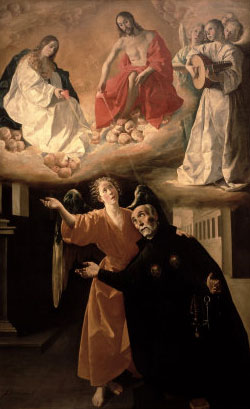
St Alphonsus Rodriguez


Image of St. Alphonsus Rodriguez

Facts

Feastday: October 30
Birth: 1532
Death: 1617


Confessor and Jay brother, also called Alonso. He was born in Segovia, Spain, on July 25, 1532, the son of a wealthy merchant, and was prepared for First Communion by Blessed Peter Favre, a friend of Alphonsus' father. While studying with the Jesuits at Alcala, Alphonsus had to return home when his father died. In Segovia he took over the family business, was married, and had a son. That son died, as did two other children and then his wife. Alphonsus sold his business and applied to the Jesuits. His lack of education and his poor health, undermined by his austerities, made him less than desirable as a candidate for the religious life, but he was accepted as a lay brother by the Jesuits on January 31, 1571. He underwent novitiate training and was sent to Montesion College on the island of Majorca. There he labored as a hall porter for twenty-four years. Overlooked by some of the Jesuits in the house, Alphonsus exerted a wondrous influence on many. Not only the young students, such as St. Peter Claver, but local civic tad and social leaders came to his porter's lodge for advice tad and direction. Obedience and penance were the hallmarks of his life, as well as his devotion to the Immaculate Conception. He experienced many spiritual consolations, and he wrote religious treatises, very simple in style but sound in doctrine. Alphonsus died after a long illness on October 31, 1617, and his funeral was attended by Church and government leaders. He was declared Venerable in 1626, and was named a patron of Majorca in 1633. Alphonsus was beatified in 1825 and canonized in September 1888 with St. Peter Claver.

No words, just sad

Ousted New Orleans deacon George Brignac sued and accused of sexually assaulting another altar boy

The sixth annual St. Joseph's Altar at the St. Joseph Hospice in Harahan is blessed by George Brignac on March 14, 2008. In the original caption of this photo, Brignac was referred to as 'deacon,' a title the Archdiocese of New Orleans says he should not have held at the time because, by then, he had been removed from the diaconate ministry following allegations of sexual abuse of children. Brignac has never been convicted of those charges.
The sixth annual St. Joseph's Altar at the St. Joseph Hospice in Harahan is blessed by George Brignac on March 14, 2008. In the original caption of this photo, Brignac was referred to as 'deacon,' a title the Archdiocese of New Orleans says he should not have held at the time because, by then, he had been removed from the diaconate ministry following allegations of sexual abuse of children. Brignac has never been convicted of those charges. (Donald Stout, The Times-Picayune)
0 shares

Ex-deacon George Brignac, who was accused decades ago of raping an altar boy at the Holy Rosary School in a case that led to a more than $500,000 settlement from the Archdiocese of New Orleans, has been named in another lawsuit filed Monday (Oct. 29) that alleges he sexually molested another altar boy at the same school between 1977 and 1982.
The 17-page suit, filed in Orleans Parish Civil District Court, claims that Brignac sexually assaulted the unnamed plaintiff, who was between the ages of eight and 13 when the instances occurred, on multiple occasions while teaching at the Holy Rosary School in New Orleans.
The suit says Brignac began at the school on Esplanade Avenue in New Orleans after being acquitted on charges in Jefferson Parish that he abused a child at St. Matthew School in River Ridge. The Archdiocese paid out more than half a million dollars May 11 to settle a lawsuit in connection with the St. Matthew incident in the 1970s and ’80s, a settlement first reported by the New Orleans Advocate.
Archdiocese of N.O. pays over $500K to settle child rape accusations against deacon: report

The lawsuit argues “the Archdiocese took no steps to protect the children” at either school. The New Orleans Police Department is now investigating the Holy Rosary allegations of the other former altar boy.
Following allegations that he molested a 7-year-old boy, Brignac was defrocked and removed from the ordained ministry in 1988, but allowed to still serve as a lector at the St. Mary Magdalen church in Metairie. Archbishop Gregory Aymond issued a statement in July saying Brignac should not have been allowed to perform lector duties.
In interviews with The Advocate, Brignac, now 83, did not deny touching children but said his actions had “no sexual motive.”
A spokesperson said Monday the archdiocese had not yet been served with the lawsuit.
Brignac met the plaintiff in Monday’s suit in 1977, when the boy was in third grade and serving as an altar boy. According to the lawsuit, Brignac immediately began “grooming” the boy for further abuse by “hugging and kissing him on the head, face and lips.” John Doe’s father abandoned his family a year later and the lawsuit alleges Brignac “used this vacancy to take full advantage of John Doe’s vulnerability.” Brignac then began fondling John Doe under his cassock as they were alone and preparing for morning Mass, according to the lawsuit.
Ousted Catholic deacon accused of sexual misconduct continued serving 'for several years' as lector

Countless acts of abuse followed, including one that occurred in 1981 when Brignac took a group of altar boys to a local water park. When dropping off the plaintiff at his home, Brignac parked in from of the house, pulled down the boy’s swimming trunks and assaulted him, the lawsuit says.
Brignac warned the boy that he would get in trouble if he reported the inappropriate behavior, the suit says. The boy remained silent for years “out of fear and embarrassment,” according to the suit.
Attorneys Benjamin Sanders, Matthew Fransen, John Denenea and Richard Trahant make up the plaintiff’s legal team.
The plaintiff argues that the church treated claims against Brignac with negligence and fraudulence and granted him a “favored position” despite the allegations because his twin brother is a longtime priest assigned to several parishes within the Archdiocese of New Orleans.
The plaintiff also contends he is owed an unspecified amount of damages from Brignac and the archdiocese, saying the abuse caused “severe and permanent emotional distress, nervousness and anxiety, sleeplessness, depression, crying spells” and suicidal thoughts.
Louisiana’s statutes of limitation for civil child sexual abuse cases could prevent the plaintiff from seeking damages for actions dating back decades. But attorneys could argue that the limitations do not apply if there were recent efforts to cover up actions prompting lawsuits.
At least 10 other men also accused Brignac of abusing or raping them when they were children, according to a report by the Advocate.