Tuesday, July 31, 2018

Tomorrow it's August; here is the monthly prayer intention of Pope Francis

August


Universal – The Treasure of Families

That any far-reaching decisions of economists and politicians may protect the family as one of the treasures of humanity.

Amen.

Monday, July 30, 2018

Almost missed this; today was the 1st feast day of Blessed Solanus Casey, beatified in 2017

Monday, July 30


Blessed Solanus Casey


“Blessed Be God in All of His Designs.”


SOLANUS CASEY

Share


Capuchin Franciscan Priest (1870-1957)
His life
+ Bernard Francis (“Barney”) Casey was born in Oak Grove, Wisconsin. to Irish immigrants.
+ After school, Barney left the family farm to take various jobs in Minnesota, including working as a prison guard and street car operator. At this time, he considered marriage and even proposed to a girl, but the marriage wasn’t to be.
+ After witnessing a murder, Barney re-evaluated his life and its trajectory. This led him to consider the priesthood. He enrolled in the minor seminary of the Archdiocese of Milwaukee, hoping to become a diocesan priest. However, classes were taught in German and Latin (neither of which he knew how to speak) and he struggled in his studies. The seminary officials encouraged him to enter a religious community, if he wanted to become a priest.
+ In 1897, he entered the Capuchin Franciscans in Detroit and received the religious name “Solanus.” He was ordained in Milwaukee in 1904 but, because of his poor academic performance, he was ordained as a “simplex priest,” meaning that he could only celebrate Mass but would not be granted faculties to hear confessions or to preach in public.
+ Father Solanus served in various friaries in New York before being assigned to St. Bonaventure’s Monastery in Detroit in 1924. He served as porter for the community until 1945, also leading prayer services for the sick. It was during this time that he developed a reputation for his hospitality and care for the poor and people spoke of miraculous cures which they attributed to his prayers.
+ Solanus loved to play the violin and sing Irish songs, but he wasn’t a particularly gifted musician and he would often taken his violin to the chapel to play before the Blessed Sacrament, much to the relief of the friars who didn’t particularly appreciate his efforts.
+ In 1946, Solanus was transferred to the friars’ novitiate in Huntington, Indiana. He was suffering from ill health and was eventually sent back to Detroit in 1956. His health continued to decline until his death on July 31, 1957. More than 20,000 filed past his coffin in the days before his funeral.
+ Blessed Solanus Casey was beatified in 2017.
For reflection
How merciful is the Good God in making us dependent upon another.”—Blessed Solanus Casey
Prayer
God, who in your providence conformed Blessed Solanus Casey to the image of your Son making him tireless in service to the poor, by his intercession and example, grant also to us the same generosity and joy in giving of ourselves in service to our neighbor. Through our Lord Jesus Christ, your Son, who lives and reigns with you in the unity of the Holy Spirit, one God, for ever and ever. Amen.

From soldier to Saint

St Ignatius of Loyola


Image of St. Ignatius Loyola

Facts

Feastday: July 31
Patron Dioceses of San Sebastian and Bilbao, Biscay & Gipuzkoa, Basque Country, Military Ordinariate of the Philippines, Society of Jesus, soldiers, Educators and Education.
Birth: 1491
Death: 1556
Beatified By: July 27, 1609 by Paul V
Canonized By: March 12, 1622 by Gregory XV


Born Inigo Lopez de Loyola in 1491, the man known as Ignatius of Loyola entered the world in Loiola, Spain. At the time, the name of the village was spelled "Loyola," hence the discrepancy. Inigo came of age in Azpeitia, in northern Spain. Loyola is a small village at the southern end of Azpeitia.
Inigio was the youngest of thirteen children. His mother died when he was just seven, and he was then raised by Maria de Garin, who was the wife of a blacksmith. His last name, "Loyola" was taken from the village of his birth.
Despite the misfortune of losing his mother he was still a member of the local aristocracy and was raised accordingly. Inigio was an ambitious young man who had dreams of becoming a great leader. He was influenced by stories such as The Song of Roland and El Cid.
At the age of sixteen, he began a short period of employment working for Juan Velazquez, the treasurer of Castile. By the time he was eighteen, he became a soldier and would fight for Antonio Manrique de Lara, Duke of Nájera and Viceroy of Navarre.
Seeking wider acclaim, he began referring to himself as Ignatius. Ignatius was a variant of Inigio. The young Ignatius also gained a reputation as a duelist. According to one story, he killed a Moor with whom he argued about the divinity of Jesus.
Ignatius fought in several battles under the leadership of the Duke of Najera. He had a talent for emerging unscathed, despite participating in many battles. His talent earned him promotions and soon he commanded his own troops.
In 1521, while defending the town of Pamplona against French attack, Ignatius was struck by a cannonball in the legs. One leg was merely broken, but the other was badly mangled. To save his life and possibly his legs, doctors performed several surgeries. There were no anesthetics during this time, so each surgery was painful. Despite their best efforts, Ignatius' condition deteriorated. After suffering for a month, his doctors warned him to prepare for death.
On June 29, 1521, on the feast of Saints Peter and Paul, Ignatius began to improve. As soon as he was healthy enough to bear it, part of one leg was amputated which while painful, sped his recovery.
During this time of bodily improvement, Ignatius began to read whatever books he could find. Most of the books he obtained were about the lives of the saints and Christ. These stories had a profound impact on him, and he became more devout.
One story in particular influenced him, "De Vita Christi" (The life of Christ). The story offers commentary on the life of Christ and suggested a spiritual exercise that required visualizing oneself in the presence of Christ during the episodes of His life. The book would inspire Ignatius' own spiritual exercises.
As he lay bedridden, Ignatius developed a desire to become a working servant of Christ. He especially wanted to convert non-Christians.
Among his profound realizations, was that some thoughts brought him happiness and others sorrow. When he considered the differences between these thoughts, he recognized that two powerful forces were acting upon him. Evil brought him unpleasant thoughts while God brought him happiness. Ignatius discerned God's call, and began a new way of life, following God instead of men.
By the spring of 1522, Ignatius had recovered enough to leave bed. On March 25, 1522, he entered the Benedictine monastery, Santa Maria de Montserrat. Before an image of the Black Madonna, he laid down his military garments. He gave his other clothes away to a poor man.
He then walked to a hospital in the town of Manresa. In exchange for a place to live, he performed work around the hospital. He begged for his food. When he was not working or begging, he would go into a cave and practice spiritual exercises.
His time in prayer and contemplation helped him to understand himself better. He also gained a better understanding of God and God's plan for him.
The ten months he spent between the hospital and the cavern were difficult for Ignatius. He suffered from doubts, anxiety and depression. But he also recognized that these were not from God.
Ignatius began recording his thoughts and experiences in a journal. This journal would be useful later for developing new spiritual exercises for the tens of thousands of people who would follow him. Those exercises remain invaluable today and are still widely practiced by religious and laity alike.
The next year, in 1523, Ignatius made a pilgrimage to the Holy Land. His goal was to live there and convert non-believers. However, the Holy Land was a troubled place and Church officials did not want Ignatius to complicate things further. They asked him to return after just a fortnight.
Ignatius realized he needed to obtain a complete education if he wanted to convert people. Returning to Barcelona, Ignatius attended a grammar school, filled with children, to learn Latin and other beginning subjects. He was blessed with a great teacher during this time, Master Jeronimo Ardevol.
After completing his primary education, Ignatius traveled to Alcala, then Salamanca, where he studied at universities. In addition to studying, Ignatius often engaged others in lengthy conversations about spiritual matters.
These conversations attracted the attention of the Inquisition.
In Spain, the Inquisition was responsible for ferreting out religious dissent and combating heresy. The Inquisition was not as it has long been depicted in the media.
The Inquisition accused Ignatius of preaching without any formal education in theology. Without this training, it was likely that Ignatius could introduce heresy by way of conversation and misunderstanding.
Ignatius was questioned three times by the Inquisition, but he was always exonerated.
Ignatius eventually decided he needed more education, so he traveled north, seeking better schools and teachers. He was 38 years old when he entered the College of Saint Barbe of the University of Paris. This education was very structured and formalized. Later, Ignatius would be inspired to copy this model when establishing schools. The ideas of prerequisites and class levels would arise from the Jesuit schools, which here heavily inspired by Ignatius' experience in Paris.
Ignatius earned a master's degree at the age of 44. When he subsequently applied for his doctorate, he was passed over because of his age. He also suffered from ailments, which the school was concerned could impact his studies.
While at school in Paris, Ignatius roomed with Peter Faber and Francis Xavier. Faber was French and Xavier was Basque. The men became friends and Ignatius led them in his spiritual exercises. Other men soon joined their exercises and became followers of Ignatius. The group began to refer to themselves as "Friends in the Lord," an apt description.
The circle of friends, shared Ignatius' dream of traveling to the Holy Land, but conflict between Venice and the Turks made such a journey impossible. Denied the opportunity to travel there, the group then decided to visit Rome. There, they resolved to present themselves to the Pope and to serve at his pleasure.
Pope Paul III received the group and approved them as an official religious order in 1540. The band attempted to elect Ignatius as their first leader, but he declined, saying he had not lived a worthy life in his youth. He also believed others were more experienced theologically.
The group insisted however, and Ignatius accepted the role as their first leader. They called themselves the Society of Jesus. Some people who did not appreciate their efforts dubbed them "Jesuits" in an attempt to disparage them. While the name stuck, by virtue of their good work the label lost its negative connotation.
Ignatius imposed a strict, almost military rule on his order. This was natural for a man who spent his youth as a soldier. It might be expected that such rigor would dissuade people from joining, but it had the opposite effect. The order grew.
The Society of Jesus soon found its niche in education. Before Ignatius died in 1556, his order established 35 schools and boasted 1,000 members. The order was responsible for much of the work of stopping the spread of the Protestant Reformation. The Society advocated the use of reason to persuade others and combat heresy.
Today, the Society of Jesus is known for its work in educating the youth around the world. Several universities have been founded in the name of Ignatius and in the traditional Jesuit spirit. The Jesuits also perform many other important works around the globe.
Ignatius' passed away on July 31, 1556, at the age of 64. He was beatified by Pope Paul V on July 27, 1609 and canonized on March 12, 1622. His feast day is July 31. He is the patron saint of the Society of Jesus, soldiers, educators and education.

What a difference a week makes, but is ok, really, very much ok!

My view is way different tonight from last Monday night; so was the meal, good old fashioned red beans in rice in my little country home northeast of Abita Springs compared to Palace Café on world famous Canal St.  By now we had experienced the opening Mass and the fast paced events of Monday including the gift of presence by Cardinal Tobin and so many others.  The inspirational and spiritual high was peaking as we still looked forward to three more days of events and collegiality shared with so many deacons and their wives, families.

So here is the deal on this Monday.  Not long after we arrived home, just before dusk on Thursday evening, I knew that my diaconal batteries were recharged and I was anxious to share with anyone willing to listen the events of the week spent in New Orleans at the 2018 National Diaconate Congress.  In the days since our return I have rejoiced in the many pictures being shared on social media, the great stories starting to appear in respected Catholic publications, and the sweet memories of that special week.

I've rededicated myself to my oaths and promises from ordination, to the balance that includes marriage, ministry and secular employment, to proclaim the Gospel more powerfully, to pray more frequently, more deeply, more intimately.  I'm in Scripture more and I look forward to my opportunities to minister.  I am trying to remember the fact that I'm deacon at work, at home, on the tractor (since the Congress I've logged about 5 hours on that Kubota) and everywhere life takes me.  Today was the first day back to work and I concentrated on my tasks, clients and co-workers with greater joy!

I love being a Permanent Deacon; I try to be aware that how I act, what I say and do in all situations may not allow others to see that love for my diaconate.  I've pledged, refreshed by everything at that Congress, to be more focused on the "being" part of diakonia than the "doing" part.

Since the Congress I've assisted at three Masses, preached three homilies, offered Benediction, begin to arrange & prepare three Baptisms and review my prep notes for the new Bible study beginning September 11th.

I will always be very, very thankful for the great week in New Orleans spent at the 50th anniversary of the Permanent Diaconate at the National Congress!

From the Diocese of Cleveland this sterling report on Cardinal Tobin's address to Deacons at the National Diaconate Congress


Deacons hear from Cardinal Tobin at annual diaconate congress


Deacons from across the country met July 22-26 in New Orleans for the 2018 National Diaconate Congress.
Among those representing the Diocese of Cleveland was Deacon Dave Kushner, who heads the permanent diaconate formation program for the diocese.
Attendees heard Cardinal Joseph Tobin of Newark, New Jersey, talk about how the ministry of the deacon has changed during Church history. He said today deacons are a sign of what Christians are called to be in their service of God and neighbor. The diaconate is crucial to the Church’s life, he said, emphasizing the deacons’ threefold ministry of word, sacrament and charity, “permeated by a commitment to charity and justice.”
“The deacon brings the church’s ordained ministry to every dimension of human life — from workplace, marketplace to home, to school, to hospital, nursing home and prison,” the cardinal told deacons attending the event.
The permanent diaconate was reinstated in the Church in 1967 by Pope Paul VI.
Cardinal Tobin said deacons are necessary in today’s Church, “And, not simply as a steppingstone to the priesthood or as a remedy to the shortage of priests. The Second Vatican Council and all the popes that have followed agree that ‘diakonia’ or service is a (fundamental) element of the Church,” he said. “Without forms of the diakonia, the Church is no longer the Church; it becomes something else.”
Cardinal Tobin thanked the deacons for their service and their wives for their continued support. He said the deacon’s life of action, charity and service is modeled after Jesus’ life and was written about by St. Mark: “For the son of man did not come to be served but to serve, and to give his life as ransom for many.” (Mark 10:45)
He believes that permanent deacons have a second gift: to close the chasm between faith and love, a chasm that divides the Eucharist from daily life. By their “deceivingly simple gesture” at the Eucharistic table — dismissing the assembly when Mass ends — he believes deacons can close this gap.
“It is the deacon who has the final word: ‘The Mass has ended, go in peace,'” Cardinal Tobin said.

Because who the deacon is; this is what he does; bringing Christ to a killer

The killer and his deacon

We’re upstairs in his office, where three pictures of a young man in gray prison clothes are taped to his computer. They sit closer to him than the pictures of his grandchildren.
At 63 years old, Larry Day doesn’t have many friends. He makes a lot of them, but then they die. He’s often there as the machine is turned off for the last time. 
As a church deacon, his job could best be explained as religious hospice.
I was here because of a sermon Larry had given. It was about a relationship.
More than that, it was about finding hope in the darkest of places.
We talk for an hour before a call interrupts us, and Larry puts it on speaker phone. It’s the man from the photos.
This call is originating from an Ohio correctional facility and may be recorded or monitored. 
The automated greeting is robotic and female, but not pleasant like Siri. Larry has gotten to know this voice well.
When he starts, it sounds like he is speaking to a child.
Larry’s voice is never intimidating, even though he used to be a high school principal, and it's always high-pitched. Even then, it seems to go up an octave higher when speaking to Josh.
Joshua Estes is a 27-year-old from Eaton, Ohio. A man who was baptized in jail.
He’s the product of a broken home, a father who never sees his son and is Larry's best friend.
Josh is also a convicted killer.
...
This is the second time Josh has called today. At 8:20 a.m., inmate No. A666506 excitedly told Larry about his new job as a clerk for the prison's addiction services. 
It's almost noon now and Josh just came from church. He starts to tell Larry about the thousands of pushups he does to pass the time when he is cut off. 
This call is originating from an Ohio correctional facility and may be recorded or monitored. 
This happens every few minutes. Larry rolls his eyes and smiles.
He knows the routine, and he knows when the robo-voice is close to signaling one minute remaining. 
Larry is sitting in a church pew, his phone a foot from him. Josh is some 140 miles away. 
It's December now, and there are four inches of snow in Marion, Ohio. It's beautiful, Josh tells the deacon, if he looks past the razor wire.
You have one minute remaining.
Josh tells Larry he loves him, for the second time this call, and to expect another message later today. He is still saying goodbye when the phone disconnects.


Today is Word Day against Human Trafficking; pray for an end to this horror

© Vatican Media

July 30, 2018: World Day against Trafficking in Persons

Pope and Holy See Continue Tireless Effort to Help Victims

Pope Francis and the Holy See continue to press for an end to the horrendous practice of human trafficking today, July 30, 2018: World Day against Trafficking in Persons.
The day is promoted by the United Nations. Pope Francis noted it after praying the noonday Angelus on July 29, 2018, with a crowd of 25,000 pilgrims in St. Peter’s Square:
“This plague reduces many men, women, and children to slavery for the purpose of labor and sexual exploitation, the sale of organs, of vagrancy and forced delinquency, also here, in Rome. Migration routes are also often used by traffickers and exploiters, to recruit new victims of trafficking. It’s the responsibility of all to denounce the injustices and to oppose firmly this shameful crime.”
Human trafficking is a crime that exploits women, children, and men for numerous purposes including forced labor and sex, according to the United Nations.  The International Labour Organization estimates that 21 million people are victims of forced labor globally. This estimate also includes victims of human trafficking for labor and sexual exploitation. While it is not known how many of these victims were trafficked, the estimate implies that currently, there are millions of trafficking in persons victims in the world.
Every country in the world is affected by human trafficking, whether as a country of origin, transit, or destination for victims, the UN claims. Children make up almost a third of all human trafficking victims worldwide, according to the United Nations Office on Drugs and Crime Global Report on Trafficking in Persons. Additionally, women and girls comprise 71 percent of human trafficking victims, the report states.
In 2010, the General Assembly adopted the Global Plan of Action to Combat Trafficking in Persons, urging Governments worldwide to take coordinated and consistent measures to defeat this scourge. The Plan calls for integrating the fight against human trafficking into the UN’s broader programmes in order to boost development and strengthen security worldwide. One of the crucial provisions in the Plan is the establishment of a UN Voluntary Trust Fund for victims of trafficking, especially women and children.
At the same time, the Holy See has been outspoken in its concern about trafficking. During the May 28-29, 2018, meetings of Session I of the 1st Supplementary Human Dimension Meeting (SHDM) of the Organization for Security and Cooperation in Europe (OSCE), held in Vienna, Monsignor Janusz S. Urbańczyk, the Holy See’s permanent representative to the OSCE, stressed two key elements:
1) “Strengthen education and awareness-raising efforts, including human rights education, and develop and implement empowerment programmes which take into account the particular needs of women, men, girls, and boys, in order to enhance the capacity to recognize, prevent and fight human trafficking within communities”
2) “Promote multi-agency, cross-sectoral and multinational capacity-building programmes that foster measures to prevent human trafficking in all of its forms, with a particular focus on factors that make people vulnerable to trafficking”
Pope Francis has been involved in a very personal way in the outreach to victims of human trafficking, hosting many at the Vatican.
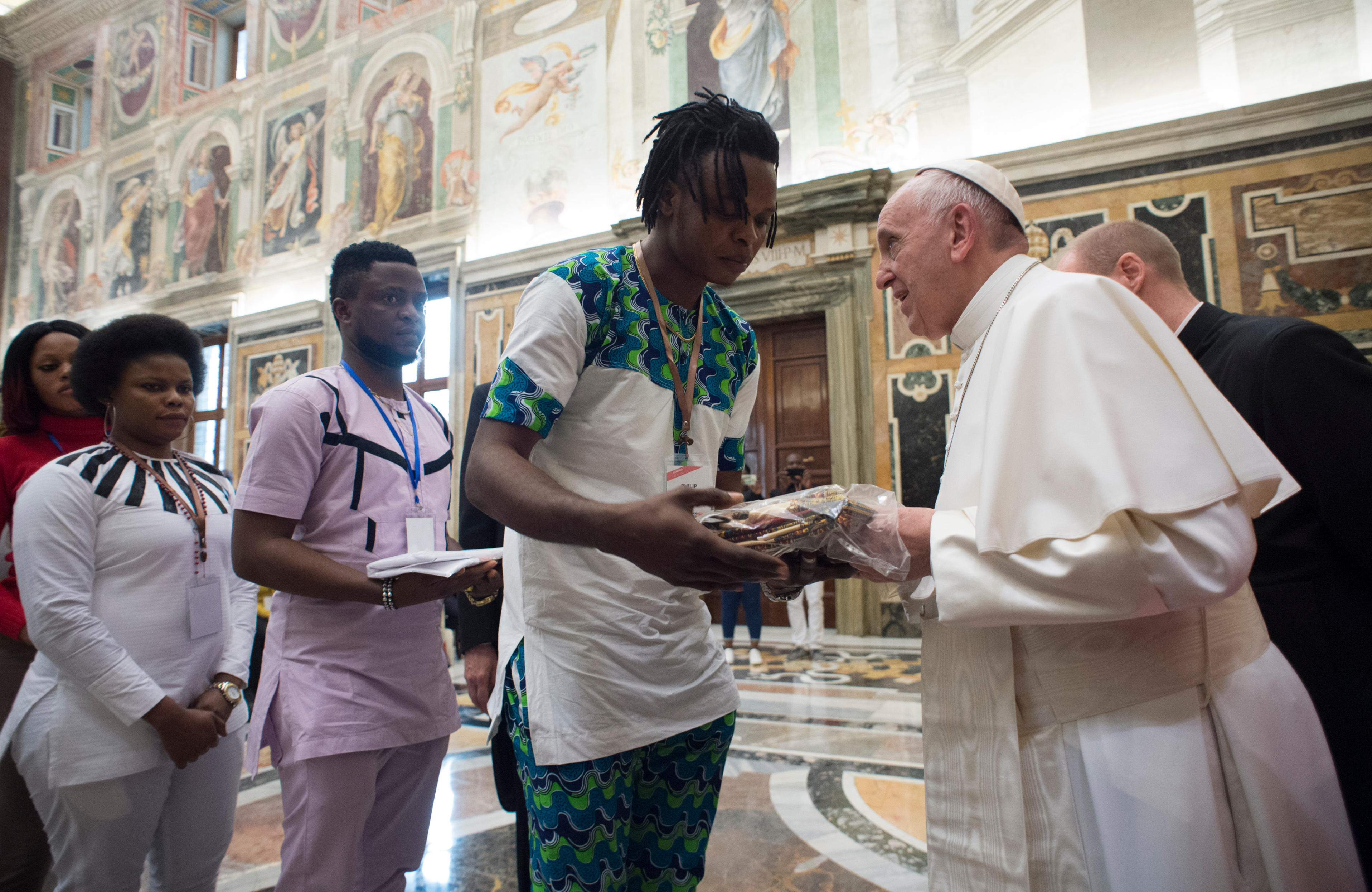
For 110 survivors of human trafficking, February 12, 2018, was truly a day to remember in a positive sense, as they were received by Pope Francis in the Clementine Hall of the Apostolic Palace in the Vatican.
Those present had come to Rome for the February 8 Observance of International Day of Prayer and Reflection against Human Trafficking. February 8 is the feast day of St. Josephine Bakhita, patron of the victims of human trafficking.
This was the first time the Holy Father met with victims of human trafficking in conjunction with the observance of the International Day, according to Vatican News and his message was clear and consistent: “I have never lost the opportunity to denounce this crime against humanity.”
In answering questions from those present, the Pope suggested that the lack of action to address human trafficking isn’t just because of ignorance of the problem, but also an unwillingness of some to face the issue.  Much of the challenging is fighting criminal organizations and corruption.
Other Church leaders have joined the Pope to express the need to solve the crisis of human trafficking.
“We are doing this for the sake of victims and survivors and we will not be deflected,” said Cardinal Vincent Nichols, Archbishop of Westminster and president of the Episcopal Conference of England and Wales and president of the “Santa Marta Group,” in an exclusive interview with ZENIT on February 10, 2018.
Pope Francis encouraged the work of the Santa Marta Group on February 9, 2018, in an address to its members in the Clementine Hall of the Vatican Apostolic Palace. The group, established by the Holy Father in 2014, to battle trafficking and slavery.
“Experience shows that such modern forms of slavery are far more widespread than previously imagined, even – to our scandal and shame –within the most prosperous of our societies,” the Pope said.  “As leaders in law enforcement, research and public policy, and pastoral assistance, you offer an essential contribution to addressing the causes and effects of this modern-day scourge, which continues to cause untold human suffering.”