Wednesday, May 30, 2018

June Papal Prayer Intention

June

Universal – Social Networks

That social networks may work towards that inclusiveness which respects other for their differences.

The Catholic Priesthood is all male, always was, is and always will be; no need for further discussion

Featured Image
UniGregoriana / youtube screen grab
Diane Montagna Diane Montagna Follow Diane

News

Church’s teaching on male-only priesthood is ‘infallible’: Vatican doctrine chief

Diane Montagna Diane Montagna

ROME, May 29, 2018 (LifeSiteNews) — The head of the Vatican office overseeing Church doctrine has insisted that the Church’s teaching on the male-only priesthood is “infallible,” and has offered a veiled rebuke of a prominent Cardinal who recently claimed the teaching could change.
In an article set to appear in the Wednesday, May 30th edition of the Vatican newspaper, L’Osservatore Romano, Archbishop Luis Ladaria, SJ said the reservation of the ordained priesthood to men is part of the deposit of faith, and the Catholic Church, in obedience to her Lord, cannot change this tradition.
Ladaria, who succeeded Cardinal Gerhard Müller as prefect of the Congregation for the Doctrine of the Faith, reaffirmed Pope John Paul II’s teaching in the 1994 apostolic letter Ordinatio Sacerdotalis, that “the Church has no authority whatsoever to confer priestly ordination on women and that this judgment is to be definitively held by all the Church’s faithful.”
“The Congregation for the Doctrine of the Faith, in response to a doubt about the teaching of Ordinatio sacerdotalis, reiterated that it is a truth belonging to the deposit of faith,” the Spanish archbishop added.
“In this light, it is a cause of serious concern to still see voices being raised in some countries that call into question the definitiveness of this doctrine,” he said. “In order to maintain that this is not definitive, it is argued that it has not been defined ex cathedra and that a subsequent decision of a future pope or council could therefore overturn it.”
Ladaria said that sowing these doubts causes “grave confusion among the faithful,” not only about the sacrament of Holy Orders as part of the divine constitution of the Church, but also about “the ordinary Magisterium which can infallibly teach Catholic doctrine.”
In early April, Austrian Cardinal Christoph Schönborn, who in some circles is considered a likely candidate as the next pope, said in an interview: “The question of the ordination [of women] is a question which clearly can only be clarified by a council. That cannot be decided upon by a pope alone. That is a question too big to be decided from the desk of a pope.”
When the reporter asked if Schönborn was referring to ordination of women as priests, Schönborn replied, “as deacons, priests, bishops.”
In his May 30 article titled, “The definitive character of Ordinatio Sacerdotalis,” Archbishop Ladaria endeavors to dispel doubt regarding the Church’s teaching on a male-only priestood. He writes: “With regard to the ministerial priesthood, the Church recognizes that the impossibility of ordaining women belongs to the ‘substance of the sacrament’ of Holy Orders (cf. Denzinger-Hünermann, 1728). The Church has no capacity to change this substance.”
“Conscious that, in obedience to the Lord, she cannot modify this tradition, the Church also strives to deepen its meaning, since the will of Jesus Christ, who is the Logos, is never without meaning,” the Vatican doctrinal chief continued. “The priest, in fact, acts in the person of Christ, the bridegroom of the Church, and his being a man is an indispensable element of this sacramental representation (cf. Congregation for the Doctrine of the Faith, Inter insigniores, n. 5).”
Recalling that the Blessed Virgin Mary is the most perfect image of the Church, Ladaria said that “fidelity to Christ’s plan for the ministerial priesthood is precisely what makes it possible … to deepen and promote ever more the specific role of women in the Church.”
Doubts raised about the definitiveness of Ordinatio sacerdotalis also have serious consequences for the way we understand the Magisterium of the Church, the head of the Vatican’s doctrinal office further noted.
“It is important to reaffirm that infallibility does not concern only the solemn pronouncements of a council or of the Supreme Pontiff when he speaks ex cathedra, but also the ordinary and universal teaching of the bishops scattered throughout the world, when they propose, in communion with one another and with the Pope, Catholic doctrine that is to be held definitively,” he said.
“John Paul II referred to this infallibility in Ordinatio sacerdotalis,” Ladaria argued. “Thus he did not declare a new dogma but, with the authority conferred on him as the successor of Peter, he formally confirmed and made explicit, in order to remove all doubt, what the ordinary and universal Magisterium has considered throughout the history of the Church as belonging to the deposit of faith.”
Archbishop Ladaria added that Pope Benedict XVI also insisted on this teaching. In a 2012 homily on Holy Thursday, Benedict told bishops and priests gathered for the Chrism Mass that John Paul II “stated in an irrevocable manner” that the Church “had no authorization from the Lord” regarding the ordination of women.
Finally, the current prefect of the CDF illustrated Pope Francis’ continuity with his predecessors on a male-only priesthood. Referencing Evangelii Gaudium, he also pointed to the Pope’s return flight from Sweden in 2016, when he said: “As for the ordination of women in the Catholic Church, the last clear word was given by Saint John Paul II, and this holds.”
Ladaria concluded the article, writing: “Only fidelity to [Jesus’] words, which will not pass away, ensures that we are rooted in Christ and in his love. Only the acceptance of his wise plan, which takes shape in the sacraments, strengthens the roots of the Church, so that she might bear the fruit of eternal life.”
Although the definitive character of Ordinatio Sacerdotalis is evident to those who recognise the authority of the magisterium, one informed observer pointed out that “there are many around the pope (one thinks e.g. of the Cardinal of Vienna) for whom nothing is ever settled.”
“The advocates of women’s ordination will pay lip service to Ordinatio Sacerdotalis, knowing that the text does not consider the diaconate directly, hoping to reassure opponents that if they give way on the diaconate they will be left in peace,” he said. “Then, once the pass is sold and ‘conservatives’ have conceded that sacramental orders can be bestowed on women, they will make short work of Ordinatio Sacerdotalis.
Here below is a LifeSiteNews translation of the article by Archbishop Ladaria, SJ.
 
“The definitive character of Ordinatio Sacerdotalis. Regarding some doubts.”
“Abide in me and I in you. As the branch cannot bear fruit by itself, unless it abides in the vine, neither can you, unless you abide in me” (John, 15: 4). If the Church is able to offer life and salvation to the whole world, it is due to her rootedness in Jesus Christ, her founder. This rootedness takes place first and foremost through the sacraments, with the Eucharist at the center. Instituted by Christ, they are the founding pillars of the Church that continuously generate her as his body and his bride. Intimately linked to the Eucharist is the sacrament of Holy Orders, in which Christ makes himself present to the Church as the source of her life and work. Priests are are configured “to Christ the Priest in such a way that they can act in the person of Christ the Head” (Presbyterorum Ordinis, n. 2).
Christ willed to confer this sacrament on the twelve apostles, all men, who in turn communicated it to other men. The Church has always known herself to be bound by this decision of the Lord, which excludes that the ministerial priesthood can validly be conferred on women. John Paul II, in his apostolic letter Ordinatio sacerdotalis, issued on May 22, 1994, taught: “in order that all doubt may be removed regarding a matter of great importance,” and “in virtue of my ministry of confirming the brethren” (cf. Lk 22:32) “that the Church has no authority whatsoever to confer priestly ordination on women and that this judgment is to be definitively held by all the Church’s faithful” (n. 4). The Congregation for the Doctrine of the Faith, in response to a doubt about the teaching of Ordinatio sacerdotalis, reiterated that it is a truth belonging to the deposit of faith.
In this light, it is a cause of serious concern still to see voices being raised in some countries that call into question the definitiveness of this doctrine. In order to maintain that this is not definitive, it is argued that it has not been defined ex cathedra and that a subsequent decision of a future Pope or Council could therefore overturn it. Sowing these doubts causes grave confusion among the faithful, not only about the sacrament of Holy Orders as part of the divine constitution of the Church, but also about the ordinary Magisterium which can infallibly teach Catholic doctrine.
In the first place, with regard to the ministerial priesthood, the Church recognizes that the impossibility of ordaining women belongs to the “substance of the sacrament” of Holy Orders (cf. Denzinger-Hünermann, 1728). The Church has no capacity to change this substance, because it is precisely on the basis of the sacraments instituted by Christ that she is generated as Church. It is not only a matter of disciple, but also of doctrine, as it concerns the structure of the sacraments, which are the original place of and encounter with Christ and the transmission of the faith. Therefore, we are standing before an obstacle that prevents the Church from being more effective in her activity in the world. If the Church cannot intervene, indeed, it is because on that point the original love of God intervenes. He is at work in the ordination of priests, so that the Church always contains, in every situation in her history, the visible and effective presence of Jesus Christ “as the principal source of grace” (Francis, Evangelii gaudium, n. 104).
Conscious that, in obedience to the Lord, she cannot modify this tradition, the Church also strives to deepen its significance, since the will of Jesus Christ, who is the Logos, is never without meaning. The priest, in fact, acts in the person of Christ, the Bridegroom of the Church, and his being a man is an indispensable element of this sacramental representation (cf. Congregation for the Doctrine of the Faith, Inter insigniores, n. 5).  Certainly, the difference in functions between men and women does not bring with it any subordination, but rather mutual enrichment. We recall that the perfect image of the Church is Mary, the Mother of the Lord, who did not receive the apostolic ministry. Thus we see that masculine and feminine — the original language which the Creator has inscribed in the human body — are taken up in the work of our redemption. Fidelity to Christ’s plan for the ministerial priesthood is precisely what makes it possible, then, to deepen and promote ever more the specific role of women in the Church, given that, “in the Lord, woman is not independent of man nor man of woman” (1 Cor 11:11). Additionally, this can shed light on our culture, which struggles to understand the meaning and goodness of the difference between man and woman, which also touches on their complementary mission in society.
Secondly, the doubts raised about the definitiveness of Ordinatio sacerdotalis also have serious consequences for the way we understand the Magisterium of the Church. It is important to reaffirm that infallibility does not concern only the solemn pronouncements of a council or of the Supreme Pontiff when he speaks ex cathedra, but also the ordinary and universal teaching of the bishops scattered throughout the world, when they propose, in communion with one another and with the Pope, Catholic doctrine that is to be held definitively. John Paul II referred to this infallibility in Ordinatio sacerdotalis. Thus, he did not declare a new dogma but, with the authority conferred on him as the successor of Peter, formally confirmed and made explicit, in order to remove all doubt, what the ordinary and universal Magisterium has considered throughout the history of the Church as belonging to the deposit of faith. Precisely this way of deciding reflects a style of ecclesial communion, for the Pope did not want to work alone, but as a witness listening to an uninterrupted and lived tradition. On the other hand, no one will deny that the Magisterium can express itself infallibly on truths that are necessarily connected with what is formally revealed, since only in this way can it exercise its function of safeguarding and faithfully exposing the deposit of faith in a holy manner.
A further proof of the commitment with which John Paul II examined the question is the prior consultation he wished to have in Rome with the presidents of the episcopal conferences who were seriously interested in this issue. All, without exception, declared with full conviction, through the Church’s obedience to the Lord, that she does not have the faculty to confer priestly ordination on women.
Benedict XVI also insisted on this teaching, recalling during the Chrism Mass on April 5, 2012, that John Paul II “stated in an irrevocable manner” that the Church “had no authorization from the Lord” regarding the ordination of women. Benedict XVI later asked, with regard to some who had not accepted this doctrine: “But is disobedience really a way? Are we able to perceive in it something of the conformation to Christ which is the prerequisite for every true renewal, or  rather only the desperate urge to do something, to transform the Church according to our desires and our ideas?”
Pope Francis has also returned to the subject. In his apostolic exhortation Evangelii gaudium, he reaffirmed that the reservation of “the priesthood to males, as a sign of Christ the Spouse who gives himself in the Eucharist,” is not a question open to discussion, and he invited everyone not to interpret this doctrine as an expression of power, but of service, so that the equal dignity of men and women in the one body of Christ might better be perceived (104). In the press conference, during the return flight from his apostolic trip to Sweden on November 1, 2016, Pope Francis reiterated: “As for the ordination of women in the Catholic Church, the last clear word was given by Saint John Paul II, and this holds.”
In this time, when the Church is called to respond to so many challenges of our culture, it is essential that she remain in Jesus, like the branches in the vine. This is why the Teacher invites us to ensure that his words remain in us: “If you keep my commandments, you will remain in my love” (John 15:10). Only fidelity to his words, which will not pass away, ensures that we are rooted in Christ and in his love. Only the acceptance of his wise plan, which takes shape in the sacraments, strengthens the roots of the Church, so that she might bear the fruit of eternal life.
by Luis Ladaria, Prefect of the Congregation for the Doctrine of the Faith
Translation by Diane Montagna

At end of May, Pope Francis honors Mary


© Vatican Media

‘Mary, Our Refuge in Difficult Times,’ Reminds Pope

Honors Blessed Mother as Her Month Draws to a Close Tomorrow

‘The Virgin Mary is a refuge in difficult times.’
Pope Francis gave this reminder at his weekly General Audience on Wednesday morning, May 30, 2018, in St. Peter’s Square, where he continued his catecheses on Confirmation.
As he does each week, the Pope addressed “a special thought” at the end of the meeting, to young people, the elderly, the sick and new spouses.
“Tomorrow,” he said, “we are concluding the month of Mary.”
“May the Mother of God,” he wished, “be your refuge in times of joy, as well as in difficult times, and may she guide your families so that they cultivate homes of prayer, reciprocal understanding and giving.”

We are home!

In less than 13 hours, from North Carolina to, well, at least to Winn Dixie.  Yep after almost 13 hours of driving we had to stop at the WD because we are out of staples, mainly edible food!  And then we had to pick up our golden girl, Delilah.  But we are home, car unpacked, mailed reviewed and first load of clothes in the wash.

We loved our visit with our NC family and Calvin and Katelynn were, as usual, lots of fun an good for many smiles and warm heart moments.  And while we will miss them, we are planning to go visit grandbaby #3 in the morning!

More posts tonight on this very HOT Wednesday back at the Talbot farm and at the abitadeacon!!

Tuesday, May 29, 2018

Pope Francis has a busy summer planned

Vatican releases summer schedule of major papal events

Vatican releases summer schedule of major papal events
Pope Francis waves upon his arrival in St. Peter's Square at the Vatican, for his weekly general audience, Wednesday, May 23, 2018. (Credit: Alessandra Tarantino/AP.)
Pope Francis will create 14 new cardinals during a late afternoon consistory June 28, not June 29 as he had announced originally.
VATICAN CITY - Pope Francis will create 14 new cardinals during a late afternoon consistory June 28, not June 29 as he had announced originally.
The date change was included in the schedule of papal liturgies through August, which was released by the Vatican May 29.
The schedule also confirmed that Pope Francis will celebrate the feast of the Body and Blood of Christ June 3, not in Rome as has been the tradition since 1979, but in the seaside town of Ostia, about 16 miles west of Rome. The evening Mass outside St. Monica Church will be followed by a Corpus Christi procession to the Church of Our Lady of Bonaria.
Ostia was where St. Monica, the mother of St. Augustine, died in 387 on a journey back to Africa after St. Augustine’s conversion to Christianity. The ancient city’s name is related to the Latin word for “mouth” because it was a port area at the mouth of the Tiber River. In modern Italian, “ostia” is the word for the eucharistic host.
During his pontificate, Blessed Paul VI celebrated the feast day in various neighborhoods in and around Rome, including in Ostia in 1968. St. John Paul II fixed the celebration at St. John Lateran, the cathedral of the Diocese of Rome, followed by a Corpus Christi procession to the Basilica of St. Mary Major.
Covering the months of June, July and August, the pope’s liturgical schedule included:
- An “ecumenical pilgrimage” to Geneva June 21.
- The creation of new cardinals June 28 in St. Peter’s Basilica.
- Mass in St. Peter’s Basilica June 29, the feast of Sts. Peter and Paul, with the blessing of palliums for archbishops named to their archdioceses over the course of the past year.
- An ecumenical gathering July 7 in the southern Italian city of Bari for prayers for peace in the Middle East. Bari’s ancient basilica dedicated to St. Nicholas is an important place of pilgrimage for both Catholics and Orthodox Christians.
- Apostolic visit to Dublin Aug. 25-26 for the final days of the World Meeting of Families.

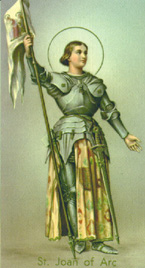
The Maid of Orleans, Martyr and Saint

St. Joan of Arc

Image of St. Joan of Arc

Facts

Feastday: May 30
Patron of soldiers and France
Birth: 1412
Death: 1431
Canonized By: Pope Benedict XV

St. Joan of Arc is the patroness of soldiers and of France.
On January 6, 1412, Joan of Arc was born to pious parents of the French peasant class in the obscure village of Domremy, near the province of Lorraine. At a very early age, she was said to have heard the voices of St. Michael, St. Catherine, and St. Margaret.
At first the messages were personal and general, but when she was 13-years-old, she was in her father's garden and had visions of Saint Michael, Saint Catherine, and Saint Margaret, each of whom told her to drive the English from French territory. They also asked that she bring the Dauphin to Reims for his coronation.
After their messages were delivered and the saints departed, Joan cried, as "they were so beautiful."
When she was sixteen-years-old, she asked her relative, Durand Lassois, to take her to Vaucouleurs, where she petitioned Robert de Baudricourt, the garrison commander, for permission to visit the French Royal Court in Chinon.
Despite Baudricourt's sarcastic response to her request, Joan returned the following January and left with the support of two of Baudricourt's soldiers: Jean de Metz and Bertrand de Poulengy.
Jean de Metz admitted Joan had confided in him, saying, "I must be at the King's side ... there will be no help if not from me. Although I would rather have remained spinning [wool] at my mother's side ... yet must I go and must I do this thing, for my Lord wills that I do so."
With Metz and Poulengy at her side, Joan met Baudricourt and predicted a military reversal at the Battle of Rouvray near Orléans, which were confirmed several days later by a messenger's report. When Baudricourt realized the distance of the battle's location and the time it would have taken Joan to make the journey, he concluded she had seen the reversal by Divine revelation, which caused him to believe her words.
Once she had Baudricourt's belief, Joan was granted an escort to Chinon through hostile Burgundian territory. For her safety, she was escorted while dressed as a male soldier, which later led to charges of cross-dressing, but her escorts viewed as a sound precaution.
Two members of her escort confirmed they and the people of Vaucouleurs gave her the clothing and had been the ones to suggest she don the outfit.
When she arrived in the Royal Court, she met in a private conference with Charles VII and won his trust. Yolande of Aragon, Charles' mother-in-law, planned a finance relief expedition to Orléans and Joan asked to travel with the army while wearing armor, which the Royal government agreed to. They also provided Joan's armor and she depended on donations for everything she took with her.
With a donated horse, sword, banner, armor, and more, Joan arrived to Orléans and quickly turned the Anglo-French conflict into a religious war.
Charles' advisors worried Joan's claims of doing God's work could be twisted by his enemies, who could easily claim she was a sorceress, which would link his crown to works of the devil. To prevent accusations, the Dauphin ordered background inquiries and a theological exam at Poitiers to verify Joan's claims.
In April 1429, the commission of inquiry "declared her to be of irreproachable life, a good Christian, possessed of the virtues of humility, honesty and simplicity." Rather than deciding on whether or not Joan was acting on the basis of divine inspiration, theologians at Poitiers told the Dauphin there was a "favorable presumption" on the divine nature of her mission.
Charles was satisfied with the report but theologians reminded him Joan must be tested. They claimed, "[t]o doubt or abandon her without suspicion of evil would be to repudiate the Holy Spirit and to become unworthy of God's aid."
They suggested her test should be a test of her claim to lift the siege of Orléans, as she originally predicted would happen.
In response to the test, Joan arrived at Orléans on April 29, 1429, where Jean d'Orléans, the acting head of the ducal family of Orléans, ensured she was excluded from war councils and kept ignorant of battles.
During the five months prior to Joan's arrival to Orléans, the French had only attempted one offensive assault, which resulted in their defeat, but after her arrival, things began to change.
Though Joan claimed the army was always commanded by a nobleman and that she never killed anyone in battle since she preferred only to carry her banner, which she preferred "forty times" better than a sword, several noblemen claimed she greatly effected their decisions since they accepted she gave Divinely inspired advice.
On May 4, the Armagnacs captured the fortress of Saint Loup and the next day led to fortress Saint-Jean-le-Blanc, which was deserted. With Joan at the army's side, English troops approached the army to stop their advance but a cavalry charge was all it took to turn the English away without a fight.
The Armagnacs captured an English fortress build around the Les Augustins monastery and attacked the English stronghold Les Tourelles on May 7. Joan was shot with an arrow between her neck and shoulder as she held her banner outside Les Tourelles, but returned to encourage the final assault to take the fortress. The next day, the English retreated from Orléans and the siege was over.
When Joan was in Chinon and Poitiers, she had declared she would show a sign at Orléans, which many believe was the end of the siege. Following the departure of the English, prominent clergymen began to support her, including the Archbishop of Embrun and the theologian Jean Gerson, each of which wrote supportive treatises.
After the Orléans victory, Joan was able to persuade Charles VII to allow her to march into other battles to reclaim cities, each of which ended in victory. When the military supplies began to dwindle, they reached Troyes, where Brother Richard, a wandering friar, had warned the city about the end of the world and was able to convince them to plant beans, which yields an early harvest. Just as the beans ripened, Joan and the army arrived and was able to restore their supplies.
Following their march to Troyes, Joan and the French military made its way to Paris, where politicians failed to secure Duke Philip of Burgundy's agreement to a truce. Joan was present at the following battles and suffered a leg wound from a crossbow bolt. Despite one failed mission - taking La-Charité-sur-Loire" - Joan and her family were ennobled by Charles VII in reward of her actions on the battlefield.
A truce with England came following Joan's ennoblement but was quickly broken. When Joan traveled to Compičgne to help defend against an English and Burgundian siege, she was captured by Burgundian troops and held for a ransom of 10,000 livres tournois. There were several attempts to free her and Joan made many excape attempts, including jumping from her 70-foot (21m) tower, landing on the soft earth of a dry moat, but to no avail. She was eventually sold to the English for 10,000 gold coins and was then tried as a heretic and witch in a trial that violated the legal process of the time.
Clerical notary Nicolas Bailly, who was responsible to collect testimony against Joan, was unable to find any evidence against her. Without evidence, the courts lacked grounds to initiate trial but one was opened anyway. They denied Joan the right to a legal advisor and filled the tribunal with pro-English clergy rather than meeting the medieval Church's requirement to balance the group with impartial clerics.
When the first public examination opened, Joan pointed out that the partisans were against her and she asked for "ecclesiastics of the French side" to provide balance, but her request was denied.
Jean Lemaitre, the Vice-Inquisitor of Northern France, objected to the trial from the beginning and many eyewitnesses later reported he was forced to cooperate after the English threatened to kill him. Other members of the clergy were threatened when they refused as well, so the trial continued.
The trial record includes statements from Joan that eyewitnesses later claimed astonished the court since she was an illiterate peasant who was able to escape theological traps. The most well-known exchange was when Joan was "[a]sked if she knew she was in God's grace, she answered: 'If I am not, may God put me there; and if I am, may God so keep me.'"
The question is a trap because the church doctrine was that no one could be certain of being in God's grace. If she answered yes, she would have been charged with heresy, but if she answered no, she would have been confessing her own guilt. Notary Boisguillaume later testified that "[t]hose who were interrogating her were stupefied."
Many members of the tribunal later testified important parts of the transcript were altered.
Joan was held in a secular prison guarded by English soldiers, instead of being in an ecclesiastical prison with nuns as her guards per Inquisitorial guidelines. When Joan appealed to the Council of Basel and the Pope to be placed in a proper prison, Bishop Cauchon denied her request, which would have stopped his proceeding.
While imprisoned, Joan wore military clothing so she could tie her clothing together, making it harder to be raped. There was no protection in a dress, and a few days after she started wearing one she told a tribunal member that "a great English lord had entered her prison and tried to take her by force." Following the attempted rape, Joan returned to wearing male clothing as a precaution and to raise her defenses against molestation.
Jean Massieu testified her dress had been taken by the guards and she had nothing else to wear.
When she returned to male clothing, she was given another count of hersy for cross-dressing, though it was later disputed by the inquisitor presiding over court appeals after the war. He found that cross-dressing should be evaluated based on context, including the use of clothing as protection against rape if it offered protection.
In accordance to the inquisitor's doctrine, Joan would have been justified in wearing armor on a battlefield, men's clothing in prison and dressing as a pageboy when traveling through enemy territory.
The Chronique de la Pucelle states it deterred molestation when Joan was camped in the field but she donned a dress when men's garments were unnecessary.
Clergy who testified at the posthumous appellate trial confirmed that she wore male clothing in prison to deter molestation.
Though the Poitiers record did not survive the test of time, Joan had referred the court to the Poitiers inquiry when questioned about her clothing and circumstances indicate the Poitiers clerics approved the practive. She had also kept her hair short through the military campaigns and during her imprisonment, which Inquisitor Brehal, theologian Jean Gerson and all of Joan's supporters understood was for practical reasons.
Despite the lack of incriminating evidence, Joan was condemned and sentenced to die in 1431.
Eyewitness accounts of Joan's execution by burning on May 30, 1431 describe how she was tied to a tall pillar at the Vieux-Marché in Rouen. She asked Fr. Martin Ladvenu and Fr. Isambart de la Pierre to hold a crucifix before her and an English soldier made a small cross she put in the front of her dress. After she died, the English raked the coals to expose her body so no one could spread rumors of her escaping alive, then they burned her body two more times to reduce it to ashes so no one could collect relics. After burning her body to ash, the English threw her remains into the Seine River and the executioner, Geoffroy Thérage, later said he "... greatly feared to be damned."
In 1452, during an investigation into Joan's execution, the Church declared a religious play in her honor at Orléans would let attendees gain an indulgence by making a pilgrimage to the event.
A posthumous retrial opened following the end of the war. Pope Callixtus III authorized the proceeding, which has also been called the "nullification trial," after Inquisitor-General Jean Bréhal and Joan's mother Isabelle Romée requested it.
The trial was meant to determine if Joan's condemnation was justly handled, and of course at the end of the investication Joan received a formal appeal in November 1455 and the appellate court declared Joan innocent on July 7 1456.
Joan of Arc was a symbol of the Catholic League during the 16th century and when Félix Dupanloup was made bishop of Orléans in 1849, he pronounced a panegyric on Joan of Arc and led efforts leading to Joan of Arc's beatification in 1909. On May 16, 1920, Pope Benedict XV canonized her.
Centuries after her death, Joan became known as a semi-legendary figure. There were several sources of information about her life, time on the battlefield and trials, with the main sources being chronicles.
Many women have seen Joan as a brave and active woman who operated within a religious tradition that believed a person of any class could receive a divine calling.
Joan of Arc has been depicted in several works by famous writers such as William Shakespeare (Henry VI, Part 1), Voltaire (The Maid of Orleans), Mark Twain (Personal Recollections of Joan of Arc), and many many more.
Images depicting Joan of Arc often show her with short hair adorned in armor.

A little Tuesday night update from North Carolina

Our short 3-day visit to see the family up here in N.C. is over and Wendy and I plan on taking off early in the morning.  We are so glad we came as we have not seen the family and played with the grandkids since December.  This was our 1st visit up here since November but I spent 3 days of that trip in a hospital.

Our return trip will be dodging lots of rain from wrap around remnants from Alberto.  As long as the interstates are passable we will be good.  I always dread hitting Atlanta and we will be passing through around 11 in the morning.  That's bad enough on a typical work day but worse if heavy rain persists; time will tell.

The highlight of our trip is always to spend face time with Calvin & Katelyn.  They are growing so big as they approach their 6th and 3rd birthday respectively.  We spent most of the time swimming and playing in the yard and just hanging out with the family.  We really enjoyed the visit, short as it was.  We went out to eat together a couple of times and Wendy and I got to make mass at St. Pius X Church(see previous article).  And not only did we celebrate Memorial Day while here, we also celebrated Jimmy & Sara's 8th wedding anniversary!

So prayers for traveling mercies and good weather and no severe rain and we should be home in Louisiana by tomorrow evening!

Blogging will resume in earnest tomorrow night, Thursday sometime.  Peace!

Tuesday morning Papal homily


© Vatican Media

Pope’s Morning Homily: Worldly Patterns Promise Everything & Give Nothing

During Morning Mass, Francis Says to Walk Toward Holiness, We Must ‘Be Free & Feel Free’

Do not remain attached to worldly ways of thinking and behavior. You know better. Hence, claim your freedom by embracing your call to holiness.
According to Vatican News, Pope Francis stressed this during his daily morning Mass at Casa Santa Marta as he reflected on the day’s reading from the First Letter of Peter which urges Christians to be holy in every aspect of their conduct.
In the homily, Francis discussed that call to holiness and the importance of moving away from our worldly way of thinking and behavior that formerly enslaved us.
“The call to holiness, which is the normal call, is our call to live as a Christian, namely living as a Christian is the same as saying ‘living as a saint’. Many times we think of holiness as something extraordinary, like having visions or lofty prayers … or some think that being holy means having a face like that in a cameo … no. Being holy is something else. It is to proceed along this path that the Lord tells us about holiness.”
“And what is it, to proceed along the path of holiness?” the Pope asked. “Peter says it,” he answered, “‘Put all your hope in that grace that will be given to you when Jesus Christ manifests Himself.'”
Walking towards holiness, the Pontiff said, means proceeding towards that grace, that encounter with Jesus Christ. Like walking towards the light, Francis highlighted that many times we don’t see the road well, because the light dazzles us.
“But we are not mistaken, noted the Pope, “because we see the light and we know the way”. When you walk with the light behind you, you can see the road well, but in reality there is shadow, not light, in front of you.”
The Pope urged Christians not to go back to their worldly patterns of behaving.
Stressing so many things enslave us, the Jesuit Pope stressed that for Christians to walk toward holiness, they need “to be free and to feel free.”
Do Not
It is for this reason, he said, that Peter urges us not to conform “to the desires of our former ignorance.” In his First Letter to the Romans, Saint Paul say: “Do not conform,” which means don’t get involved in worldly patterns of behavior.
“This is the correct translation of this advice – do not adopt the worldly patterns, – do not adopt those patterns of behavior, that worldly way of thinking, that way of thinking and judging that the world offers you because this deprives you of freedom.
To proceed towards holiness, the Pope stressed, one must be free: free to go forward, looking at the light, going forward. “When we return, as he says here, to the way of life we had before our encounter with Jesus Christ or when we return to those patterns of worldly behavior, we lose our freedom.”
“In moments of trials and tribulations, we always are tempted to look back, to look at the worldly patterns of behavior, at the patterns that we had before setting out the path towards salvation: without freedom. And without freedom one cannot be holy.”
“Freedom is the condition for moving forward while looking at the light ahead of us. Do not adopt the worldly patterns of behavior, walk forward, looking at the light that is the promise, in hope; this is the promise like the people of God in the desert: when they looked forward everything went fine; when they were nostalgic because they could no longer eat the good things they formerly had, they made mistakes and forgot that they had no freedom back there.”
Called Daily to Holiness
The Lord, the Pope reminded, calls us to holiness every day.
To know if we are on our way to this call, the Pope said there are two parameters. “First of all, if we look towards the light of the Lord in the hope of finding it and, then if when the trials come, we look ahead and do not lose our freedom by taking refuge in worldly patterns of behavior, which promise you everything and give you nothing.”
“You will be holy because I am holy: this is the Lord’s commandment.”
Pope Francis concluded, praying God to grant us the grace to understand correctly what the path of holiness is.

If I love you all the way to heaven, I want you to know how you can sin against the Holy Spirit; the unforgiveable sin

The 6 sins against the Holy Spirit


Essentially, they are 6 manifestations of one and the same sin: rejecting the grace of God to the point of forbidding Him to forgive us and save us

The Gospel says in Matthew, 12, 32:
“And whosoever shall say a word against the Son of man, it shall be forgiven him: but if any man speak against the Holy Ghost, he shall not be forgiven him, neither in this world nor in the future “
The sins against the Holy Spirit consist in the rejection of the grace of God; it is the refusal of salvation, complete rejection of action, unceasing invitations and warnings of the Holy Spirit. They are sins in which the goodness of God is put into question. It is a sin for pure malice, contrary to the goodness which is the Holy Spirit. The will of the person who sins is so hardened that it does not desire the mercy of God and rejects His goodness.

Sin against the Holy Spirit is unforgivable precisely because it is the sinner himself who prevents God from forgiving him . Because God respects the freedom with which He created us, He respects the sinner’s decision to firmly refuse to be forgiven.
The Pope St. Pius X taught in his Large Catechism , which are six sins against the Holy Spirit :
ALSE SEE:  Seven (7) Signs Your Guardian Angel Is Trying to Contact You
1 – Despair of salvation , when one loses hope in salvation, judging that his life is already lost and that is doomed, even before the Judgment. He thinks divine mercy is small. He does not believe in the power and righteousness of God.

2nd – Presumption of salvation, when the person cultivates in his soul an idea of perfection that implies a feeling of pride. She thinks she’s saved by what she’s already done. Only God knows whether what we have done deserves the prize of salvation or not. Our salvation can be lost until the last moment of our lives, and God is our Eternal Judge. We must believe in divine mercy, but we can not usurp the Divine inalienable attribute of the Judgment. The mere fact that he already considers himself elected is an attitude that indicates the weakness of the virtue of humility before God. We must have the moral conviction that we are right in our actions, but we can not say that in the eyes of God we are definitely saved. Calvinists, for example, affirm the definitive election of the faithful, by God’s eternal and immutable decree. The Catholic Church teaches that, normally, men know nothing of their destiny unless there is a private revelation accepted by the sacred magisterium. For this reason, men can not be considered saved before the Judgment.

3. To deny the truth known as such by the magisterium of the Holy Church , when one does not accept the truths of faith (dogmas of faith), even after an exhaustive doctrinal explanation. This is the case with heretics. He considers his personal understanding superior to that of the Church and to the teaching of the Holy Spirit which assists the sacred teaching.

4th – Envy of the grace that God gives to others . Envy is a feeling that is irritated because the other got something good. Even if you have that or you can get a day. It is the act of not wanting the good of the fellow. If I envy the grace that God gives to someone, I am saying that person does not deserve such grace, thus making me the judge of the world. I am turning against the divine will. I am turning against the Law of Love to my neighbor. We should not envy a good that someone has conquered. If this good is the fruit of honest and persevering work, it is God’s will that one enjoy that grace.

5 – Obstination in sin is the firm will to remain in error even after the action of the Holy Spirit. The person creates his criterion of ethical judgment. Or it simply does not adopt any ethics and thus departs from the will of God and rejects Salvation.

6º – Final impending is the result of a lifetime of rejection of God. The individual persists in error until the end, refusing to repent and penance, refuses salvation to the end. He consecrates himself to the adversary of Christ. Not even at the hour of death does he try to approach the Father, manifesting humility. It does not open to the invitation of the Holy Spirit.