reflections, updates and homilies from Deacon Mike Talbot inspired by the following words from my ordination: Receive the Gospel of Christ whose herald you have become. Believe what you read, teach what you believe and practice what you teach...
Sunday, January 28, 2018
Monday Saint of the Day; beatified by St Pope JPII
Overshadowed by the DC March, the West Coast March for Life is growing
Above, Thomas Aquinas College students at the Walk for Life West Coast in San Francisco. Below, David Daleiden and other participants, including those from LIFE Runners and students from the University of Colorado-Boulder, as well as seminarians. (Photos by Nicholas Wolfram Smith)
Blogs | Jan. 27, 2018
Crowd of Thousands Offers Joyful Witness at San Francisco’s Walk for Life West Coast
Highlights of the Jan. 27 rally for the unborn.
On Saturday, tens of thousands of pro-lifers descended on San Francisco for the 14th Annual Walk for Life West Coast (online here). The walkers ranged from well-known advocates of the pro-life cause to Catholic college students and seminarians.
Now in his 10th year of attending the West Coast Walk for Life, David Daleiden told the Register he loves how the walk “brings the pro-life movement into the heart of the abortion industry.” Daleiden contrasted the continuous growth of the Walk for Life with the decreasing presence of pro-abortion protesters. While 10 years ago, the walk was “like running the gauntlet,” he said, now they can’t turn out significant numbers of people to support taxpayer-funded abortion.

“These marches feel like victory marches now, for the first time, because we’re winning,” he said.
Daleiden said the Walk for Life had a “very humble, spiritual core.”
“We don’t have political power in San Francisco,” he said. “All we have is the power of the spirit that comes through in an achingly beautiful way. That’s what I Iove about the Walk for Life.”
Pat Castle, founder and coach of LIFE Runners, loves the Walk for Life because of “the opportunity to meet other pro-lifers and hear their stories. There’s nothing more inspirational than to meet. It’s a beautiful thing.”
About 40 University of Colorado-Boulder students from the St. Thomas Aquinas Catholic Center came, too. Their pastor, Father Peter Mussett, told the Register that the students belong to “an incredibly compassionate generation” that is “deeply aware of the profound need for healing.”
Madalena, a senior who came for the first time to the walk, told the Register, “It was a really cool experience, especially to see how alive the Church is, how alive the pro-life movement is.”
Danny Anderson said that it’s “cool to be a witness here, publicly witnessing to life.”
Both avid photographers, Molli Nava told the Register she looks forward to publishing her photos of an event that often lacks coverage and show the history of the walk: “I want my kids to see that there were people standing up for life then.”
Thomas Aquinas College students also flocked to the walk. The motto on the back of their sweatshirts was Carpe Veritatem, Seamus O’Brien said, and the Walk for Life “is a chance to seize the truth: that abortion is murder and is wrong.” O’Brien and his fellow students hope that the momentum from being at the walk will carry over to their campus pro-life work, like a prayer service they organize outside of an abortion facility in Ventura, California. “John Paul II called us an ‘Easter people.’ It’s a youthful and joyful movement.”
Seminarians Andy Kelly (shown below left) and Thomas Stuart (right) also attended.
Kelly, a seminarian from the Diocese of Spokane, Washington, at St. Patrick’s Seminary in Menlo Park, California, told the Register it was “wonderful to see this many people praying for others and standing up for their faith.” He said he is encouraged that the pro-life movement is making headway nationally and said it was joyful “seeing so many happy people supporting and affirming life.”
Now in his 10th year of attending the West Coast Walk for Life, David Daleiden told the Register he loves how the walk “brings the pro-life movement into the heart of the abortion industry.” Daleiden contrasted the continuous growth of the Walk for Life with the decreasing presence of pro-abortion protesters. While 10 years ago, the walk was “like running the gauntlet,” he said, now they can’t turn out significant numbers of people to support taxpayer-funded abortion.

“These marches feel like victory marches now, for the first time, because we’re winning,” he said.
Daleiden said the Walk for Life had a “very humble, spiritual core.”
“We don’t have political power in San Francisco,” he said. “All we have is the power of the spirit that comes through in an achingly beautiful way. That’s what I Iove about the Walk for Life.”
Pat Castle, founder and coach of LIFE Runners, loves the Walk for Life because of “the opportunity to meet other pro-lifers and hear their stories. There’s nothing more inspirational than to meet. It’s a beautiful thing.”

Madalena, a senior who came for the first time to the walk, told the Register, “It was a really cool experience, especially to see how alive the Church is, how alive the pro-life movement is.”

Both avid photographers, Molli Nava told the Register she looks forward to publishing her photos of an event that often lacks coverage and show the history of the walk: “I want my kids to see that there were people standing up for life then.”

Seminarians Andy Kelly (shown below left) and Thomas Stuart (right) also attended.

Pope Francis shows solidarity with Ukranians
Pope to Ukrainian Greek Catholics: ‘I Am Here Today to Say I Am Close You’
Visiting Rome’s Greek-Catholic Community, Pope Prays for End to Violence, Says Do Not Lose Hope
Pope Francis visited Rome’s Greek-Catholic Community of Ukrainians today at the Basilica of St. Sophia on Via Boccea, northwest of Rome, Jan. 28, 2018.
Jumbotrons were set up outside the church transmitting coverage to the faithful unable to be inside. Faithful welcomed the Pope with Ukrainian Christmas songs because for Greek-Catholic Ukrainians, following the Julian calendar, it is still Christmastime, since the Feast of the Presentation of Jesus at the Temple is February 18.
During the encounter, the Major Archbishop of Kiev, Sviatoslav Shevchuk, leader of the Greek-Catholic Church of Ukraine presented the community to the Pope, and he and the Pope exchanged greetings.
In Pope Francis’ address he reflected on Cardinal Josyp Slipyi, Salesian Ukrainian Bishop Stepan Czmil, and Cardinal Lubomyr Husar, former Major Archbishop of the Greek-Catholic Church of Ukraine, and their great examples they have given.
During the visit today, Francis descended into the crypt to pray at the tomb of Salesian Ukrainian Bishop Stepan Czmil.
With January 22 marking the 40th Anniversary of the bishop’s passing, Bishop Czmil was sent as a missionary in 1948 to Buenos Aires and would teach at the Salesian school that young Jorge Bergoglio attended. Through him, one of his first educators, Bergoglio would be introduced to the Byzantine rite and get to know the Greek Catholic Community of Ukraine.
Also in his address, the Pontiff also reminded: “A living parish is a meeting place with the living Christ.” Recognizing the many Ukrainian women of great faith and charity, he told them: “You are precious and you bring in many Italian families the announcement of God.”
Recognizing how much the Ukrainian people have suffered, the Pope said, “I am here today to tell you all that I am close to you: close with my heart, with my prayers, and when I celebrate Mass.”
“I pray to the Prince of Peace to stop the weapons,” he said, telling the faithful to never lose hope.
Before returning to the Vatican, the Pope saw the mosaics of the basilica.
Major Archbishop Shevchuk explained to journalists in the Vatican on Friday, that four years ago, Ukraine suffered the aggression of a neighboring country, Russia.
According to UN agencies today in Ukraine there are 2 million internally displaced persons. It is a crisis that continues and escalates. These statistics demonstrate the most serious humanitarian crisis in Europe after the Second World War. In spite of this, it is a ‘forgotten war,’ as was said by Vatican Secretary of State, Cardinal Pietro Parolin, during his visit to Russia last August.
Pope St John Paul II visited St. Sophia in Rome in 1984, to pay homage to the tomb of Cardinal Josyp Slipyi, the Head of the Greek Catholic Community of Ukraine who was harshly persecuted under the Soviet regime, including 18 years in prison, before eventually being freed. Blessed Pope Paul VI was there, previously in 1969, for the consecration of the Basilica, the initiative of Cardinal Slipyi.
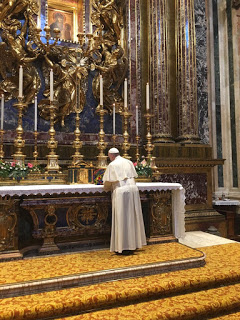
The Pope arrived around 4 p.m., after having celebrated Mass this morning at Rome’s Marian Basilica of Santa Maria Maggiore, and after having his traditional noon Angelus.Jumbotrons were set up outside the church transmitting coverage to the faithful unable to be inside. Faithful welcomed the Pope with Ukrainian Christmas songs because for Greek-Catholic Ukrainians, following the Julian calendar, it is still Christmastime, since the Feast of the Presentation of Jesus at the Temple is February 18.
During the encounter, the Major Archbishop of Kiev, Sviatoslav Shevchuk, leader of the Greek-Catholic Church of Ukraine presented the community to the Pope, and he and the Pope exchanged greetings.In Pope Francis’ address he reflected on Cardinal Josyp Slipyi, Salesian Ukrainian Bishop Stepan Czmil, and Cardinal Lubomyr Husar, former Major Archbishop of the Greek-Catholic Church of Ukraine, and their great examples they have given.
During the visit today, Francis descended into the crypt to pray at the tomb of Salesian Ukrainian Bishop Stepan Czmil.
With January 22 marking the 40th Anniversary of the bishop’s passing, Bishop Czmil was sent as a missionary in 1948 to Buenos Aires and would teach at the Salesian school that young Jorge Bergoglio attended. Through him, one of his first educators, Bergoglio would be introduced to the Byzantine rite and get to know the Greek Catholic Community of Ukraine.
Also in his address, the Pontiff also reminded: “A living parish is a meeting place with the living Christ.” Recognizing the many Ukrainian women of great faith and charity, he told them: “You are precious and you bring in many Italian families the announcement of God.”
Recognizing how much the Ukrainian people have suffered, the Pope said, “I am here today to tell you all that I am close to you: close with my heart, with my prayers, and when I celebrate Mass.”
“I pray to the Prince of Peace to stop the weapons,” he said, telling the faithful to never lose hope.
Before returning to the Vatican, the Pope saw the mosaics of the basilica.
Major Archbishop Shevchuk explained to journalists in the Vatican on Friday, that four years ago, Ukraine suffered the aggression of a neighboring country, Russia.
According to UN agencies today in Ukraine there are 2 million internally displaced persons. It is a crisis that continues and escalates. These statistics demonstrate the most serious humanitarian crisis in Europe after the Second World War. In spite of this, it is a ‘forgotten war,’ as was said by Vatican Secretary of State, Cardinal Pietro Parolin, during his visit to Russia last August.
Today's Angelus Address with Pope Francis
Angelus Address: Today’s Gospel Presents Jesus ‘as a Powerful Prophet in Words and in Deeds’
“Jesus Is Our Teacher, Powerful in Words and in Deeds”
Here is a ZENIT translation of the address Pope Francis gave today before and after praying the midday Angelus with those gathered in St. Peter’s Square.
* * *
Before the Angelus
Dear Brothers and Sisters, good morning!
This Sunday’s Gospel (Cf. Mark 21-28) is part of the broader narration indicated as the “day of Capernaum.” At the center of today’s account is the event of an exorcism, through which Jesus is presented as a powerful prophet in words and in deeds.
He enters the synagogue of Capernaum on the Sabbath and begins to teach. The people remain amazed by His words because they aren’t ordinary words; they aren’t like they hear usually. In fact, the scribes teach but without having their own authority. And Jesus teaches with authority. Jesus teaches, instead, as one who has authority, thus revealing Himself as One Sent by God, and not as a simple man who must base his teaching on previous traditions. Jesus has full authority; His doctrine is new and the Gospel says that the people commented: “A new teaching, given with authority” (v. 27).
At the same time, Jesus reveals Himself powerful also in deeds. In the synagogue of Capernaum there was a man possessed by an unclean spirit, who manifests himself crying out these words: “What have you to do with us, Jesus of Nazareth? Have you come to destroy us? I know who you are, the Holy One of God!” (v. 24). And the devil says the truth: Jesus came to destroy the devil, to destroy the devil, to overcome him. This unclean spirit knows the power of Jesus and he also proclaims His holiness. Jesus rebukes him, saying: “Be silent and come out of him!” (v. 25). These few words of Jesus suffice to obtain a victory over Satan, who comes out of that man, convulsing him and crying out in a loud voice” (v. 26). This fact very much impresses those present. They were all prey to fear and questioned among themselves, saying: “What is this? [. . .] “With authority He commands even the unclean spirits, and they obey Him!” (v. 27). Jesus’ power confirms the authoritativeness of His teaching. He doesn’t just pronounce words, but acts. Thus He manifests God’s plan with words and with the power of deeds. In fact, in the Gospel we see that, in His earthy mission, Jesus reveals the love of God, be it with preaching be it with innumerable gestures of care and help to the sick, the needy, children and sinners.
Jesus is our Teacher, powerful in words and deeds. Jesus communicates to us all the light that illumines the way, sometimes dark, of our existence. He also communicates to us the necessary strength to overcome difficulties, trials and temptations. We think of what a great grace it is for us to have known this so powerful and so good a God! A teacher is a friend, who indicates to us the way and takes care of us, especially when we are in need.
May the Virgin Mary, woman of listening, help us to be silent around and within ourselves, to hear — in the noise of the messages of the world –, the most authoritative word there is: that of her Son Jesus, who announces the meaning of our existence and frees us from all slavery, including that of the Evil One.
[Original text: Italian] [ZENIT’s translation by Virginia M. Forrester]
After the Angelus
Dear Brothers and Sisters,
Yesterday we received the painful news from Afghanistan of the terrible terrorist massacre carried out in the capital, Kabul, with almost one hundred dead and numerous wounded. A few days ago another grave attack, always in Kabul, sowed terror and death in a large hotel. Up to when will the Afghan people have to endure this inhuman violence? Let us pray in silence for all the victims and for their families; and let us pray for all those in that country who continue to work to build peace.
Observed today is the World Leprosy Day. Unfortunately, this illness still affects especially the most disadvantaged and poorest people. We assure these brothers and sisters our closeness and solidarity, and we also pray for those who look after them and do their utmost for their reinsertion in society.
I greet the families, the parishes, the Associations and all those that have come from Italy and from so many parts of the world, in particular, the students of Badajoz, Spain, and the faithful of Ljubljana, Slovenia, and those of Venice and Veglie.
I greet very affectionately the boys and girls of Catholic Action of the Diocese of Rome! I hope that even making noise, you are able to do good things, no? Dear youngsters, this year also you many of you have come accompanied by your parents and teachers and assistant priests at the end of the “Caravan of Peace.” I thank you for this initiative. Don’t tire of being instruments of peace and joy among your contemporaries! We now listen to the message of your friends, next to me, who will read it.
[Reading of the Message] [He turns to the two youngsters that read the Message]:
Thank you; thank you. Stay here. Greet, greet, greet without fear!”
And now, together with our prayers for peace, each one of us prays for peace in his heart. Together with these prayers the balloons will go up to Heaven!
Have you seen these balloons? When we pray badly, when we lead a life that isn’t the life that Jesus wants, our prayers don’t reach Heaven and so we need help to make them go up. When you feel that your prayers don’t go up, look for someone’s help.
I wish you all a happy Sunday. Please, don’t forget to pray for me. Have a good lunch and goodbye!
* * *
Before the Angelus
Dear Brothers and Sisters, good morning!
This Sunday’s Gospel (Cf. Mark 21-28) is part of the broader narration indicated as the “day of Capernaum.” At the center of today’s account is the event of an exorcism, through which Jesus is presented as a powerful prophet in words and in deeds.
He enters the synagogue of Capernaum on the Sabbath and begins to teach. The people remain amazed by His words because they aren’t ordinary words; they aren’t like
At the same time, Jesus reveals Himself powerful also in deeds. In the synagogue of Capernaum there was a man possessed by an unclean spirit, who manifests himself crying out these words: “What have you to do with us, Jesus of Nazareth? Have you come to destroy us? I know who you are, the Holy One of God!” (v. 24). And the devil says the truth: Jesus came to destroy the devil, to destroy the devil, to overcome him. This unclean spirit knows the power of Jesus and he also proclaims His holiness. Jesus rebukes him, saying: “Be silent and come out of him!” (v. 25). These few words of Jesus suffice to obtain a victory over Satan, who comes out of that man, convulsing him and crying out in a loud voice” (v. 26). This fact very much impresses those present. They were all prey to fear and questioned among themselves, saying: “What is this? [. . .] “With authority He commands even the unclean spirits, and they obey Him!” (v. 27). Jesus’ power confirms the authoritativeness of His teaching. He doesn’t just pronounce words, but acts. Thus He manifests God’s plan with words and with the power of deeds. In fact, in the Gospel we see that, in His earthy mission, Jesus reveals the love of God, be it with preaching be it with innumerable gestures of care and help to the sick, the needy, children and sinners.
Jesus is our Teacher, powerful in words and deeds. Jesus communicates to us all the light that illumines the way, sometimes dark, of our existence. He also communicates to us the necessary strength to overcome difficulties, trials and temptations. We think of what a great grace it is for us to have known this so powerful and so good a God! A teacher is a friend, who indicates to us the way and takes care of us, especially when we are in need.
May the Virgin Mary, woman of listening, help us to be silent around and within ourselves, to hear — in the noise of the messages of the world –, the most authoritative word there is: that of her Son Jesus, who announces the meaning of our existence and frees us from all slavery, including that of the Evil One.
[Original text: Italian] [ZENIT’s translation by Virginia M. Forrester]
After the Angelus
Dear Brothers and Sisters,
Yesterday we received the painful news from Afghanistan of the terrible terrorist massacre carried out in the capital, Kabul, with almost one hundred dead and numerous wounded. A few days ago another grave attack, always in Kabul, sowed terror and death in a large hotel. Up to when will the Afghan people have to endure this inhuman violence? Let us pray in silence for all the victims and for their families; and let us pray for all those in that country who continue to work to build peace.
Observed today is the World Leprosy Day. Unfortunately, this illness still affects especially the most disadvantaged and poorest people. We assure these brothers and sisters our closeness and solidarity, and we also pray for those who look after them and do their utmost for their reinsertion in society.
I greet the families, the parishes, the Associations and all those that have come from Italy and from so many parts of the world, in particular, the students of Badajoz, Spain, and the faithful of Ljubljana, Slovenia, and those of Venice and Veglie.
I greet very affectionately the boys and girls of Catholic Action of the Diocese of Rome! I hope that even making noise, you are able to do good things, no? Dear youngsters, this year also you many of you have come accompanied by your parents and teachers and assistant priests at the end of the “Caravan of Peace.” I thank you for this initiative. Don’t tire of being instruments of peace and joy among your contemporaries! We now listen to the message of your friends, next to me, who will read it.
[Reading of the Message] [He turns to the two youngsters that read the Message]:
Thank you; thank you. Stay here. Greet, greet, greet without fear!”
And now, together with our prayers for peace, each one of us prays for peace in his heart. Together with these prayers the balloons will go up to Heaven!
Have you seen these balloons? When we pray badly, when we lead a life that isn’t the life that Jesus wants, our prayers don’t reach Heaven and so we need help to make them go up. When you feel that your prayers don’t go up, look for someone’s help.
I wish you all a happy Sunday. Please, don’t forget to pray for me. Have a good lunch and goodbye!
A Marian Papal Homily on this special event in Rome
Pope’s Homily for Feast of Translation of ‘Salus Populi Romani’ Marian Icon
‘When Mary is in the home, the devil does not enter’
Pope Francis celebrated Mass in the Papal Basilica of Santa Maria Maggiore this morning, Jan. 28, 2018, Fourth Sunday of Ordinary Time, on the occasion of the Feast of the Translation of the Icon of the Salus Populi Romani. Here is a ZENIT translation of the homily the Pope gave in the course of the Holy Mass.
* * *
As a people of God on their way, we are here to stand in the temple of the Mother. The presence of the Mother makes this temple a family home to us children. Together with generations of Romans, we recognize in this maternal house, our home, the house where we find refreshment, comfort, protection, [and] shelter. The Christian people have understood, from the beginning, that in the difficulties and trials, we must resort to the Mother, as indicated by the most ancient Marian antiphon: Under your protection we seek refuge, Holy Mother of God: do not despise the supplications of us who are undergoing trials, but deliver us from all danger, O glorious and blessed Virgin.
We are looking for refuge. Our Fathers in the faith have taught that in turbulent moments, we must gather under the mantle of the Holy Mother of God. Once the persecuted and the needy sought from the noble, high-ranking women, refuge; yet they stretched out their cloaks, which were considered inviolable, as a sign of reception, for they granted protection. Similarly, we see this with us and Our Lady, the highest woman of mankind. Her coat is always open to welcome us and gather us. The Christian East reminds us of this, where many celebrate the protection of the Mother of God, who is depicted in a beautiful icon, where she with her mantle, shelters her children and covers the whole world. Even the ancient monks recommended, in trials, to take refuge under the mantle of the Holy Mother of God: to invoke her – “Holy Mother of God” -this prayer, and repeating it was already a guarantee of protection and help: “Holy Mother of God”, ” Holy Mother of God “… Only in this way.
This wisdom, which comes from afar, helps us: the Mother guards faith, protects relationships, saves us in the storms and preserves from evil. When Mary is in the home, the devil does not enter. Where Mary is in the home, the devil does not enter. Where there is the Mother, disturbance does not prevail, fear does not win. Who of us does not need this, who of us is not sometimes upset or restless? How often is the heart is a stormy sea, where the waves of problems overlap and winds of worry do not cease to blow! Mary is the sure ark in the midst of the flood. Ideas or technology will not give us comfort and hope, but what does is the face of the Mother, her hands that caress life, her mantle that shelters us. We learn to find refuge, going every day to the Mother.
Do not despise the petitions, the antiphon continues. When we plead to her, Mary pleads for us. There is a good title in Greek that says this: Grigorusa, that is to say “she who intercedes promptly”. This ‘promptly’ is the adjective that Luke uses in the Gospel to say how Mary went to Elizabeth: soon, promptly! She intercedes promptly, does not delay, as we have heard in the Gospel, where she immediately brings to Jesus the concrete need of the people: “They have no wine” (Jn 2: 3), nothing more! This is how it happens every time, if we invoke it: when we lack hope, when joy is scarce, when our strength is exhausted, when the star of life is obscured, the Mother intervenes. And if we invoke her, she intervenes more. She is attentive to our labors, sensitive to the turbulence – the turbulence of life -, close to the heart. And she never, never despises our prayers; she does not let even one fall. She is a Mother, she is never ashamed of us, she only waits to be able to help her children.
An episode can help us understand this. Next to a hospital bed, a mother watched over her son, in pain after an accident. That mother was always there, day and night. Once she complained to the priest, saying: “But the Lord has not allowed something to us mothers!” “What?” asked the priest. She answered: “[He has not allowed mothers] to take the pain of their children.” Here is the mother’s heart: she is not ashamed of the wounds, of the weaknesses of her children, but she wants them with him. And the Mother of God and ours knows how to take with her, console, watch, heal.
The antiphon continues with, free us from all danger. The Lord himself knows that we need shelter and protection in the midst of so many dangers. For this reason, at the highest moment, on the Cross, he said to the beloved disciple, to every disciple: “Behold your Mother!” (Jn 19:27). The Mother is not ‘optional,’ something ‘optional’, she is the testament of Christ. And we need her […] like a baby being carried in her arms. It is a great danger for the faith to to live without a Mother, without protection, letting ourselves be carried away by life like leaves from the wind. The Lord knows and tells us to welcome the Mother. It is not spiritual etiquette, it is a need for life. Loving her is not poetry, it is knowing how to live. Because without Mother, we cannot be children. And we, first of all, are children, beloved children, who have God for the Father and the Madonna for Mother.
The Second Vatican Council teaches that Mary is “a sign of certain hope and consolation for the pilgrim people of God” (Const Lumen Gentium, VIII, V). It is a sign, it is the sign that God has placed for us. If we do not follow it, we go astray. Because there is a signage of spiritual life, which must be observed. It indicates to us, “still wandering and placed in the midst of dangers and troubles” (ibid., 62), the Mother, who has already reached the goal. Who better than she can accompany us on the journey? What are we waiting for? Like the disciple who under the Cross welcomed the Mother with him, as said in the Gospel (Jn 19,27), we too, from this maternal house, invite Mary to our home, in our heart, in our life. We cannot be neutral or detached from the Mother, otherwise we lose our identity as children and our identity as a people, and we live a Christianity made up of ideas, programs, without trust, without tenderness, without heart. But without a heart, there is no love and faith risks becoming a beautiful tale of other times. The Mother, on the other hand, guards and prepares children. She loves them and protects them, so that they love and protect the world. Let’s make the Mother the guest of our daily life, the constant presence in our home, our safe haven. Let’s entrust all to her every day. Let’s invoke her in every turbulence. And let’s not forget to come back to her to thank her.
Now looking at her, having just left ‘the hospital’, let us look at her with tenderness and say hello to her as the Christians of Ephesus greeted her: All together, three times: “Holy Mother of God.” All together: “Holy Mother of God, Holy Mother of God, Holy Mother of God”.
As a people of God on their way, we are here to stand in the temple of the Mother. The presence of the Mother makes this temple a family home to us children. Together with generations of Romans, we recognize in this maternal house, our home, the house where we find refreshment, comfort, protection, [and] shelter. The Christian people have understood, from the beginning, that in the difficulties and trials, we must resort to the Mother, as indicated by the most ancient Marian antiphon: Under your protection we seek refuge, Holy Mother of God: do not despise the supplications of us who are undergoing trials, but deliver us from all danger, O glorious and blessed Virgin.
We are looking for refuge. Our Fathers in the faith have taught that in turbulent moments, we must gather under the mantle of the Holy Mother of God. Once the persecuted and the needy sought from the noble, high-ranking women, refuge; yet they stretched out their cloaks, which were considered inviolable, as a sign of reception, for they granted protection. Similarly, we see this with us and Our Lady, the highest woman of mankind. Her coat is always open to welcome us and gather us. The Christian East reminds us of this, where many celebrate the protection of the Mother of God, who is depicted in a beautiful icon, where she with her mantle, shelters her children and covers the whole world. Even the ancient monks recommended, in trials, to take refuge under the mantle of the Holy Mother of God: to invoke her – “Holy Mother of God” -this prayer, and repeating it was already a guarantee of protection and help: “Holy Mother of God”, ” Holy Mother of God “… Only in this way.
This wisdom, which comes from afar, helps us: the Mother guards faith, protects relationships, saves us in the storms and preserves from evil. When Mary is in the home, the devil does not enter. Where Mary is in the home, the devil does not enter. Where there is the Mother, disturbance does not prevail, fear does not win. Who of us does not need this, who of us is not sometimes upset or restless? How often is the heart is a stormy sea, where the waves of problems overlap and winds of worry do not cease to blow! Mary is the sure ark in the midst of the flood. Ideas or technology will not give us comfort and hope, but what does is the face of the Mother, her hands that caress life, her mantle that shelters us. We learn to find refuge, going every day to the Mother.
Do not despise the petitions, the antiphon continues. When we plead to her, Mary pleads for us. There is a good title in Greek that says this: Grigorusa, that is to say “she who intercedes promptly”. This ‘promptly’ is the adjective that Luke uses in the Gospel to say how Mary went to Elizabeth: soon, promptly! She intercedes promptly, does not delay, as we have heard in the Gospel, where she immediately brings to Jesus the concrete need of the people: “They have no wine” (Jn 2: 3), nothing more! This is how it happens every time, if we invoke it: when we lack hope, when joy is scarce, when our strength is exhausted, when the star of life is obscured, the Mother intervenes. And if we invoke her, she intervenes more. She is attentive to our labors, sensitive to the turbulence – the turbulence of life -, close to the heart. And she never, never despises our prayers; she does not let even one fall. She is a Mother, she is never ashamed of us, she only waits to be able to help her children.
An episode can help us understand this. Next to a hospital bed, a mother watched over her son, in pain after an accident. That mother was always there, day and night. Once she complained to the priest, saying: “But the Lord has not allowed something to us mothers!” “What?” asked the priest. She answered: “[He has not allowed mothers] to take the pain of their children.” Here is the mother’s heart: she is not ashamed of the wounds, of the weaknesses of her children, but she wants them with him. And the Mother of God and ours knows how to take with her, console, watch, heal.
The antiphon continues with, free us from all danger. The Lord himself knows that we need shelter and protection in the midst of so many dangers. For this reason, at the highest moment, on the Cross, he said to the beloved disciple, to every disciple: “Behold your Mother!” (Jn 19:27). The Mother is not ‘optional,’ something ‘optional’, she is the testament of Christ. And we need her […] like a baby being carried in her arms. It is a great danger for the faith to to live without a Mother, without protection, letting ourselves be carried away by life like leaves from the wind. The Lord knows and tells us to welcome the Mother. It is not spiritual etiquette, it is a need for life. Loving her is not poetry, it is knowing how to live. Because without Mother, we cannot be children. And we, first of all, are children, beloved children, who have God for the Father and the Madonna for Mother.
The Second Vatican Council teaches that Mary is “a sign of certain hope and consolation for the pilgrim people of God” (Const Lumen Gentium, VIII, V). It is a sign, it is the sign that God has placed for us. If we do not follow it, we go astray. Because there is a signage of spiritual life, which must be observed. It indicates to us, “still wandering and placed in the midst of dangers and troubles” (ibid., 62), the Mother, who has already reached the goal. Who better than she can accompany us on the journey? What are we waiting for? Like the disciple who under the Cross welcomed the Mother with him, as said in the Gospel (Jn 19,27), we too, from this maternal house, invite Mary to our home, in our heart, in our life. We cannot be neutral or detached from the Mother, otherwise we lose our identity as children and our identity as a people, and we live a Christianity made up of ideas, programs, without trust, without tenderness, without heart. But without a heart, there is no love and faith risks becoming a beautiful tale of other times. The Mother, on the other hand, guards and prepares children. She loves them and protects them, so that they love and protect the world. Let’s make the Mother the guest of our daily life, the constant presence in our home, our safe haven. Let’s entrust all to her every day. Let’s invoke her in every turbulence. And let’s not forget to come back to her to thank her.
Now looking at her, having just left ‘the hospital’, let us look at her with tenderness and say hello to her as the Christians of Ephesus greeted her: All together, three times: “Holy Mother of God.” All together: “Holy Mother of God, Holy Mother of God, Holy Mother of God”.
Saturday, January 27, 2018
The Angelic Doctor; the Universal Teacher; Patron of all universities and students
St. Thomas Aquinas
Thomas is believed to have been born in the castle of Roccasecca in the old county of the Kingdom of Sicily, which is now known as the Lazio region of Italy, in 1225. His parents were well-off, but as the youngest son Thomas was expected to enter the monastery.
At 5-years-old, Thomas began his education at Monte Cassino, where he remained until the military conflict between Emperor Frederick II and Pope Gregory IX reached the abbey. He was then transferred and enrolled at the studium generale in Naples.
It is believed that Thomas was introduced to his philosophical influences - Aristotle, Averroes, and Maimonides - at the university, where he also met John of St. Julian, a Dominican preacher, who influenced him to join the recently founded Dominican Order.
When Thomas' family learned of his decision, his mother Theodora arranged for him to be moved to Paris. When Thomas was travelling to Rome, his brothers captured him and returned him to their parents at the castle of Monte San Giovanni Campano.
Thomas was held captive in the castle for one year as his family tried to keep him from joining the Dominican Order. In the year he was held, Thomas tutored his sisters and communicated with members of the Dominican Order.
In an effort to change Thomas' mind, two of his brothers hired a prostitute to seduce him, but legends claim Thomas drove her off with a fire iron. That night, two angels appeared to him in a dream and strengthened his resolve to remain celibate.
When Theodora realized she could not sway her son, she tried to preserve the family name by arranging for his escape through a window. She believed a secret escape was better than appearing to accept his decision.
Following his escape in 1244, Thomas turned to Naples, then to Rome and met the Master General of the Dominical Order, Johannes von Wildeshausen.
The next year, Thomas went to study at the Faculty of the Arts at the University of Paris, where he is believed to have met Dominican scholar Albertus Magnus, the Chair of Theology at the College of St. James.
In 1248, Thomas chose to follow Magnus to the new studium generale at Cologne rather than accepting Pope Innocent IV's offer to appoint him abbot of Monte Cassino as a Dominican. Though Thomas hesitated, when they reached the university, Magnus appointed him magister studentium.
Thomas was quiet and seldom spoke at the university, leading other students to believe he was mentally delayed, but Magnus prophetically said, "You call him the dumb ox, but in his teaching he will one day produce such a bellowing that it will be heard throughout the world."
Following the conclusion of his education, Thomas taught in Cologne as an apprentice professor and instructed students on the books of the Old Testament. It was during this time he wrote Expositio super Isaiam ad litteram, Postilla super Ieremiam, and Postilla super Threnos.
In 1252, Thomas returned to Paris to earn his master's degree in theology. As an apprentice professor, he lectured on the Bible and devoted his final three years of his education to Peter Lombard's Sentences.
Thomas composed a commentary on Sentences, titled Scriptum super libros Sententiarium and also wrote De ente et essentia.
The spring of 1256 saw Thomas appointed regent master in theology at Paris, and one of his first works after assuming the office was Contra impugnantes Dei cultum et religionem, in defense of mendicant orders, which William of Saint-Amour had been attacking.
Between 1256 to 1259, Thomas spent his tenure writing several books, such as Questiones disputatae de veritate, Quaestiones quodlibetales, Expositio super librum Boethii De trinitate, and Expositio super librum Boethii De hebdomadibus. At the conclusion of his regency, Thomas was in the process of writing one of his most famous works, Summa contra Gentiles.
In 1259, Thomas completed his first regency and returned to Naples, where he was appointed general preacher. In September 1261, he was asked to lecture in Orvieto, and during his stay he finished Summa contra Gentiles, as well as Catena aurea, and Contra errores graecorum.
In 1265, Thomas was summoned to Rome to serve as the papal theologian and was later ordered by the Dominican Chapter of Agnani to teach at the studium conventuale, which was the first school to teach the full range of philosophical subjects of both moral and natural natures.
While teaching, Thomas wrote his most famous work, Summa theologiae, which he believed was particularly useful to beginning students "because a doctor of Catholic truth ought not only to teach the proficient, but to him pertains also to instruct beginners."
He continued to write and released several more books until 1268, when he was called to Paris for a second teaching regency. He was named regent master again, and stayed until 1272. During this time, he wrote De virtutibus and De aeternitate mundi.
At the conclusion of his regency, the Dominicans called Thomas to establish a university wherever he wanted with a staff of whomever he wished. He established the university in Naples and took the regent master post. In 1273 Thomas was seen by the sacristan Domenic of Caserta to be crying and levitating in prayer before an icon of the crucified Christ at the Dominican convent of Naples, in the Chapel of Saint Nicholas.
During this prayer, Christ is said to have told him, "You have written well of me, Thomas. What reward would you have for your labor?"
Thomas replied, "Nothing but you, Lord."
Following this exchange, something happened but Thomas never wrote or spoke of it. He abandoned his routine and, when begged to return to work, replied, "I cannot, because all that I have written seems like straw to me."
In May of 1274, Thomas was called to the Second Council of Lyon, where his works for Pope Urban IV would be presented. While journeying to the meeting, Thomas hit his head on the branch of a fallen tree and fell ill. He was escorted to Monte Cassino to recover, then he set out again.
Unfortunately, he became ill once again and stopped at the Cistercian Fossanova Abbey, where the monks cared for him for several days.
He received his last rites and prayed, "I receive Thee, ransom of my soul. For love of Thee have I studied and kept vigil, toiled, preached and taught..."
Thomas died on March 7, 1274 during a commentary on the Song of Songs. Thomas' remains were placed in the Church of the Jacobins in Toulouse on January 28, 1369.
It is not known who beatified Thomas, but on July 18, 1323, Pope John XXII canonized him.
His original feast day was March 7, the day of his death, but because the date often falls within Lent, in 1969, a revision of the Roman Calendar changed his feast day to January 28, the date his relics were moved to Toulouse. Pope Pius V declared Saint Thomas a doctor of the church, saying Thomas was "the most brilliant light of the Church."
Saint Thomas' remains were moved to the Basilique de Sant-Sernin, Toulouse between 1789 and 1974. They were then returned to the Church of the Jacobins.
In the 16th century, the university in Paris Thomas often taught at was renamed the College of Saint Thomas, and in the 20th century it was relocated to the convent of Saints Dominic and Sixtus before being transformed into the Pontifical University of Saint Thomas Aquinas.
Saint Thomas' comments and philosophical writings are still debated today, and his aesthetic theories, such as the concept of claritas, deeply influenced the literary writings of James Joyce and Italian semiotician Umberto Eco.
Saint Thomas is often depicted with an open book or writing with a quill.
At 5-years-old, Thomas began his education at Monte Cassino, where he remained until the military conflict between Emperor Frederick II and Pope Gregory IX reached the abbey. He was then transferred and enrolled at the studium generale in Naples.
It is believed that Thomas was introduced to his philosophical influences - Aristotle, Averroes, and Maimonides - at the university, where he also met John of St. Julian, a Dominican preacher, who influenced him to join the recently founded Dominican Order.
When Thomas' family learned of his decision, his mother Theodora arranged for him to be moved to Paris. When Thomas was travelling to Rome, his brothers captured him and returned him to their parents at the castle of Monte San Giovanni Campano.
Thomas was held captive in the castle for one year as his family tried to keep him from joining the Dominican Order. In the year he was held, Thomas tutored his sisters and communicated with members of the Dominican Order.
When Theodora realized she could not sway her son, she tried to preserve the family name by arranging for his escape through a window. She believed a secret escape was better than appearing to accept his decision.
Following his escape in 1244, Thomas turned to Naples, then to Rome and met the Master General of the Dominical Order, Johannes von Wildeshausen.
The next year, Thomas went to study at the Faculty of the Arts at the University of Paris, where he is believed to have met Dominican scholar Albertus Magnus, the Chair of Theology at the College of St. James.
In 1248, Thomas chose to follow Magnus to the new studium generale at Cologne rather than accepting Pope Innocent IV's offer to appoint him abbot of Monte Cassino as a Dominican. Though Thomas hesitated, when they reached the university, Magnus appointed him magister studentium.
Thomas was quiet and seldom spoke at the university, leading other students to believe he was mentally delayed, but Magnus prophetically said, "You call him the dumb ox, but in his teaching he will one day produce such a bellowing that it will be heard throughout the world."
Following the conclusion of his education, Thomas taught in Cologne as an apprentice professor and instructed students on the books of the Old Testament. It was during this time he wrote Expositio super Isaiam ad litteram, Postilla super Ieremiam, and Postilla super Threnos.
In 1252, Thomas returned to Paris to earn his master's degree in theology. As an apprentice professor, he lectured on the Bible and devoted his final three years of his education to Peter Lombard's Sentences.
Thomas composed a commentary on Sentences, titled Scriptum super libros Sententiarium and also wrote De ente et essentia.
The spring of 1256 saw Thomas appointed regent master in theology at Paris, and one of his first works after assuming the office was Contra impugnantes Dei cultum et religionem, in defense of mendicant orders, which William of Saint-Amour had been attacking.
Between 1256 to 1259, Thomas spent his tenure writing several books, such as Questiones disputatae de veritate, Quaestiones quodlibetales, Expositio super librum Boethii De trinitate, and Expositio super librum Boethii De hebdomadibus. At the conclusion of his regency, Thomas was in the process of writing one of his most famous works, Summa contra Gentiles.
In 1265, Thomas was summoned to Rome to serve as the papal theologian and was later ordered by the Dominican Chapter of Agnani to teach at the studium conventuale, which was the first school to teach the full range of philosophical subjects of both moral and natural natures.
While teaching, Thomas wrote his most famous work, Summa theologiae, which he believed was particularly useful to beginning students "because a doctor of Catholic truth ought not only to teach the proficient, but to him pertains also to instruct beginners."
He continued to write and released several more books until 1268, when he was called to Paris for a second teaching regency. He was named regent master again, and stayed until 1272. During this time, he wrote De virtutibus and De aeternitate mundi.
At the conclusion of his regency, the Dominicans called Thomas to establish a university wherever he wanted with a staff of whomever he wished. He established the university in Naples and took the regent master post. In 1273 Thomas was seen by the sacristan Domenic of Caserta to be crying and levitating in prayer before an icon of the crucified Christ at the Dominican convent of Naples, in the Chapel of Saint Nicholas.
During this prayer, Christ is said to have told him, "You have written well of me, Thomas. What reward would you have for your labor?"
Thomas replied, "Nothing but you, Lord."
Following this exchange, something happened but Thomas never wrote or spoke of it. He abandoned his routine and, when begged to return to work, replied, "I cannot, because all that I have written seems like straw to me."
In May of 1274, Thomas was called to the Second Council of Lyon, where his works for Pope Urban IV would be presented. While journeying to the meeting, Thomas hit his head on the branch of a fallen tree and fell ill. He was escorted to Monte Cassino to recover, then he set out again.
Unfortunately, he became ill once again and stopped at the Cistercian Fossanova Abbey, where the monks cared for him for several days.
He received his last rites and prayed, "I receive Thee, ransom of my soul. For love of Thee have I studied and kept vigil, toiled, preached and taught..."
It is not known who beatified Thomas, but on July 18, 1323, Pope John XXII canonized him.
His original feast day was March 7, the day of his death, but because the date often falls within Lent, in 1969, a revision of the Roman Calendar changed his feast day to January 28, the date his relics were moved to Toulouse. Pope Pius V declared Saint Thomas a doctor of the church, saying Thomas was "the most brilliant light of the Church."
Saint Thomas' remains were moved to the Basilique de Sant-Sernin, Toulouse between 1789 and 1974. They were then returned to the Church of the Jacobins.
In the 16th century, the university in Paris Thomas often taught at was renamed the College of Saint Thomas, and in the 20th century it was relocated to the convent of Saints Dominic and Sixtus before being transformed into the Pontifical University of Saint Thomas Aquinas.
Saint Thomas' comments and philosophical writings are still debated today, and his aesthetic theories, such as the concept of claritas, deeply influenced the literary writings of James Joyce and Italian semiotician Umberto Eco.
Saint Thomas is often depicted with an open book or writing with a quill.
A homily for 4th Sunday in Ordinary Time
I fight authority, authority always wins! True words from singer John Mellencamp. Authority always does seem to win.
We all should know quite a bit about authority. We would first learn authority from our parents, then perhaps from teachers, supervisors and when we became parents ourselves. We are taught to respect authority in civil matters when it comes to obeying laws, how we treat our fellow man, even that dreaded task of paying our taxes.
As people of faith, there is one authority we have no need to fight; the authority of Jesus Christ and His bride, the Catholic Church!
On this 4th Sunday in Ordinary Time we have a shift from "calling and vocation" to "authority". In today's reading from Mark's Gospel we see Jesus teaching for the first time. This is no ordinary teaching for Scripture tells us that Jesus taught with authority. So much so that even an unclean spirit obeyed Jesus. All commented that Jesus taught with authority, a new teaching! Now Mark does not give us any details on what Jesus was teaching but rather focuses on authority. There is also another important aspect to this story. By now Jesus had been gathering his followers, performing miracles and healings and now he is teaching with authority. Still many people and certainly the synagogue officials did not know who Jesus is. Yet the unclean spirit identified Jesus as the Holy One of God! Even the demons and unclean spirits know who Jesus is yet the people miss the clues. That happens all around us today. Despite 2,000 years of Church teaching, Sacred Tradition and Sacred Scripture, many miss Jesus, the one who teaches with authority, as the Holy One of God!
How do these teachings continue to be passed on to this day? How does each subsequent generation know of the Holy One of God? Where do we find authority today? Let's be clear, all authority is a gift from God and the teaching authority of Jesus is still that of Jesus. But in God's plan, by his holy design and perfect will, that authority lies in what we call the Magesterium - the teaching authority of Holy Mother Church!
We understand the Magesterium as the teaching of the Pope, Christ's Vicar on Earth and the Bishops in union with the Pope. Church teaching tells us that when teaching definitively on matters of faith and morals we can be assured that this is teaching with authority, the authority of Jesus Christ. We can also be assured that, as promised, when teaching on matters of faith and morals, that teaching is protected by the Holy Spirit. The Pope, when teaching ex-cathedra, from the Chair of Peter, is protected from all error. Now that is authority! The Magesterium, the teaching authority of the Church, along with Sacred Scripture and Sacred Tradition, combine to make up the full deposit of faith, the three-legged stool that guides us to holiness and salvation.
Do we not need such a teaching authority today? Indeed we do. It is the Magesterium called upon in every generation to guide the people of God through the storms that an ever increasing secular world and lifestyle throw at us. Could the Christians of the first few centuries ever have imagined that their descendants, you and I, would be dealing with things like abortion on demand, late-term abortions, hideous forms of chemical, artificial birth control that closes the door to life, making human beings dependent on the chemical companies getting rich while sickening those who take these drugs in more and varied ways as the science reveals the true horror. How about euthanasia and legalized killing, like just happened in Oregon, and the day that once great nations would dare to redefine marriage. It is the Magesterium of the Catholic Church that has, is and will continue to teach with authority that we are to do God's will not the will of culture, societies, media and politicians hell-bent on replacing God with the power they think they have. Yes it is the magisterium, leading all of us, the people of God, in opposing what is wrong and doing what is right. Oh yes, sometimes, many times, we stumble and we must acknowledge that even many of our own do not follow Church teaching. Unlike many other once relevant Christian traditions that bend and sway and change every time they place their finger in the air, Holy Mother Church has held firm in these important life issues. As the bride of Christ, the same Christ that teaches with authority, the Church must teach with that same authority.
What does this mean f or us this week; what can we do? We are challenged this week, by today's Gospel and today's social challenges, to know what the true teaching authority of the Catholic Church is all about. We must go to the Catechism of the Catholic Church. If you don't have one, why not? There is not one Catholic family that should be without one in each home. Of course, in today's world, it is on the internet. Google it! If you don't know what Google is, ask your kids and grandkids. Now once you have access to the Catechism, our homework this week is to carefully read paragraphs 74-100. If we read this carefully and thoughtfully, we will learn much of what we need to know about the teaching authority of the Catholic Church, the Magesterium. Please commit to read these sections of the Catechism, at least twice in the week ahead. And since in all things we are called to prayer, this week a beautiful and special prayer is available to each of us. This coming Friday, 1st Friday, we have all day Adoration and evening Benediction of the Blessed Sacrament. Some of us avail ourselves of this beautiful devotion and opportunity to pray but some of us have not been to Adoration and Benediction in a long, long time. What better week, when the teaching authority of our Church is attacked with more and more evil, than to come and participate in Adoration and even Benediction. Please read the bulletin for times and details.
Yep, when we fight authority, we are told authority always wins. In the authority of Jesus Christ, and in his bride, Holy Mother Church, we have no need to fight. And we should take great joy that this authority always wins; but it is a win for each and everyone of us, who does not fight it, but embraces this authority. Yes, following the authority of Jesus Christ and His Holy Catholic Church, we win!
We all should know quite a bit about authority. We would first learn authority from our parents, then perhaps from teachers, supervisors and when we became parents ourselves. We are taught to respect authority in civil matters when it comes to obeying laws, how we treat our fellow man, even that dreaded task of paying our taxes.
As people of faith, there is one authority we have no need to fight; the authority of Jesus Christ and His bride, the Catholic Church!
On this 4th Sunday in Ordinary Time we have a shift from "calling and vocation" to "authority". In today's reading from Mark's Gospel we see Jesus teaching for the first time. This is no ordinary teaching for Scripture tells us that Jesus taught with authority. So much so that even an unclean spirit obeyed Jesus. All commented that Jesus taught with authority, a new teaching! Now Mark does not give us any details on what Jesus was teaching but rather focuses on authority. There is also another important aspect to this story. By now Jesus had been gathering his followers, performing miracles and healings and now he is teaching with authority. Still many people and certainly the synagogue officials did not know who Jesus is. Yet the unclean spirit identified Jesus as the Holy One of God! Even the demons and unclean spirits know who Jesus is yet the people miss the clues. That happens all around us today. Despite 2,000 years of Church teaching, Sacred Tradition and Sacred Scripture, many miss Jesus, the one who teaches with authority, as the Holy One of God!
How do these teachings continue to be passed on to this day? How does each subsequent generation know of the Holy One of God? Where do we find authority today? Let's be clear, all authority is a gift from God and the teaching authority of Jesus is still that of Jesus. But in God's plan, by his holy design and perfect will, that authority lies in what we call the Magesterium - the teaching authority of Holy Mother Church!
We understand the Magesterium as the teaching of the Pope, Christ's Vicar on Earth and the Bishops in union with the Pope. Church teaching tells us that when teaching definitively on matters of faith and morals we can be assured that this is teaching with authority, the authority of Jesus Christ. We can also be assured that, as promised, when teaching on matters of faith and morals, that teaching is protected by the Holy Spirit. The Pope, when teaching ex-cathedra, from the Chair of Peter, is protected from all error. Now that is authority! The Magesterium, the teaching authority of the Church, along with Sacred Scripture and Sacred Tradition, combine to make up the full deposit of faith, the three-legged stool that guides us to holiness and salvation.
Do we not need such a teaching authority today? Indeed we do. It is the Magesterium called upon in every generation to guide the people of God through the storms that an ever increasing secular world and lifestyle throw at us. Could the Christians of the first few centuries ever have imagined that their descendants, you and I, would be dealing with things like abortion on demand, late-term abortions, hideous forms of chemical, artificial birth control that closes the door to life, making human beings dependent on the chemical companies getting rich while sickening those who take these drugs in more and varied ways as the science reveals the true horror. How about euthanasia and legalized killing, like just happened in Oregon, and the day that once great nations would dare to redefine marriage. It is the Magesterium of the Catholic Church that has, is and will continue to teach with authority that we are to do God's will not the will of culture, societies, media and politicians hell-bent on replacing God with the power they think they have. Yes it is the magisterium, leading all of us, the people of God, in opposing what is wrong and doing what is right. Oh yes, sometimes, many times, we stumble and we must acknowledge that even many of our own do not follow Church teaching. Unlike many other once relevant Christian traditions that bend and sway and change every time they place their finger in the air, Holy Mother Church has held firm in these important life issues. As the bride of Christ, the same Christ that teaches with authority, the Church must teach with that same authority.
What does this mean f or us this week; what can we do? We are challenged this week, by today's Gospel and today's social challenges, to know what the true teaching authority of the Catholic Church is all about. We must go to the Catechism of the Catholic Church. If you don't have one, why not? There is not one Catholic family that should be without one in each home. Of course, in today's world, it is on the internet. Google it! If you don't know what Google is, ask your kids and grandkids. Now once you have access to the Catechism, our homework this week is to carefully read paragraphs 74-100. If we read this carefully and thoughtfully, we will learn much of what we need to know about the teaching authority of the Catholic Church, the Magesterium. Please commit to read these sections of the Catechism, at least twice in the week ahead. And since in all things we are called to prayer, this week a beautiful and special prayer is available to each of us. This coming Friday, 1st Friday, we have all day Adoration and evening Benediction of the Blessed Sacrament. Some of us avail ourselves of this beautiful devotion and opportunity to pray but some of us have not been to Adoration and Benediction in a long, long time. What better week, when the teaching authority of our Church is attacked with more and more evil, than to come and participate in Adoration and even Benediction. Please read the bulletin for times and details.
Yep, when we fight authority, we are told authority always wins. In the authority of Jesus Christ, and in his bride, Holy Mother Church, we have no need to fight. And we should take great joy that this authority always wins; but it is a win for each and everyone of us, who does not fight it, but embraces this authority. Yes, following the authority of Jesus Christ and His Holy Catholic Church, we win!
The Church Offers the Face of Hope
Pope: Church Offers Face of Hope
‘The man of today no longer knows who he is and, therefore, struggles to recognize how to act well.’
In a world where individualism has threatened faith and people struggle with how to act well, the Catholic Church offers the “face of hope,” Pope Francis said on January 26, 2018.
His comments came in an address to participants in the Plenary Assembly of the Congregation for the Doctrine of the Faith, in the Clementine Hall of the Vatican Apostolic Palace.
Referring to “current neo-Pelagian and neo-gnostic tendencies”, he pointed out that these are “expressions of an individualism that relies on its own forces to save itself”. By contrast, he continued, “We, on the other hand, believe that salvation consists in communion with the risen Christ Who, thanks to the gift of His Spirit, has introduced us into a new order of relations with the Father and among men.”
The Holy Father went on to comment on important areas of discussion by the Congregation:
Ethical implications of an adequate anthropology in the economic-financial field: “Only a vision of man as a person, that is, as an essentially relational subject and connoted by a specific and broad rationality, is able to act in conformity with the objective order of morality…economic activity is to be carried on according to its own methods and laws within the limits of the moral order.”
The accompaniment of terminally ill patients: “The process of secularization, by rendering absolute the concepts of self-determination and autonomy, has led to the growth of the demand for euthanasia in many countries as an ideological affirmation of man’s will to power over life…It is clear that where life is valid not for its dignity, but for its efficiency and productivity, all this becomes possible.”
“Pain, suffering, the meaning of life and death are realities that contemporary mentality struggles to face with a look full of hope, “Pope Francis continued. And yet, without a trustworthy hope to help him confront pain and death, man cannot live well and maintain a confident perspective before his future. This is one of the services that the Church is called to make to contemporary man.”
Address of the Holy Father
Cardinals,
Venerable Brothers in the episcopate and in the priesthood,
Dear brothers and sisters,
I am pleased to meet you at the end of the Plenary Session of the Congregation for the Doctrine of the Faith. I thank the Prefect for his introduction, with which he has summarized the most important lines of your work over the last two years.
I express my appreciation for your delicate service, which responds to your Dicastery’s particular bond with the ministry of the Successor of Peter, who is called to confirm brothers in faith and the Church in unity.
I thank you for your daily commitment in support of the teaching of the bishops, in the protection of the righteous faith and the holiness of the Sacraments, and in all the various issues that today require important pastoral discernment, such as the examination of cases relating to graviora delicta and applications for the dissolution of the marriage bond in favorem fidei.
All these tasks are even more current when faced with the horizon, ever more fluid and changeable, which characterizes the self-understanding of the man of today and which has a significant influence on his existential and ethical choices. The man of today no longer knows who he is and, therefore, struggles to recognize how to act well.
In this sense, your Congregation’s task in recalling the transcendent vocation of man and the indivisible connection of his reason to truth and good, introduced by faith in Jesus Christ, appears decisive. There is nothing like the opening of reason to the light that comes from God to help man know himself and God’s plan for the world.
I, therefore, appreciate the study you have undertaken on some aspects of Christian salvation, in order to reaffirm the meaning of redemption, in reference to the current neo-Pelagian and neo-gnostic tendencies. These tendencies are expressions of an individualism that relies on its own forces to save itself. We, on the other hand, believe that salvation consists in communion with the risen Christ Who, thanks to the gift of His Spirit, has introduced us into a new order of relations with the Father and among men. Thus we can unite ourselves to the Father as sons in the Son and become a sole body in He who is “the firstborn among many brothers” (Rom 8: 29).
How can I fail to mention, then, the studies you are performing in relation to the ethical implications of an adequate anthropology also in the economic-financial field? Only a vision of man as a person, that is, as an essentially relational subject and connoted by a specific and broad rationality, is able to act in conformity with the objective order of morality. In this regard, the Magisterium of the Church has always clearly stated that “economic activity is to be carried on according to its own methods and laws within the limits of the moral order” (Vatican Ecumenical Council II), Pastoral Constitution Gaudium et spes, 64).
During this Plenary Session, you have also studied some sensitive issues regarding the accompaniment of terminally ill patients. In this regard, the process of secularization, by rendering absolute the concepts of self-determination and autonomy, has led to the growth of the demand for euthanasia in many countries as an ideological affirmation of man’s will to power over life. This has also led to considering the voluntary interruption of human existence as a choice of “civilization”. It is clear that where life is valid not for its dignity, but for its efficiency and productivity, all this becomes possible. In this scenario, it must be reiterated that human life, from conception to its natural end, has a dignity that makes it intangible.
Pain, suffering, the meaning of life and death are realities that contemporary mentality struggles to face with a look full of hope. And yet, without a trustworthy hope to help him confront pain and death, man cannot live well and maintain a confident perspective before his future. This is one of the services that the Church is called to make to contemporary man.
In this sense, your mission assumes an eminently pastoral face. Authentic pastors are those who do not abandon man to himself, nor leave him in the grip of his disorientation and his errors, but with truth and mercy bring him back to find his true face in goodness. Therefore every action aimed at taking the man by the hand, when he has lost the sense of his dignity and his destiny, to lead him trustfully to rediscover the loving paternity of God, his good destiny and the ways to build a more humane world, is authentically pastoral. This is the great task that awaits your Congregation and every other pastoral institution of the Church.
Certain of your dedication to this important service, which has always been the high road of the Church, I reiterate my gratitude and express to you all my closeness, imparting my heartfelt Apostolic Blessing.
His comments came in an address to participants in the Plenary Assembly of the Congregation for the Doctrine of the Faith, in the Clementine Hall of the Vatican Apostolic Palace.
Referring to “current neo-Pelagian and neo-gnostic tendencies”, he pointed out that these are “expressions of an individualism that relies on its own forces to save itself”. By contrast, he continued, “We, on the other hand, believe that salvation consists in communion with the risen Christ Who, thanks to the gift of His Spirit, has introduced us into a new order of relations with the Father and among men.”
The Holy Father went on to comment on important areas of discussion by the Congregation:
Ethical implications of an adequate anthropology in the economic-financial field: “Only a vision of man as a person, that is, as an essentially relational subject and connoted by a specific and broad rationality, is able to act in conformity with the objective order of morality…economic activity is to be carried on according to its own methods and laws within the limits of the moral order.”
The accompaniment of terminally ill patients: “The process of secularization, by rendering absolute the concepts of self-determination and autonomy, has led to the growth of the demand for euthanasia in many countries as an ideological affirmation of man’s will to power over life…It is clear that where life is valid not for its dignity, but for its efficiency and productivity, all this becomes possible.”
“Pain, suffering, the meaning of life and death are realities that contemporary mentality struggles to face with a look full of hope, “Pope Francis continued. And yet, without a trustworthy hope to help him confront pain and death, man cannot live well and maintain a confident perspective before his future. This is one of the services that the Church is called to make to contemporary man.”
Address of the Holy Father
Cardinals,
Venerable Brothers in the episcopate and in the priesthood,
Dear brothers and sisters,
I am pleased to meet you at the end of the Plenary Session of the Congregation for the Doctrine of the Faith. I thank the Prefect for his introduction, with which he has summarized the most important lines of your work over the last two years.
I express my appreciation for your delicate service, which responds to your Dicastery’s particular bond with the ministry of the Successor of Peter, who is called to confirm brothers in faith and the Church in unity.
I thank you for your daily commitment in support of the teaching of the bishops, in the protection of the righteous faith and the holiness of the Sacraments, and in all the various issues that today require important pastoral discernment, such as the examination of cases relating to graviora delicta and applications for the dissolution of the marriage bond in favorem fidei.
All these tasks are even more current when faced with the horizon, ever more fluid and changeable, which characterizes the self-understanding of the man of today and which has a significant influence on his existential and ethical choices. The man of today no longer knows who he is and, therefore, struggles to recognize how to act well.
In this sense, your Congregation’s task in recalling the transcendent vocation of man and the indivisible connection of his reason to truth and good, introduced by faith in Jesus Christ, appears decisive. There is nothing like the opening of reason to the light that comes from God to help man know himself and God’s plan for the world.
I, therefore, appreciate the study you have undertaken on some aspects of Christian salvation, in order to reaffirm the meaning of redemption, in reference to the current neo-Pelagian and neo-gnostic tendencies. These tendencies are expressions of an individualism that relies on its own forces to save itself. We, on the other hand, believe that salvation consists in communion with the risen Christ Who, thanks to the gift of His Spirit, has introduced us into a new order of relations with the Father and among men. Thus we can unite ourselves to the Father as sons in the Son and become a sole body in He who is “the firstborn among many brothers” (Rom 8: 29).
How can I fail to mention, then, the studies you are performing in relation to the ethical implications of an adequate anthropology also in the economic-financial field? Only a vision of man as a person, that is, as an essentially relational subject and connoted by a specific and broad rationality, is able to act in conformity with the objective order of morality. In this regard, the Magisterium of the Church has always clearly stated that “economic activity is to be carried on according to its own methods and laws within the limits of the moral order” (Vatican Ecumenical Council II), Pastoral Constitution Gaudium et spes, 64).
During this Plenary Session, you have also studied some sensitive issues regarding the accompaniment of terminally ill patients. In this regard, the process of secularization, by rendering absolute the concepts of self-determination and autonomy, has led to the growth of the demand for euthanasia in many countries as an ideological affirmation of man’s will to power over life. This has also led to considering the voluntary interruption of human existence as a choice of “civilization”. It is clear that where life is valid not for its dignity, but for its efficiency and productivity, all this becomes possible. In this scenario, it must be reiterated that human life, from conception to its natural end, has a dignity that makes it intangible.
Pain, suffering, the meaning of life and death are realities that contemporary mentality struggles to face with a look full of hope. And yet, without a trustworthy hope to help him confront pain and death, man cannot live well and maintain a confident perspective before his future. This is one of the services that the Church is called to make to contemporary man.
In this sense, your mission assumes an eminently pastoral face. Authentic pastors are those who do not abandon man to himself, nor leave him in the grip of his disorientation and his errors, but with truth and mercy bring him back to find his true face in goodness. Therefore every action aimed at taking the man by the hand, when he has lost the sense of his dignity and his destiny, to lead him trustfully to rediscover the loving paternity of God, his good destiny and the ways to build a more humane world, is authentically pastoral. This is the great task that awaits your Congregation and every other pastoral institution of the Church.
Certain of your dedication to this important service, which has always been the high road of the Church, I reiterate my gratitude and express to you all my closeness, imparting my heartfelt Apostolic Blessing.
Friday, January 26, 2018
Founder of the Ursulines
St. Angela Merici
At just 10-years-old, Angela and her older sister became orphans and went to live with their uncle in Salo. There they led a quiet and devout Catholic Christian life. After the untimely death of her sister, Angela was saddened by the fact the that she had not had the opportunity to receive her last Sacraments and was concerned for her sister's eternal salvation.
Angela was inspired by the Holy Spirit to dedicate herself to the Lord and to give her life in service to the Church to help everyone grow closer to the Lord. Still filled with grief, she prayed for God to reveal the condition of her deceased sister's soul. In a vision, she learned her sister was in Heaven with the company of saints. She became increasingly more devout and joined the Third Order of St. Francis where she also pledged to remain a consecrated virgin, forsaking marriage to one man to be married to the Lord and His Church.
Inspired by the Holy Spirit, Angela became convinced there was great need for a better way of teaching these young girls. So, she opened her own home to them and began to teach them herself. She devotedly taught them the Catholic Christian faith. By her example and instruction, she taught them to how to pray and participate in the sacramental life of the Church. She evangelized and catechized these young girls, opening them up to the life of grace.
Another vision from the Lord revealed to Angela that she was to found an institution with other consecrated virgins to further devote their lives toward the religious training of young girls. These women had little money and no power, but were bound together by their dedication to education and commitment to Jesus Christ and service to His Church.
Living in their own homes, the girls met for prayer and classes where Angela reminded them, "Reflect that in reality you have a greater need to serve [the poor] than they have of your service."
Angela's charming nature and natural leadership qualities made this a successful endeavor. She was so successful she accepted an invitation from the neighboring town, Brescia, to establish a similar school there.
In 1524, she eagerly took on the opportunity to travel to the Holy Land. During the journey, she was suddenly struck with blindness while on the island of Crete. This didn't stop her though; she continued the journey with as much enthusiasm as she would have if she had her vision. She made the entire pilgrimage and visited the sacred shrines. On the journey back home, her sight was miraculously restored while she was praying before a crucifix in the same place where she had become blind. The Lord showed Angela through this experience that she must never shut her eyes to the needs she saw around her ? to not shut her heart to God's call.
During the Jubilee year in 1525, Angela traveled to Rome to gain the special grace of the plenary indulgence offered to all Christian pilgrims. Pope Clement VII had heard of Angela and her great holiness. He noted her wonderful success as a religious teacher for young girls and invited her to stay in Rome. Angela was humble, disliked publicity and kindly declined the generous offer.
On November 25, 1535, Angela gathered together 12 young virgins and laid down the foundation for the Order of the Ursulines at a small house near the Church of St. Afra in Bresica with Angela's Company of Saint Ursula, under the patronage of St. Ursula.
Angela's goal was to elevate family life through Christian education for women ? the future wives and mothers. The community she founded was different than many of the religious orders of women which existed in her day. She believed it was important to teach the girls in their own homes with their own families. One of her favorite sayings was, "Disorder in society is the result of disorder in the family."
Though the women in the community wore no special religious habit and took no formal vows, Angela wrote a Rule of Life for those who lived and served in the community of women. They did pledge to live a life of consecrated celibacy, poverty and obedience. They lived this Rule of Life within their own homes.
This was the first group of consecrated women to work outside of a formal cloister or convent in her day and became the first teaching order of women in the Catholic Church. The community existed as what is called a "secular institute" until years after Angela's death.
The Ursulines opened both schools and orphanages and in 1537, Angela was elected "Mother and Mistress" of the group. Her Rule was officially approved by Pope Paul III in 1544 and the Ursulines became a recognized religious community of women with a teaching ministry.
Before her death, Angela reassured her Sisters who were afraid to lose her in death: "I shall continue to be more alive than I was in this life, and I shall see you better and shall love more the good deeds which I shall see you doing continually, and I shall be able to help you more."
St. Angela Merici died on January 27, 1540. Clothed in the habit of a Franciscan tertiary, Angela was buried in the Church of St. Afra in Brescia.
Angela is often attributed with a cloak and ladder.
She is the patron saint of sickness, disabled and physically challenged people, and those grieving the loss of parents. Her feast day is celebrated on January 27.
Subscribe to:
Posts (Atom)