The big thing to hit these parts(around Abita Springs) has been the recent parish mission at St. Jane's. This past week we had Fr. Thomas Sullivan, from the Fathers of Mercy, offer a beautiful parish mission. I understand it was so faithfully received by our parishioners. I managed to attend the Tuesday night session and so glad that I attended. Someone asked me last night why I missed the majority of the mission?? The answer is simple; for me my ministry goes beyond the physical boundaries of my parish. Don't get me wrong, I pour out myself for my parish; I love St. Jane's and our mission too for that matter. But I love my ministry to the men at Rayburn and any other opportunity I have to be of service to the Church by serving others. I had an incredible experience Wednesday night at the prison; after almost 10 years of going to Rayburn, we had our largest single attendance for our normal Wednesday night gatherings; 80+ men! And after a robust, spirit-filled communion service, the men asked me to lead them in the Stations of the Cross; another first! Needless to say it was a soul-lifting evening. I also enjoy the opportunities as a Deacon to prepare couples for marriage. It is truly a journey that I get to walk with each couple as we pray and discern along the way all the way to the wedding day, and then beyond. Another opportunity I experience as a Deacon is to share the gift of this ministry with those discerning their own vocational call. I had one such opportunity this week and I pray that my words and my witness always are helpful to the discerning!
Today is Saturday, it is the Feast of the Annunciation. On this feast day the big event is the Abbey Youth Fest up at St. Joseph Abbey. The monks are now a little more than one year past the devastating flood that caused $ 30MM in damages to the historic Abbey and Seminary College. The event is an incredible witness every year as about 4K youth and their chaperones attend the day long celebration of faith, culminating in Mass and evening Adoration and Benediction. Today the rains came; I mean they came. From what I've been able to understand from following friends and deacons on the ground, the event was postponed for awhile and resumed in a large auditorium on the Abbey Campus. I hope they can get going again as the rain has slowed down. There is so much hope emanating from this event; I wish every Catholic could witness such a mass of Catholic youth freely giving themselves in praise and worship of the Triune God. I am always inspired when I have been able to attend. Tonight Wendy and I will attend a wedding over in New Orleans. I realized just today that this may be the first Catholic wedding I attend where I am not on the altar. I pray the wedding is beautiful and the couple have many blessed years together.
So it looks like the rain is going away and hopefully the youth can continue the Abbey Fest and the wedding is blessed with some rays of sunshine.
Saturday, March 25, 2017

In Milan Pope urges religious to help our young people
Pope to Religious: ‘Whether We Like It or Not, We Must Be Pastors Determined to Help Our Young People In This World in Which They Are Inserted’

During Pastoral Visit to Milan, Francis Urges Religious Not to Fear Multicultural Society, Warns Against Ideologies
L'OSSERVATORE ROMANO
“As pastors, we cannot avoid forming discernment in a very insidious scenario, in a culture of abundance, which presents many possibilities as valid and good, in which our young people are exposed to continuous ‘zapping,’ being able to navigate in two or three screens, various virtual scenarios, at the same time.”
Pope Francis made this appeal to religious who he met with this morning during his pastoral visit to the northern Italian city of Milan, with whom he met in the city’s Duomo.

“Whether we like it or not,” he encouraged, “it is the world in which they are inserted and it is our duty as pastors to help them to cross this world. Therefore, I think it is important to teach them to discern, so that they have the tools and elements that help them to walk the path of life, without the Holy Spirit that is in them being extinguished. ”
“When we are children,” said the Pontiff, “it is easy for the father and the mother to tell us what to do, and that is fine. But as we grow up amid a multitude of voices which all ‘seem’ to be right, the discernment of what brings us to the Resurrection, to life and not to a culture of death, is crucial. ”
The Holy Father shared these thoughts in the medieval Gothic cathedral during the encounter where he was asked questions by the city’s clergy. Diocesan priest, Gabriele Gioia, asked him how one is to face secularization and the evolution of plural, multiethnic, multicultural and multireligious society.

The Pope noted that “in every age since the early Christians has had multiple challenges” and recalled the episode of Peter in the house of Cornelius in Caesarea.
“We must not fear challenges and it is good that they exist. They are a sign of a living faith, of a community that seeks the Lord and has eyes and an open heart,” he said.
“Rather,” he warned, “let us fear a faith without challenges which is considered complete as if everything had been accomplished.” Because the challenges “help us to make our faith not become ideological.”
And for “multicultural, multi religious and multiethnic” societies, he pointed out that the Church’s history has much to teach us about the culture of diversity, because “the Holy Spirit is the master of diversity.”
Francis invited everyone to look at dioceses, religious communities, congregations, with so many charisms and ways of bringing to life the experience of believers.

“The Church,” said the Pope, “is an experience with many forms, one, but with many forms.”
The Holy Father also pointed out that the Gospel is enriched by its four versions. He therefore invited not to confuse unity with uniformity, plurality with pluralism.
 “Everything that does not assume ‘human drama’ can be a very clear and distinguished theory, but not consistent with Revelation and therefore, ideological,” he said, speaking on the necessity of faith to be truly Christian and never illusory.
After speaking with priests and consecrated persons, the Pope recited the Angelus prayer outside the Duomo.
Afterward, he will visit the inmates of the San Vittore Prison, and join them for lunch, and then celebrate Mass in Monza Park.
The Holy Father’s last event before returning to Rome is a meeting with recently confirmed young people in the Meazza-San Siro of Milan Stadium.
Pope Francis made this appeal to religious who he met with this morning during his pastoral visit to the northern Italian city of Milan, with whom he met in the city’s Duomo.
“Whether we like it or not,” he encouraged, “it is the world in which they are inserted and it is our duty as pastors to help them to cross this world. Therefore, I think it is important to teach them to discern, so that they have the tools and elements that help them to walk the path of life, without the Holy Spirit that is in them being extinguished. ”
“When we are children,” said the Pontiff, “it is easy for the father and the mother to tell us what to do, and that is fine. But as we grow up amid a multitude of voices which all ‘seem’ to be right, the discernment of what brings us to the Resurrection, to life and not to a culture of death, is crucial. ”
The Holy Father shared these thoughts in the medieval Gothic cathedral during the encounter where he was asked questions by the city’s clergy. Diocesan priest, Gabriele Gioia, asked him how one is to face secularization and the evolution of plural, multiethnic, multicultural and multireligious society.
The Pope noted that “in every age since the early Christians has had multiple challenges” and recalled the episode of Peter in the house of Cornelius in Caesarea.
“We must not fear challenges and it is good that they exist. They are a sign of a living faith, of a community that seeks the Lord and has eyes and an open heart,” he said.
“Rather,” he warned, “let us fear a faith without challenges which is considered complete as if everything had been accomplished.” Because the challenges “help us to make our faith not become ideological.”
And for “multicultural, multi religious and multiethnic” societies, he pointed out that the Church’s history has much to teach us about the culture of diversity, because “the Holy Spirit is the master of diversity.”
Francis invited everyone to look at dioceses, religious communities, congregations, with so many charisms and ways of bringing to life the experience of believers.
“The Church,” said the Pope, “is an experience with many forms, one, but with many forms.”
The Holy Father also pointed out that the Gospel is enriched by its four versions. He therefore invited not to confuse unity with uniformity, plurality with pluralism.
“Everything that does not assume ‘human drama’ can be a very clear and distinguished theory, but not consistent with Revelation and therefore, ideological,” he said, speaking on the necessity of faith to be truly Christian and never illusory.After speaking with priests and consecrated persons, the Pope recited the Angelus prayer outside the Duomo.
Afterward, he will visit the inmates of the San Vittore Prison, and join them for lunch, and then celebrate Mass in Monza Park.
The Holy Father’s last event before returning to Rome is a meeting with recently confirmed young people in the Meazza-San Siro of Milan Stadium.
Friday, March 24, 2017
The Annunciation of the BVM, March 25th
Feast of the Annunciation of the Blessed Virgin Mary
Annunciation of the Blessed Virgin Mary, the FEAST OF the, March 25, also called in old calendars: FESTUM INCARNATIONIS, INITIUM REDEMPTIONIS, CONCEPTIO CHRISTI, ANNUNTIATIO CHRISTI, ANNUNTIATIO DOMINICA. In the Orient, where the part which Mary took in the Redemption is celebrated by a special feast, December 26, the Annunciation is a feast of Christ; in the Latin Church, it is a feast of Mary. It probably originated shortly before or after the Council of Ephesus (c. 431). At the time of the Synod of Laodicea (372) it was not known; St. Proclus, Bishop of Constantinople (d. 446), however, seems to mention it in one of his homilies. He says, that the feast of the coming of Our Lord and Savior, when He vested Himself with the nature of man (quo hominum genus indutus), was celebrated during the entire fifth century. This homily, however, may not be genuine, or the words may be understood of the feast of Christmas.
In the Latin Church this feast is first mentioned in the Sacramentarium of Pope Gelasius (d. 496), which we possess in a manuscript of the seventh century; it is also contained in the Sacramentarium of St. Gregory (d. 604), one manuscript of which dates back to the eighth century. Since these sacramentaries contain additions posterior to the time of Gelasius and Gregory, Duchesne (Origines du culte chretien, 118, 261) ascribes the origin of this feast in Rome to the seventh century; Probst, however, (Sacramentarien, 264) thinks that it really belongs to the time of Pope Gelasius. The tenth Synod of Toledo (656), and Trullan Synod (692) speak of this feast as one universally celebrated in the Catholic Church.
All Christian antiquity (against all astronomical possibility) recognized the 25th of March as the actual day of Our Lord's death. The opinion that the Incarnation also took place on that date is found in the pseudo Cyprianic work "De Pascha Computus", c. 240. It argues that the coming of Our Lord and His death must have coincided with the creation and fall of Adam. And since the world was created in spring, the Savior was also conceived and died shortly after the equinox of spring. Similar fanciful calculations are found in the early and later Middle Ages, and to them, no doubt, the dates of the feast of the Annunciation and of Christmas owe their origin. Consequently the ancient martyrologies assign to the 25th of March the creation of Adam and the crucifixion of Our Lord; also, the fall of Lucifer, the passing of Israel through the Red Sea and the immolation of Isaac. (Thurston, Christmas and the Christian Calendar, Amer. Eccl. Rev., XIX, 568.) The original date of this feast was the 25th of March. Although in olden times most of the churches kept no feast in Lent, the Greek Church in the Trullan Synod (in 692; can. 52) made an exception in favor of the Annunciation. In Rome, it was always celebrated on the 25th of March. The Spanish Church transferred it to the 18th of December, and when some tried to introduce the Roman observance of it on the 25th of March, the 18th of December was officially confirmed in the whole Spanish Church by the tenth Synod of Toledo (656). This law was abolished when the Roman liturgy was accepted in Spain.
The church of Milan, up to our times, assigns the office of this feast to the last Sunday in Advent. On the 25th of March a Mass is sung in honor of the Annunciation. (Ordo Ambrosianus, 1906; Magistretti, Beroldus, 136.) The schismatic Armenians now celebrate this feast on the 7th of April. Since Epiphany for them is the feast of the birth of Christ, the Armenian Church formerly assigned the Annunciation to January 5, the vigil of Epiphany. This feast was always a holy day of obligation in the Universal Church. As such it has been abrogated for France and the French dependencies, for the United States, for England and Scotland, though not for Ireland. By a decree of the S. R. C., April 23, 1895, the rank of the feast was raised from a double of the second class to a double of the first class. If this feast falls within Holy Week or Easter Week, its office is transferred to the Monday after the octave of Easter. In some German churches it was the custom 'to keep its office the Saturday before Palm Sunday if the 25th of March fell in Holy Week. The Greek Church, when the 25th of March occurs on one of the three last days in Holy Week, transfers the Annunciation to Easter Monday; on all other days, even on Easter Sunday, its office is kept together with the office of the day. Although no octaves are permitted in Lent, the Dioceses of Loreto and of the Province of Venice, the Carmelites, Dominicans, Servites, and Redemptorists, celebrate this feast with an octave
He is called another Maximilian Kolbe
Husband, father, and priest, Blessed Emilian saved Jews, scorned Nazis, died a martyr
 Meg Hunter-Kilmer | Mar 23, 2017

A member of an Eastern Catholic Rite, this hero of the Church is like another Maximilian Kolbe.
With its wars, persecutions, and oppressive regimes, the 20th century was an era of saints — martyrs beyond number on every continent.Some of these martyrs were seized for living ordinary Christian lives; others seemed to delight in defying the powers that be.
Blessed Emilian Kovch (1884-1944) was one of the latter, a married Eastern Catholic priest and father of six who was persecuted under Communism and Nazism because he refused to lie low while others suffered.
Emilian Kovch was a Ukrainian man, the son of a Greek Catholic priest. (Though the Greek Catholic Church is union with Rome, it has some different disciplines; married men in this rite may be ordained priests.)
Emilian was ordained the year after his marriage and began to work in a parish as an ordinary parish priest. Early 20th-century Ukraine was no place for ordinary men, however, and Fr. Kovch spent 1919-1921 as a military chaplain. He was captured and briefly held as a prisoner of war, entirely unaware that this was training for what was to come.
After his service, Fr. Kovch returned to life as a husband, father, and small-town priest. He cared for orphans and the poor, organized Eucharistic congresses and pilgrimages, and worked in support of the Ukrainian independence movement; this last made him a person of interest to the reigning Polish government.
His house was searched some 40 times and on at least one occasion he was fined and imprisoned in a monastery. Despite this constant conflict, he preached passionately against any anti-Polish sentiment and was heartbroken when some of his parishioners looted the homes of Poles when the Soviets took over.
Though Fr. Kovch was arrested in the last days of Soviet rule, he and his two daughters managed to escape, learning soon after that all the prisoners in their group had been murdered by the Soviets as the Nazis approached.
With the arrival of the Nazis, Fr. Kovch began to remind his people that they had a duty to fight anti-Semitism, and soon came the day to act.
SS troops had chased some local Jews into a synagogue and were throwing firebombs inside. Without regard for his own safety, this priest of Jesus Christ raced to the synagogue, blocked the doors, and angrily ordered the soldiers to go away. To everyone’s shock, they did just that!
Having stared down a mob of Nazis, Fr. Kovch turned to the synagogue and ran inside, directing the effort to save the people burning within.
In an attempt to save them from the death camps, Fr. Kovch began catechizing and baptizing Jews by the thousands, with the approval of his archbishop, who was himself hiding 1,500 Jews. Despite pressures from the occupying force (and the dangers incurred by a letter he wrote to Adolf Hitler himself denouncing Hitler’s fascist policies), Kovch survived a year and a half before being arrested in December 1942. At one point, his Nazi-defying courage became evident in an interview conducted by a Gestapo officer:
Officer: Did you know that it is prohibited to baptize Jews?Such defiance could only lead to a concentration camp, where Fr. Kovch celebrated Mass, heard confessions, baptized prisoners, and counseled men of all faiths and no faith. The only priest in his group of prisoners, he was the light of Christ shining in the darkness, and when his family attempted to have him released, he begged them to leave him there:
Fr. Kovch: I didn’t know anything.
Officer: Do you now know it?
Fr. Kovch: Yes.
Officer: Will you continue to do it?
Fr. Kovch: Of course.
I understand that you are trying to get me released. But I beg you not to do this. Yesterday they killed 50 people. If I am not here, who will help them to get through these sufferings? They would go on their way to eternity with all their sins and in the depths of unbelief, which would take them to hell. But now they go to death with their heads held aloft, leaving all their sins behind them. And so they pass over to the eternal city.Many who tell the story of St. Maximilian Kolbe say he was able to offer his life because he had no wife and children to mourn him, but the life of Bl. Emilian Kovch proves otherwise. Kolbe, like Kovch, was free to die because he was a follower of Jesus Christ.
Though Kovch surely lamented the grief his wife and children would endure, he was a Christian first and a priest at that.
In the camp he remained, suffering and serving for more than a year before dying on March 25, 1944.
Though his feast day is far overshadowed by the Solemnity of the Annunciation celebrated the same day, Blessed Emilian stands as a witness to married priests and to all who fight injustice.
Blessed Emilian Kovch, pray for us!
Thursday, March 23, 2017
Thursday morning homily of Pope Francis
Pope’s Morning Homily: Hardening of Hearts Has Grave Consequences

At Casa Santa Marta, Francis Warns About Becoming Catholic Pagans or Catholic Atheists
PHOTO.VA - OSSERVATORE ROMANO
Don’t allow your heart to be hardened, for it can have grave consequences.
According to Vatican Radio, Pope Francis suggested this today, March 23, 2017, during his daily morning Mass at Casa Santa Marta, while reflecting on today’s first reading from the Book of the Prophet Jeremiah, which highlights the importance of listening to the Word of God.
According to Vatican Radio, Pope Francis suggested this today, March 23, 2017, during his daily morning Mass at Casa Santa Marta, while reflecting on today’s first reading from the Book of the Prophet Jeremiah, which highlights the importance of listening to the Word of God.
The Pope encouraged everyone present to listen to the Word of God to avoid the risk of a hardened heart.
To those who forget the wonder of the first meeting with Jesus, the Pope gave some advice: “Each of us can ask ourselves today: ‘Have I stopped listening to the Word of God, taking the Bible in my hands and talking only to myself? Has my heart been hardened?”
“Am I far from the Lord? Have I lost my fidelity to the Lord and do I live with the idols that offer me worldliness every day? Have I lost the joy of the wonder of my first meeting with Jesus?”
Warning
“When we do not stop to listen to the voice of the Lord we end up moving away, we turn away from Him, we turn our backs. And if we do not listen to the voice of the Lord, we listen to other voices.”
In doing so, he pointed out, we become unfaithful or even “Catholic atheists.”
If we do not listen to God’s voice, then in the end we listen to the voices of idols, he underscored, noting that eventually, “we become deaf: deaf to the Word of God.”
“And all of us, if we stop a little today and look at our hearts, we will see how many times – how many times! – we close our ears and how many times we have become deaf.”
Francis lamented when a people, a community, including parishes and dioceses, close their ears and “become deaf to the Word of the Lord,” meaning “they search for other voices, other lords, and it ends with idols, the idols of the world, the worldliness that society offers.”
That community, he said, distances itself from the living God.
Catholic paganos or catholic atheists
If the heart hardens, the Pontiff warned, we become “Catholic pagans,” even “Catholic atheists.”
As we move away from the Lord, the Pope added, our hearts harden and one moves further away from God every day.
These two things–not listening to God’s Word and a hardened heart, closed in on itself–the Holy Father stressed, causes many to lose their sense of fidelity.
In this scenario, he said, we have no reference to the love of the living God, and we risk becoming unfaithful Catholics, Catholic pagans or, uglier still, Catholic atheists.
How does it end…
The Pope then asked, “This infidelity, how does it end?”
Referring to the Gospel passage from St Luke, in which Jesus is accused of healing people through the power of Beelzebul, he responded: “It ends in confusion; you do not know where God is or where He is not, you confuse God with the devil.”
This failure to listen and this hardening of the heart, the Pope cautioned, “leads to confusion, making you forget fidelity and, ultimately, blaspheming.”
Pope Francis concluded, praying for us to obtain the grace to listen, “so that our hearts will not be hardened.”
From NCR: Fatima Visionaries to become Saints this May


(Public domain)
Vatican | Mar. 23, 2017
Pope: Fatima Visionaries Francisco and Jacinta Marto Will Be Proclaimed Saints
The Holy Father has approved the second and final miracle needed to canonize the ‘Blesseds,’ which will likely take place in May.
VATICAN CITY — On Thursday Pope Francis approved the second and final miracle needed to canonize Blesseds Francisco and Jacinta Marto, two of the shepherd children who witnessed the Fatima Marian apparitions.
The Pope approved the miracle in a March 23 audience with Cardinal Angelo Amato, prefect of the Congregation for the Causes of Saints, during which he advanced six other causes, approving one other miracle, two causes for martyrdom and three causes of heroic virtue.
In addition, the Pope also approved a positive vote from members of the canonization for six martyrs who are already “Blessed” but do not yet have a second miracle for their cause.
However, the most significant of the causes approved is that of Francisco and Jacinta Marto. With the approval of the second miracle, the two may now be canonized saints. It is likely Pope Francis will preside over their canonization himself while in Fatima May 12-13 for the centenary of the apparitions.
Francisco and Jacinta are the youngest non-martyrs to be beatified in the history of the Church.
The brother and sister, who tended to their families’ sheep with their cousin Servant of God Lucia Santo in the fields of Fatima, Portugal, witnessed the apparitions of Mary, now commonly known as Our Lady of Fatima.
During the first apparition, which took place May 13, 1917, Our Lady asked the three children to say the Rosary and to make sacrifices, offering them for the conversion of sinners. The children did, praying often, giving their lunch to beggars and going without food themselves. They offered up their daily crosses and even refrained from drinking water on hot days.
In October 1918, Francisco and Jacinta became seriously ill with the Spanish flu. Our Lady appeared to them and said she would to take them to heaven soon.
Bed-ridden, Francisco requested his first Communion. The following day, Francisco died, April 14, 1919. Jacinta suffered a long illness, as well. She was eventually transferred to a Lisbon hospital and operated on for an abscess in her chest, but her health did not improve. She died Feb. 20, 1920.
Pope John Paul II beatified Francisco and Jacinta May 13, 2000, on the 83rd anniversary of the first apparition of Our Lady at Fatima, teaching us that even young children can become saints.
In addition to Francisco and Jacinta, the Pope also approved a miracle for Blessed Angelo da Acri, a Capuchin priest who died in October 1739, allowing for his canonization.
Causes for martyrdom approved by the Pope — meaning they can be beatified — include Father Giuseppe Maria Fernández Sánchez and his 32 companions, who were priests and coadjutor brothers of the Congregation of the Mission, as well as six laypersons from the Association of the Miraculous Medal of the Blessed Virgin Mary, who were killed in hatred of the faith in 1936 during the Spanish Civil War.
Another martyrdom cause approved by the Pope was that of Servant of God Regina Maria Vattalil, a Poor Clare nun killed in hatred of the faith in 1995.
The martyrs who were already “Blessed” but may now be canonized based on the congregation’s vote are: Andrea de Soveral and Ambrogio Francesco Ferro, diocesan priests; Matteo Moreira, layman, killed in hatred of the faith in Brazil in 1645; and Cristoforo, Antonio and Giovanni, teenagers, killed in hatred of the faith in Mexico in 1529.
He also declared the heroic virtue of the following people: Daniele da Samarate, a Capuchin priest; Macrina Raparelli, founder of the Congregation of the Sisters of Basiliane Daughters of St. Macrina; and Daniela Zanetta, a laywoman.
The Pope approved the miracle in a March 23 audience with Cardinal Angelo Amato, prefect of the Congregation for the Causes of Saints, during which he advanced six other causes, approving one other miracle, two causes for martyrdom and three causes of heroic virtue.
In addition, the Pope also approved a positive vote from members of the canonization for six martyrs who are already “Blessed” but do not yet have a second miracle for their cause.
However, the most significant of the causes approved is that of Francisco and Jacinta Marto. With the approval of the second miracle, the two may now be canonized saints. It is likely Pope Francis will preside over their canonization himself while in Fatima May 12-13 for the centenary of the apparitions.
Francisco and Jacinta are the youngest non-martyrs to be beatified in the history of the Church.
The brother and sister, who tended to their families’ sheep with their cousin Servant of God Lucia Santo in the fields of Fatima, Portugal, witnessed the apparitions of Mary, now commonly known as Our Lady of Fatima.
During the first apparition, which took place May 13, 1917, Our Lady asked the three children to say the Rosary and to make sacrifices, offering them for the conversion of sinners. The children did, praying often, giving their lunch to beggars and going without food themselves. They offered up their daily crosses and even refrained from drinking water on hot days.
In October 1918, Francisco and Jacinta became seriously ill with the Spanish flu. Our Lady appeared to them and said she would to take them to heaven soon.
Bed-ridden, Francisco requested his first Communion. The following day, Francisco died, April 14, 1919. Jacinta suffered a long illness, as well. She was eventually transferred to a Lisbon hospital and operated on for an abscess in her chest, but her health did not improve. She died Feb. 20, 1920.
Pope John Paul II beatified Francisco and Jacinta May 13, 2000, on the 83rd anniversary of the first apparition of Our Lady at Fatima, teaching us that even young children can become saints.
In addition to Francisco and Jacinta, the Pope also approved a miracle for Blessed Angelo da Acri, a Capuchin priest who died in October 1739, allowing for his canonization.
Causes for martyrdom approved by the Pope — meaning they can be beatified — include Father Giuseppe Maria Fernández Sánchez and his 32 companions, who were priests and coadjutor brothers of the Congregation of the Mission, as well as six laypersons from the Association of the Miraculous Medal of the Blessed Virgin Mary, who were killed in hatred of the faith in 1936 during the Spanish Civil War.
Another martyrdom cause approved by the Pope was that of Servant of God Regina Maria Vattalil, a Poor Clare nun killed in hatred of the faith in 1995.
The martyrs who were already “Blessed” but may now be canonized based on the congregation’s vote are: Andrea de Soveral and Ambrogio Francesco Ferro, diocesan priests; Matteo Moreira, layman, killed in hatred of the faith in Brazil in 1645; and Cristoforo, Antonio and Giovanni, teenagers, killed in hatred of the faith in Mexico in 1529.
He also declared the heroic virtue of the following people: Daniele da Samarate, a Capuchin priest; Macrina Raparelli, founder of the Congregation of the Sisters of Basiliane Daughters of St. Macrina; and Daniela Zanetta, a laywoman.
Pope Francis sends his prayerful solidarity to London
Pope Sends Telegram for Terrorist Attack in London
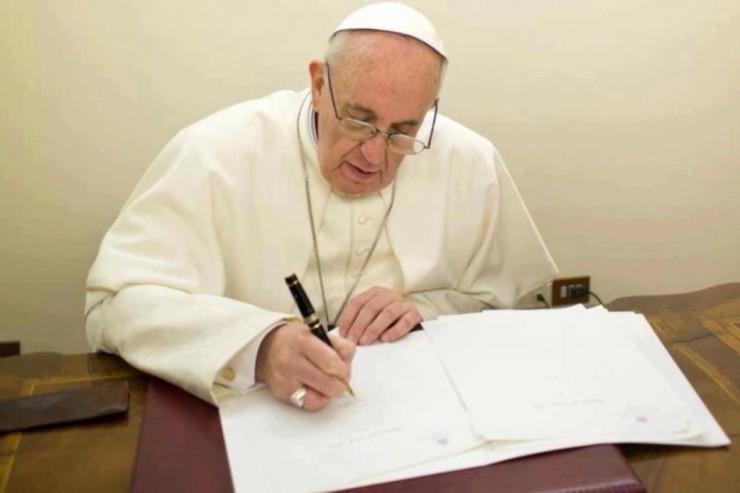
‘Deeply saddened to learn of the loss of life and of the injuries caused by the attack central London, His Holiness Pope Francis expresses his prayerful solidarity with all those affected by this tragedy.’
Pope Francis has sent his condolences to the loved ones of the victims of the terrorist attack yesterday in London. According to BBC, yesterday, March 22, 2017, in a terror attack near the Houses of Parliament, four people were killed and some 40 others injured. During the afternoon, a terrorist drove a car over Westminster Bridge, near the Houses of Parliament in the city central, killing at least two pedestrians and injuring many others. The car subsequently crashed into railings outside the Houses of Parliament. Armed with a knife, the attacker ran to Parliament where he police confronted him. One officer, who was not armed, was stabbed and killed. The armed officers shot dead the attacker.
Below is the Vatican-provided text of the Pope’s message:
***
Below is the Vatican-provided text of the Pope’s message:
***
His Eminence Cardinal Vincent Nichols
Archbishop of Westminster
President of the Bishops’ Conference of England and Wales
Deeply saddened to learn of the loss of life and of the injuries caused by the attack central London, His Holiness Pope Francis expresses his prayerful solidarity with all those affected by this tragedy. Commending those who have died to the loving mercy of Almighty God, His Holiness invokes divine strength and peace upon their grieving families, and he assures the nation of his prayers at this time.
Cardinal Pietro Parolin
Secretary of State
Archbishop of Westminster
President of the Bishops’ Conference of England and Wales
Deeply saddened to learn of the loss of life and of the injuries caused by the attack central London, His Holiness Pope Francis expresses his prayerful solidarity with all those affected by this tragedy. Commending those who have died to the loving mercy of Almighty God, His Holiness invokes divine strength and peace upon their grieving families, and he assures the nation of his prayers at this time.
Cardinal Pietro Parolin
Secretary of State
Wednesday, March 22, 2017
Bishop of Lima Peru, he defended the poor and the native Indians
St. Toribio Alfonso de Mogrovejo

Archdiocese of New Orleans offfering diocese-wide confessions for three consecutive Wednesdays
#NOLACatholic Churches open for Evenings of Confession March 22, 29 and April 5
Archbishop Gregory M. Aymond • Tue, Mar 14 2017
Dear Sisters and Brothers in Christ:
I pray that your Lenten journey has been a time of drawing closer to Christ and responding to his invitation to conversion.
As we identify an area of our life that needs change, we can be assured of God's help for us to face our weakness and experience a change of heart. Lent should include standing before our merciful God and asking for his forgiveness in the Sacrament of Reconciliation, better known as Confession.
Please be reminded that a priest will be available in every church in the Archdiocese of New Orleans for the next 3 Wednesdays from 5:00pm - 6:30pm. The heart of Jesus is open and he invites you to know and accept his mercy.
Whether we have been to Confession recently, or perhaps it has been many years, now is the time to know that his heart is open and eager to forgive.
Let us remember one another in prayer as we continue this journey through Lent to the new life of Easter.
Wishing you God's blessings, I am
Sincerely in Christ,
Most Reverend Gregory M. Aymond
Archbishop of New Orleans
Subscribe to:
Posts (Atom)