Saturday, February 25, 2017

From royalty to Sainthood

St. Isabel of France


Image of St. Isabel of France

Facts

Feastday: February 26


Sister of St. Louis and daughter of King Louis VIII of France and Blanche of Castile, she refused offers of marriage from several noble suitors to continue her life of virginity consecrated to God. She ministered to the sick and the poor, and after the death of her mother, founded the Franciscan Monastery of the Humility of the Blessed Virgin Mary at Longchamps in Paris. She lived there in austerity but never became a nun and refused to become abbess. She died there on February 23, and her cult was approved in 1521

Pope Francis to visit the Anglicans

Pope to Visit Anglican All Saints Church on Sunday
During Visit to Italy’s Largest Anglican Congregation, Francis Will Bless Byzantine Statue
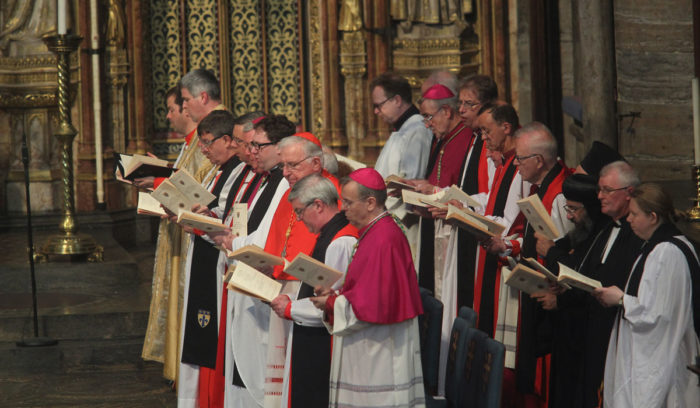
WA-Rome-50th-23-700x408
Evensong marking the 50th anniversary of the Anglican Centre in Rome. Image: Westminster-Abbey.org© (image found on the website of the Ambassador's blog)
Marking the first Pope to enter inside an Anglican church in his own diocese as Bishop of Rome, Pope Francis’ visit this Sunday, Feb. 26, to the Church of England chaplaincy of All Saints in Rome, will be historic.
According to a statement released by the Holy See Press Office, during the afternoon encounter to Italy’s largest Anglican congregation, “the Holy Father will join the congregation for a short Choral Evensong service which includes the blessing of a specially commissioned icon and the twinning of All Saints with the Catholic parish of Ognissanti, a Rome church with strong ecumenical ties.”
During the afternoon liturgy at the Church near Rome’s Spanish steps, which will take the form of a shortened Choral Evensong, Pope Francis will deliver a homily and afterwards, he will answer questions from members of the congregation.
The Italian state recently granted legal recognition to the church, which is part of the Diocese in Europe’s Archdeaconry of Italy and Malta.
The event, the statement pointed out, comes as part of the 200th anniversary celebrations for All Saints which began with a small group of worshippers holding the first Church of England liturgy on October 27th 1816. The current church was built over half a century later, designed by George Edmund Street, one of the most famous British architects of the Victorian era.

Friday, February 24, 2017

From England to Germany she is our Saint of the Day


Image of St. Walburga

Facts

Feastday: February 25
Death: 779


St. Walburga, Virgin (Feast day - February 25) Walburga was born in Devonshire England, around 710. She was the daughter of a West Saxon chieftain and the sister of St. Willibald and Winebald. Walburga was educated at Wimborne Monastery in Dorset, where she became a nun. In 748, she was sent with St. Lioba to Germany to help St. Boniface in his missionary work. She spent two years at Bishofsheim, after which she became Abbess of the double monastery at Heidenheim founded by her brother Winebald. At the death of Winebald, St. Walburga was appointed Abbess of both monasteries by her brother Willibald, who was then Bishop of Eichstadt. She remained superior of both men and women until her death in 779. She was buried first at Heidenheim, but later her body was interred next to that of her brother, St. Winebald, at Eichstadt. at a small church called Holy Cross around which a group of canonesses were gathered

Friday Morning Papal Homily

Pope’s Morning Homily: “Is Justice or Mercy More Important to God? They Are One Thing …”
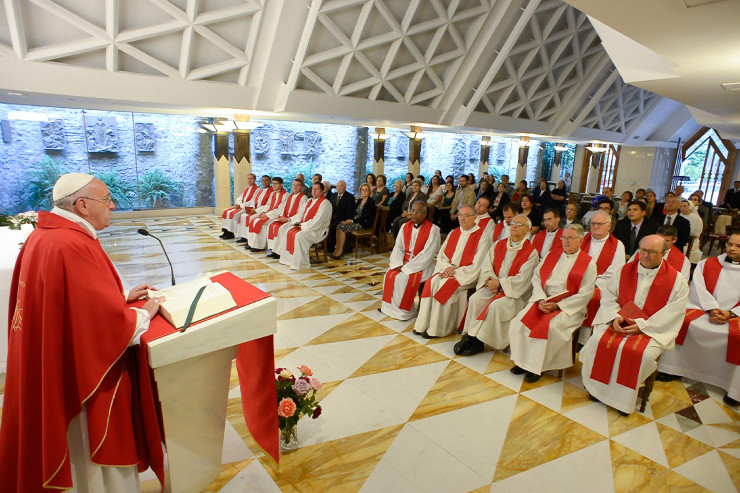
At Casa Santa Marta, Francis Says Jesus Does Not Yield  to the Hypocritical Logic of Casuistry and Always Affirms the Truth, with Mercy
_0002421
L'Osservatore Romano
Jesus tells the truth; He does not yield to the logic of casuistry, behind which hypocrisy hides.
According to Vatican Radio, Pope Francis stressed this during his daily morning Mass at his residence Casa Santa Marta, commenting on today’s Gospel in which the Doctors of the Law ask the Nazarene: “Is it licit for a husband to repudiate his wife?”
According to the Holy Father, they use this question to put Jesus “to the test,” who instead  is not deceived. “They only thought of the faith in terms of ‘it can’ or ‘it cannot’ be done, up to where it can, up to where it cannot “ be done. The Pontiff describes it as the “logic of casuistry,” in which “Jesus does not enter.”
In fact, the Savior addresses a question to them: “But what did Moses order? What is in your Law?” And they “explain the permission that Moses gave to repudiate one’s wife, and they are in fact the ones who fall into the trap. Because Jesus describes them as ‘hard of heart’: ‘Because of the hardness of your heart he wrote this norm for you,’ and He says the truth, without casuistry, without permissions – the truth,” continued Francis.
Jesus never negotiates with the truth, commented the Pontiff. And He does so also when His disciples ask him about adultery, to whom He repeats: “One who repudiates his wife and marries another, commits adultery toward her, and if she has repudiated her husband and marries another, she commits adultery.”
Despite adultery being “grave,” reflects the Pope, Jesus speaks so often with an adulteress, a pagan, even drinking “from her glass, which was not purified.” He confronts the sinner and in the end absolves her thus: “I do not condemn you. Do not sin again.”
Pope Bergoglio describes this “way of Jesus” as a course that goes “from casuistry to the truth and to mercy.” Therefore, he commented: “Jesus leaves casuistry out. To those who wished to put Him to the test, to those who thought with this logic of ‘it can’ , he describes – not here but in another passage of the Gospel; — as hypocrites. Also with the fourth Commandment, they refused to assist their parents with the excuse that they had made a good offering to the Church. Hypocrites, casuistry is hypocritical. It is a hypocritical thought. ‘It can – it cannot’ be done … which then becomes more subtle, more diabolic: but up to where can I? But from here to here, I cannot. It is the deceit of casuistry. “
A Christian’s task is to imitate Jesus, having truth coincide with mercy, which in the Savior is “the incarnation of the Father’s Mercy.” To succeed in this task “is not easy,” clarified Francis. “The grace of God is needed.”
Hence, his invitation to turn to the Lord: “’Lord, may I be just, but just with mercy.’ Not just, covered by casuistry. Just in mercy, as you are. Just in mercy. Then, one of a casuistic mentality can ask: ‘But what is more important in God, justice or mercy?’ It is also a bad thought that seeks to find a way out … What is more important? They are not two: they are only one, only one thing.”
Therefore, “in God justice is mercy and mercy is justice. May the Lord help us to understand this way, which isn’t easy, but which will make us happy and will make many people happy,” concluded the Pope.

Thursday, February 23, 2017

Thursday morning preaching with the Pope

Pope’s Morning Homily: No Double Lives, Convert
At Casa Santa Marta, Francis Reflects on How Scandal Destroys
150611-01-740x493
Photo Archives - L'OSSERVATORE ROMANO
No more double lives. Convert now…
According to Vatican Radio, Pope Francis gave this advice to faithful during his daily morning Mass at Casa Santa Marta, as he reflected on how converting shouldn’t be on our list of procrastinated items, because scandal destroys.
Drawing inspiration from today’s Gospel, the Pope urged: “Cut off your hand,” “Pluck out your eye,” but “don’t scandalize the little ones,” referring to the just, those who confide in the Lord, who believe simply in the Lord.
“But what is scandal?” the Pontiff asked, noting scandal is saying one thing and doing another.
“It is a double life, a double life. A totally double life: ‘I am very Catholic, I always go to Mass, I belong to this association and that one; but my life is not Christian, I don’t pay my workers a just wage, I exploit people, I am dirty in my business, I launder money…’ A double life. And so many Christians are like this, and these people scandalize others.”
How Many Times
“How many times have we heard – all of us, around the neighborhood and elsewhere – ‘but to be a Catholic like that, it’s better to be an atheist.’ It is that, scandal. You destroy. You beat down.”
This, Francis lamented, happens every day, and is seen all the time on TV or in the papers.
“In the papers, there are so many scandals, and there is also the great publicity of the scandals. And with the scandals there is destruction.”
Example
Francis then gave the example of a company that was on the brink of failure. While the workers were wishing to avoid a just strike, the company had not done well, and they wished to talk with the company’s authorities.
The people, the Argentine Pontiff noted, didn’t have money for their daily needs because they had not received their wages. Yet, the head of the company, a Catholic, Pope Francis said, was taking his winter vacation on a beach in the Middle East, and the people knew it.
“These are scandals,” Francis said.
“Jesus talks, in the Gospel, about those who commit scandal, without saying the word ‘scandal,’ but it’s understood: But you will arrive in heaven and you will knock at the gate: ‘Here I am, Lord!’ – ‘But don’t you remember? I went to Church, I was close to you, I belong to this association, I did this… Don’t you remember all the offerings I made?’
‘Yes, I remember. The offerings, I remember them: All dirty. All stolen from the poor. I don’t know you.’
That, Francis warned, will be Jesus’ response to these scandalous people who live a double life.
Double Life
“The double life comes from following the passions of the heart, the capital sins that are the wounds of original sin,” hiding the passions, but following them, the Pope explained. The first Reading, in fact, tells us that they do not satisfy, and not to trust in riches, to not say, “There’s enough for myself.” And so Pope Francis calls us to not put off conversion:
Pope Francis then encouraged all faithful to consider if there is something of a double life within us, and if as we seem to be good believers, good Catholics, underneath, we are doing something else.
‘But, sure, the Lord will eventually forgive everything, but I’ll keep going as I have been…’ If there is something saying, “Sure, this is not going well, I will convert, but not today: tomorrow.’ Let’s think about that. And let us profit from the Word of the Lord.
Pope Francis concluded, reminded those present that scandal destroys.

Founded religious order for care of girls; beatified by Pope St JPII


Image of Bl. Tommaso Maria Fusco

Facts

Feastday: February 24
Birth: 1831
Death: 1891
Beatified By: Pope John Paul II


Thomas Mary Fusco, the seventh of eight children, was born on1 December 1831 in Pagani, Salerno, in the Diocese of Nocera-Sarno, Italy, to Dr Antonio, a pharmacist, and Stella Giordano, of noble descent. They were known for their upright moral and religious conduct, and taught their son Christian piety and charity to the poor.
He was baptized on the day he was born in the parish of S. Felice e Corpo di Cristo. In 1837, when he was only six years old, his mother died of cholera and a few years later, in 1841, he also lost his father. Fr Giuseppe, an uncle on his father's side and a primary school teacher, then took charge of his education.
Since 1839, the year of the canonization of St Alphonsus Mary de' Liguori, little Tommaso had dreamed of church and the altar; in 1847 he was at last able to enter the same diocesan seminary of Nocera which his brother Raffaele would leave after being ordained a priest in 1849.
On 1 April 1851, Tommaso Maria received the sacrament of Confirmation and on 22 December 1855, after completing his seminary formation, he was ordained a priest by Bishop Agnello Giuseppe D'Auria.
In those years, sorrowful because of the loss of his loved ones, including his uncle (1847) as well as his young brother, Raffaele (1852), the devotion to the Patient Christ and to his Blessed Sorrowful Mother, already dear to the entire Fusco family, took root in Tommaso Maria, as in fact his biographers recall: "He had a deep devotion to the crucified Christ which he cherished throughout his life".
Right from the start he saw to the formation of boys for whom he opened a morning school in his own home, while for young people and adults, bent on increasing their human and Christian formation, he organized evening prayers at the parish church of S. Felice e Corpo di Cristo. This was a true place of conversion and prayer, just as it had been for St Alphonsus, revered and honoured in Pagani for his apostolate.
In 1857, he was admitted to the Congregation of the Missionaries of Nocera under the title of St Vincent de Paul and became an itinerant missionary, especially in the regions of Southern Italy.
In 1860 he was appointed chaplain at the Shrine of our Lady of Carmel (known as "Our Lady of the Hens") in Pagani, where he built up the men's and women's Catholic associations and set up the altar of the Crucified Christ and the Pious Union for the Adoration of the Most Precious Blood of Jesus.
In 1862 he opened a school of moral theology in his own home to train priests for the ministry of confession, kindling enthusiasm for the love of Christ's Blood; that same year, he founded the "(Priestly) Society of the Catholic Apostolate" for missions among the common people; in 1874 he received the approval of Pope Pius IX, now blessed.
Deeply moved by the sorry plight of an orphan girl, a victim of the street, after careful preparation in prayer for discernment, Fr Tommaso Maria founded the Congregation of the "Daughters of Charity of the Most Precious Blood" on 6 January, the Solemnity of Epiphany in 1873. This institute was inaugurated at the Church of Our Lady of Mount Carmel, in the presence of Bishop Raffaele Ammirante, who, with the clothing of the first three sisters with the religious habit, blessed the first orphanage for seven poor little orphan girls of the area. It was not long before the newborn religious family and the orphanage also received the Pope's blessing, in response to their request.
Fr Tommaso Maria continued to dedicate himself to the priestly ministry, preaching spiritual retreats and popular missions; and from his apostolic travels sprang the many foundations of houses and orphanages that were a monument to his heroic charity, which was even more ardent in the last 20 years of his life (1870-1891).
In addition to his commitments as founder and apostolic missionary, he was parish priest (1874-1887) at the principal church of S. Felice e Corpo di Cristo in Pagani, extraordinary confessor to the cloistered nuns in Pagani and Nocera and, in the last years of his life, spiritual father of the lay congregation at the Shrine of Our Lady of Mount Carmel.
It was not long before Fr Tommaso Maria, envied for the good he achieved in his ministry and for his life as an exemplary priest, was faced with humiliation and persecution and, in 1880, even a brother priest's slanderous calumny. However, sustained by the Lord, he lovingly carried that cross which own Pastor, Bishop Ammirante had foretold at the time of his institute's foundation: "Have you chosen the title of the Most Precious Blood? Well, may you be prepared to drink the bitter cup".
During the harshest of trials, which he bore in silence, he would repeat: "May work and suffering for God always be your glory and in your work and suffering, may God be your consolation on this earth, and your recompense in heaven. Patience is the safeguard and pillar of all the virtues".
Wasting away with a liver-disease, Fr Tommaso Maria died a devout death on 24 February 1891, praying with the elderly Simeon: Lord, now let your servant depart in peace, according to your word" (Lk 2, 29).
He was only 59 years old! In the notice issued by the town council of Pagani on 25 February 1891 the Gospel witness of his life, known to one and all, was summarized in these words: "Tommaso Maria Fusco, Apostolic Missionary, Founder of the Daughters of Charity of the Most Precious Blood, an exemplary priest of indomitable faith and ardent charity, worked tirelessly in the name of the Redeeming Blood for the salvation of souls: in life he loved the poor and in death forgave his enemies".
His life was directed to the highest devotion of Christian virtues by the priestly life, lived intensely in constant meditation on the mystery of the Father's love, contemplated in the crucified Son whose Blood is "the expression, measure and pledge" of divine Charity and heroic charity to the poor and needy, in whom Fr Tommaso Maria saw the bleeding Face of Jesus.
His writings, preaching and popular missions marked his vast experience of faith and the light of Christian hope that shone from his vocation and actions. He had a vital, burning love for God; it enflamed his words and his apostolate, made fruitful by love for God and neighbour, by union with the crucified Jesus, by trust in Mary, Immaculate and Sorrowful, and above all by the Eucharist.
Fr Tommaso Maria Fusco was an Apostle of Charity of the Most Precious Blood, a friend of boys and girls and young people and attentive to every kind of poverty and human and spiritual misery.
For all these reasons he enjoyed the fame of holiness among the diocesan priests, among the people and among his spiritual daughters who received his charism, and witness to it today in the various parts of the world where they carry out their apostolate in communion with the Church.
The cause for the beatification of Fr Tommaso Maria Fusco was initiated in 1955 and the decree of his heroic Christian virtues was published on 24 April 2001. The miraculous healing of Mrs Maria Battaglia on 20 August 1964 in Sciacca, Agrigento, Sicily, through the intercession of Fr Tommaso Maria Fusco was recognized on7 July 2001.
With his beatification, Pope John Paul II presents Fr Tommaso Maria Fusco as an example and a guide to holiness for priests, for the people of God and for his spiritual daughters, the Daughters of Charity of the Most Precious Blood.

He was a disciple of one of the 12 Apostles


Image of St. Polycarp

Facts

Feastday: February 23


Imagine being able to sit at the feet of the apostles and hear their stories of life with Jesus from their own lips. Imagine walking with those who had walked with Jesus, seen him, and touched him. That was what Polycarp was able to do as a disciple of Saint John the Evangelist.
But being part of the second generation of Church leaders had challenges that the first generation could not teach about. What did you do when those eyewitnesses were gone? How do you carry on the correct teachings of Jesus? How do you answer new questions that never came up before?
With the apostles gone, heresies sprang up pretending to be true teaching, persecution was strong, and controversies arose over how to celebrate liturgy that Jesus never laid down rules for.
Polycarp, as a holy man and bishop of Smyrna, found there was only one answer -- to be true to the life of Jesus and imitate that life. Saint Ignatius of Antioch told Polycarp "your mind is grounded in God as on an immovable rock."
When faced with heresy, he showed the "candid face" that Ignatius admired and that imitated Jesus' response to the Pharisees. Marcion, the leader of the Marcionites who followed a dualistic heresy, confronted Polycarp and demanded respect by saying, "Recognize us, Polycarp." Polycarp responded, "I recognize you, yes, I recognize the son of Satan."
On the other hand when faced with Christian disagreements he was all forgiveness and respect. One of the controversies of the time came over the celebration of Easter. The East, where Polycarp was from, celebrated the Passover as the Passion of Christ followed by a Eucharist on the following day. The West celebrated Easter on the Sunday of the week following Passover. When Polycarp went to Rome to discuss the difference with Pope Anicetus, they could not agree on this issue. But they found no difference in their Christian beliefs. And Anicetus asked Polycarp to celebrate the Eucharist in his own papal chapel.
Polycarp faced persecution the way Christ did. His own church admired him for following the "gospel model" -- not chasing after martyrdom as some did, but avoiding it until it was God's will as Jesus did. They considered it "a sign of love to desire not to save oneself alone, but to save also all the Christian brothers and sisters."
One day, during a bloody martyrdom when Christians were attacked by wild animals in the arena, the crowd became so mad that they demanded more blood by crying, "Down with the atheists; let Polycarp be found." (They considered Christians "atheists" because they didn't believe in their pantheon of gods.) Since Polycarp was not only known as a leader but as someone holy "even before his grey hair appeared", this was a horrible demand.
Polycarp was calm but others persuaded him to leave the city and hide at a nearby farm. He spent his time in prayer for people he knew and for the Church. During his prayer he saw a vision of his pillow turned to fire and announced to his friends that the dream meant he would be burned alive.
As the search closed in, he moved to another farm, but the police discovered he was there by torturing two boys. He had a little warning since he was upstairs in the house but he decided to stay, saying, "God's will be done."
Then he went downstairs, talked to his captors and fed them a meal. All he asked of them was that they give him an hour to pray. He spent two hours praying for everyone he had every known and for the Church, "remembering all who had at any time come his way -- small folk and great folk, distinguished and undistinguished, and the whole Catholic Church throughout the world." Many of his captors started to wonder why they were arresting this holy, eighty-six-year-old bishop.
But that didn't stop them from taking him into the arena on the Sabbath. As he entered the arena, the crowd roared like the animals they cheered. Those around Polycarp heard a voice from heaven above the crowd, "Be brave, Polycarp, and act like a man."
The proconsul begged the eighty-six-year-old bishop to give in because of his age. "Say 'Away with the atheists'" the proconsul urged. Polycarp calmly turned to the face the crowd, looked straight at them, and said, "Away with the atheists." The proconsul continued to plead with him. When he asked Polycarp to swear by Caesar to save himself, Polycarp answered, "If you imagine that I will swear by Caesar, you do not know who I am. Let me tell you plainly, I am a Christian." Finally, when all else failed the proconsul reminded Polycarp that he would be thrown to the wild animals unless he changed his mind. Polycarp answered, "Change of mind from better to worse is not a change allowed to us."
Because of Polycarp's lack of fear, the proconsul told him he would be burned alive but Polycarp knew that the fire that burned for an hour was better than eternal fire.
When he was tied up to be burned, Polycarp prayed, "Lord God Almighty, Father of your beloved and blessed Son Jesus Christ, through whom we have received knowledge of you, God of angels and powers, of the whole creation and of the whole race of the righteous who live in your sight, I bless you, for having made me worthy of this day and hour, I bless you, because I may have a part, along with the martyrs, in the chalice of your Christ, to resurrection in eternal life, resurrection both of soul and body in the incorruptibility of the Holy Spirit. May I be received today, as a rich and acceptable sacrifice, among those who are in you presence, as you have prepared and foretold and fulfilled, God who is faithful and true. For this and for all benefits I praise you, I bless you, I glorify you, through the eternal and heavenly High Priest, Jesus Christ, your beloved Son, through whom be to you with him and the Holy Spirit glory, now and for all the ages to come. Amen."
The fire was lit as Polycarp said Amen and then the eyewitnesses who reported said they saw a miracle. The fire burst up in an arch around Polycarp, the flames surrounding him like sails, and instead of being burned he seemed to glow like bread baking, or gold being melted in a furnace. When the captors saw he wasn't being burned, they stabbed him. The blood that flowed put the fire out.
The proconsul wouldn't let the Christians have the body because he was afraid they would worship Polycarp. The witnesses reported this with scorn for the lack of understanding of Christian faith: "They did not know that we can never abandon the innocent Christ who suffered on behalf of sinners for the salvation of those in this world." After the body was burned, they stole the bones in order to celebrate the memory of his martyrdom and prepare others for persecution. The date was about February 23, 156.

Wednesday, February 22, 2017

Wednesday General Audience with the Pope

GENERAL AUDIENCE: Pope: ‘Let Us See Ourselves, World With Christ’s Eyes’
Official Synthesis of the Catechesis — February 22nd 2017
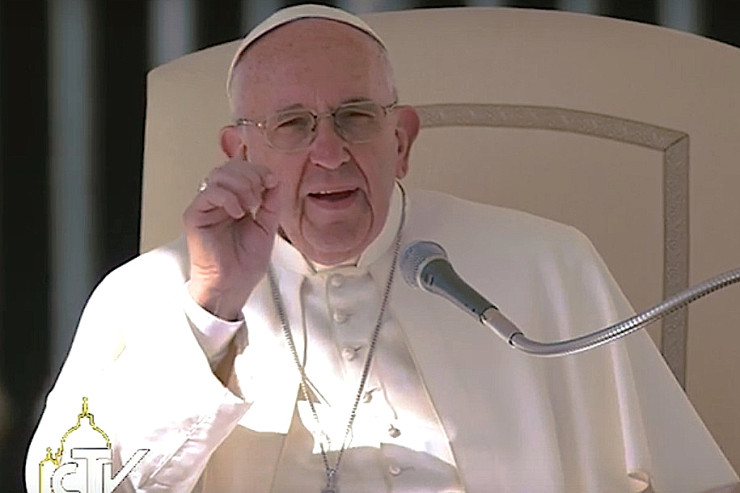
Pope at Audience
CTV Screenshot
‘Let us see ourselves and the world with Christ’s eyes,’ encouraged Pope Francis during the General Audience of February 22, 2017.
Continuing his catecheses on Christian hope, the Pope meditated on how Saint Paul reminds us that creation is God’s gift, which reveals to us His loving plan, and what this means to faithful on a practical level.
Pope Francis concluded, praying that all faithful realize that amid being discouraged or tempted to despair, we are to remember “that the Holy Spirit comes to our aid, to keep alive our cries to God, and to reveal new heavens and a new earth which he is preparing for us.”
***
Speaker:
Dear Brothers and Sisters: Rather than being something we possess and use for own pleasure, Saint Paul reminds us that creation is God’s gift, which reveals to us his loving plan. But when we are self-centred and commit sin, we break our communion with God, and the original beauty of human nature and creation is marred. Thus, rather than show God’s infinite love, creation bears the wounds of human pride. The Lord, however, does not abandon us, but offers us a new horizon of freedom and salvation. Saint Paul reminds us of this truth, by inviting us to hear the groaning of all people and things, and even the groaning of the Holy Spirit in our hearts. These groans are not sterile, but speak of the pangs of birth, the ushering in of new life. Despite the many signs of our sins and failings, we know that we are saved by the Lord, and even now contemplate and experience within ourselves and all around us signs of the Resurrection, a new creation. We know that Jesus wants to heal us and creation once and for all, and reconcile us in his love. Let us see ourselves and the world with Christ’s eyes. And when we are discouraged or tempted to despair, let us remember that the Holy Spirit comes to our aid, to keep alive our cries to God, and to reveal new heavens and a new earth which he is preparing for us.
Speaker:
I greet the English-speaking pilgrims and visitors taking part in today’s Audience, particularly those from England, Ireland, Norway, India and the United States of America. Upon all of you, I invoke the gifts of mercy and peace, and I pray to the Lord that they may help you to care for creation and one another. May God bless you!

Tuesday, February 21, 2017

The Feast of the Chair of St. Peter

This feast brings to mind the mission of teacher and pastor conferred by Christ on Peter, and continued in an unbroken line down to the present Pope. We celebrate the unity of the Church, founded upon the Apostle, and renew our assent to the Magisterium of the Roman Pontiff, extended both to truths which are solemnly defined ex cathedra, and to all the acts of the ordinary Magisterium.
The feast of the Chair of Saint Peter at Rome has been celebrated from the early days of the Christian era on 18 January, in commemoration of the day when Saint Peter held his first service in Rome. The feast of the Chair of Saint Peter at Antioch, commemorating his foundation of the See of Antioch, has also been long celebrated at Rome, on 22 February. At each place a chair (cathedra) was venerated which the Apostle had used while presiding at Mass. One of the chairs is referred to about 600 by an Abbot Johannes who had been commissioned by Pope Gregory the Great to collect in oil from the lamps which burned at the graves of the Roman martyrs. — New Catholic Dictionary


Chair of St. Peter
Since early times, the Roman Church has had a special commemoration of the primatial authority of St. Peter. As witness one of the most renowned of the Apostolic Fathers, the Roman See has always held a peculiar place in the affection and obedience of orthodox believers because of its "presiding in love" and service over all the Churches of God.
"We shall find in the Gospel that Jesus Christ, willing to begin the mystery of unity in His Church, among all His disciples chose twelve; but that, willing to consummate the mystery of unity in the same Church, among the twelve He chose one. He called His disciples, said the Gospel; here are all; and among them He chose twelve. Here is the first separation, and the Apostles chosen. And these are the names of the twelve Apostles: the first, Simon, who is called Peter. [Mt. 10, 1-2] Here, in a second separation, St. Peter is set at the head, and called for that reason by the name of Peter, 'which Jesus Christ,' says St. Mark, 'had given him,' in order to prepare, as you will see, the work which He was proposing to raise all His building on that stone.
"All this is yet but a beginning of the mystery of unity. Jesus Christ, in beginning it, still spoke to many: Go, preach; I send you [see Mt. 28, 19]. Now, when He would put the last hand to the mystery of unity, He speaks no longer to many: He marks out Peter personally, and by the new name which He has given him. It is One who speaks to one: Jesus Christ the Son of God to Simon son of Jonas; Jesus Christ, who is the true Stone, strong of Himself, to Simon, who is only the stone by the strength which Jesus Christ imparts to him. It is to him that Christ speaks, and in speaking acts on him, and stamps upon him His own immovableness. And I, He says, say to you, you are Peter; and, He adds, upon this rock I will build my Church, and, He concludes, the gates of hell shall not prevail against it. [Mt. 16, 18] To prepare him for that honor Jesus Christ, who knows that faith in Himself is the foundation of His Church, inspires Peter with a faith worthy to be the foundation of that admirable building. You are the Christ, the Son of the living God. [Mt. 16, 16] By that bold preaching of the faith he draws to himself the inviolable promise which makes him the foundation of the Church.
"It was, then, clearly the design of Jesus Christ to put first in one alone, what afterwards He meant to put in several; but the sequence does not reverse the beginning, nor the first lose his place. That first word, Whatsoever you shall bind, said to one alone, has already ranged under his power each one of those to whom shall be said, Whatsoever you shall remit; for the promises of Jesus Christ, as well as His gift, are without repentance; and what is once given indefinitely and universally is irrevocable. Besides, that power given to several carries its restriction in its division, while power given to one alone, and over all, and without exception, carries with it plenitude, and, not having to be divided with any other, it has no bounds save those which its terms convey."
Excerpted from The See of St. Peter, Jacques Bossuet.