Wednesday, September 28, 2016

St. Michael the Archangel, defend us in battle....


Image of St. Michael the Archangel

Facts

Feastday: September 29
Patron of grocers, soldiers, doctors, mariners, paratroopers, police, and sickness


Saint Michael the Archangel isn't a saint, but rather he is an angel, and the leader of all angels and of the army of God. This is what the title "Archangel" means, that he is above all the others in rank.
St. Michael has four main responsibilities or offices, as we know from scripture and Christian tradition.
  • The first is to combat Satan.
  • The second is to escort the faithful to heaven at their hour of death.
  • The third is to be a champion of all Christians, and the Church itself.
  • And the fourth is to call men from life on Earth to their heavenly judgment.
Very little is known about St Michael other than what we know from scriptures, which themselves are sparse.
In Daniel, St. Michael is mentioned twice. The first time as one who helped Daniel, and the second time he is mentioned with regard to the end times of the world when he will stand for the "children of thy people."
His next mention comes in the Epistle of St. Jude, where St. Michael is said to guard the tombs of Moses and Eve and has contended with Satan over the body of Moses.
The final mention is in Revelation, where St. Michael and his angels, do battle with the dragon.
There are other scriptures where St. Michael is implied, but not mentioned by name, such as the angel; who defends the gate to Paradise, who defends against Balaam, and "who routed the army of Sennacherib."
Today, St. Michael is invoked for protection, especially from lethal enemies. He is also the patron of soldiers, police and doctors.

Pope Francis expresses condolences and solidarity to Israel on death of Shimon Peres

Pope’s Telegram for Death of Former Israel President Shimon Peres
‘As the State of Israel mourns Mr Peres, I hope that his memory and many years of service will inspire us all to work with ever greater urgency for peace and reconciliation between peoples.’
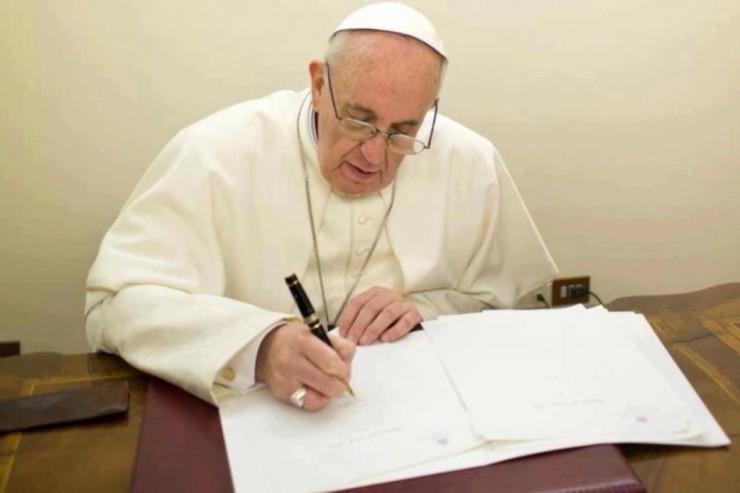
Pope writing a letter
Below is a Vatican-provided translation of the telegram of condolences Pope Francis sent upon learning of the death of Former President of Israel Shimon Peres:
***
His Excellency Reuven Rivlin
President of the State of Israel
I was deeply saddened to learn of the death of His Excellency Shimon Peres, and I wish to convey to you and to all the people of Israel my heartfelt condolences. I fondly recall my time with Mr Peres at the Vatican and renew my great appreciation for the late President’s tireless efforts in favour of peace. As the State of Israel mourns Mr Peres, I hope that his memory and many years of service will inspire us all to work with ever greater urgency for peace and reconciliation between peoples. In this way, his legacy will truly be honoured and the common good for which he so diligently laboured will find new expressions, as humanity strives to advance on the path towards enduring peace. With the assurance of my prayers for all who grieve, especially for the Peres family, I invoke the divine blessings of consolation and strength upon the nation.
FRANCISCUS PP.
[Original text: English] [Vatican-provided text]

Wednesday General Audience with Pope Francis

English Summary of Pope’s General Audience
‘The good thief helps us to understand how we should approach God: with awe and not fear, with respect for God’s power and infinite goodness. When we approach him in this way, we entrust ourselves to his mercy, even in the darkest of moments.’
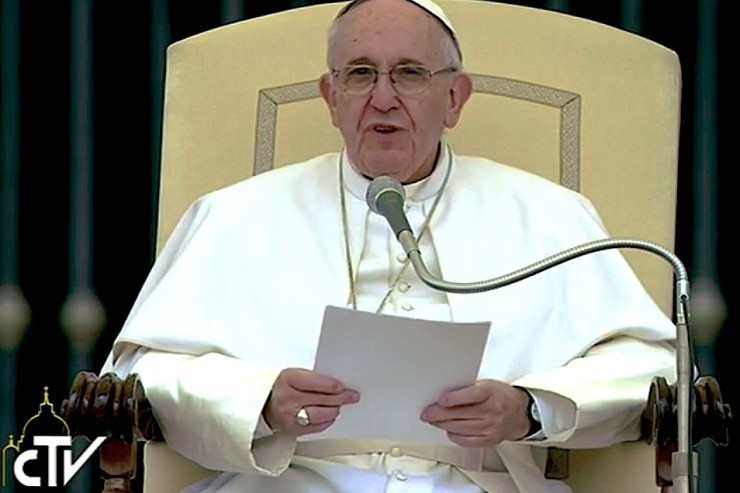
Pope at Audience CTV
CTV Pope - General Audience
Here is the Vatican-provided English-language summary of Pope Francis’ General Audience this morning in St. Peter’s Square:
***
Speaker:Dear Brothers and Sisters: Jesus’ words during his Passion culminate in forgiveness: “Father, forgive them; for they know not what they do” (Lk 23:34). For the good thief, these are not mere words, for Jesus truly forgives him. For the bad thief, however, it is inconceivable that the Messiah would remain on the Cross and not save himself. But it is precisely by remaining on the Cross that Jesus offers salvation to every person regardless of their situation. This Jubilee Year is a time of grace and mercy for all, the good and the bad, those in health and those who suffer. It is a time to remember that nothing can separate us from the love of God (cf. Rm 8:39). To all those sick in hospital, who live within the walls of a prison, or who are trapped by war, we are called to look to Christ Crucified on the Cross, who is God with us, who remains with us on the Cross and who offers himself as our Saviour. The good thief helps us to understand how we should approach God: with awe and not fear, with respect for God’s power and infinite goodness. When we approach him in this way, we entrust ourselves to his mercy, even in the darkest of moments. For God is always with us sinners, and he loves us even to death on the Cross. Let us see in the good thief a model of confidence in the Lord and, like him, let us call upon Jesus’ name and ask him to remember us in Paradise.

Speaker: I greet the English-speaking pilgrims and visitors taking part in today’s Audience, particularly those from England, Scotland, Ireland, Denmark, Norway, Switzerland, Brunei, India, Indonesia, Malaysia, South Korea, Japan, Vietnam, South Africa, Australia, Canada and the United States of America. I extend a special welcome to the seminarians of the Pontifical North American College and their families gathered here for the Ordination to the Diaconate to be celebrated tomorrow. May God bless you all!
[Original text: English] [Vatican-provided text]  

Tuesday, September 27, 2016

A Christian King and Martyr


Image of St. Wenceslaus

Facts

Feastday: September 28
Patron of Bohemia, Czech state, Prague
Birth: 907
Death: 935


St. Wenceslaus, also known by Vaclav, was born near Prague, and was the son of Duke Wratislaw. He was taught Christianity by his grandmother, St. Ludmila. The Magyars, along with Drahomira, an anti-Christian faction murdered the Duke and St. Lumila, and took over the government. Wenceslaus was declared the new ruler after a coup in 922. He encouraged Christianity. Boleslaus, his brother, no longer successor to the throne, after Wenceslaus' son was born, joined a group of noble Czech dissenters. They invited Wenceslaus to a religious festival, trapped and killed him on the way to Mass. He is the patron saint of Bohemia and his feast day is Sept. 28.

A new Bishop for Texas

Dallas Priest Named to Lead Lubbock Diocese
Robert Coerver, 62, has a counseling degree in addition to his theology studies
Holy Shepherd
ZENIT - HSM
Pope Francis has named Msgr. Robert Coerver as bishop of the Diocese of Lubbock, Texas, and accepted the resignation of Bishop Plácido Rodríguez.
Msgr. Coerver serves as a priest in the Diocese of Dallas.
The appointment and resignation were publicized today.
A native of Dallas, Robert Coerver, 62, was born June 6, 1954. He earned a bachelor’s degree in philosophy from the University of Dallas, and pursued post-graduate studies at the Pontifical University of Saint Thomas Aquinas (Angelicum), in Rome. Bishop-elect Coerver also holds a licentiate in spiritual theology from the Pontifical Gregorian University in Rome and a master’s degree in counseling and guidance from Texas A & M University. He was ordained a priest in the Diocese of Dallas in 1980.
In 2004, Pope John Paul II named him a prelate of honor with the title of monsignor.
Bishop Rodríguez, who has headed the Diocese of Lubbock since 1994, is 75. Bishop Rodríguez was born in Guanajuato, Mexico in 1940. He was ordained a priest on May 23, 1968, and was appointed auxiliary bishop of Chicago in 1983. On April 5, 1994, he was appointed bishop of Lubbock and was installed on June 1, 1994.
The Diocese of Lubbock comprises 23,382 square miles in the state of Texas. It has a population of 494,458 people of whom 136,894, or 28 percent, are Catholic.

Tuesday Morning Papal Homily

Pope’s Advice for Accompanying the Suffering: Don’t Give Speeches. Be Close. Caress.
At Casa Santa Marta, Francis says spiritual desolation is something we’ll all experience at some point
Santa Marta
L'Osservatore Romano
Spiritual desolation is something everyone will experience at some point, says Pope Francis, and when we see a loved one going through this darkness, we need to offer comfort and support with our closeness, not our counsels.
The Pope said this today during morning Mass at Casa Santa Marta, reported Vatican Radio.
Drawing from the reading from Job, the Holy Father noted, “Spiritual desolation is something that happens to all of us: it can be stronger or weaker … but that feeling of spiritual darkness, of hopelessness, mistrust, lacking the desire to live, without seeing the end of the tunnel, with so much agitation in one’s heart and in one’s ideas…  Spiritual desolation makes us feel as though our souls are crushed, we can’t succeed, we can’t succeed and we also don’t want to live: ‘Death is better!’ This was Job’s outburst. It was better to die than live like this. We need to understand that when our soul is in this state of generalized sadness we can barely breathe: This happens to all of us … whether strong or not … to all of us. (We need to) understand what goes on in our hearts.”
The solution to spiritual desolation is prayer, the Pontiff said.
“What should we do when we experience these dark moments, be it for a family tragedy, an illness, something that weighs us down?”
Noting that some people would think of taking a pill to sleep and remove them from their problems or drinking “one, two, three or four glasses” he warned that these methods “do not help.” Instead, today’s liturgy shows us how to cope with this spiritual desolation, “when we are lukewarm, depressed and without hope.”
The Pope said the way out from this situation is to pray, to pray loudly, just as Job did, day and night until God listens. “It is a prayer to knock at the door but with strength! ‘Lord, my soul is surfeited with troubles. My life draws near to Hell. I am numbered among those who go down into the pit; I am a man without strength.’ How many times have we felt like this, without strength?  And here is the prayer. Our Lord himself taught us how to pray in these dreadful moments. ‘Lord, you have plunged me into the bottom of the pit. Upon me, your wrath lies heavy. Let my prayer come before you, Lord.’ This is the prayer and this is how we should pray in our darkest, most dreadful, bleakest and most crushed moments that are really crushing us. This is genuine prayer. And it’s also giving vent just like Job did with his sons. Like a son.”

Comfort the afflicted

For those close to the people who are suffering, the way to proceed is with closeness, silence and prayer, since words and speeches in these situations can do harm, the Pontiff suggested.
“First of all, we must recognize in ourselves these moments of spiritual desolation, when we are in the dark, without hope and asking ourselves why. Secondly, we must pray to the Lord like today’s reading from Psalm 87 teaches us to pray during our dark moments. ‘Let my prayer come before you, Lord.’ Thirdly, when I draw close to a person who is suffering, whether from illness, or whatever other type of suffering and who is experiencing a sense of desolation, we must be silent: but a silence with much love, closeness and caresses.  And we must not make speeches that don’t help in the end and even can do harm.”
The Pope concluded his homily by asking the Lord to grant us these three graces: the grace to recognize spiritual desolation, the grace to pray when we are afflicted by this feeling of spiritual desolation and also the grace to know how to be close to people who are suffering terrible moments of sadness and spiritual desolation.

Monday, September 26, 2016

The Father to the Poor; the Apostle of Charity


Image of St. Vincent de Paul

Facts

Feastday: September 27
Patron of charities; horses; hospitals; leprosy; lost articles; Madagascar; prisoners; Richmond, Virginia; spiritual help; Saint Vincent de Paul Societies; Sacred Heart Cathedral Preparatory; Vincentian Service Corps; volunteers
Birth: 1581
Death: 1660
Beatified By: August 13, 1729, Rome, Papal States by Pope Benedict XIII
Canonized By: June 16, 1737, Rome, Papal States by Pope Clement XII


St. Vincent de Paul was born to a poor peasant family in the French village of Pouy on April 24, 1581. His first formal education was provided by the Franciscans. He did so well, he was hired to tutor the children of a nearby wealthy family. He used the monies he earned teaching to continue his formal studies at the University of Toulose where he studied theology.
He was ordained in 1600 and remained in Toulose for a time. In 1605, while on a ship traveling from Marseilles to Narbone, he was captured, brought to Tunis and sold as a slave. Two years later he and his master managed to escape and both returned to France.
St. Vincent went to Avignon and later to Rome to continue his studies. While there he became a chaplain to the Count of Goigny and was placed in charge of distributing money to the deserving poor. He became pastor of a small parish in Clichy for a short period of time, while also serving as a tutor and spiritual director.
From that point forward he spent his life preaching missions to and providing relief to the poor. He even established hospitals for them. This work became his passion. He later extended his concern and ministry to convicts. The need to evangelize and assist these souls was so great and the demands beyond his own ability to meet that he founded the Ladies of Charity, a lay institute of woman, to help, as well as a religious institute of priests - the Congregation of Priests of the Mission, commonly referred to now as the Vincentians.
This was at a time when there were not many priests in France and what priests there were, were neither well-formed nor faithful to their way of life. Vincent helped reform the clergy and the manner in which they were instructed and prepared for the priesthood. He did this first through the presentation of retreats and later by helping develop a precursor to our modern day seminaries. At one point his community was directing 53 upper level seminaries. His retreats, open to priests and laymen, were so well attended that it is said he infused a "Christian spirit among more than 20,000 persons in his last 23 years."
The Vincentians remain with us today with nearly 4,000 members in 86 countries. In addition to his order of Vincentian priests, St. Vincent cofounded the Daughters of Charity along with St. Louise de Marillac. There are more than 18,000 Daughters today serving the needs of the poor in 94 countries. He was eighty years old when he died in Paris on September 27, 1660.He had "become the symbol of the successful reform of the French Church". St. Vincent is sometimes referred to as "The Apostle of Charity" and "The Father of the Poor".
His incorrupt heart can be found in the Convent of the Sisters of Charity and his bones have been embedded in a wax effigy of the Saint located at the Church of the Lazarist Mission. Both sites are located in Paris, France.
Two miracles have been attributed to St Vincent - a nun cured of ulcers and a laywoman cured of paralysis. As a result of the first, Pope Benedict XIII beatified him on August 13, 1729. Less than 8 years later (on June 16, 1737) he was canonized by Pope Leo XIII. The Bull of Canonization recognized Vincent for his charity and reform of the clergy, as well as for his early role in opposing Jansenism.
It has been reported that St. Vincent wrote more than 30,000 letters in his lifetime and that nearly 7,000 had been collected in the 18th century. There are at least five collections of his letters in existence today.
The feast day for St. Vincent, the patron of all charitable societies, is September 27.

Pope Francis address to relatives of those murdered in Nice, France

Pope to Those Mourning Nice Victims: Respond to Devil’s Assault With Works of God
Assures relatives of terrorist’s victims that Church, Peter are close and filled with compassion
Nice. Terrorism.
L'Osservatore Romano
Pope Francis on Saturday welcomed to the Vatican some of the relatives of the July 14 terrorist attack in Nice, France, assuring them of the closeness of the Church and the Successor of Peter.
Nearly 90 people were killed and more than 430 injured that night, when a terrorist drove a cargo truck into crowds celebrating Bastille Day.
“I want to share your pain, a pain that becomes even greater when I think of the children, even of entire families, whose life was taken away from them suddenly in a dramatic way,” the Pope said. “I assure each of you of my compassion, my closeness and my prayer.”
The Holy Father noted the hope of the Resurrection, praying that “our heavenly Father, Father of all,” may “take to Himself your dear deceased, so that they soon find the rest and joy of eternal life.”
He also urged the mourning to confront hatred with love.
“When the temptation is great to withdraw into oneself or to respond to hatred with hatred, to violence with violence, a genuine conversion of heart is necessary,” he said. “This is the message that Jesus’ Gospel addresses to all of us. One can respond to the assaults of the devil only with the works of God, which are forgiveness, love and respect of one’s neighbor, even if he is different than you.”
The Pope reiterated the closeness of the Church, saying that She is near “with immense compassion.”
“With her presence at your side in these very heavy moments to be faced, she asks the Lord to come to your help and to put in your hearts sentiments of peace and fraternity,” he said.
“Dear brothers and sisters,” the Pope said, “once again I assure you of my prayer and of all the tenderness of the Successor of Peter.”

On ZENIT’s Web page:
Full text: https://zenit.org/articles/popes-address-to-victims-of-the-terrorist-attack

Another Catholic Priest murdered in Mexico

Kidnapped Mexican Catholic priest found shot dead

  • 26 September 2016

People gather at Our Lady of Asuncion Church in Paso Blanco, Veracruz state, Mexico, for funeral Mass in memory of Catholic priest murdered in Veracruz. 21 Sept 2016Image copyright AP
Image caption Funerals have already been held for two other priests killed in Veracruz state last week
A Roman Catholic priest who was kidnapped in western Mexico a week ago has been found shot dead.
The body of Jose Alfredo Lopez Guillen was found late on Saturday near the town of Puruandiro in Michoacan state, prosecutors said.
He is the third priest to be found murdered in Mexico in the past week.
Father Lopez Guillen had been robbed before being abducted from his home last Monday in Janamuato, Michoacan state, Church officials said.
The Michoacan prosecutor's office said a post-mortem examination showed the priest had been killed several days before his body was found.
On the same day that he disappeared, the bodies of two other priests who had vanished the day before were found by a roadside in Veracruz, on Mexico's east coast. They had also been shot dead. It is not believed their deaths are linked to that of Father Lopez Guillen.
His death brings the number of priests murdered in Mexico since 2012 to 15, according to figures from the Catholic Multimedia Center, which monitors violence against clerics.
Veracruz and Michoacan have been plagued by years of violence from drug cartels and other organised crime.