Monday, September 28, 2015

After Cuba/USA the Pope does not slow down; Synod in October, to Africa in November

Vatican officially confirms Pope Francis' visit to Africa in November

Pope Francis greets pilgrims in St. Peter's Square during the Wednesday general audience on May 28, 2014. Credit: Daniel Ibáñez/CNA.
.- The Vatican today officially announced that Pope Francis will travel to Kenya, Uganda and the Central African Republic in November, a plan informally revealed by the Pope himself this summer.

After accepting “the invitation issued by the respective Heads of State and the Bishops,” Pope Francis is scheduled to visit the African continent from Nov. 25-30, a Sept. 10 communique from the Vatican announced.
He will set foot in Kenya first, where he will stay from Nov. 25-27, before moving on to Uganda Nov. 27-29. His last stop will be the Central African Republic, from Nov. 29-30.
Francis first announced his intention to travel to Africa – specifically the Central African Republic and Uganda – during a news conference while returning from a trip to Sri Lanka and the Philippines in January.
He confirmed the plans in a June 12 meeting with hundreds of priests from around the world participating in the Third World Priests Retreat in the Basilica of St. John Lateran when he answered a question from an African priest about when he planned to visit.
“God willing, I will be in Africa in November. In the Central African Republic first and then Uganda,” he responded.
The Pope also noted that the trip will come “before the presidential transition in the Central African Republic, and Uganda after the 50th anniversary of the martyrs, though a little late.”
The 22 Ugandan Martyrs were killed by the king in the 1880s for refusing to recant their faith. They were canonized Oct. 18, 1964 by Pope Paul VI in St. Peter's Basilica. The Church of Uganda has already begun preparations for the celebration of the Golden Anniversary of the canonization with a diocesan conference on the 22 saints.
Although Pope Francis has previously spoken about visiting the African continent, today’s confirmation from the Vatican makes it official.
In the June meeting with priests, Pope Francis also addressed pastoral concerns in Africa, noting that while there might be a shortage of priests, the presence of lay catechists is strong.
As far as the Church in Africa goes, “the backbone are the catechists. I think that the formation of lay catechists is fundamental in Africa. They are the ones who carry the Church forward,” the Pope said.
Besides the catechists, there are two other institutions which stand out in caring for the people, which are the schools and the hospitals, Francis observed.
“The tenderness, the care. Many religious sisters, many laity spend years and years and years caring for the sick with great tragedies. How many laity go there to serve as doctors in the tragedies!” he said.
Francis also praised the creative spirit present in the African liturgy, saying that behind it lay “a great spiritual experience.”
However, he also touched on various challenges Africans face such as terrorism and the exploitation of the land, which he spoke of in his recent encyclical on the environment, “Laudato Si.”
Right now in Africa there is “a serious problem of the ideological wars” led by groups such as Boko Haram that needs to be addressed, he said, noting that the continent has also become “a place of despoilment.”
“I say this with all respect and with a lot of love: Africa is an attractive place to despoil… (there is) the ability to go there in search of wood, gold or metals, and ravage and leave,” the Pope explained.
Pope Francis stressed the need to solve social and developmental problems so that people no longer need to travel to Europe in search of a better life.
“This is an emergency. What is needed is that Europe goes there to Africa not to take things out of Africa, but to invest in Africa so that Africa has industry, work, and the people don't need to come here. This is the more social work,” he said.
“Europe has been very generous with Africa in terms of what's Catholic. Today the world isn't generous with Africa because they exploit it. They treat it as a land of exploitation.”

How other Christians see Catholicism thru the Papacy; better than I would have thought.

From Antichrist to Brother in Christ: How Protestant Pastors View the Pope

LifeWay Research finds Pope Francis has improved opinions of Catholic Church.


From Antichrist to Brother in Christ: How Protestant Pastors View the PopeAleteia / Flickr

More than half of evangelical pastors say Pope Francis is their brother in Christ.
More than one-third say they value the pope's view on theology, and 3 in 10 say he has improved their view of the Catholic Church.
Those are among the findings of a new study of 1,000 Protestant senior pastors, released this week from Nashville-based LifeWay Research.
Overall, the survey found that many Protestant pastors have taken a liking to Pope Francis.
Nearly 4 in 10 say the pope, known for his humility and concern for the poor, has had a positive impact on their opinions of the Catholic Church. Almost two-thirds view Pope Francis as a genuine Christian and “brother in Christ.”
However, half of Protestant pastors say they do not value Pope Francis’ opinion on matters of theology.

LifeWay asked 1,000 Protestant pastors in America about their views in a phone survey from September 8–21, 2015, shortly before the pontiff’s visit to the United States this week.
Pope Francis, who in March 2013 became the first non-European and first Jesuit priest to be named pope, has been outspoken on such issues as welcoming immigrants, shunning materialism, and protecting the environment.
For 43 percent of Protestant pastors, Pope Francis has not changed their views of the Catholic Church. However, half say the current pope has affected their opinions—and almost three times as many cite a positive impact (37%) as a negative one (14%).
“Our sample itself—Protestant pastors—is named after the Protestant Reformation, so they are particularly interesting to survey,” said Ed Stetzer, executive director of LifeWay Research. “And the survey says that this pope does, indeed, have a ‘Francis effect,’ even on a group of people named for protesting the very faith the pope leads.”

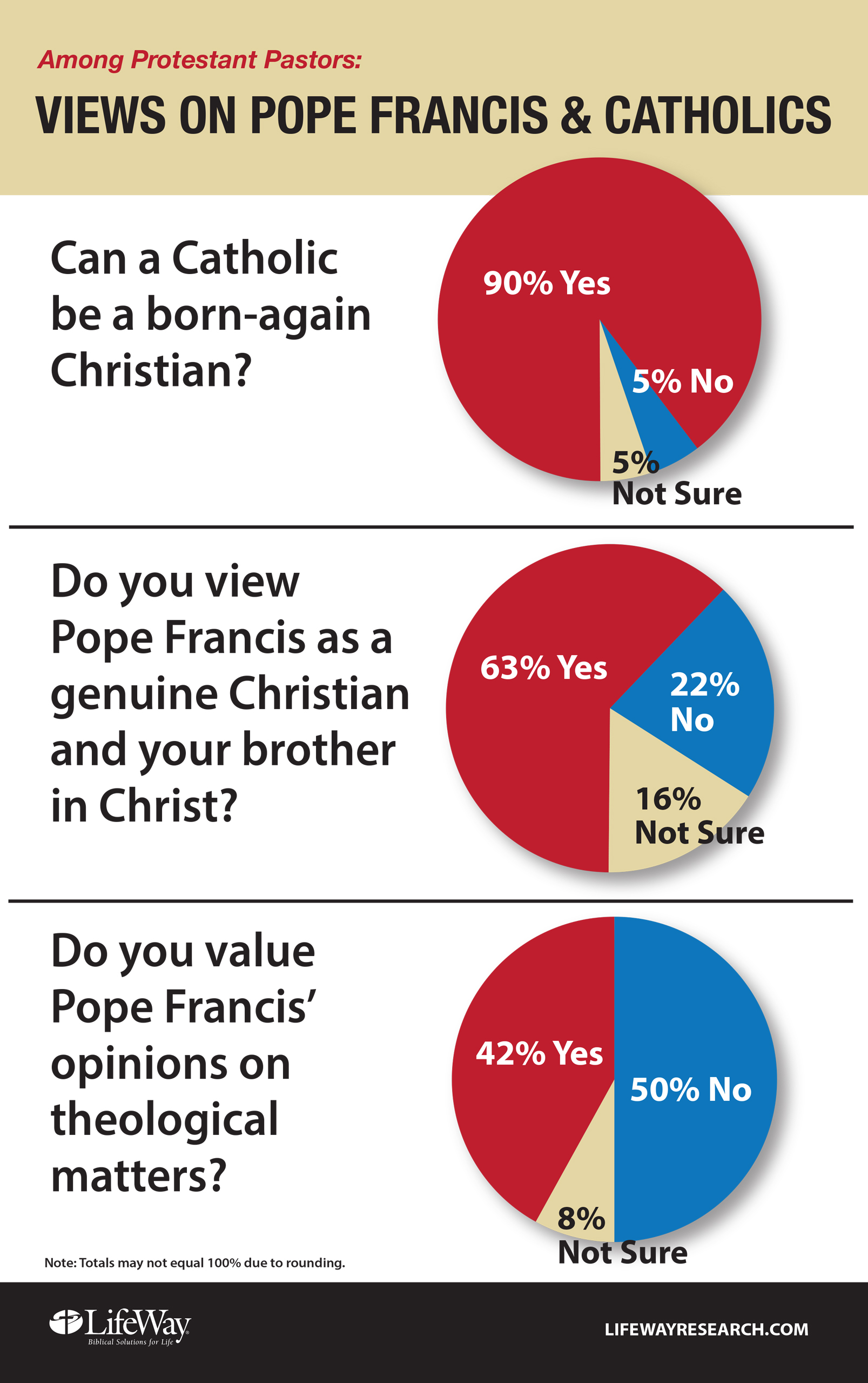
On whether Catholics can be “born-again Christians,” 90 percent of Protestant pastors and 92 percent of evangelical pastors agree. But they are less certain whether the pope is their brother in Christ: 63 percent agree Francis is a genuine Christian, 22 percent disagree, and 16 percent are unsure.
Evangelical pastors report more skepticism about Pope Francis than their mainline Protestant counterparts. While 80 percent of mainline Protestant pastors believe the pope is a true Christian, only 58 percent of evangelical pastors agree. About a quarter of evangelicals (23%) disagree, while one-fifth (19%) are not sure.
“The fact that some pastors don’t see the pope as their ‘brother in Christ’ seems strange to many outside Protestantism and evangelicalism, I imagine,” Stetzer said. “However, the forerunners of most Protestant pastors—from Luther, to Wesley, to Spurgeon, to many others—certainly did not see the pope as their ‘brother in Christ.’
“Within a few centuries, the pope has gone from anti-Christ to ‘brother in Christ’ for a lot of Protestants.”
In an editorial for CT this week, evangelical pastor Chris Castaldo argued that among Protestants and Catholics, disagreement over religious authority and salvation fades as piety trumps doctrine. (Pope Francis was also the subject of a 2014 CT cover story.)
Protestant pastors are divided on whether they value Pope Francis’ opinion on theological issues. More than 4 in 10 (42%) say they value the pope’s opinion, but 50 percent say they do not. Mainline pastors (57%) are more likely than evangelical pastors (36%) to say they value Pope Francis’ opinion.
Mainline pastors are also more likely to say Pope Francis has influenced their opinion of the Catholic Church, with 50 percent saying the impact has been positive and 9 percent saying it has been negative. In contrast, 30 percent of evangelical pastors say Pope Francis has boosted their opinion of Catholicism, while 15 percent say their opinion has declined.
Favorable views of Pope Francis are most pronounced among highly educated Protestant pastors and those in the Northeast, the survey finds.
Fifty-one percent of Protestant pastors in the Northeast say Pope Francis improves their opinion of the Catholic Church, compared to 38 percent in the Midwest, 34 percent in the South, and 31 percent in the West. Most Northeastern pastors (53%) also say they value the pope’s opinions on theological matters, a view shared by fewer than half of pastors in the Midwest (45%), South (39%), and West (38%).
More than two-thirds of Protestant pastors with a master’s or doctoral degree (69%) view Pope Francis as a genuine Christian and brother in Christ, compared to 42 percent of those with a bachelor’s degree or no college degree.
Those with a master’s degree or higher are also significantly more likely to say they value Pope Francis’ opinions on theological matters (49%) and the pope improves their opinion of the Catholic Church (43%). Among those with less formal education, 22 percent value the pope’s theological opinion and 18 percent say he has a positive impact on their view of Catholicism.
CT frequently covers Pope Francis, including examining the recent release of his encyclical, how many of his fans disagree with him on global warming, and the theology behind his warnings on climate change.
Lisa Cannon Green is senior writer for Facts & Trends magazine.
The phone survey of Protestant pastors was conducted Sept. 8-21, 2015. The calling list was a stratified random sample drawn from a list of all Protestant churches in America. Each interview was conducted with the senior pastor, minister, or priest of the church called. Responses were weighted by region to more accurately reflect the population. The completed sample is 1,000 surveys. The sample provides 95 percent confidence that the sampling error does not exceed plus or minus 3.2 percent. Margins of error are higher in sub-groups.
 
>>>Don't forget my constant take on this is the playbook that teaches certain Protestant denominations to discount or sadly, even hate Catholicism as a way to recruit members and jusify their existence.

Sunday, September 27, 2015

King, Martyr and Saint

St. Wenceslaus

 
Image of St. Wenceslaus

Facts

Feastday: September 28
Patron of Bohemia, Czech state, Prague
Birth: 907
Death: 935

St. Wenceslaus, also known by Vaclav, was born near Prague, and was the son of Duke Wratislaw. He was taught Christianity by his grandmother, St. Ludmila. The Magyars, along with Drahomira, an anti-Christian faction murdered the Duke and St. Lumila, and took over the government. Wenceslaus was declared the new ruler after a coup in 922. He encouraged Christianity. Boleslaus, his brother, no longer successor to the throne, after Wenceslaus' son was born, joined a group of noble Czech dissenters. They invited Wenceslaus to a religious festival, trapped and killed him on the way to Mass. He is the patron saint of Bohemia and his feast day is Sept. 28.

The Pope departs the USA; we will forever be changed!

Pope Departs: ‘I Will Pray for You and Your Families’  

Official text of Pope Francis’ remarks to the World Meeting of Families’ organizing committee, volunteers and benefactors at Philadelphia’s International Airport.


09/27/2015 Comment
CTV/YouTube
– CTV/YouTube
Mr. Vice-President, Distinguished Authorities, My Brother Bishops, Dear Friends,
My days with you have been brief. But they have been days of great grace for me and, I pray, for you too. Please know that as I prepare to leave, I do so with a heart full of gratitude and hope.
I am grateful to all of you and to the many others who worked so hard to make my visit possible and to prepare for the World Meeting of Families. In a particular way I thank Archbishop Chaput and the Archdiocese of Philadelphia, the civil authorities, the organizers, and all the many volunteers and benefactors who assisted in ways large and small.
I also thank the families who shared their witness during the Meeting. It is not so easy to speak openly of one’s life journey! But their honesty and humility before the Lord and each of us showed the beauty of family life in all its richness and diversity. I pray that our days of prayer and reflection on the importance of the family for a healthy society will inspire families to continue to strive for holiness and to see the Church as their constant companion, whatever the challenges they may face.
At the end of my visit, I would also like to thank all those who prepared for my stay in the Archdioceses of Washington and New York. It was particularly moving for me to canonize Saint Junípero Serra, who reminds us all of our call to be missionary disciples, and I was also very moved to stand with my brothers and sisters of other religions at Ground Zero, that place which speaks so powerfully of the mystery of evil. Yet we know with certainty that evil never has the last word, and that, in God’s merciful plan, love and peace triumph over all.
Mr. Vice-President, I ask you to renew my gratitude to President Obama and to the Members of Congress, together with the assurance of my prayers for the American people. This land has been blessed with tremendous gifts and opportunities. I pray that you may all be good and generous stewards of the human and material resources entrusted to you.
I thank the Lord that I was able to witness the faith of God’s people in this country, as manifested in our moments of prayer together and evidenced in so many works of charity. Jesus says in the Scriptures: “Truly, I say to you, as you did it to one of the least of these my brethren, you did it to me”. Your care for me and your generous welcome are a sign of your love for Jesus and your faithfulness to him. So too is your care for the poor, the sick, the homeless and the immigrant, your defense of life at every stage, and your concern for family life. In all of this, you recognize that Jesus is in your midst and that your care for one another is care for Jesus himself.
As I leave, I ask all of you, especially the volunteers and benefactors who assisted with the World Meeting of Families: do not let your enthusiasm for Jesus, his Church, our families, and the broader family of society run dry. May our days together bear fruit that will last, generosity and care for others that will endure! Just as we have received so much from God –gifts freely given us, and not of our own making – so let us freely give to others in return.
Dear friends, I embrace all of you in the Lord and I entrust you to the maternal care of Mary Immaculate, Patroness of the United States. I will pray for you and your families, and I ask you, please, to pray for me. May God bless you all. God bless America!


Read more: http://www.ncregister.com/daily-news/pope-departs-i-will-pray-for-you-and-your-families/#ixzz3mzO4oJlc

Final Mass, final message from Pope Francis on his American Apostolic Visit

God's love is for everyone – and it's dangerous to think otherwise, Pope says

 Pope Francis celebrates the opening Mass of the 2014 Extraoridinary Synod on the Family in St. Peter's Basilica, Oct. 5, 2014. Credit: Lauren Cater/CNA.
Pope Francis celebrates the opening Mass of the 2014 Extraoridinary Synod on the Family in St. Peter's Basilica, Oct. 5, 2014. Credit: Lauren Cater/CNA.
.- At the final Mass closing out the 2015 World Meeting of Families in Philadelphia, Pope Francis warned against narrowing God’s love and works to only a certain group of people.
“To raise doubts about the working of the Spirit, to give the impression that it cannot take place in those who are not ‘part of the group’, who are not ‘like us’, is a dangerous temptation,” the Holy Father said Sept. 27.
“Not only does it block conversion to the faith; it is a perversion of the faith!”
In the day's Mass readings, Pope Francis pointed out, both Moses and Jesus rebuked their followers for the same reason: trying to put limits on God's works. Joshua told Moses that people were prophesying without a mandate and John reported that the disciples had put a stop to people casting out demon’s in Christ’s name.
“Would that we could all be prophets!” he said, “Would that all of us could be open to miracles of love for the sake of all the families of the world, and thus overcome the scandal of a narrow, petty love, closed in on itself, impatient of others.”
“But the temptation to be scandalized by the freedom of God, who sends rain on the righteous and the unrighteous alike, by passing bureaucracy, officialdom and inner circles, threatens the authenticity of faith.”
Pope Francis’ first visit to the United States culminated in his stop in Philadelphia for the World Meeting of Families. While there, he made an unscheduled visit with five survivors of sexual abuse.
His visit also included a trip to New York where he addressed the United Nations and Washington, D.C. where he was the first pope to speak to a joint meeting of Congress.
He will travel back to the Vatican where next week Bishops will convene for the much anticipated Synod on the Family.
The Holy Father praised all the families who came to the meeting calling it “something prophetic, a kind of miracle in today’s world.”
Family life is so important because it is full of “little gestures” that make up a vibrant faith life.
Hugs after an absence, a warm meal shared at the end of the day, evening prayers and the like teach us love, which is why we call the family the “true domestic churches.”
Although these small acts of love that are learned in the family often get lost in daily life, they still make a difference in each day.
“Love is shown by little things, by attention to small daily signs which make us feel at home. Faith grows when it is lived and shaped by love.
He said that as seen in today’s readings, “Jesus tells us not to hold back these little miracles.”
“Instead, he wants us to encourage them, to spread them. He asks us to go through life, our everyday life, encouraging all these little signs of love as signs of his own living and active presence in our world.”
In this vein we should ask ourselves, “How are we trying to live this way in our homes, in our societies? What kind of world do we want to leave to our children?”
“Sterile divisions” can no longer be tolerated because we now face an “urgent challenge of protecting our home.”
Therefore, he said, Christians are asking other families of the world for help in spreading love and generosity.
“Anyone who wants to bring into this world a family which teaches children to be excited by every gesture aimed at overcoming evil – a family which shows that the Spirit is alive and at work – will encounter our gratitude and our appreciation,” he said. “Whatever the family, people, region, or religion to which they belong!”
Speaking briefly off the cuff, he said: "I will leave you with a question. In your house do people yell, or do you speak with love or affection or kindness?"
"This is a good way to measure our love."

Six years ago I delivered this homily at St. Jane calling on all Catholics to have and read the Bible and the Catechism

Do you know where you’re going to? Do you like the things that life is showing you? Where are you going to? Do you know?

These lines from one of the greatest songs in the career of Diana Ross got me to thinking; do we know where we are going to?

I know that when I travel, I plan to know just where I’m going to. Most of the time my travel works out great, especially these days with Map Quest and Google Maps. Sometimes though I lose my way and my wife will tell you that I hate to stop for directions. Help might just be one stop away but often I fail to stop and ask for directions.

Life is always a series of directions and instructions. Just yesterday at my house we had to install a new ceiling fan. The fan came with detailed instructions that helped to successfully install the fan. Directions and instructions lead us to the right destination and help us achieve the end in mind.

As people of faith do we follow the directions of Jesus Christ and follow the instructions of His Church? Do we know where we are going to? Do we know?

This one Gospel passage today has much to focus on. We have everything from St. John complaining about exorcists to Jesus teaching us to cut off our hand and foot and pluck out an eye. And we hear Jesus warn of the unquenchable fire of Gehenna. Three times in today’s Gospel, Jesus speaks of Gehenna. Jesus is giving us our roadmap, our instructions to avoid Gehenna, but what is Gehenna?

No one speaks of hell and it’s consequences in New Testament Scripture more than Jesus himself. In using the term Gehenna, He is referring to the burning, rotting garbage dump that lay on the outskirts of Jerusalem. It was an awful place; foul, dirty, obnoxious odor as garbage and refuse burned and decayed all day and all night. In Old Testament times, human sacrifice was practiced here as the victim would simply be placed on the trash fire to burn. His followers and listeners would know the place well and could not imagine a worse place on earth. And Jesus refers to Gehenna to paint a picture of hell.

Jesus tells us that there is only one detour that leads to hell. That detour is sin and the possibility for one to die in a state of mortal sin. Hell is not a place created by God for Him to send sinners to this fiery eternity. No, hell is a place that only we can arrive at by losing our way and not stopping to ask directions. Hell can only be achieved by willfully ignoring His instructions and doing things our way; not His way.

Hell is not a place created by God for Him to punish; for God to pronounce sentence. Hell is a state that we choose by alienating ourselves from God’s love and mercy. But God does not desire that we follow this detour for He declares: “I take no pleasure in the death of a sinner but rather that He be converted and live.”

So how do we avoid this horrible detour and stay on the right path, following only God’s map and His instructions? Know the way. Follow the commandments and follow the beatitudes too. The commandments clearly spell out what we should do and not do and the beatitudes call us to do more; to serve and help others. Remember the answer Jesus gave to the one who asked Him, what is the greatest commandment? He replied: “Love the Lord your God with your heart, with all your soul, with all your mind and with all your strength. And the second is this: you shall love your neighbor as yourself.” This is what He calls us to do.

The Catholic Church, founded by Jesus, is the ongoing Body of Christ and She continues to guide us with His instructions to help us avoid that detour to hell. Through the Sacraments we have another roadmap to help us follow the way. One sacrament that is a must is that of reconciliation or confession. To follow the directions we must be aware of mortal sin and venial sin. The Church teaches us that mortal sin destroys and turns one away from God. Venial sin offends and wounds. Mortal sin is a grave matter and is committed with full knowledge and deliberate consent.

So much of what is considered commonplace in today’s society may apply here. Adultery for example is mortal sin. Every time we chose to have a sexual relationship outside of marriage we lose our way and commit mortal sin. This is just one example that I offer to make the wider point. Another is an overall indifference to attending Mass. I’ll go this week, maybe not next week, maybe again in two weeks but every time I go, I’ll receive Holy Communion. Missing Mass, with no grave reason is also an example of mortal sin.

But let’s also remember, sin can be forgiven. We must attend to confession quickly when we are aware of mortal sin. But let’s also remember, in all cases, Catholics are required to go to confession at least once a year. This is firm; there is no wiggle room in the Church’s teaching. But again let’s remember, Jesus stands ready to absolve us of our sins if we just follow the map and confess our sins. His mercy truly endures forever.

Let’s never forget these two important set of directions: the Bible and the Catechism. These are a must for every home and should be read and studied and prayed with often. Everything about sin I’ve spoken about here comes from the Catechism.

Every choice we make ultimately forms us and shapes us into who we are. By our choices we define ourselves and our relationship with God. We decide; do we want to follow Him, do we want His directions and His instructions? Do we want to live with Him eternally in Heaven or without Him forever in Hell?

Do you know where you’re going to?

Where are you going to? Do you know?

Pope Francis rolling along on this last day of his Papal visit

Help youth be brave in opting for marriage and family, Pope tells bishops

Pope Francis speaks at St. Charles Borromeo Seminary in Philadelphia to bishops taking part in the World Meeting of Families, Sept. 27, 2015. Credit: EWTN.
.- Pope Francis told bishops Sunday that a widespread consumerism and desire to follow new fads has rendered youth fearful of commitments, and said that as pastors they must encourage youth to be brave in going against the tide.
He began his speech, however, with an impromptu reflection on the clergy sex abuse crisis, mentioning that he had met earlier with victims and their families. He said the victims “have become true heralds of hope and mercy. In humility, we owe each of them and their families an immense debt of gratitude … they made the light of christ shine on something so awful: the sexual abuse of minors.”
“I say this now because I just met with some victims of sexual abuse, and at that time I heard how they're being helped in a special way here in this archdiocese, by Archbishop Chaput, and I thought it was the right thing to do, to tell you where I was this morning.”
The Pope then continued with his prepared remarks, noting his joy at being able to reflect together with fellow bishops: “I am happy to be able to share these moments of pastoral reflection with you, amid the joyful celebrations for the World Meeting of Families,” he said Sept. 27 at the chapel of Philadelphia's St. Charles Borromeo Seminary.
“To Congress a couple days ago, I said we are living in a culture that pushes young people not to form families: some because they don’t have the material resources to realize a wedding, or a life together. But others just choose this because they think they're better off this way – but that's the temptation, to not lay a foundation, to not have a family. As pastors, we bishops are called to collect our energies and to rebuild enthusiasm for making families correspond ever more fully to the blessing of God which they are!”
“We need to invest our energies not so much in rehearsing the problems of the world around us and the merits of Christianity, but in extending a sincere invitation to young people to be brave and to opt for marriage and the family.”
Francis’ comments on his last day in the U.S. were addressed to bishops participating in the World Meeting of Families.
After spending three days in Cuba, the Pope arrived to Washington D.C. Sept. 23, where he met with president Barack Obama and addressed a joint-meeting of U.S. Congress. He then moved onto New York, where he spoke to the United Nations and met with school children in Harlem.
He met with the bishops before celebrating Mass to close the World Meeting of Families, and will board a plane to Rome later this evening.
In his speech to the bishops, Pope Francis said that despite current challenges, the family shouldn’t be viewed primarily as a cause for concern, but rather “the joyous confirmation of God’s blessing upon the masterpiece of creation.”
A key pastoral concern amid the constant changes of our time is to recognize the gift of the family, and be aware that both gratitude and appreciation ought to prevail over worries or complaints.
The family, he said,  “is the fundamental locus of the covenant between the Church and God’s creation. Without the family, not even the Church would exist. Nor could she be what she is called to be.”
However, the Pope noted that Christians are not immune to the changes of our time, and because of that “the unprecedented changes taking place in contemporary society, with their social, cultural – and now juridical – effects on family bonds” shouldn’t be disregarded.
While until recently the civil institution of marriage and the Christian sacrament were a shared notion seen as interrelated and mutually supportive, “this is no longer the case,” Francis observed.
Using the example of neighborhood stores and large supermarkets, the Pope said that formerly the situation was like the local stores, which had everything needed for both personal and family life, even if it wasn’t “cleverly displayed.”
“Business was done on the basis of trust, people knew one another, they were all neighbors. They trusted one another. They built up trust,” he said, noting that later the big supermarkets sprang up with large spaces and an endless selection of merchandise.
“The world seems to have become one of these great supermarkets; our culture has become more and more competitive. Business is no longer conducted on the basis of trust; others can no longer be trusted. There are no longer close personal relationships,” Francis said.
In a culture that seems to encourage people not to trust, the most important thing now appears to be following the latest trend, even in terms of religion, he continued.
Consumerism now determines what is important, he said. “Consuming relationships, consuming friendships, consuming religions, consuming, consuming… Whatever the cost or consequences. A consumption which does not favor bonding, a consumption which has little to do with human relationships,” adding that “joy is not something that can be 'consumed'.”
Social bonds, the Pope observed, have become a mere means for satisfying one’s own needs, rather than focusing on the other person, their lives, and their stories.
“This causes great harm,” he said, and diagnosed “a kind of impoverishment born of a widespread and radical sense of loneliness” as the root cause of many contemporary problems.
“Running after the latest fad, accumulating ‘friends’ on one of the social networks, we get caught up in what contemporary society has to offer. Loneliness with fear of commitment in a limitless effort to feel recognized.”
However, Pope Francis said that youth shouldn’t be condemned or pegged with blame for living and growing up in this type of society.
“Should they hear their pastors saying that ‘it was all better back then,’ ‘the world is falling apart and if things go on this way, who knows where we will end up?’” he asked.
“No, I do not think that this is the way,” he said, explaining that as shepherds, it is their responsibility to “seek out, to accompany, to lift up, to bind up the wounds of our time.”
As bishops, they must look at things “realistically, with the eyes of one who feels called to action, to pastoral conversion. The world today demands this conversion on our part.”
Rather than viewing the current situation as a mere indifference or “pure and simple selfishness” regarding marriage and the family, many youth have “have yielded to a form of unconscious acquiescence” inside a culture of discouragement, the Pope observed.
Francis explained that youth “are paralyzed when they encounter the beautiful, noble and truly necessary challenges which faith sets before them,” and often  put off marriage in order to wait for ideal conditions, “when everything can be perfect.”
“Meanwhile, life goes on, without really being lived to the full. For knowledge of life’s true pleasures only comes as the fruit of a long-term, generous investment of our intelligence, enthusiasm and passion.”
He added, off-the-cuff, that “In Buenos Aires many of the women were complaining, saying, 'I have a son who’s 30, 34, and he won't get married. I don’t know what to do!' I would tell them, 'Well, quit ironing his shirts!'”
“We need to give to the young people enthusiasm,” he told the bishops, “so they will take this worthwhile risk. Here too, we bishops need parrhesia!”
After giving a mock conversation between a bishop and a young person about “Why don’t you get married?” he said that bishops must “accompany them, and help them to mature, to make this decision to get married.”
Returning to his prepared remarks, the Pope said that “A Christianity which does little in practice, while incessantly explaining its teachings, is dangerously unbalanced. I would even say that it is stuck in a vicious circle.”
Rather, in a culture where concern for oneself is the overriding trend, it’s the pastor’s job to show that the “the Gospel of the family” is truly good news.
“We are not speaking about some romantic dream,” he said, adding that “the perseverance which is called for in having a family and raising it transforms the world and human history.”
Pastors must watch over the dreams, lives and growth of his flock, Francis said, explaining that this isn’t done by talking, but guiding. “Only one capable of standing in the midst of the flock can be watchful, not someone who is afraid of questions, contact, accompaniment.”
He stressed the importance of prayer in the life of a pastor, and questioned whether or not they are prepared to “waste time” with families, uplifting them in time of discouragement.
The Pope gave an extended and impromptu reflection on the office of bishops: “pray, and announce the Gospel – this always drew my attention about the beginning of the Church, because the widows and the orphans were not well taken care of, and the apostles couldn't handle them. And so they came up with the office of deacons, to deal with them! And the Holy Spirit inspired them, 'you have to build up deacons', and when Peter announces this decision, he says, 'now, we have chosen seven of you to be deacons, to take care of these problems, these situations.'”
From this institution of the diaconate, he said, the bishops are freed to pray. “From this we can expect two things: prayer, and preaching … What is the primary job of a bishop? To pray. To pray. The second task of a bishop, that goes with the first, is preaching. [Preaching] helps us. Dogmatic definitions help us – if not, you have to deal with Cardinal Mueller! But this helps us. It gives the definition of a bishop, and what his role is. He is a shepherd – he needs to shepherd, and proclaim, and take care of the sheep. To do that, he needs to pray and to preach. If there's time, he can get to the rest of what he needs to do.”
Returning to his prepared remarks he said that “By our own humble Christian apprenticeship in the familial virtues of God’s people, we will become more and more like fathers and mothers, and less like people who have simply learned to live without a family.”
“Our ideal is not to live without love!”  he said, explaining that a good pastor renounces the love of a family “in order to focus all his energies, and the grace of his particular vocation, on the evangelical blessing of the love of men and women who carry forward God’s plan of creation, beginning with those who are lost, abandoned, wounded, broken, downtrodden and deprived of their dignity.”
Jesus is the model for the mission of a pastor, who is called to imitate the Son’s love for the Father, he said, adding that “only God can authorize this, not our own presumption!”
Ministry must first of all deepen the bond between the Church and the family, the Pope said, otherwise “it becomes arid, and the human family will grow irremediably distant, by our own fault, from God’s joyful good news.”
Pope Francis closed by praying for a renewed closeness between the family and the Church.
The family, he said, “is our ally, our window to the world, and the evidence of an irrevocable blessing of God destined for all the children who in every age are born into this difficult yet beautiful creation which God has asked us to serve!”

Pope Francis goes to prison in Philadelphia

Confinement is not exclusion! Pope Francis visits with Philly inmates

Pope Francis embraces a man at Curran-Fromhold Correction Facility in Philadelphia Sept. 27, 2015. Credit: EWTN.
.- During his visit to a Philadelphia correctional facility this morning, Pope Francis said every person is marked and bruised by life, but Jesus washes away our sins and invites us to live a full life.
“Life is a journey, along different roads, different paths, which leave our mark on us,” the Pope said. “All of us need to be cleansed, to be washed. All of us are being sought out by the Teacher, who wants to help us resume our journey.”
“The Lord goes in search of us; to all of us he stretches out a helping hand.”
Pope Francis met with some 100 inmates and their families at Curran-Fromhold Correctional Facility, in one of the last public events of his pastoral visit to the United States. The inmates were Christian and Muslim, and racially diverse. According to the Philadelphia Inquirer, their charges ranged from murder and rape to robbery and drug offenses.
The Pope centered his reflections on the Gospel scene in which Jesus washes the feet of his disciples. At the time, the gesture was a sign of welcome because guests’ feet were frequently dusty, cut and bruised by the dust and stones on the roads.
“That is why we see Jesus washing feet, our feet, the feet of his disciples, then and now,” Pope Francis reflected. We know in faith that Jesus seeks us out. He wants to heal our wounds, to soothe our feet, which hurt from travelling alone, to wash each of us clean from our journey.”
The Pope then stressed that Jesus heals us in order to give us the opportunity to live a full life again.
“The Lord tells us this clearly with a sign: he washes our feet so we can come back to the table. The table from which he wishes no one to be excluded,” the Pope said. “Unless I wash your feet, I will not be able to give you the life which the Father always dreamed of, the life for which he created you.”
“Jesus comes to meet us so that he can restore our dignity as children of God. He wants to help us set out again, to resume our journey, to recover our hope, to restore our faith and trust.”
“He wants us to keep walking along the paths of life, to realize that we have a mission, and that confinement is not the same thing as exclusion.”
Pope Francis challenged inmate, prison workers and society as a whole to see each other with these eyes of Christ, “which are not scandalized by the dust picked up along the way, but want to cleanse, heal and restore.”
He said an inmate’s time in prison should be a time of rehabilitation, and all are called to encourage and assist in this rehabilitation.
“This time in your life can only have one purpose: to give you a hand in getting back on the right road, to give you a hand to help you rejoin society,” he said. “All of us are part of that effort, all of us are invited to encourage, help and enable your rehabilitation.
“(Jesus) asks us to create new opportunities: for inmates, for their families, for correctional authorities, and for society as a whole.”
The Pope lamented prison systems “which are not concerned to care for wounds, to soothe pain, to offer new possibilities.”
“Any society, any family which cannot share or take seriously the pain of its children, and views that pain as something normal or to be expected, is a society “condemned” to remain a hostage to itself, prey to the very things which cause that pain,” he warned.
Pope Francis then reflected that he came to the prison as a pastor and a brother in solidarity with inmates and their families.
“I have come so that we can pray together and offer our God everything that causes us pain, but also everything that gives us hope, so that we can receive from him the power of the resurrection.”
“Let us look to Jesus, who washes our feet. He is “the way, and the true, and the life”. He comes to save us from the lie that says no one can change. May the power of his love and his resurrection always be a path leading you to new life.”

Pope Francis directly addresses clergy sex abuse scandal

Pope Francis on Abuse Scandal: “All Responsible Will Be Held Accountable”

The Holy Father met with victims of sexual abuse by the the clergy


“I admit to a careful oversight to insure that youth are protected and that all responsible will be held accountable. . .Those who have survived have become true heralds of mercy. Humbly we owe each of them our gratitude for their courage. And they have had to suffer terrible abuse, sexual abuse of minors. I say this I would like to express my gratitude to the archbishop and I felt it very important that I share this message with you today.”
This is a fast translation of a communique from the Holy See, provided by Father Thomas Rosica, C.S.B.:
Communiqué of Fr. Federico Lomobardi, SJ, Director of the Holy See Press Office re: Pope Francis’ Meeting with Victims of Sexual Abuse by the Clergy for by members of their own families or teachers
This morning between 8:00 and 9:00 am, at St. Charles Borromeo Seminary, the Holy Father received some victims of sexual abuse by the clergy or by members of their families or their teachers. The group consisted of five adults – three women, two men – who have suffered abuse when they were minors. Each person was accompanied by a family member or support person. The group was accompanied by Cardinal Seán Patrick O’Malley, Archbishop of Boston and Chair of the commission set up by the Pope for the protection of minors; by the Archbishop of Philadelphia, Most Reverend Charles Chaput and Bishop Fitzgerald, head of the Diocese of Philadelphia Office for the protection of minors. The Pope spoke with visitors, listening to their stories and offering them a few words together as a group and later listening to each one individually. He then prayed with them and expressed his solidarity in sharing their suffering, as well as his own pain and shame in especially in the case of injury caused them by clergy or church workers.
Pope Francis reiterated the commitment of the Church so that all victims be heard and treated with justice; the guilty be punished and crimes of abuse be combated with an effective prevention program in the Church and in society. The Pope thanked the victims for their essential contribution to restore the truth and begin the journey of healing. The meeting lasted about half an hour and ended with the blessing of the Holy Father.
The pope’s prepared text is here.