Friday, February 24, 2012

Cardinal Dolan only a Cardinal for a week and already being touted as a future Pope

Cardinal Dolan praised as Pope material
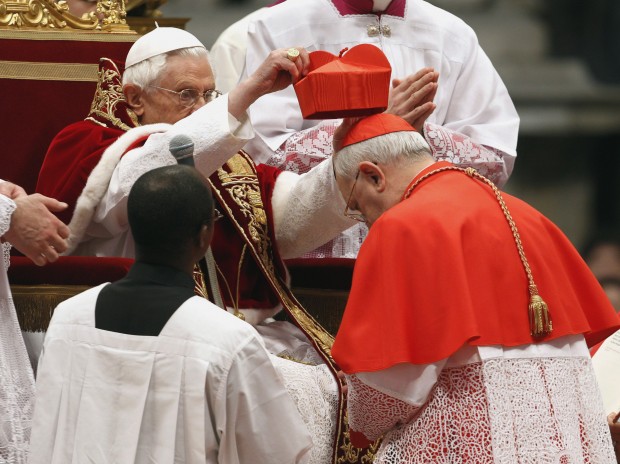
 
APTOPIX Vatican Cardinals


NY's Dolan Elevated to Cardinal in Rome Ceremony
Pope Benedict XVI brought 22 new Catholic churchmen, including New York Archbishop Timothy Dolan, into the elite club of cardinals who will elect his successor in a ceremony that took into account evidence the 84-year-old is slowing down. (Feb. 18)
VATICAN CITY • Ballwin native Timothy Dolan is already being praised in the Italian media as a possible Pope.
Dolan, one of 22 who became cardinals on Saturday in a service known as a consistory, emerged during the weekend as a star, delivering a highly praised speech and being called an improbable "papabile," or having qualities of a future pope.
Traditionally Americans are ruled out as papal contenders, with the argument that the world doesn't need a superpower pope. But Dolan's joyful demeanor seemed to have struck a chord in a Vatican that has been anything but joyful over a rash of news reports about political infighting and financial mismanagement.
"He certainly is going to be given many responsibilities as a cardinal," said the other American getting a red hat Saturday, Cardinal Edwin O'Brien, outgoing archbishop of Baltimore. Asked if he thought Dolan had the stuff to be pope, O'Brien deadpanned: "His mother thinks so."
Dolan artfully dodged the question when asked about the speculation Saturday by a gaggle of reporters who traveled from the U.S. for the ceremony: "Io non parlo inglese," he said. ("I don't speak English.")
In remarks at the start of the service, Benedict recalled that the red color of the three-pointed hat, or biretta, and the scarlet cassock cardinals wear, symbolizes the blood that cardinals must be willing to shed to remain faithful to the church.
"The new cardinals are entrusted with the service of love: love for God, love for his church, an absolute and unconditional love for his brothers and sisters even unto shedding their blood, if necessary," Benedict said.
It was a similar theme Dolan touched on in his keynote speech to cardinals and the pope on Friday, which was peppered with jokes, references to books, films and his own experiences as archbishop in New York, Milwaukee and as rector of the U.S. seminary in Rome.
"Holy Father, can you omit the 'shedding of your blood' when you present me with the biretta?" Dolan asked the pope. "Of course not! We are but 'scarlet audiovisual aids' for all of our brothers and sisters also called to be ready to suffer and die for Jesus."
The Vatican said the pope had given Dolan a papal thumbs up, terming his speech "enthusiastic, joyful and profound." Dolan said Benedict referred to the speech again on Saturday during the few moments they shared privately when Benedict gave him his skullcap, biretta and ring.
"He thanked me again for yesterday, which meant a lot," Dolan told reporters at a reception after the ceremony.
"He did have a little trouble getting the ring on the finger, which was a little embarrassing."


Read more: http://www.stltoday.com/lifestyles/faith-and-values/cardinal-dolan-praised-as-pope-material/article_c102fb21-71ed-5995-b234-12063fb061c0.html#ixzz1nMSsHOZa

Emily Gras; a good news story from New Orleans you must read!

Mardi Gras soul, in action, turns girl's parade nightmare into a dream come true

Published: Friday, February 24, 2012, 8:00 PM
Times-Picayune Staff
Forget what the calendar might have said. On Friday, at least in one part of New Orleans, it was Emily Gras.

Personal Parade for Emily
Enlarge CHRIS GRANGER / THE TIMES-PICAYUNE Wearing a pair of Elvis glasses given to her by a member of the Krewe of Rolling Elvi and a wreath of leaves, Emily Mueller looks around the Muses den. Mueller, who is autistic, was jeered at because of her disorder by someone on the parade route during the Muses parade last Thursday. After the incident, Mueller and her mother, Amy, center, left the parade right away. On Friday, February 24, 2012, members of the Krewe of Muses held a last minute party for Mueller. Krewe of Muses leads effort to ease disappointment of autistic Mardi Gras enthusiast gallery (10 photos)
Emily Mueller, an 11-year-old north shore girl with autism, was the object of one drunken young man’s abuse during the Krewe of Muses parade on Feb. 16. She was reduced to tears before she could see any of her favorite parade.
Her mother, Amy Mueller, wrote about the experience online on Thursday, detailing the man’s cruel words and thoughtless actions. She wrote that the man came close to setting Emily’s hair on fire with a cigarette and spilling beer on her before calling her a “retard” to his friends and, later, to her face. Emily asked her mother to take her home, saying she never wanted to participate in Mardi Gras again.
On Friday morning, Amy said, she awoke to learn that she and her daughter had become the objects of an online love fest.
Her post on NOLAFemmes.com generated 30,000 page views and about 600 responses, and sympathetic comments flooded Twitter and Facebook. In no time at all, #EmilyGras became a popular Twitter hashtag. Some residents relayed prayers and warm wishes, while others volunteered to send Muses memorabilia they caught at the parade, and a Tulane University group announced it will hold an awareness day on March 7 to educate people about autism and the destructive power of the epithet “retard.”
And that was just the beginning.
Staci Rosenberg, Muses’ founder, offered to open up the den Friday morning so the organization could make it up to Emily. Emily was even invited to climb aboard the krewe’s signature fiber-optic, high-heeled shoe.
Muses members, clad in this year’s one-shouldered teal robes, attended in full force, despite the short notice.

Mardi Gras redeemed Mardi Gras redeemed Muses recreates magical night for autistic girl. Watch video

Louise Regan, a four-year krewe member, said she was excited to give Emily the celebration she deserved, even though she had learned about it only an hour before it began.
In addition to Muses, costumed members of the 610 Stompers, the Rolling Elvi and the Pussyfooters gathered at the den to strut, dance and bestow glittery shoes, leis, beads and stuffed animals upon Emily, who pronounced the experience “overwhelming.”
“We’re an all-women marching group. We support women — the mom and the little girl,” said Anne Titelbaum, a Pussyfooter marcher for six years. “We were all little girls at one time, and no one is perfect.”
Mark Decker, a Rolling Elvi for three years, said several members of his group even skipped work to attend.
“It’s what we do,” he said. “It’s not just about Mardi Gras; it’s about being charitable and giving back.”
Other visitors, many accompanied by their own children, also lined up to give Mardi Gras goodies to Emily, who wore a crown of ivy leaves, a Muses symbol. She greeted each gift with a shy smile and soft “thank you,” as bags of loot piled around her.
“I think it’s really sweet,” she said, giggling behind an oversized pair of Elvis-inspired sunglasses.
In a demonstration of what Rosenberg called “the power of viral media,” nearly 100 people descended upon the den.
Rudy and Michelle Brown and their daughter, Kelsey, owners of Nola Snow Snowballs, showed up unbidden and started turning out snowballs for anyone who wanted one. Their operation was next to a table where king cake was being dispensed.
“We saw the story on Facebook,” Rudy Brown said. “We had a similar experience last Mardi Gras, and we wanted to make it up to Emily.”
Lauren Thom, creator of the Fleurty Girl T-shirt line, said the attitude displayed at the Emily Gras celebration is what defines New Orleans, adding, “This wouldn’t happen anywhere else.”
“They rained on her parade,” Thom said, “so we gave her her own.”
Sydni Dunn and John Pope wrote this report. Dunn can be reached at sdunn@timespicayune.com or 504.826.3371. Pope can be reached at jpope@timespicayune.com or 504.826.3317.


>>>This story makes me feel sooo good about the vast majority of people in New Orleans.  The effort to make this little girl feel so special was herculean.  Congratulations to all involved.  And to the fool who got his laughs by making fun of little Emily; shame on you.  I will pray that you seek forgiveness and have a sincere change of heart.

New Orleans is called the City that Care Forgot; but these people demonstrated that New Orleanians don't forget to care!!

Thursday, February 23, 2012

The holiness of a Priest; beatified by Blessed JPII

Bl. Tommaso Maria Fusco

Bl. Tommaso Maria Fusco
Feastday: February 24
1831 - 1891
Beatified By: Pope John Paul II

Thomas Mary Fusco, the seventh of eight children, was born on1 December 1831 in Pagani, Salerno, in the Diocese of Nocera-Sarno, Italy, to Dr Antonio, a pharmacist, and Stella Giordano, of noble descent. They were known for their upright moral and religious conduct, and taught their son Christian piety and charity to the poor.
He was baptized on the day he was born in the parish of S. Felice e Corpo di Cristo. In 1837, when he was only six years old, his mother died of cholera and a few years later, in 1841, he also lost his father. Fr Giuseppe, an uncle on his father's side and a primary school teacher, then took charge of his education.
Since 1839, the year of the canonization of St Alphonsus Mary de' Liguori, little Tommaso had dreamed of church and the altar; in 1847 he was at last able to enter the same diocesan seminary of Nocera which his brother Raffaele would leave after being ordained a priest in 1849.
On 1 April 1851, Tommaso Maria received the sacrament of Confirmation and on 22 December 1855, after completing his seminary formation, he was ordained a priest by Bishop Agnello Giuseppe D'Auria.
In those years, sorrowful because of the loss of his loved ones, including his uncle (1847) as well as his young brother, Raffaele (1852), the devotion to the Patient Christ and to his Blessed Sorrowful Mother, already dear to the entire Fusco family, took root in Tommaso Maria, as in fact his biographers recall: "He had a deep devotion to the crucified Christ which he cherished throughout his life".


Pope Benedict reflects on Ash Wednesday

Desert Sojourn Is Time of Ambivalence, Says Pope


Chance for First Love, But Danger of Seduction


By Kathleen Naab
VATICAN CITY, FEB. 22, 2012 (Zenit.org).- As Benedict XVI led the Church in beginning Lent today, he reflected that the sojourn in the desert is a time of ambivalence: an opportunity for special closeness with God, a time of "first love," but also a time of aridity, want and clouds that obscure heaven.
The Pope offered these reflections during the general audience, which on Ash Wednesday, he traditionally dedicates to a reflection on Lent.
This year, he noted the multitude of biblical references to the number 40, listing them with a brief explanation of each.
"With the recurring number of 40, a spiritual atmosphere is described which remains relevant and valid," the Holy Father said. "And the Church, precisely through these days of Lent, intends to preserve their enduring value and to make their efficacy present for us. The Christian liturgy during Lent seeks to promote a path of spiritual renewal in light of this long biblical experience, above all for the sake of learning to imitate Jesus, who during the 40 days he spent in the desert, taught us to conquer temptation with the Word of God."
Benedict XVI noted that the 40 years of Israel wandering in the desert was a time of "ambivalent attitudes and situations."
"On the one hand," he said, "they are the season of first love with God, and between God and his people, when he speaks to their hearts, pointing out to them the path to follow. God, as it were, had taken up his abode with Israel; he went before them in a cloud and a column of fire; each day, he provided for their nourishment by making manna descend from the heavens and by making water gush forth from the rock. Therefore, the years Israel passed in the desert can be seen as the time of their being especially chosen by God and of their clinging to him: the time of first love."
Nevertheless, those 40 years are also "the time of the greatest temptation and peril, when Israel murmurs against her God and wishes to return to paganism and to build her own idols, out of the need she feels to worship a God who is closer and more tangible."
Restored joy
The Pope suggested that this "ambivalence," we "surprisingly rediscover in Jesus' earthy sojourn; naturally, however, without any compromise with sin."
Jesus' 40 days in the desert are a time of "profound union with the Father," the Pontiff said, but also a time when he "is exposed to danger and is assailed by temptation and the seduction of the Evil One, who proposes another Messianic way, one distant from God's design, for it passes by way of power, success, and domination and not by way of the total gift of the cross."
Benedict XVI applied the same "situation of ambivalence" to the Church today.
"In this 'desert,'" he said, "we who believe certainly have the opportunity to have a profound experience of God, who strengthens the spirit, confirms the faith, nourishes hope and inspires charity. It is an experience that makes us sharers in Christ's victory over sin and death through his sacrifice of love on the cross. But the 'desert' is also a negative aspect of the reality that surrounds us: aridity; the poverty of words of life and values; secularism and cultural materialism, which enclose people within the worldly horizons of an existence bereft of all reference to the transcendent. This is also the environment in which even heaven above us is obscured, for it is covered by the clouds of egoism, misunderstanding and deception."
"Despite this," the Pope continued, "also for the Church today, time spent in the desert can be transformed into a time of grace, for we have the certainty that God can make the living water that quenches thirst and brings refreshment gush forth even from the hardest rock."
The Holy Father concluded with this reflection on Lent: "We can find in these 40 days that lead us to the Easter of Resurrection the renewed hope that enables us to accept every difficulty, affliction and trial with patience and with faith, in the knowledge that out of the darkness the Lord will make a new day to dawn. And if we have been faithful to Jesus by following him on the way of the cross, the radiant world of God, the world of light, of truth and of joy will be restored to us: It will be the new dawn created by God himself. I wish a blessed journey of Lent to you all!"
--- --- ---
On ZENIT's Web page:
Full text: www.zenit.org/article-34347?l=english

Wednesday, February 22, 2012

A disciple of an apostle

St. Polycarp

St. Polycarp
St. Polycarp
Feastday: February 23

Imagine being able to sit at the feet of the apostles and hear their stories of life with Jesus from their own lips. Imagine walking with those who had walked with Jesus, seen him, and touched him. That was what Polycarp was able to do as a disciple of Saint John the Evangelist.
But being part of the second generation of Church leaders had challenges that the first generation could not teach about. What did you do when those eyewitnesses were gone? How do you carry on the correct teachings of Jesus? How do you answer new questions that never came up before?
With the apostles gone, heresies sprang up pretending to be true teaching, persecution was strong, and controversies arose over how to celebrate liturgy that Jesus never laid down rules for.
Polycarp, as a holy man and bishop of Smyrna, found there was only one answer -- to be true to the life of Jesus and imitate that life. Saint Ignatius of Antioch told Polycarp "your mind is grounded in God as on an immovable rock."


Benedictine monk credited with reform; Doctor & Saint

Saint Peter Damian, O.S.B. (Petrus Damiani, also Pietro Damiani or Pier Damiani; c. 1007[1] – February 21/22, 1072) was a reforming monk in the circle of Pope Gregory VII and a cardinal. In 1823, he was declared a Doctor of the Church. Dante placed him in one of the highest circles of Paradiso as a great predecessor of Saint Francis of Assisi.

Read more here:  http://www.catholic.org/saints/saint.php?saint_id=780

>>>Note: his feast day is now February 21st even though there is some confusion about the date of his death.

The latest letter from Cardinal Dolan to brother Bishops concerning the government attack on religious liberty

Dear Brother Bishops,
Since we last wrote to you concerning the critical efforts we are undertaking together to protect religious freedom in our beloved country, many of you have requested that we write once more to update you on the situation and to again request the assistance of all the faithful in this important work. We are happy to do so now.
First, we wish to express our heartfelt appreciation to you, and to all our sisters and brothers in Christ, for the remarkable witness of our unity in faith and strength of conviction during this past month. We have made our voices heard, and we will not cease from doing so until religious freedom is restored.
As we know, on January 20, the Department of Health and Human Services announced a decision to issue final regulations that would force practically all employers, including many religious institutions, to pay for abortion inducing drugs, sterilizations, and contraception. The regulations would provide no protections for our great institutions—such as Catholic charities, hospitals, and universities—or for the individual faithful in the marketplace. The regulations struck at the heart of our fundamental right to religious liberty, which affects our ability to serve those outside our faith community.
Since January 20, the reaction was immediate and sustained. We came together, joined by people of every creed and political persuasion, to make one thing resoundingly clear: we stand united against any attempt to deny or weaken the right to religious liberty upon which our country was founded.
On Friday, February 10, the Administration issued the final rules. By their very terms, the rules were reaffirmed “without change.” The mandate to provide the illicit services remains. The exceedingly narrow exemption for churches remains. Despite the outcry, all the threats to religious liberty posed by the initial rules remain.
Religious freedom is a fundamental right of all. This right does not depend on any government’s decision to grant it: it is God-given, and just societies recognize and respect its free exercise. The free exercise of religion extends well beyond the freedom of worship. It also forbids government from forcing people or groups to violate their most deeply held religious convictions, and from interfering in the internal affairs of religious organizations.
Recent actions by the Administration have attempted to reduce this free exercise to a “privilege” arbitrarily granted by the government as a mere exemption from an all-encompassing, extreme form of secularism. The exemption is too narrowly defined, because it does not exempt most non-profit religious employers, the religiously affiliated insurer, the self-insured employer, the for-profit religious employer, or other private businesses owned and operated by people who rightly object to paying for abortion inducing drugs, sterilization, and contraception. And because it is instituted only by executive whim, even this unduly narrow exemption can be taken away easily.
In the United States, religious liberty does not depend on the benevolence of who is regulating us. It is our “first freedom” and respect for it must be broad and inclusive—not narrow and exclusive. Catholics and other people of faith and good will are not second class citizens. And it is not for the government to decide which of our ministries is “religious enough” to warrant religious freedom protection.
This is not just about contraception, abortion-causing drugs, and sterilization—although all should recognize the injustices involved in making them part of a universal mandated health care program. It is not about Republicans or Democrats, conservatives or liberals. It is about people of faith. This is first and foremost a matter of religious liberty for all. If the government can, for example, tell Catholics that they cannot be in the insurance business today without violating their religious convictions, where does it end? This violates the constitutional limits on our government, and the basic rights upon which our country was founded.
Much remains to be done. We cannot rest when faced with so grave a threat to the religious liberty for which our parents and grandparents fought. In this moment in history we must work diligently to preserve religious liberty and to remove all threats to the practice of our faith in the public square. This is our heritage as Americans. President Obama should rescind the mandate, or at the very least, provide full and effective measures to protect religious liberty and conscience.
Above all, dear brothers, we rely on the help of the Lord in this important struggle. We all need to act now by contacting our legislators in support of the Respect for Rights of Conscience Act, which can be done through our action alert on www.usccb.org/conscience.
We invite you to share the contents of this letter with the faithful of your diocese in whatever form, or by whatever means, you consider most suitable. Let us continue to pray for a quick and complete resolution to this and all threats to religious liberty and the exercise of our faith in our great country.

Timothy Cardinal Dolan
Archbishop of New York
President, United States Conference of Catholic Bishops

Most Reverend William E. Lori
Bishop of Bridgeport
Chairman, Ad Hoc Committee for Religious Liberty

Remembering the feastday of the Chair of St. Peter

Chair of St. Peter


This feast commemorates Christ’s choosing Peter to sit in his place as the servant-authority of the whole Church (see June 29).
After the “lost weekend” of pain, doubt and self-torment, Peter hears the Good News. Angels at the tomb say to Magdalene, “The Lord has risen! Go, tell his disciples and Peter.” John relates that when he and Peter ran to the tomb, the younger outraced the older, then waited for him. Peter entered, saw the wrappings on the ground, the headpiece rolled up in a place by itself. John saw and believed. But he adds a reminder: “...[T]hey did not yet understand the scripture that he had to rise from the dead” (John 20:9). They went home. There the slowly exploding, impossible idea became reality. Jesus appeared to them as they waited fearfully behind locked doors. “Peace be with you,” he said (John 20:21b), and they rejoiced.

The Pentecost event completed Peter’s experience of the risen Christ. “...[T]hey were all filled with the holy Spirit” (Acts 2:4a) and began to express themselves in foreign tongues and make bold proclamation as the Spirit prompted them.

Only then can Peter fulfill the task Jesus had given him: “... [O]nce you have turned back, you must strengthen your brothers” (Luke 22:32). He at once becomes the spokesman for the Twelve about their experience of the Holy Spirit—before the civil authorities who wished to quash their preaching, before the council of Jerusalem, for the community in the problem of Ananias and Sapphira. He is the first to preach the Good News to the Gentiles. The healing power of Jesus in him is well attested: the raising of Tabitha from the dead, the cure of the crippled beggar. People carry the sick into the streets so that when Peter passed his shadow might fall on them.

Even a saint experiences difficulty in Christian living. When Peter stopped eating with Gentile converts because he did not want to wound the sensibilities of Jewish Christians, Paul says, “...I opposed him to his face because he clearly was wrong.... [T]hey were not on the right road in line with the truth of the gospel...” (Galatians 2:11b, 14a).

At the end of John’s Gospel, Jesus says to Peter, “Amen, amen, I say to you, when you were younger, you used to dress yourself and go where you wanted; but when you grow old, you will stretch out your hands, and someone else will dress you and lead you where you do not want to go” (John 21:18). What Jesus said indicated the sort of death by which Peter was to glorify God. On Vatican Hill, in Rome, during the reign of Nero, Peter did glorify his Lord with a martyr’s death, probably in the company of many Christians.

Second-century Christians built a small memorial over his burial spot. In the fourth century, the Emperor Constantine built a basilica, which was replaced in the 16th century.


Comment:

Like the committee chair, this chair refers to the occupant, not the furniture. Its first occupant stumbled a bit, denying Jesus three times and hesitating to welcome gentiles into the new Church. Some of its later occupants have also stumbled a bit, sometimes even failed scandalously. As individuals, we may sometimes think a particular pope has let us down. Still, the office endures as a sign of the long tradition we cherish and as a focus for the universal Church.


Quote:

Peter described our Christian calling in the opening of his First Letter, “Blessed be the God and Father of our Lord Jesus Christ, who in his great mercy gave us a new birth to a living hope through the resurrection of Jesus Christ from the dead...” (1 Peter 1:3a).


Wednesday, February 22, 2012

>>>Note this feast was not celebrated today because of Ash Wednesday; it may have been transferred to another day this year in your diocese or simply suppressed.  In any case, we should remember the importance of this feastday!

Ash Wednesday thru the eyes of one Deacon

This has been a rich, deeply spiritual, personally challenging Ash Wednesday for me.  It comes at a time when I am experiencing great joy in my ministries as a Permanent Deacon and follower of Christ and when I am experiencing great turmoil due to a difficult situation in my professional career.  Over the course of the last two weeks I have been experiencing both stress from the situation alluded to above and great personal spiritual tugging at my heart.  While everyone in these parts was immersed in Mardi Gras, and that's ok, I was looking forward with great anticipation to this day, Ash Wednesday.

Through my eyes, this has been a deeply spiritual and emotional day.  Having scheduled a day off, I arose early to assist my pastor at morning Mass, which included distribution of ashes.  We had over 300 present for morning Mass.  I spent some time reviewing evangelization documents and took a quiet drive through the countryside until I returned for the lunch hour Mass.  Again I assisted the pastor and distributed ashes; this time more than 400 were in attendance. 

The afternoon I decided to take up the challenge of our Archbishop(see previous post) and am working on fasting and, of course, abstinence from meat.  And for me and all my neighbors down here, to truly make this sacrificial, I avoided shrimp, oysters or catfish and opted for a plain tuna fish sandwich.  And no diet coke!

And today I was prompted to share a message for my friends and family who have lost their connection to Christ and His Church: as I sat listening to John Michael Talbot's rendition of Come Back to Me, I asked them to consider coming back to Him.  One of my most deepest prayers ever is that those who find themselves, like I did not that long ago, seperated from Christ, find their way back.

Tonight, I'm returning to my congregation for a third time, to assist the priest and distribute ashes.

Tomorrow will then bring a deeply personal challenge as I reconcile the spirituality and ministry that I crave and meet my professional challenges head on. 

In Lent 2012, unlike any other time in my life, I will be challenged to truly reflect the love and mercy of Jesus Christ while being an icon of Christ the Servant, despite knowing that there are some who are comin against me.  But I will remember: if God is for us, who can be against us and Be not afraid!

I wish for each of you reading this a blessed, fulfilling and spiritual Lent; when that leads you, and hopefully me, closer to Jesus Christ and His Church!