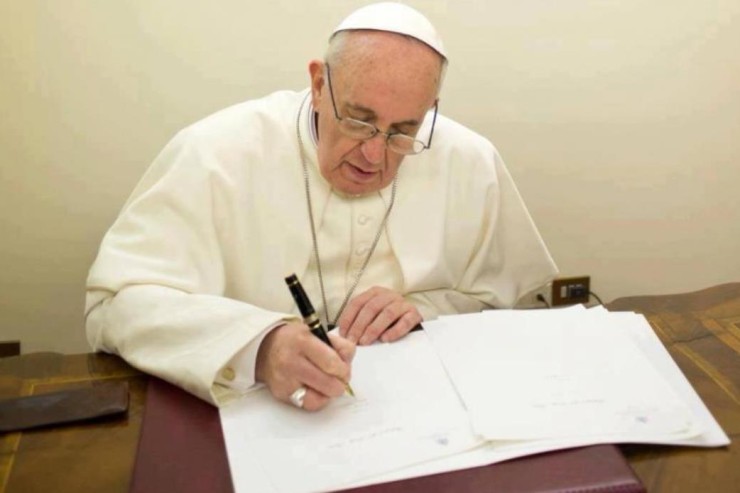
Pope Francis’ Instruction ‘Ecclesiae Sponsae Imago’ on ‘Ordo virginum’
Approved by the Holy Father on June 8, 2018, the Solemnity of the Most Sacred Heart of Jesus
Here is the Vatican provided text of the instruction, signed by the Holy Father on June 8, 2018:
***
Introduction
1. The image of the Church as the Bride of Christ is presented in the New Testament as an effective icon, revealing the intimate nature of the relationship that the Lord Jesus wanted to establish with the community of those who believed in him (Ep 5:23-32; Rev19:7-9; 21:2-3,9)
Since apostolic times this expression of the mystery of the Church has been demonstrated in a unique way in the lives of those women who with spousal love are dedicated to the Lord Jesus in virginity. Responding to a charism kindled in them by the Holy Spirit, they experience the spiritual fertility of an intimate relationship with him and offer the fruits of this relationship to the Church and to the world.
2. Some passages in the New Testament and in the writings of the first Christian centuries show that this form of evangelical life appeared in a spontaneous way in the different regions where ecclesial communities developed[1]. In the context of pagan society, it took its place among other forms of the ascetic life which were clear signs of the novelty of Christianity and of its capacity to respond to the deepest questions about the meaning of human existence[2]. In a process similar to that which concerned the status of widows who chose continence « in honour of the flesh of the Lord »[3], consecrated female virginity gradually assumed the characteristics of a state of life publicly recognised by the Church[4].
In the first three centuries, large numbers of consecrated virgins underwent martyrdom in order to remain faithful to the Lord. Among these were Agatha of Catania, Lucy of Syracuse, Agnes and Cecilia of Rome, Thecla of Iconium, Apollonia of Alexandria, Restituta of Carthage, and Justa and Rufina of Seville. From that time, right up to today the memory of the virgin martyrs has remained as a striking reminder of the total gift of self that virginal consecration demands.
In the women who embraced this vocation and responded to it with a decision to persevere in life-long virginity, the Fathers of the Church saw a reflection of the image of the Church as the Bride, totally dedicated to her Bridegroom: thus they refer to them as sponsae Christi (brides of Christ), Christo dicatae (dedicated to Christ), Christo maritatae (married to Christ), Deo nuptae (brides of God)[5]. In the living body of the Church, they comprised an institutionalized coetus (group), identified by the name of the Ordo virginum (Order of virgins)[6].
3. From the IV century, entry into the Ordo virginum took place through a solemn liturgical rite presided over by the diocesan bishop. In the heart of the community gathered for the Eucharistic celebration, the woman expressed her sanctum propositum (holy resolution) to remain in virginity for her whole life, for the love of Christ. The Bishop then pronounced the consecratory prayer. As affirmed already in the writings of Ambrose of Milan and subsequently, starting from the most ancient liturgical sources, the nuptial symbolism of the rite was displayed particularly by the bestowal of the veil on the virgin by the Bishop, a gesture that corresponded to the velatio (placing of the marriage veil) that took place during the marriage celebration[7].
4. The respect and pastoral concern that accompanied the evolution of the consecrated virgins are amply demonstrated in patristic literature. The Fathers did not limit themselves to criticizing the behaviour of consecrated women that was not in accord with their commitment to lead a chaste life in humble discipleship of Christ. They also challenged and vigorously opposed the arguments of those who denied the value of consecrated virginity as well as heretical deviations that supported the ideal of virginity and continence on the basis of a negative conception of matrimony and sexuality. Reflecting on the theological foundations of virginal consecration, they highlighted its charismatic origins, evangelical motivation, ecclesial and social significance, reference to the Virgin Mary as exemplar, and the prophetic value of anticipation and vigilant expectation of full communion with the Lord that will be brought about only at his glorious return at the end of time. Addressing the consecrated virgins « more with affection than with the authority »[8] of their office, they exhorted consecrated virgins to nourish and express their love for Christ the Bridegroom through attentive meditation on the Scriptures and in persevering personal and liturgical prayer; by practising asceticism, the virtues and the works of mercy; by cultivating an attitude of obedient attention to the magisterium of the Bishop and in the obligation to safeguard ecclesial communion. Thus, they would offer a transparent and persuasive evangelical witness within the Christian community and in the social setting within which they remained inserted, generally living with their family of origin and at times in community.
In the same period, by means of papal decrees and the constitutions of provincial councils, the regulation of essential aspects of this form of life began to be defined.
5. While consecrated virgins in the first centuries usually lived with their own families, as cenobitic monasticism developed the Church associated virginal consecration with community life, and therefore with the observance of a common rule and obedience to a superior. Over the course of centuries, the original way of life of the Ordo virginum, with its characteristic foundations in the local ecclesial community under the guidance of the diocesan bishop, gradually disappeared.
No comments:
Post a Comment